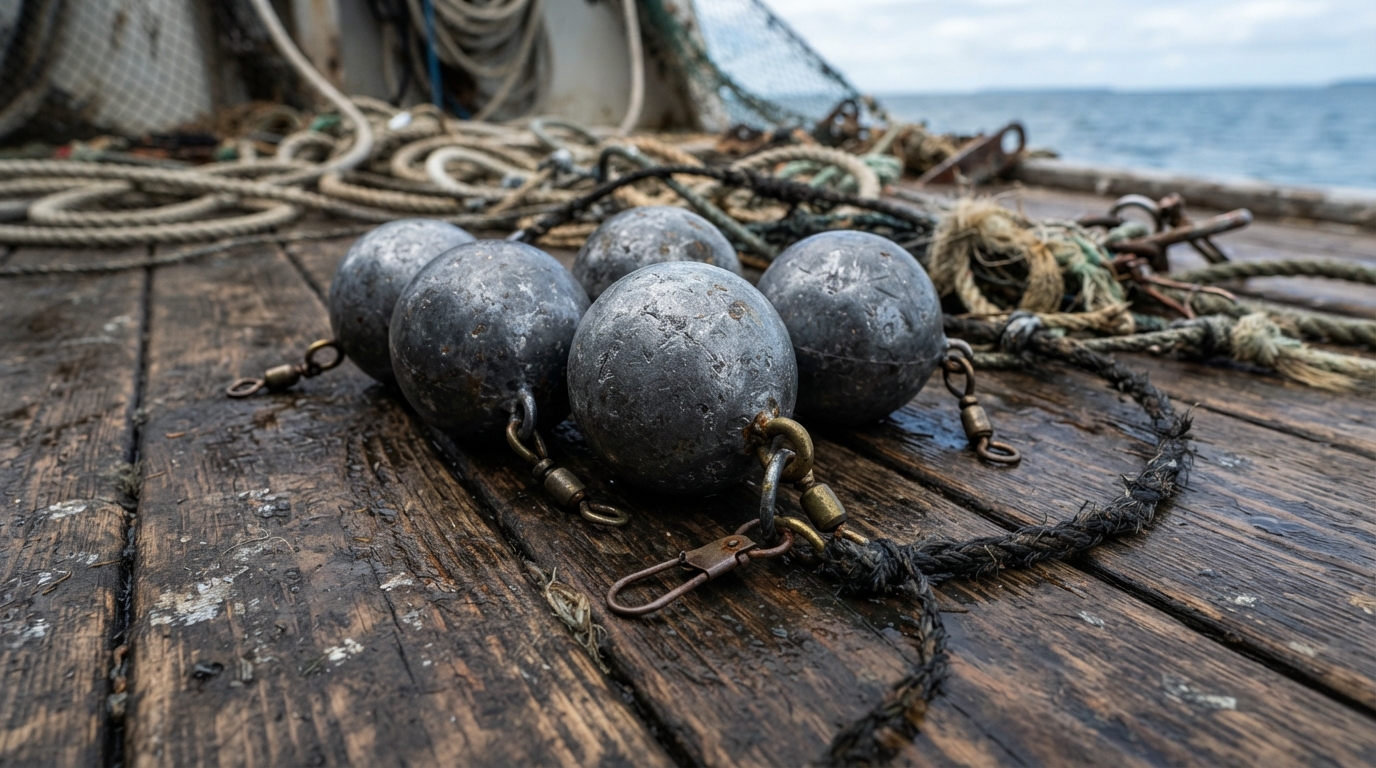
Lingcod Sinker Sizing: 16oz-48oz (Drift Speed Chart)
As an Amazon Associate I earn from qualifying purchases. Product links on this page are affiliate links — they cost you nothing extra.
⏱ 15 min read
Holding bottom contact for deep-water lingcod between 300 and 700 feet requires 16 to 48 ounces of lead, sized at 1 ounce per 15 feet of depth during dead slack and stepping up to 1 ounce per 8 to 10 feet of depth when drift speeds reach 1.5 to 2.0 knots. Line scope must remain under 30 degrees from vertical, meaning total line counter payout should never exceed 120% of your sonar depth. Once drag pushes line angle past 30 degrees, upward water pressure lifts the sinker out of the strike zone and sweeps your hooks directly into rock pinnacle snags.
When line counter payout exceeds depth by more than 20%, you are no longer vertical. The central issue is simple: how do you balance the lead mass needed to cut through cross-current shear without exhausting the angler or deadening tactile bite detection?
Key Takeaways
- Keep your line angle strictly under 30 degrees from vertical to stop water friction from lifting terminal tackle off bottom.
- Deploy 16oz to 24oz sinkers in 300 to 450 feet of water when surface drift stays below 0.8 knots.
- Step up to 32oz to 48oz torpedo or cannonball weights for depths past 500 feet or when drift speeds hit 1.2 to 2.0 knots.
- Tie lead to a 20lb to 25lb sacrificial monofilament breakaway dropper loop to preserve expensive braided mainline during pinnacle snags.
- Cut through conflicting mid-column current layers by spooling with 50lb or 65lb eight-carrier braid rather than thicker 80lb line.
📋 Pocket Cheat Sheet: Lingcod Sinker Sizing
Baseline weight formulas and critical scope thresholds.
BASE FORMULAS: • Dead drift (<0.5 kt): 1 oz lead per 15 ft depth • Moderate drift (0.5-1.0 kt): 1 oz lead per 12 ft depth • Fast drift (1.0-2.0 kt): 1 oz lead per 8-10 ft depthDEPTH TARGETS: • 300 ft: 20 oz (calm) to 32 oz (current) • 500 ft: 32 oz (calm) to 48 oz (current) • 700 ft: 48 oz max conventional hand-crank limit
OPERATIONAL LIMITS: • Max Line Scope: 30 degrees from vertical • Recovery Rule: Scope >30° = reel up and reset drift • Failure Point: Bait lifts 10+ ft off bottom when scoped
Copy this into your notes app.
Table of Contents
- Baseline Formulas for Deep-Drop Lingcod Weight
- How Line Diameter and Current Compound Subsurface Drag
- Matching Sinker Shapes to Current Speed and Bottom Terrain
- The Lingcod Deep Drop Sinker and Drift Speed Chart
- Field Rigging and Breakaway Management on the Water
- Sources & Further Reading
Baseline Formulas for Deep-Drop Lingcod Weight
Holding bottom contact across rocky structure in 300 to 700 feet demands lead weights that overcome the combined drag of hull drift, braided line diameter, and subsurface currents. A drift speed above 1.5 knots at 500 feet pulls standard sinkers out of the strike zone almost immediately. Lingcod cling tightly to high-relief bottom features, waiting to ambush prey. Catch logs published by the Pacific Fishery Management Council confirm that mature lingcod aggregate along steep shelf breaks and pinnacle edges where current sweeps baitfish across the rock faces.
When line scope exceeds 30 degrees from vertical, dynamic water pressure pushes against the mainline and lifts the sinker several fathoms above the bottom. The boat keeps drifting, pulling the trailing terminal tackle horizontally across the reef until hooks lodge into basalt crevices. This dynamic mirrors the horizontal line displacement documented in the Downrigger Blowback: True Depth at 80-180ft (Chart), where tow speed pulls weighted lines into flat curves.
Adding raw lead preserves vertical tracking, but heavy weights take a toll on gear and angler endurance. Manually checking bottom with a 48-ounce lead in 600 feet of water creates severe fatigue after just a few drops. Paired with a heavy two-speed reel like an Avet EXW 30/2 or a Penn International 30VISX, a 3-pound lead turns every missed strike into an exhausting recovery. Anglers running dedicated 12-volt battery setups can offset this strain by cross-referencing power requirements in our Electric Reel Amp Draw: 12V vs 24V Sizing (With Charts) guide before choosing continuous-duty motors.
If you drop with insufficient lead to save physical effort, your line scopes out, bait lifts off bottom, and hooks foul on the rocks. If you fish too heavy, the rod tip loses tactile sensitivity, hiding subtle takes from fish that grab and hold live bait. Similar weight-to-depth calculations apply when fine-tuning metal jigs via the Slow Pitch Jig Weight Chart: 100 to 800 Feet (Chart), but baited dropper rigs generate far more hydrodynamic drag than clean metal slabs. Survey protocols from the Washington Department of Fish and Wildlife stress that maintaining vertical contact is the single most critical factor for accurate bottom sampling along offshore reefs.
🧩 Puzzle: The Phantom Bottom Taps
A skipper sets up a drift over a known 450-foot pinnacle plateau. The sonar shows a flat bottom with a 1.6-knot surface drift. Angler A drops a 24-ounce cannonball on 80-pound braid, while Angler B drops a 32-ounce torpedo on 50-pound braid. Within three minutes, Angler A’s line counter reads 540 feet and Angler A feels rhythmic tapping, claiming the lead is bouncing bottom. Meanwhile, Angler B’s counter reads 475 feet with zero bottom contact felt. Yet only Angler B hooks a lingcod when dropping two feet lower. What caused Angler A’s rhythmic tapping?
Reveal the answer
Angler A’s lead never touched bottom; the rhythmic tapping was line vibration (hydrodynamic vortex shedding) caused by high current pulling against thick 80-pound braid scoped out at a 42-degree angle. Angler B’s thinner line and heavier torpedo cut vertically to within two feet of the reef where lingcod hold, demonstrating the thinking move of distinguishing hydro-mechanical feedback from true geological contact.
How Line Diameter and Current Compound Subsurface Drag
Braided line diameter and conflicting ocean current layers determine total hydrodynamic drag far more than surface boat speed alone. In depths between 300 and 700 feet, every hundredth of a millimeter in line thickness adds friction that lifts terminal sinkers upward.
Line belly describes the lateral arc water friction pushes into submerged fishing line. This bowing pulls terminal tackle away from vertical alignment and dampens bite detection. According to specifications from Shimano PowerPro, standard 50lb braided line measures 0.36mm in diameter, 65lb measures 0.41mm, and 80lb expands to 0.43mm. In 500 feet of water, that 0.07mm difference between 50lb and 80lb braid adds roughly 21 square inches of surface area exposed to moving water. Running 50lb or 65lb eight-carrier braid allows an angler to hold bottom with a 24oz sinker in conditions that force an 80lb line to blow out with 40oz. The same hydrodynamic mechanics apply when anchoring in heavy freshwater currents, as demonstrated in our Fraser River Sturgeon Sinker Table: 16-36oz (Worksheet).
       SURFACE DRIFT: 1.5 KTS (NORTH)
 [Boat] ─────────────────────────────
    \
     \  Surface Layer (0-150ft)
      \
       )  COUNTER-CURRENT: 0.8 KTS (SOUTH)
      /   Mid-Depth Layer (150-400ft)
     /
    (   BOTTOM CURRENT: SLACK
     \  Deep Layer (400-600ft)
      |
    [32oz Sinker on Reef]
Subsurface current rarely moves in a single direction throughout the water column. Oceanographic records from the National Oceanic and Atmospheric Administration Physical Oceanography Division indicate that Pacific continental shelf waters frequently develop stratified layers moving in conflicting directions. A boat may register a surface drift of 1.2 knots heading northwest, while an intermediate boundary layer at 300 feet flows southeast at 0.8 knots.
These opposing currents push the line into an extended S-curve. Once an S-curve develops, direct tension between the rod tip and the bottom rig disappears. A 32oz torpedo weight might tap bottom initially, but water friction soon balloons the mainline, dragging the lead sideways into jagged rocks. Similar line drag calculations appear in our Halibut Drift Calculator: Braid vs Lead (Field Chart), where heavy drag sweeps terminal tackle out of position.
Wind drift adds another obstacle by pushing the hull across the surface faster than subsurface water flow. When a 15-knot breeze accelerates boat drift to 1.8 knots across a 0.5-knot current, line angle opens wide. To stay vertical, add 8oz of lead for every 0.5 knots of drift speed exceeding 1.0 knot. For heavy offshore currents, consult our Sinker Weight and Wire Gauge for 3-5 Knot Currents (Chart) to gauge how hydrodynamic resistance escalates with water velocity.
Which current-management style are you?
Tick every statement that sounds like you. Your most-ticked group is your default. (An informal reflection, not an assessment.)
The Anchor Point
The Finesse Drifter
The Active Helmsman
Your profile: The Anchor Point
Blind spot: Excessive lead mass deadens sensitivity, causing missed bites and severe arm fatigue. Counter-move: Drop mainline to 50lb braid to shave off 16oz of required lead while preserving gear strength.
Your profile: The Finesse Drifter
Blind spot: Thinner line cuts drag but lacks abrasion resistance against pinnacle structures during hookups. Counter-move: Splice a 10-foot section of 60lb fluorocarbon directly above your terminal rig to shield against jagged edges.
Your profile: The Active Helmsman
Blind spot: Burning fuel to correct every minor wind gust takes your focus off structure alignment. Counter-move: Deploy a properly sized drift sock to stabilise drift rates at 0.8 knots before touching the throttle.
Matching Sinker Shapes to Current Speed and Bottom Terrain
Sinker geometry dictates whether terminal tackle slices through current or wedges itself permanently into rocky fissures. Using the wrong sinker shape widens your line scope, pulls the bait away from the reef, and causes constant snags.
Torpedo and Stick Sinkers for Fast Drifts
Torpedo and cylindrical stick sinkers drop rapidly because their narrow profile slices through water resistance. When drift speeds exceed 1.0 knot, lateral water pressure forces wide lead shapes upward. Hydrodynamic testing published by the Society of Naval Architects and Marine Engineers (SNAME) shows that streamlined cylindrical bodies produce approximately 35% less profile drag than spherical forms of equal displacement.
Rig a 32oz or 48oz torpedo lead when surface drift clocks between 1.2 and 2.0 knots over flat gravel, cobble, or mud-sand transitions. The slim profile maintains a line angle below 15 degrees, keeping bait within 3 feet of the bottom. When running near fast rips, evaluate your mainline against the guidelines in our Sinker Weight and Wire Gauge for 3-5 Knot Currents (Chart) to confirm that your line diameter does not cancel out the sinker’s hydrodynamic advantage.
Cannonball Weights for High-Relief Structure
Spherical cannonball weights are the best choice when drifting over jagged basalt reefs, steep boulders, and vertical pinnacles. The Washington Department of Fish and Wildlife notes that big lingcod favor high-relief rocky habitat with vertical rises exceeding 20 feet. Torpedo sinkers easily slip into narrow vertical fractures and jam under the boat’s momentum.
Cannonballs roll across uneven ledges and bounce over crevices instead of jamming. Run round lead whenever drift speed remains below 0.8 knots. At low speeds, the higher drag of a spherical shape will not pull your line off vertical, and its wide profile keeps the weight from sliding into narrow rock cracks.
⚠️ Anti-Pattern: The Indestructible Rig Trap
What it looks like: Fastening a 32oz or 48oz sinker directly to an 80lb main leader or heavy cross-lock snap with no built-in weak point.
Why it’s tempting: Anglers believe heavy hardware ensures the weight survives snags and saves money on terminal lead replacement.
What it costs: When the lead wedges into a deep fissure under boat momentum, the rig locks solid to the seabed; high line tension breaks the expensive braided mainline high up the spool, dumping hundreds of feet of braid and disabling the outfit for the entire drift cycle.
Do instead: Anchor every sinker to a three-way swivel using a dedicated sacrificial dropper loop made of light monofilament.
Sacrificial Breakaway Rigging
Rigging a sacrificial dropper loop is standard operating procedure for deep-water commercial and charter boats. Tie a 4- to 6-inch strand of 20lb to 25lb nylon monofilament between the bottom eye of a heavy-duty Rosco 2/0 three-way brass swivel and your lead eyelet. Connect the braided mainline to the top eye, then tie your 60lb to 80lb fluorocarbon bait leader to the middle eye. Anglers using specialized shock connections in other heavy-drag fisheries, such as those described in our Class IV Himalayan Sinker Rig: Tension Guide (Cord Chart), follow this same principle to isolate sacrificial failure points.
If a crevice traps your 32oz sinker, put steady pressure on the rod. The 20lb monofilament breaks cleanly at the swivel, saving your hooks, bait rig, and braided mainline. If an exceptionally large lingcod surfaces, manage the deck landing using heavy taglines modeled on our Flying Gaff Tagline Sizing Chart (150-800lb Pelagics) to secure fish safely against the hull.
The Lingcod Deep Drop Sinker and Drift Speed Chart
Maintaining a vertical presentation for lingcod in 300 to 700 feet of water requires sizing your lead between 16 and 48 ounces so your line counter never exceeds 120% of your sonar depth.
Spool angle is the tilt of your mainline measured relative to the water surface as the boat drifts away from the rig. If line angle exceeds 30 degrees from vertical, your bait lifts away from the reef, drifts out of the strike zone, and snags. Data from the National Oceanic and Atmospheric Administration (NOAA) indicates that Pacific Northwest shelf margins regularly produce bottom tidal currents exceeding 1.5 knots during spring exchanges.
The table below matches water depth bands directly to GPS drift speed over ground. Use 50lb or 65lb braid with a torpedo or cannonball lead to match these benchmarks.
| Depth Bracket | Drift: 0.5–0.9 kt | Drift: 1.0–1.4 kt | Drift: 1.5–1.9 kt | Drift: 2.0+ kt |
|---|---|---|---|---|
| 300–399 ft | 16 oz | 24 oz | 32 oz | 40 oz |
| 400–499 ft | 24 oz | 24 oz | 32 oz | 48 oz |
| 500–599 ft | 24 oz | 32 oz | 40 oz | 48 oz |
| 600–699 ft | 32 oz | 40 oz | 48 oz | Power drift only |
| 700+ ft | 32 oz | 48 oz | Power drift only | Power drift only |
Line friction accumulates as depth increases, matching the tow dynamics covered in our Downrigger Blowback: True Depth at 80-180ft (Chart). When switching from whole-bait dropper rigs to iron jigs, check your lure selection against the Slow Pitch Jig Weight Chart: 100 to 800 Feet (Chart) to preserve action while maintaining sink rate. For deep-sea trolling or heavy-tide fisheries, cross-reference these weight specs with our High-Speed Wahoo Sinker Chart (16oz to 96oz Depth Guide) and Daytime Swordfish Lead Sizing: 8lb to 18lb (Chart).
Fishing deep offshore currents requires watching two metrics: line payout on your counter and your rod tip angle. If the sonar reads 400 feet and your line counter shows 480 feet upon touchdown, your scope ratio is 1.2:1. That is your working ceiling. If payout reaches 500 feet (a 1.25:1 ratio) or your spool angle passes 35 degrees, step up one weight tier immediately (for example, moving from 24oz to 32oz).
When working structure in 600 to 700 feet during drifts above 1.5 knots, unassisted drifting will fail. You must "power drift" by bumping the vessel into gear against the wind or swell at 0.5 to 1.0 knots to keep your lines pinned vertically under the boat. If you target bottom dwellers from small craft, review our rigging guidelines in Kayak Halibut Harpoon Rigging (Blueprint & Chart) to ensure gear is properly secured before handling heavy fish near the water line.
Work the 5 Whys on your own bottom-drift blowout
Step 1: Identify the immediate physical failure
Why did the sinker fail to hold bottom within the targeted depth zone?
Example: Line counter shows 560 feet of deployed line while sonar indicates bottom depth is only 400 feet.
Step 2: Check terminal hydrodynamics
Why did the line payout reach a 1.4:1 ratio relative to bottom depth?
Example: The current pushed the 24oz cannonball past a 40-degree spool angle within two minutes of drop.
Step 3: Measure drift dynamics
Why did the terminal tackle encounter excessive water drag?
Example: The vessel drift speed accelerated from 0.8 knots to 1.7 knots as wind shifted against tidal flow.
Step 4: Audit gear selection
Why was the rig underweighted for the increased drift speed?
Example: The terminal rig was left at 24oz based on the morning slack-tide conditions instead of adjusting for the current surge.
Step 5: Apply the operational remedy
Why did operational protocols fail to prevent tackle blowback?
Example: The crew lacked a clear rule to swap weights whenever line angle exceeds 30 degrees or scope ratio passes 1.2:1.
BLOWOUT ROOT CAUSE AUDIT:
[Sonar Depth]: _____ ft
[Line Counter at Bottom Contact]: _____ ft
[Calculated Ratio (Counter / Depth)]: _____ : 1
[Measured Drift Speed]: _____ knots
[Current Sinker Weight]: _____ oz
[Corrective Action]: Jump weight to _____ oz
Field Rigging and Breakaway Management on the Water
Rigging an effective deep-drop lingcod spread requires assembling high-tensile swivels, abrasion-resistant leaders, and calibrated breakaway links before lines enter the water. A structured pre-drop protocol prevents mainline loss and ensures your bait tracks within striking distance of structure.
- Verify line counter calibration against sonar depth during slack water before starting your first drift pass.
- Rig terminal tackle with a dedicated 20lb to 25lb nylon monofilament breakaway strand measuring 4 to 6 inches between the bottom swivel eye and the sinker.
- Deploy cannonball weights across high-relief basalt pinnacles; switch to streamlined torpedo weights when drifting across gravel flats or sand-rubble channels.
- Check spool entry angle every 90 seconds during a drift; initiate an immediate reset whenever line departure angle exceeds 30 degrees from vertical.
- Step up sinker mass by 8oz to 16oz whenever your line counter payout reaches or exceeds 1.2 times the sounder depth.
Sources & Further Reading
Lingcod sinker selection for depths between 300ft and 700ft relies on hydrodynamic drag equations, offshore bathymetric charting, and groundfish survey standards. Sizing lead weights between 16oz and 48oz to counter drift speeds of 0.5 to 2.5 knots directly offsets line friction to control blowback angle.
Blowback angle is the angular deviation of your fishing line from vertical caused by water drag against vessel motion. Keeping this angle below 20 degrees keeps terminal tackle inside the strike zone along rocky benthic contours.
Empirical sinker charts draw from principles published in Sighard Hoerner’s engineering text Fluid-Dynamic Drag, which details how cross-sectional area and fluid velocity dictate towline deflection. A standard 65-pound braided line with a 0.41mm diameter generates roughly 4.2 pounds of dynamic drag force when drifting across a 1.5-knot surface current at 500ft of deployed depth. Offsetting that drag requires at least a 32oz torpedo weight to avoid scope-out, where line pulls horizontally and loses bottom tracking completely.
Management frameworks established by state and federal authorities also guide these rigging requirements. Biologists monitoring demersal fish distribution through NOAA Fisheries report that mature lingcod (Ophiodon elongatus) inhabit high-relief pinnacles along the continental shelf edge at 400ft to 650ft. Precision weight selection prevents gear from fouling protected rocky reefs and minimizes terminal tackle loss in designated conservation areas monitored by the Pacific Fishery Management Council.
- Hoerner, S.F. (1965). Fluid-Dynamic Drag: Practical Information on Aerodynamic Drag and Hydrodynamic Resistance. Hoerner Fluid Dynamics.
- Love, M. (2011). Certainly More Than You Want to Know About the Fishes of the Pacific Coast. Really Famous, Inc.
- NOAA Fisheries (2021). Stock Assessment of Lingcod (Ophiodon elongatus) for the U.S. West Coast. National Marine Fisheries Service.
- Pacific Fishery Management Council (2020). Pacific Coast Groundfish Fishery Management Plan. PFMC.
Recommended gear
Portable Saltwater Offshore Heavy 3-Piece Travel Graphite Baitcasting Fishing Pole
A three-piece graphite casting rod that breaks down for travel while keeping the backbone needed for heavy saltwater work.
Affiliate link
