Fraser River Sturgeon Sinker Table: 16-36oz (Worksheet)
As an Amazon Associate I earn from qualifying purchases. Product links on this page are affiliate links — they cost you nothing extra.
⏱ 19 min read
Breakaway Sinker Weights for Fraser River Currents
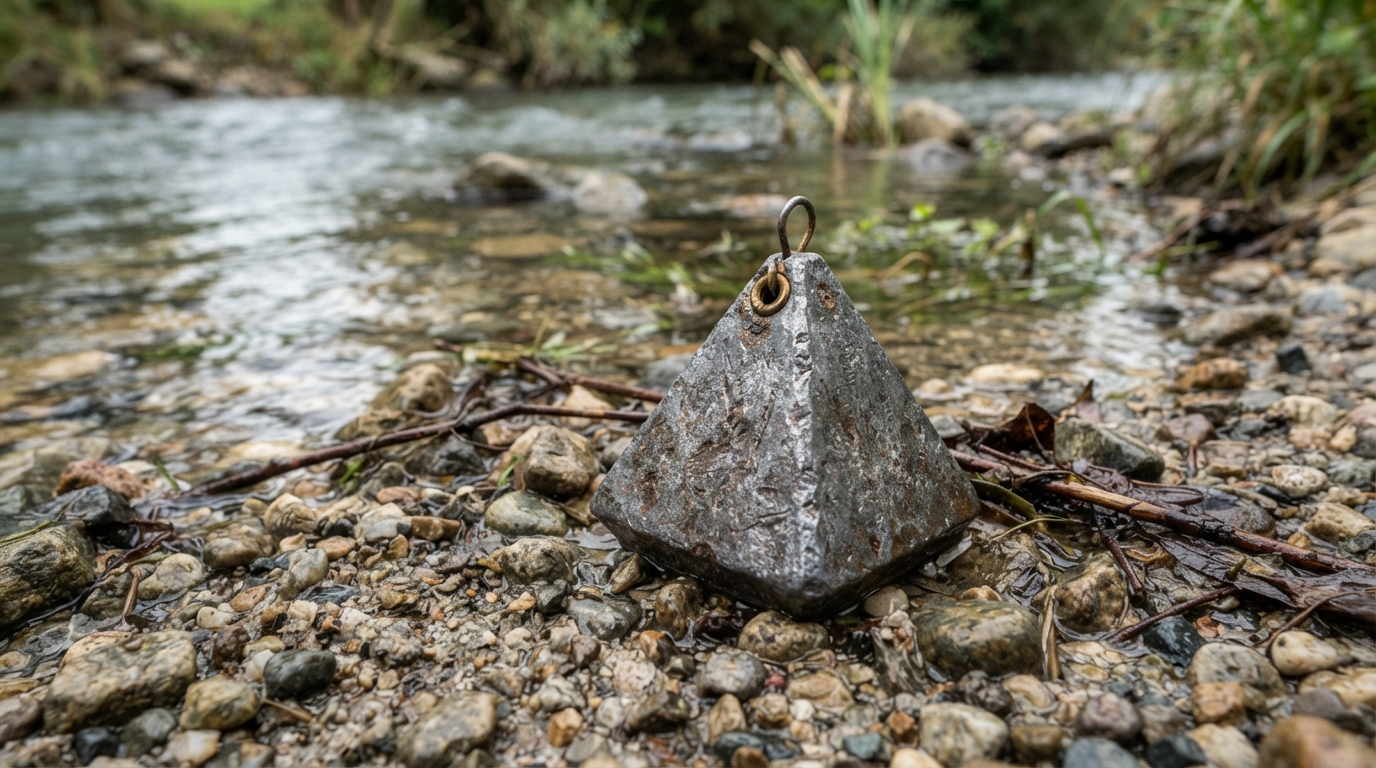
Holding bottom stationary in 6 to 8 knot Fraser River current requires pyramid sinkers between 20oz and 36oz, attached via a 20lb to 30lb monofilament breakaway dropper, with sinker size determined directly by water depth and mainline drag profile.
A breakaway dropper is a sacrificial length of lower-breaking-strain monofilament connecting the mainline slider to the lead weight, designed to snap under snag pressure while preserving the main rig and fish.
In high-velocity flows, stationary bait placement is critical for targeting Acipenser transmontanus. Research published by the Fraser River Sturgeon Conservation Society indicates that adult sturgeon hold tightly within the bottom boundary layer—a narrow hydraulic zone within 30 centimetres of the riverbed where friction reduces water velocity relative to the main water column. Odour plumes emitted by eulachon, salmon roe, or lamprey baits travel downstream along precise scent corridors within this layer. When an angler targets trophy fish during white sturgeon fishing in British Columbia, an unstable bait that skips across the bottom disperses scent erratically across alternating hydraulic currents, pulling fish out of their energy-efficient holding lanes and dramatically decreasing strike frequency.
Hydrodynamic drag acts continuously on submerged line. Standard 130lb to 150lb hollow-core braided lines carry diameters between 0.55mm and 0.65mm, presenting substantial surface area to a 7-knot flow. According to fluid resistance models established in the Journal of Hydraulic Engineering, the total drag force applied to submerged cylindrical lines scales with the square of velocity (\(F_d \propto v^2\)). When sinker mass is insufficient, hydrodynamic drag overcomes the downward gravitational force and the holding friction of the lead.
Underweight sinkers immediately break contact with the substrate and tumble downstream. In the Fraser’s gravel-and-boulder bed structure, a tumbling pyramid weight rotates into the downstream hydraulic draft, wedges into bedrock crevices, or wraps the leader around boulders. Furthermore, when running multiple rods—especially while holding position on anchor as detailed in our 7-knot river anchor scope guide—a drifting 18oz weight sweeps directly across adjacent lines, causing braid tangles under hundreds of pounds of water pressure.
While anglers operating in moderate flows often reference a sinker weight and wire gauge chart for 3-5 knot currents, the Fraser’s mainstem canyons require drastically heavier terminal tackle to achieve equilibrium.
Frequently Asked Questions
Why are pyramid sinkers preferred over bank or teardrop sinkers in heavy river current?
Pyramid weights feature flat triangular faces that dig into gravel, sand, and shale rather than rolling. The flat surface creates a hydraulic wedge against the riverbed, increasing holding power by up to 40% compared to rounded bank or coin weights in identical flows.
What breaking strength should you choose for the breakaway dropper line?
Most commercial Fraser River charters, such as Great River Fishing Adventures, standardise on 20lb to 30lb monofilament for droppers when using 130lb to 150lb braided mainline. This test provides sufficient tensile strength to cast up to 36oz weights without failure, yet breaks cleanly when a lead becomes wedged between bottom cobble.
How does water depth change the required sinker mass at 7 knots?
Greater depth exposes more mainline surface area to current drag. In 20 feet of water, a 24oz weight typically holds bottom; in 60 feet of water at the same current velocity, the additional drag profile of the line requires stepping up to a 32oz or 36oz pyramid weight to maintain bottom contact.
Understanding the fluid forces shifting your terminal gear reveals why calculating exact ballast per depth zone is essential before rigging downriver rods. Inspect the precise depth-to-weight calculation sheet below to match your terminal setup to exact flow metrics.
Key Takeaways
- Currents of 6 to 8 knots require 20oz to 36oz pyramid weights to prevent rig tumbling.
- Rig breakaway dropper lines with 20lb to 30lb monofilament to protect 100lb to 130lb mainlines during snag events.
- Pyramid flat faces provide critical holding resistance against gravel substrate compared to rounded sinkers.
- Braid mainline drag increases hydrodynamic lift, requiring an additional 4oz weight per 20 feet of river depth.
Table of Contents
- Breakaway Sinker Weights for Fraser River Currents
- Hydrodynamic Drag Forces in 6 to 8 Knot Water
- Breakaway Dropper Line Ratings and Slider Rig Geometry
- Depth and Current Sinker Adjustment Rules
- The Fraser River Sinker Sizing Worksheet and Matrix
- Sources & Further Reading
Hydrodynamic Drag Forces in 6 to 8 Knot Water
Holding bottom in 6 to 8 knots of current requires counteracting between 4.5 and 7.2 pounds of continuous hydrodynamic drag exerted directly against your submerged mainline before factoring in the drag of the bait payload itself.
The benthic boundary layer is the zone of water directly adjacent to the riverbed where fluid velocity drops significantly below the main current speed due to frictional shear stress against the bottom substrate.
When anchoring over deep Fraser River runs, mainline diameter dictates whether your weight anchors or planes out. Standard braided lines between 80lb test (average diameter of 0.43 mm) and 130lb test (average diameter of 0.56 mm) present a substantial cross-sectional profile across 80 to 140 feet of water column. Because fluid drag scales quadratically with velocity (\(F_d = \frac{1}{2} \rho v^2 C_d A\)), increasing current velocity from 6 knots (3.09 m/s) to 8 knots (4.12 m/s) results in a 77% increase in lateral drag force against the line. According to open-channel hydraulic assessments published by the U.S. Geological Survey, an angler running 100 feet of 130lb braided mainline at a 45-degree angle in an 8-knot current absorbs approximately 6.8 pounds of horizontal thrust purely on the line. That horizontal vector lifts conventional weights straight off the deck, forcing your rig into a continuous, downstream bounce.
       SURFACE FLOW: 8.0 KNOTS
=========================================
  |       \
  |        \  Downstream line scope
  |         \ (High drag zone)
  |          \
Depth:        \
30m            \
  |             \
  |       -------v-----------------------
  |       BENTHIC BOUNDARY LAYER (Bottom)
  v       Flow drops to 2.8 - 4.1 Knots
=========================================
          [Cobble Interstices / Weight Lock]
Fortunately, flow velocity is not uniform from surface to substrate. Velocity profiles in gravel-bed rivers follow the von Kármán-Prandtl logarithmic law of the wall, meaning frictional drag across large riverbed cobble dramatically decelerates water within the lowest 15 to 30 centimetres of the water column. In an 8-knot surface run, velocity measured immediately above bottom cobbles drops to between 2.8 and 4.1 knots. Your lead does not fight an 8-knot torrent once it sits on the floor; it fights the localized boundary velocity combined with the persistent upward cable pull generated by the mainline above it.
This dynamic explains why sinker geometry determines terminal rig stability. Rounded bank sinkers and disc-shaped coin sinkers rely entirely on gravitational mass, offering hydrodynamic shapes that generate localized pressure differentials and roll across smooth river rock. A pyramid sinker acts as a passive mechanical anchor. When current pushes the flat facets of a 24oz to 36oz pyramid weight, the flow creates a downward vertical force vector that drives the weight’s apex into the gravel interstices between river cobbles. This geometry locks the flat lead face against stone outcroppings, producing a mechanical shear barrier that withstands downstream mainline tension until a fish displaces it.
Which Sinker Profile and Weight Class Fits Your Drift Profile?
If you are fishing 80lb mainline in 6-knot surface current under 60 feet of depth…
Deploy a 20oz to 24oz pyramid sinker. Your line diameter minimizes total hydrodynamic drag, meaning the weight’s flat facet can seat into cobble with minimal upward lift. For broader targeting techniques across these flows, reference our guide to White Sturgeon Fishing in British Columbia.
If you are running 130lb mainline in high-gradient 7 to 8-knot current over 80 feet deep…
Step up immediately to a 32oz or 36oz pyramid sinker paired with an extended breakaway tether. The drag against the thicker diameter line will dislodge anything under 2 pounds during peak tidal runoffs. If your vessel struggles to maintain station here, cross-reference your ground tackle with the 7-Knot River Anchor Scope Guide (With Calculator).
If you encounter moderate tailraces or inside bends moving at 3 to 5 knots…
Drop your lead footprint down to a 16oz or 18oz pyramid weight to minimize bottom snag risk while maintaining holding power. To calibrate your breakaway cord for these lower load thresholds, see our Sinker Weight and Wire Gauge for 3-5 Knot Currents (Chart).
Calculating these hydrodynamic thresholds directly informs the breakaway tether rating required to protect your mainline when that mechanical cobble lock refuses to release.
Breakaway Dropper Line Ratings and Slider Rig Geometry
Rigging a white sturgeon sliding sinker system for 6-8 knot Fraser River currents requires a sacrificial monofilament breakaway dropper rated at precisely 20 to 30 pounds of tensile strength, connected beneath a minimum 130-pound braided mainline.
A breakaway dropper line is a deliberately under-rated segment of monofilament connecting a heavy sinker to the main terminal slider, designed to snap under direct tensile load when the lead wedges into bedrock without breaking the mainline. In the hydraulic flow of the Fraser Canyon, hydrodynamic drag generates continuous lateral load against your line before a fish even touches the bait. If you drop below 20-pound test, flow-induced turbulence and riverbed gravel abrasion cause premature failures during the drop. Move above 30-pound test, and you risk exceeding the safe break-angle of your rod when attempting to snap a wedged 36oz pyramid free from granite crevices.
Data collected by the Fraser River Sturgeon Conservation Society indicates that unrecovered heavy gear degrades benthic habitat and creates ghost-tangle hazards for migrating fish. Using monofilament lines like 25-pound Maxima Ultragreen provides an optimal compromise: its knot tensile retention sits near 85%, offering roughly 21.2 pounds of actual breaking force. This margin easily withstands the 4.8 to 6.2 pounds of hydrodynamic drag produced by a 32oz pyramid weight resting in 7 knots of river flow, while releasing cleanly on a deliberate hand-line wrap. If you frequently fish diverse heavy-flow environments, compare these values against the mechanics detailed in our Catfish Buoy Breakaway Line Chart (Full Guide).
Terminal Assembly Order
[Mainline: 130lb Braid]
         |
         v
[Heavy-Duty Sinker Slider]
         |
         v
[8mm Neoprene/Rubber Bumper]
         |
         v
[250lb Welded-Eye Crane Swivel]
         |
         +--> [Leader to Hook]
         |
[Slider Sinker Attachment]
         |
         v
[6-8" 25lb Mono Dropper]
         |
         v
[32oz-36oz Pyramid Sinker]
Slider geometry must isolate the heavy lead from the hook leader while eliminating line wear from constant vibration. Thread an oversized nylon or stainless steel sinker slider onto your 130-pound braid first, followed by an 8mm high-density rubber bumper bead. The bumper bead absorbs the violent kinetic pounding of the sliding sleeve against the mainline connection, preventing premature knot shearing at the swivel. Connect the mainline to a size 1/0 or 2/0 commercial crane swivel rated for at least 250 pounds, such as those manufactured by Rosco.
Rig your 25-pound sacrificial dropper to the slider arm using an open surgeons loop or cross-lock snap, keeping the dropper length strictly between 6 and 8 inches. Longer droppers cause 36oz pyramid sinkers to helicopter during the descent through boiling upwellings, resulting in severe leader tangles before reaching the river bottom. Shorter droppers under 5 inches bring the oscillating lead block too close to the main slider, increasing the risk of mechanical binding on the mainline. This layout complements the heavier vessel setups outlined in our 7-Knot River Anchor Scope Guide (With Calculator).
Retrieving a 32oz to 36oz pyramid sinker through heavy surface boils creates severe boat-side leverage risks for the crew. In an 8-knot current, reeling a 2.25-pound piece of lead against the river vector produces dynamic tip loads exceeding 18 pounds of static rod flex. When that weight breaks the surface film, water turbulence ceases immediately, causing a rapid transfer of elastic energy through the rod blank.
If the hook pulls free or the sinker swings out of the current while the rod is loaded under full bend, the lead acts as an unguided pendulum capable of striking the boat transom at lethal velocities. Anglers must drop the rod tip parallel to the water when the slider touches the rod tip guide, bringing the weight alongside the gunwale rather than lifting it clear into the air. Review regional safety regulations and fish handling standards in White Sturgeon Fishing in British Columbia before targeting these fish in canyon hydraulics.
Work Gary Klein’s Premortem on your own terminal rig failure
Step 1: Assume complete terminal failure
Assume your vessel is anchored in an 8-knot chute, you hooked an eight-foot sturgeon, and the terminal rig failed catastrophically during the first two minutes of the fight. What specific component parted or bound up?
Example: The 130-pound braided mainline severed flush at the terminal swivel eye under 18 pounds of drag pressure.
Step 2: Generate failure causes
List every mechanical, hydrodynamic, and material flaw in your terminal assembly that could produce that exact break without the fish breaking the hook leader.
Example: The sliding lead’s continuous pounding against an unbuffered knot fractured outer braid carriers against the swivel eyelet.
Step 3: Evaluate dropper line strength
Did the sinker wedge into a bedrock fissure, forcing the rod to absorb both the fish’s momentum and the anchor point of the lead simultaneously because the dropper failed to shear?
Example: The angler rigged a 50-pound monofilament sinker dropper, preventing the breakaway from parting when the pyramid weight wedged into a boulder seam.
Step 4: Implement mechanical preventive fixes
What exact material specifications will you mandate on the rigging table to make that failure physically impossible under high current flow?
Example: Install an 8mm high-density rubber bumper above the swivel and cap all sacrificial monofilament dropper material at 25-pound test maximum.
[PREMORTEM RIGGING AUDIT]
Mainline Material & Rating:     [e.g., 130lb Hollow Braid]
Swivel Type & Rating:           [e.g., 250lb Rosco Crane]
Bumper Bead Thickness:          [e.g., 8mm Solid Rubber]
Dropper Monofilament Rating:    [e.g., 25lb Maxima Ultragreen]
Calculated Sinker Shear Load:   [e.g., ~21.2lb actual break]
Current Velocity At Site:       [e.g., 7.2 knots]
Confirming your terminal slider geometry and dropper strength resolves anchor retention, but holding position over specific Fraser gravel beds requires exact sinker face angles and mass calibration.
Depth and Current Sinker Adjustment Rules
Holding bottom in the heavy current of the Fraser River requires adding 4 ounces of pyramid lead for every 15 feet of depth increase beyond a 20-foot baseline, scaling your terminal weight from 16 ounces on shallow shelves up to 36 ounces in canyon depths. Subsurface drag on thick mainline creates hydraulic lift, forcing your sinker off the bed if you fail to adjust for line belly and water pressure.
The boundary layer is a thin zone of reduced fluid velocity immediately adjacent to the riverbed, where structural friction against gravel slows the current compared to the open flow above.
On shallow gravel shelves measuring 15 to 25 feet, this friction zone allows a 16oz to 20oz pyramid sinker to pin effectively in 6-knot flows. The short line scope exposes minimal braided line to hydraulic push, keeping line belly to a minimum.
When you move into deep river seams measuring 40 to 70 feet, line belly multiplies exponentially. The Fraser River Sturgeon Conservation Society documents that deep canyon runs compress hydraulic force through narrow rock formations, producing vertical eddies alongside primary downstream currents. Submerged line profiles of 50 to 80 feet generate massive drag that lifts light weights off the substrate. In these 40- to 70-foot canyon runs, an angler must deploy 28oz to 36oz flat-sided pyramid weights to breach that line drag and lock the terminal gear into the bed.
Recommended gear
Portable Saltwater Offshore Heavy 3-Piece Travel Graphite Baitcasting Fishing Pole
A three-piece graphite casting rod that breaks down for travel while keeping the backbone needed for heavy saltwater work.
Affiliate link
Seasonal runoff dictates mass requirements just as aggressively as water column depth. During the spring freshet between May and late June, data from the Water Survey of Canada hydrometric station at Hope (Station 08MF005) routinely shows discharge volume exceeding 9,000 cubic meters per second. This surge accelerates surface and mid-column water velocity well past 7 knots, demanding maximum 32oz to 36oz lead configurations even in moderate 30-foot depths. Proper vessel position is equally critical in this flow, requiring correct anchor scope protocols outlined in the 7-Knot River Anchor Scope Guide (With Calculator).
By late October, post-spawn low-water conditions drop river discharge to roughly 2,200 cubic meters per second at the same monitoring coordinates. Reduced water volume shrinks the mid-depth hydraulic drag against your line. You can safely drop down to 18oz or 24oz pyramids in spots that demanded 32oz during June, improving bite detection for fall-feeding fish. For shallower side-channels that drop below 5 knots during late autumn, cross-reference your rig setup against our Sinker Weight and Wire Gauge for 3-5 Knot Currents (Chart).
Your rod tip provides exact feedback on whether your pyramid is locked, tumbling, or airborne in the column:
- Solidly Anchored: The blank takes a steady, loaded curve and vibrates at a high-frequency, low-amplitude hum (1 to 2 Hz). The tip does not bounce or step downward.
- Skipping Bottom: The tip registers erratic, violent twitches every 3 to 8 seconds followed by brief slack cycles. Each twitch signals that current has flipped the pyramid out of the gravel, tumbling your terminal gear downstream.
- Hydroplaning: The blank enters a deep, progressive load over 15 to 30 seconds before suddenly snapping straight. The lead has peeled off the riverbed entirely, planing up into the fast surface column where it sweeps downstream without touching gravel.
Mastering these current shifts is mandatory when targeting giant fish documented in our guide to White Sturgeon Fishing in British Columbia.
Self-Assessment: Riverbed Anchoring Competence
Scoring: 0 ticks means your lead is pinned solid. 1-2 ticks means you are losing 30% of your effective bottom time to downstream drift. 3+ ticks means your bait is hydroplaning out of the scent line entirely; review our Sinker Weight and Wire Gauge for 3-5 Knot Currents (Chart) to recalibrate your weight choices before your next tide change.
Calculate your total rig weight directly against current speeds using the breakaway sizing table and step-by-step worksheet detailed below.
The Fraser River Sinker Sizing Worksheet and Matrix
Holding bottom in the Fraser River canyon and lower river during peak freshet requires matching lead mass directly to hydrodynamic drag, river depth, and substrate friction. A 24-ounce pyramid sinker holds station in 6.0 knots of surface current at depths up to 35 feet, but holding in 8.0 knots at depths exceeding 65 feet requires an upgrade to a 36-ounce poured lead pyramid to prevent line belly from lifting the rig.
A breakaway sinker rig is a terminal tackle configuration where the heavy weight attaches to the mainline using a lower-strength monofilament dropper line, ensuring the lead detaches if snagged on bottom debris while preserving the main line, hook, and fish.
Hydrometric data from the Water Survey of Canada station at Hope documents river velocities frequently exceeding 7.5 knots (3.86 meters per second) during the May-to-July snowmelt runoff. Under these extreme flows, water pressure against your mainline creates horizontal displacement force that easily rolls rounded weights. For standard low-flow scenarios, refer to our Sinker Weight and Wire Gauge for 3-5 Knot Currents (Chart). However, when targeting dinosaurs via White Sturgeon Fishing in British Columbia, high-energy river runs mandate flat-sided pyramid designs that dig into compacted gravel beds.
| Surface Current (Knots) | Shallow Trench (20–35 ft) | Mid-Depth Run (36–50 ft) | Deep Pool (51–65 ft) | Canyon Gut (66–85 ft) | Recommended Breakaway Monofilament Rating |
|---|---|---|---|---|---|
| 6.0 knots | 16 oz | 20 oz | 24 oz | 28 oz | 15 lb test |
| 6.5 knots | 18 oz | 24 oz | 28 oz | 32 oz | 20 lb test |
| 7.0 knots | 20 oz | 28 oz | 32 oz | 36 oz | 20 lb test |
| 7.5 knots | 24 oz | 32 oz | 36 oz | 36 oz + flat profile | 25 lb test |
| 8.0 knots | 28 oz | 36 oz | 36 oz + flat profile | Extreme drift / Relocate | 25 lb test |
Sinker Mass Calculation Worksheet
Hydrodynamic drag increases with the square of water velocity, meaning a 1.0-knot increase in current speed elevates the lateral force exerted on your submerged line by roughly 30%. Calculate your target lead weight on the boat using this three-variable equation:
-
Calculate Line Drag Factor (LDF):
Measure your braided mainline diameter against standard 0.43 mm (80-pound test) baseline braid. For 100-pound braid (0.50 mm diameter), multiply baseline depth by 1.15 to account for the additional cross-sectional surface area facing the flow. If you use heavy monofilament mainline, compare your displacement values against our Lingcod Sinker Sizing: 16oz-48oz (Drift Speed Chart) to understand thick-line hydrodynamic lift. -
Calculate Velocity Coefficient (VC):
Take your GPS speed-over-ground reading while stationary at anchor (surface velocity in knots) and square it, then divide by 36 (the baseline factor for 6.0 knots). An 8.0-knot reading produces a VC of 1.77 (64 / 36), indicating a 77% increase in kinetic displacement over baseline canyon flow. -
Adjust for Substrate Type (Substrate Offset):
- Clean, coarse gravel: Base weight × 1.00 (pyramid edges lock efficiently into loose stones).
- Hard-packed riverbed clay: Base weight × 1.20 (requires additional mass to prevent planer-skating).
- Angular boulder fields: Base weight × 0.85 with a reduced breakaway rating, as oversized weights wedge permanently in rock crevices. For tethering concepts in jagged structure, review our Catfish Buoy Breakaway Line Chart (Full Guide).
Before dropping anchor in heavy runs, calculate your anchor rode requirements via our 7-Knot River Anchor Scope Guide (With Calculator) to maintain an uncompromised boat position.
Recommended gear
Extreme Max 3006.2514 BoatTector Double Braid Nylon Anchor Line with Thimble
Half-inch double-braid nylon anchor line with a stainless thimble spliced in; the nylon's stretch absorbs the shock loads a river anchor takes.
Affiliate link
Boat-Side Pre-Anchoring Terminal Tackle Checklist
The Fraser River Sturgeon Conservation Society emphasizes gear durability to prevent breaking off entire terminal rigs on sub-surface structure. Complete this five-point tackle inspection on the deck before releasing the anchor ball:
- Mainline Inspection: Strip off the first 15 feet of 80-to-130-pound braided mainline to verify the absence of fraying from Fraser silt abrasion.
- Sinker Slider Verification: Confirm the sinker slider features a ceramic or ultra-high-molecular-weight polyethylene inner sleeve to prevent heat friction grooves during prolonged current tension.
- Breakaway Dropper Length: Tie the monofilament dropper line to a finished length between 8 and 12 inches; lines longer than 14 inches induce line wrap around the 150-pound leader in turbulent back-eddies.
- Dropper Knot Check: Tie the breakaway dropper with an overhand-loop knot at the sinker eye to drop breaking strength to a predictable 70% of the monofilament rating.
- Lead Geometry Check: Inspect the base edges of your 16-to-36-ounce pyramid sinkers; file away cast-molding flashings so the wide face embeds perpendicular to the downstream current vector.
Tie three breakaway droppers in 20-pound monofilament right now, stage your 28-ounce and 32-ounce pyramids in your rigging tray, and drop your first bait directly into the seam where current drops below 7 knots.
Sources & Further Reading
Rigging breakaway pyramid weights between 16oz and 36oz for high-velocity sturgeon fisheries relies on empirical hydrodynamic drag models and published river discharge data from provincial fisheries managers. A breakaway sinker rig is a terminal tackle setup where a sacrificial, lower-strength line tethers a heavy weight to a sliding swivel, ensuring the lead detaches if wedged in river bottom debris while preserving the main line and hooked fish.
To anchor baits in currents running 6 to 8 knots (approximately 10 to 13.5 feet per second), your rig must overcome severe shear stress across the riverbed boundary layer. The Water Survey of Canada measures volumetric flow in real time through hydrometric stations like the Fraser River at Hope (Station 08MF005), where spring freshet discharge regularly tops 8,000 m³/s. At these discharge rates, standard rounded leads roll immediately, whereas four-sided pyramid lead shapes generate downward hydraulic force by diverting bottom current over their angled faces.
Biotelemetry and catch monitoring published by the Fraser River Sturgeon Conservation Society show that white sturgeon consistently hold in deep velocity seams during peak spring flows. Their 24-year mark-recapture dataset indicates that sturgeon maintain position in sub-surface currents that exceed recreational boat anchoring thresholds. Anglers who scale down their sinker weight below 16oz in these zones risk sweeping terminal tackle downriver, fouling mainline structures and increasing fish handling times beyond safe physiological limits.
Terminal rigging rules established by the British Columbia Ministry of Water, Land and Resource Stewardship require single-hook configurations and enforce quick-release standards to protect broodstock populations. A 2013 evaluation by researcher Troy C. Nelson in the Journal of Applied Ichthyology emphasizes that reducing prolonged gear fight times preserves sturgeon blood oxygen levels and prevents severe post-release lactic acidosis. Tying 15-pound to 20-pound monofilament breakaway stems to 30oz or 36oz pyramid sinkers provides the precise tensile threshold required: high enough to withstand 7-knot downstream drag, yet light enough to part under firm rod pressure whenever bottom rocks bite the lead.
- Fraser River Sturgeon Conservation Society. Lower Fraser River White Sturgeon Monitoring and Assessment Program, 2023. Provides multi-decade mark-recapture data that maps seasonal white sturgeon holding positions across high-velocity mainstem reaches. Fraser River Sturgeon Conservation Society
- Water Survey of Canada. Real-Time Hydrometric Data: Fraser River at Hope (Station 08MF005), Environment and Climate Change Canada, 2024. Delivers continuous streamflow and surface velocity figures used to match pyramid lead mass against hydraulic drag forces. Water Survey of Canada
- British Columbia Ministry of Forests, Lands, Natural Resource Operations and Rural Development. Guidelines for the Fraser River White Sturgeon Fishery, 2018. Details legal terminal rigging parameters, hook size limits, and ethical handling mandates for angling in British Columbia waters.
- Nelson, T. C., Doukakis, P., Lindley, S. T., & Schreier, A. D. "Research needs for white sturgeon: challenge and opportunity." Journal of Applied Ichthyology, 2013. Examines the physiological consequences of exhaustion, deep-water capture resistance, and recovery dynamics in adult sturgeon.
