Flying Gaff Tagline Sizing Chart (150-800lb Pelagics)
⏱ 18 min read
Rope Diameter and Tensile Ratings for Pelagic Taglines
For 150-pound to 800-pound pelagics, flying gaff taglines require 3/8-inch (3,200-pound tensile strength) to 5/8-inch (8,200-pound tensile strength) nylon rope to absorb violent surge loads safely. Rigging below these thresholds invites mechanical failure, while rigid or oversized ropes eliminate the stretch required to buffer deceleration. This specification raises an operational problem: dynamic shock loads at boat-side multiply a fish’s nominal mass by three to five times in fractions of a second.
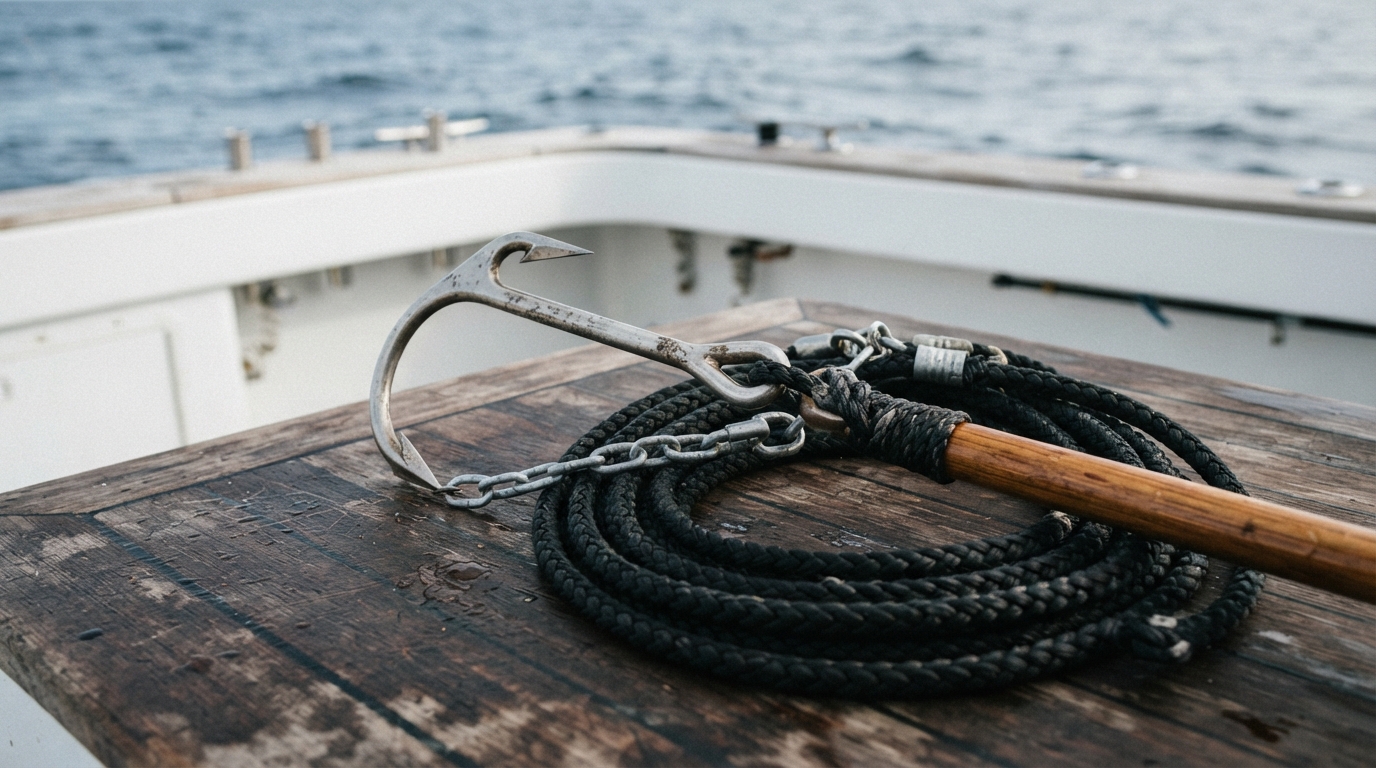
A flying gaff tagline is a heavy tether connecting a detachable gaff hook directly to a structural vessel cleat, transferring the landing load off the pole handle and onto the hull.
Sizing a tagline strictly by static scale weight ignores elementary physics. When a green 400-pound bluefin tuna sounds beneath the transom, static mass converts into directional kinetic energy. The Cordage Institute standard CI 1500 outlines how dynamic loading drastically lowers the operational safety factor of synthetic fiber lines. If that 400-pound fish accelerates downward at 15 feet per second and hits the end of a slack tagline with zero line slippage, the instantaneous arrest force routinely spikes beyond 2,000 pounds of instantaneous force.
While controlled drag pressures mitigate shock during the fight—as mapped in our Spinning Reel Drag Heat Chart: Run Times at 35lb+ Drag—the boat-side gaffing phase eliminates the rod’s parabolic cushion. When the gaff hook engages and the head separates from the handle, the fish is tethered on a short, unforgiving radius. Three distinct mechanical failure vectors emerge during this sequence:
-
Dynamic shock spikes: If a crew rigs with ultra-low-stretch line like Dyneema or worn, sun-hardened polyester, the lack of mechanical elasticity transmits 100% of the kinetic surge into the terminal connections. The rope reaches its breaking limit instantly, snapping at the eye splice or straightening the gaff hook.
-
Deck cleat detachment: Unyielding dynamic spikes transfer directly to the boat’s securing point. Testing standards published by the American Boat and Yacht Council (ABYC H-40) reveal that unbacked or undersized 8-inch deck cleats frequently fail under severe dynamic shear loads, ripping hardware through the fiberglass deck cap.
-
Crew physical trauma: A wireman or gaff handler caught holding a tagline during an unmitigated shock spike faces severe crush injuries, friction burns, or loss of footing. High-tensile nylon provides the working elongation (typically 15% to 28% stretch at 75% breaking strength) necessary to cushion this load before it rebounds into the cockpit.
Try This Today: Inspect your flying gaff tagline for fiber degradation. Measure a 10-foot section under light tension with a standard tape measure, then twist the strands open to check for powdery internal abrasion; replace the line immediately if you find broken inner fibers or if the rope has lost its natural flexibility.
Knowing nominal break strengths only solves half of the rigging equation; understanding the exact line length and rope construction dictates whether that nylon can stretch enough to dissipate boat-side kinetic energy without whipping back.
Key Takeaways
- Use 3/8-inch to 5/8-inch three-strand nylon rope offering 3,200 to 8,200 lbs minimum breaking strength.
- Tagline breaking strength must exceed target fish weight by a 4:1 minimum safety factor against dynamic shock.
- Nylon provides up to 30% elongation to absorb violent thrashing loads that snap zero-stretch Dyneema lines.
- Spliced eyes retain 90% of base rope tensile strength, while knots reduce line strength by 45%.
Table of Contents
- Rope Diameter and Tensile Ratings for Pelagic Taglines
- Three-Strand Nylon Versus High-Modulus Polyethylene Taglines
- The Complete Pelagic Flying Gaff Sizing Chart
- Eye Splices Versus Knots for Tagline Termination
- The Pre-Trip Flying Gaff Rigging and Inspection Checklist
- Sources & Further Reading
Three-Strand Nylon Versus High-Modulus Polyethylene Taglines
Three-strand soft-lay nylon rope is the mandatory construction for pelagic flying gaff taglines because its mechanical elasticity absorbs violent shock loads that high-modulus lines directly transfer into deck hardware. When a gaffed pelagic violently changes direction, the cordage material determines whether the dynamic energy dissipates through fiber elongation or shears boat fittings at the transom.
Soft-lay nylon rope is a twisted cordage construction manufactured with loose strand twisting to maximize stretch under dynamic load, yielding high shock-absorption properties at the expense of lower abrasion resistance compared to hard-lay cordage.
According to specifications in the Cordage Institute Standard CI 1301-14, quality three-strand nylon rope exhibits between 20% and 30% elongation at 75% of its minimum breaking strength. When a 500-pound bluefin tuna drops beneath the boat or rolls against the hull, this elongation functions identically to a progressive drag curve, extending the deceleration period across several milliseconds. Just as controlled friction prevents tackle failure in high-load scenarios documented in the Spinning Reel Drag Heat Chart: Run Times at 35lb+ Drag, nylon stretch caps instantaneous peak impulse loads below the failure thresholds of your transom cleats, cockpit coamings, and gaff head pins.
High-modulus polyethylene (HMPE) lines—commonly sold under brand names like Dyneema SK75 or Spectra—present the opposite mechanical profile. While HMPE delivers exceptional static tensile ratings at fractions of nylon’s diameter, its ultimate elongation at break is between 3% and 4%. Because HMPE possesses virtually zero dynamic give, kinetic force transfer occurs instantaneously:
DYNAMIC LOAD TRANSFER
[Pelagic Surges at Gaff]
        |
        v
[HMPE Line (3-4% Stretch)]
        |
        v
(Instant Shock Load Spike)
        |
        +--> Cleat Shears Off Transom
        +--> Gaff Hook Straightens
        +--> Crew Sustains Severe Injury
When a thrashing 600-pound broadbill swordfish drops against an HMPE tagline, the peak impulse load can easily double or triple the static weight of the fish in under 0.05 seconds. Rigging heavy gear for deep pelagics requires matching dynamic behavior to hardware limits, an engineering challenge also detailed in the Daytime Swordfish Lead Sizing: 8lb to 18lb (Chart). In gaffing operations, zero-stretch lines snap 3/8-inch stainless steel attachment eyes, bend gaff hooks, or violently jerk line-handlers against the covering boards.
Environmental degradation further changes the mechanical properties of offshore taglines over time. Research published by Samson Rope documents that standard nylon polymers lose 10% to 15% of their baseline tensile strength when fully saturated with water, as absorbed water molecules interrupt hydrogen bonding between polyamide chains.
Solar ultraviolet (UV) radiation breaks down exterior nylon fibers, converting smooth outer filaments into brittle, powdery fuzz that accelerates moisture intrusion. Compounding this, evaporated seawater deposits sharp sodium chloride crystals within the rope’s interior lay. When the wet rope cycles under tension, these microscopic salt facets slice load-bearing filaments from the inside out, causing uninspected taglines to lose up to 40% of their rated breaking strength within 24 months of cockpit service.
- Annual Tagline Replacement Protocol:
- Measure working diameter with calipers; retire any line exhibiting more than 10% diameter reduction from nominal factory sizing.
- Flex the rope by hand along its entire length to detect internal core stiffening, which indicates salt-crystal locking or fused nylon filaments from previous shock cycles.
- Soak new three-strand nylon in fresh water with mild fabric conditioner prior to splicing to soften the lay and lubricate interior yarn contact surfaces.
- Store taglines inside a dark cockpit locker away from direct UV exposure and fuel fumes, which chemically degrade polyamide polymers.
- Log every catch exceeding 300 pounds; replace the entire tagline immediately after two high-energy shock events regardless of the rope’s visual condition.
Knowing how fiber elasticity cushions terminal impacts is only half the equation; sizing that diameter precisely to the target species’ displacement prevents premature line parted under pressure.
The Complete Pelagic Flying Gaff Sizing Chart
Rigging a pelagic flying gaff requires matching cordage tensile strength and hook throat dimensions directly to the kinetic displacement of the fish, scaling working lines from 3/8-inch double-braid nylon for 150-pound pelagics up to 5/8-inch lines for 800-pound broadbill swordfish and giant bluefin tuna.
A flying gaff is a heavy-game landing tool featuring a detachable rigid hook head secured to a reinforced rope tagline, which separates from the release pole upon impact to tether large pelagic fish directly to a reinforced boat cleat.
Standard safety protocols published by the Cordage Institute indicate that synthetic lines undergo substantial working-load derating under dynamic shock loads. When a green 400-pound pelagic surges boat-side, instantaneous impulse spikes easily double its deadweight force. Managing these spikes requires safety ratios calibrated to fish mass categories:
| Target Bracket (lbs) | Hook Throat Size | Recommended Cordage Spec | Min. Tensile Strength | Dynamic Safety Ratio |
|---|---|---|---|---|
| 150 – 300 lbs | 5 to 6 inches | 3/8 in. Double-Braid Nylon | 3,900 lbs | ~13:1 to 10:1 |
| 301 – 500 lbs | 8 to 10 inches | 1/2 in. Double-Braid Nylon | 7,400 lbs | ~15:1 to 7.4:1 |
| 501 – 800+ lbs | 10 to 13 inches | 5/8 in. Double-Braid Nylon | 13,100 lbs | ~16:1 to 5.2:1 |
Medium-game fish (150 to 300 lbs) allow an operational safety ratio near 10:1 because their fast, erratic tail-beats generate sharp, low-mass cycles. Once targets exceed 500 pounds—such as giant bluefin tuna or heavy Pacific black marlin—safety ratios realistically scale down toward 5:1.
A 5:1 ratio provides sufficient headroom while preventing taglines from becoming too thick to handle efficiently. If you maintained a 10:1 ratio on an 800-pound bluefin, you would require a 3/4-inch line with an 18,000-pound tensile rating. Lines of that bulk reduce hook penetration velocity and clutter the cockpit during critical leadering phases, much like improperly tuned systems referenced in our Outrigger Tension Chart: 6oz to 32oz Lures (Scale Guide).
Tensile strength alone does not dictate line choice; human grip ergonomics establish a hard lower boundary. Ergonomic field trials conducted by the National Institute for Occupational Safety and Health (NIOSH) show that gloved hands lose over 20% of their isometric gripping capability when grasping wet cylinders under 10 millimeters (approx. 3/8 inch) in diameter.
Any tagline cordage under 3/8-inch slices through wet Kevlar or rubberised offshore gloves during dynamic surges. Even if a 1/4-inch high-modulus Dyneema line provides 5,000 pounds of raw break strength, wet deck hands cannot control it without suffering friction burns or hand trauma. Premium nylon double-braid cordage, manufactured by specialists like Samson Rope, combines elongation stretch (roughly 12% to 16% at 30% of break load) to soak up terminal tail-whips with the minimum gripping surface area required to prevent the line from being ripped free.
GAFF RIGGING LOAD CHAIN
[Detachable Gaff Hook]
       |
[Splice / Eye Thimble]
       |
[3/8" to 5/8" Tagline]
       |
 (Absorbs Dynamic Surge)
       |
[Stern Mooring Cleat]
Cockpit efficiency depends heavily on line management, especially when anglers transition from high-drag runs described in the Spinning Reel Drag Heat Chart: Run Times at 35lb+ Drag straight to the boat-side endgame. Calculating these load margins before you leave the dock eliminates catastrophic line failures at the transom.
🤖 A Prompt Worth Stealing
Use this prompt in any AI chat assistant to calculate safety ratios and line specs for your exact cockpit configuration.
Act as a marine mechanical engineer specializing in sportfishing rigging. Calculate the gaff tagline diameter, hook size, and dynamic safety ratio for a [TARGET SPECIES] estimated at [ESTIMATED WEIGHT IN LBS].

Evaluate two cordage choices: nylon double-braid versus hollow-braid Dyneema. Factor in an assumed shock-load factor of 2.2x fish weight, wet glove ergonomic limits (minimum 3/8-inch diameter for manual holding), and cleat tie-off friction. Present the output as a Markdown comparison table with columns: Line Material, Diameter, Breaking Strength, Effective Safety Factor, and Cockpit Risk Notes.
Paste the resulting table into your boat operations log, then iterate by asking the assistant to add hardware load limits for your specific stern cleat sizes.
Knowing your cordage tensile numbers protects the cockpit, but securing the tag line to the vessel’s structure requires understanding the exact splice terminations and hitch geometry examined in the hardware section below.
Eye Splices Versus Knots for Tagline Termination
A flying gaff tagline is a heavy tether securing a detachable gaff hook to a reinforced boat cleat, designed to hold large pelagic fish alongside the vessel under extreme shock loads. Terminating this line with an eye splice preserves up to 95% of the rope’s baseline tensile strength, whereas field knots induce catastrophic load reductions that routinely cause terminal tackle failure at the transom.
Tensile testing published by Samson Rope demonstrates that a standard bowline retains only 55% to 60% of rated cordage strength, representing an immediate loss of up to 45%. Under shock loading, the sharp internal radius of the bowline nip creates severe shear stresses where the bitter end enters the bight. The Cordage Institute standard CI 1308 specifies that bend radii smaller than three times rope diameter degrade synthetic polymer tensile capabilities significantly. When an 800-pound bluefin tuna drops into a death roll against a tight tether, that localized compression point converts dynamic kinetic energy directly into a line snap.
By contrast, an engineered five-tuck eye splice distributes longitudinal strain evenly down the body of the cordage, maintaining roughly 90% to 95% of catalog breaking capacity. Fabricating this termination on 12-strand single braid or standard 3-strand nylon demands a minimum of five full tucks, with the final two tucks tapered by 50% strand volume to eliminate abrupt density steps. Slide a commercial 316 stainless steel heavy-duty wire rope thimble into the eye before forming the lock to protect the line from hook-eye friction. Seat tubular nylon chafing gear over the entire contact circumference, seizing both tails with waxed polyester whipping twine to prevent cyclic mechanical unloading under boat chop.
Connecting this rigging requires matching your cordage strength to deck-cleat geometry. Much like monitoring thermal breakdown on a reel via our Spinning Reel Drag Heat Chart: Run Times at 35lb+ Drag, you must account for dynamic friction thresholds before setting your gear.
The baseline formula for calculating finished tagline length is:
L = D_cleat + F_transom + S_clearance
Where D_cleat is the direct distance from the selected aft mooring cleat to the gaffing station at the transom corner, F_transom is the vessel’s vertical freeboard clearance to the waterline, and S_clearance is a fixed safety margin of 2.5 feet to 3.0 feet. On an outboard center console with 28 inches (2.33 feet) of transom freeboard and a 4-foot distance from the cockpit corner cleat, the formula dictates a total line length of 8.83 feet to 9.33 feet. Setting the line shorter restricts the gaff head from reaching past the gunwale; setting it longer allows a green marlin to sound beneath the hull and foul your running gear.
[Mooring Cleat]
       |
  (D_cleat: 4.0 ft)
       v
[Transom Corner]
       |
 (F_transom: 2.3 ft)
       v
[Waterline Strike]
       |
(S_clearance: 2.7 ft)
       v
[Terminated Gaff Eye]
Work Gary Klein’s Premortem on your own problem
Step 1: Assume complete failure
Assume your flying gaff system parted completely while securing an apex pelagic at the transom. What structural component or terminal connection point broke first?
Example: The 5/8-inch nylon tagline severed cleanly at the hook attachment knot during an 8-foot boat surge.
Step 2: Generate failure modes
List every rigging, hardware, and handling flaw that could produce this exact line break without relying on bad luck as an explanation.
Example: A bowline knot reduced the line strength from 10,400 pounds to 5,720 pounds while metal-on-rope friction melted the synthetic fibers.
Step 3: Track back to actionable rigging changes
Which physical modifications remove these failure modes before the vessel ever departs the dock?
Example: Replace the tied knot with a 5-tuck eye splice lined with a 316 stainless thimble and Chafe-Pro anti-abrasion sleeving.
Step 4: Establish operational pass/fail rules
What strict pre-trip measurement or physical inspection standard will you mandate across all deck crew gear?
Example: Taglines are rejected if splices show strand slippage or if raw rope contacts metal rings without an intervening thimble.
[PREMORTEM RIGGING AUDIT]
Assumed failure point: [INSERT CRITICAL WEAKNESS]
Root mechanical mechanism: [INSERT TENSION/HEAT/ABRASION CAUSE]
Permanent physical countermeasure: [INSERT SPLICE/THIMBLE/ROPE UPGRADE]
Pre-trip go/no-go parameter: [INSERT VERIFIABLE INSPECTION METRIC]
Confirming your termination strength and cleat geometry prepares the hardware foundation, but executing a safe strike requires pairing this setup with matching dynamic rope diameters based on target weights and hull speeds.
The Pre-Trip Flying Gaff Rigging and Inspection Checklist
A flying gaff tagline requires a systematic, six-point physical inspection before every offshore trip because shock loads from thrashing pelagics subject synthetic fibers to violent, destructive tension cycles. A flying gaff tagline is a heavy-duty tether securing a detachable gaff hook to an engineered boat cleat, designed to absorb violent surges when a large gamefish breaks away from the handle. Relying on visual appearance alone invites catastrophic gear failure at the transom when securing big tuna or billfish.
The Six-Step Pre-Departure Rigging Audit
Before staging your gaff on the deck rack, execute these six mechanical checks in sequence:
- Splice Throat Geometry: Examine the eye splice around the commercial stainless steel thimble at the hook junction. The throat must seat tightly against the thimble ears without elongation, throat gaps exceeding 0.125 inches, or strand slippage.
- Cover-to-Core Shear Alignment: Milk the double-braid jacket along the core over the first 6 feet of the working end. Any bunching, loose jacket bagging, or localized core necking indicates internal core fracture from previous shock cycles.
- Internal Particulate and Grit Audit: Flex the cordage into a sharp 180-degree bend and open the outer strands with your fingers. Shine a direct inspection light into the braid interstices to evaluate salt crystal accumulation and silica sand intrusion.
- Compression and Core Suppleness Check: Pinch the line every 12 inches along its total length. A sound rope remains uniform and moderately pliable; hard, flattened, or wood-like segments indicate severe thermal fusing caused by cyclic friction under extreme load.
- Gaff Head Release Pin and Lanyard Test: Check the attachment system pairing the hook to the gaff pole—whether using rubber friction bands, synthetic o-rings, or break-away clips. The release mechanism must release cleanly under 15 to 25 pounds of direct pull, preventing the handle from transferring rotational torque into your hands.
- Cleat Connection Rigidity: Inspect the bitter-end eye splice or cleat tether hitch. Terminations should use spliced eyes rather than field knots to avoid dangerous reductions in line strength.
If your offshore strategy involves managing bridle-rigged live baits staged via Tuna Tube GPH Sizing: Skipjack vs Bonito (Worksheet) or targeting broadbill on deep structure mapped through a Daytime Swordfish Lead Sizing: 8lb to 18lb (Chart), your terminal flying gaff rigging will encounter severe dynamic forces at the rail.
Pass/Fail Criteria for Critical Rope Degradation
Evaluating cordage integrity requires objective, measurable failure benchmarks rather than guesswork. According to technical documentation published by the Cordage Institute under standard CI 2001 (Fiber Rope Inspection and Retirement Guide), inter-strand friction produces micro-damage that degrades tensile ratings long before structural failure occurs.
- Fiber Powdering (Pass/Fail): Open the strands and gently scrape the internal filaments. If fine, white synthetic powder sheds from the core or inner yarns, inter-filament abrasion has occurred. Trace dust is acceptable on exterior strands, but any measurable accumulation of crushed fiber dust inside the braid is an automatic FAIL.
- Internal Grit Intrusion (Pass/Fail): Roll the line between your thumb and forefinger under moderate pressure. If you detect sharp clicks or grinding sensations from trapped quartz sand or dried salt crystals, the internal filaments are being sawn through under load. If grit penetrates beyond the outer 10% of the jacket depth, mark the line as a FAIL.
- Splice Distortion (Pass/Fail): Measure the throat of the eye splice where the bitter end enters the standing part. Engineering data from Samson Rope shows that locked brummel and class I double-braid eye splices retain 90% of rope tensile strength when intact. If the splice crossover has migrated by more than 0.25 inches, or if individual strand crowns show pulled loops of 0.125 inches or higher, it is an automatic FAIL.
- Cleat Tether Knots (Pass/Fail): Examine the connection securing the tagline to the cockpit mooring cleat. Tying an overhand knot, bowline, or half-hitch into high-modulus polyethylene (HMPE) or double-braid nylon derates total tensile capacity by 40% to 55%. If the rope relies on field knots instead of an eye splice dropped over the cleat horns, it receives a FAIL until properly spliced.
Fixed Line Retirement Thresholds
Regardless of pristine cosmetic appearance, dynamic arrest events alter the molecular structure of synthetic fibers. Taglines subjected to deep cycles must be pulled from service based on hard operating limits:
- Shock Load Count: Retire the line immediately after arresting five sudden, dead-weight drops or extreme tail-whips from pelagics exceeding 300 pounds. Each shock load strains synthetic polymers beyond their elastic recovery limit.
- Diameter Reduction: Measure the working end with a mechanical vernier caliper under light manual tension. A sustained diameter reduction of 10% or greater at any point signals internal core collapse.
- Calendar Exposure: Nylon and polyester double-braids degrade through continuous UV exposure, saltwater hydrolysis, and atmospheric oxidation. Replace tagline cordage every two calendar seasons, or after 150 days of active offshore use.
- Surface Glazing and Melt Marks: High friction against gunnel caps, hawse pipes, or hull chimes generates surface temperatures exceeding the 428°F melting point of nylon. Any melted or fused jacket patches exceeding 0.5 inches in length require immediate condemnation.
The Extreme Angler Tagline Integrity Matrix
Prime Service
Line shows zero mechanical wear, maintains original suppleness, and retains full factory tensile strength.
Belongs here if: Total shock-load cycles are under three and diameter variation measures under 3% across the working length.
Then: Clear for offshore deployment on primary pelagic species.
Degraded Secondary
Line exhibits light surface fuzzing or salt compaction without core separation or load-induced elongation.
Belongs here if: Cordage has logged 12 to 24 months of service but retains symmetrical splices and no internal grit.
Then: Downgrade to secondary utility duty or boat bumper lanyards immediately.
Compromised Danger
Rope exhibits structural deformation, inter-strand fiber powdering, or core herniation through the cover braid.
Belongs here if: Cross-sectional diameter is reduced by 10% or more at any point along the load path.
Then: Condemn the line and sever it into 12-inch pieces to prevent accidental re-use.
Shock-Fatigued
Cordage appears intact visually but has arrested multiple maximum-strain runs from fish exceeding 400 pounds.
Belongs here if: Line has absorbed five or more heavy shock-load cycles regardless of pristine cosmetic exterior.
Then: Cut off spliced terminations and retire the core line permanently.
Pull your flying gaff from the locker today, measure the diameter at the splice throat, and discard any tagline carrying hardened segments or internal grit.
Sources & Further Reading
Rigging flying gaff taglines for giant pelagics demands adherence to structural engineering standards and international sportfishing regulations rather than dockside guesswork.
Working load limit is the maximum operational force that a rope or rigging component can safely support during regular use, calculated by dividing its minimum breaking strength by a designated safety factor. When an 800-pound bluefin tuna surges against a boat hull, shock loads easily exceed three times the fish’s static mass. According to specifications published by the Cordage Institute under standard CI 1310, commercial-grade 1/2-inch double-braided nylon rope provides an average breaking strength of 7,400 pounds, absorbing surge energy through an elongation capacity of roughly 10% to 15% at working loads.
Sportfishing compliance also dictates precise physical dimensions on the water. The International Game Fish Association explicitly caps flying gaff line length at 30 feet (9.14 meters), measuring from the hook eye to the bitter end. Exceeding this boundary by even 1 inch disqualifies a record catch under official equipment rules, regardless of how cleanly the wireman handled the leader. Veteran big-game skipper Peter Wright documented in his offshore rigging analyses that pairing IGFA-compliant lengths with marine-grade stainless hardware prevents line fouling around running gear during close-quarters cockpit battles.
- International Game Fish Association (IGFA), International Angling Rules, 2024 (https://igfa.org) — Establishes the 30-foot maximum tagline length restriction and hardware parameters for verified sportfishing records.
- Cordage Institute, CI 1310: Nylon (Polyamide) Double Braid Rope Standards, 2019 (https://www.cordageinstitute.com) — Provides verified tensile breaking strengths, elongation percentages, and dynamic load formulas for double-braid synthetic fiber lines.
- Peter Wright, Peter Wright’s Guide to Big Game Fishing, 2006 — Details cockpit safety protocols, cleat tie-off configurations, and shock-mitigation techniques when billing or gaffing heavy pelagics.
- Samson Rope Technologies, Rope User’s Manual: Technical Specifications and Splicing Guide, 2022 — Defines safe working load ratios, degradation factors from ultraviolet exposure, and eye-splice retention ratings in marine environments.
- Vic Dunaway, Baits, Rigs & Tackle, Florida Sportsman, 2001 — Outlines functional mechanical rigging systems for offshore terminal gear and heavy landing equipment.
