Tigerfish Wire Trace Selection Matrix (Full Chart)
As an Amazon Associate I earn from qualifying purchases. Product links on this page are affiliate links — they cost you nothing extra.
⏱ 15 min read
Optimal Wire Trace Length and Pound Test Baseline
Rigging for Zambezi tigerfish (Hydrocynus vittatus) requires a wire trace measuring between 25 and 45 cm in length, rated at 30 to 50 lb test (13.6 to 22.7 kg). This specific envelope provides the minimum structural safety margin against dental shear while preserving the natural swimming frequency of artificial lures. Traces shorter than 25 cm result in terminal cut-offs when fish engulf lures deep or roll during aerial jumps, whereas wire exceeding 45 cm or 50 lb test adds excessive hydrodynamic drag that deadens lure vibration.
A wire trace is a bite-resistant length of metallic leader connected between the mainline and terminal lure to prevent mechanical severance during a predatory strike. It isolates the line from direct contact with sharp teeth, gill rakers, and abrasive bony structures.
How do you prevent cut-offs against one of freshwater’s most destructive predators without neutralizing the action of your presentation?
Dental Shear and Abrasive Morphology
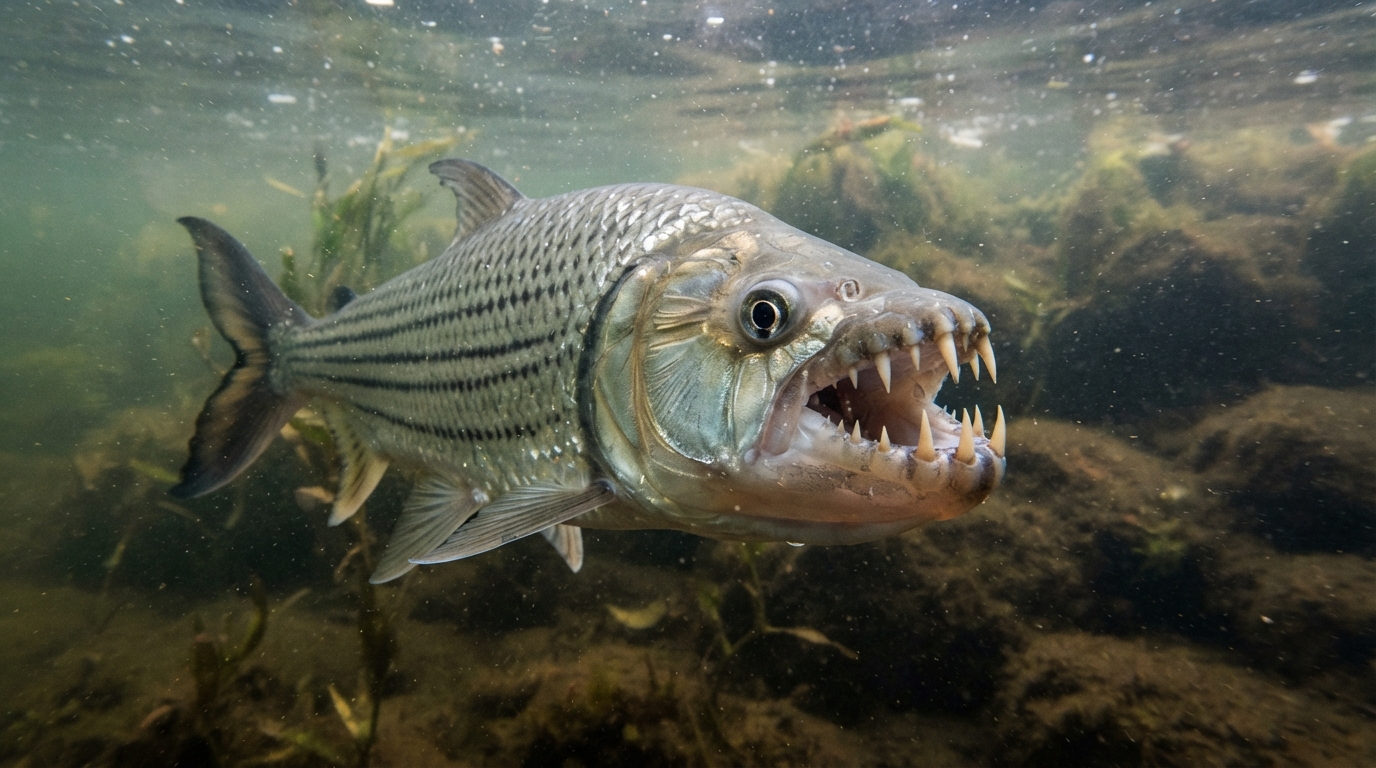
The primary driver for trace specifications is the tigerfish’s jaw architecture. According to anatomical records documented in FishBase and P.H. Skelton’s Complete Guide to the Freshwater Fishes of Southern Africa, Hydrocynus vittatus possesses eight conical, razor-edged teeth per jaw quadrant that interlock with microscopic tolerance. Rather than puncturing like a pike or grasping like a muskie, a tigerfish exerts high-velocity shearing force along an exact plane of dental occlusion.
When the jaw snaps shut at strike speeds exceeding 12 meters per second, single-strand fluorocarbon leaders—regardless of whether they are 50 lb or 100 lb test—are instantly sliced via scissor action. The danger does not end with the primary bite. During thrashing runs and violent head-shakes, secondary abrasion occurs across the knife-like edges of the operculum (gill cover) and the heavily serrated pectoral fin spines. If an angler deploys a trace shorter than 25 cm, an adult tigerfish exceeding 5 kg can easily wrap the trace around its head, bringing the abrasive opercular edge into direct contact with the braid or monofilament mainline.
The Hydraulic Rigging Conflict
The baseline dilemma in tigerfish rigging is the trade-off between structural survivability and hydrodynamic efficiency. Increasing wire diameter to resist sustained tooth friction creates water resistance that drastically alters how a lure swims.
When a crankbait or jerkbait moves through the water column, it displaces fluid, generating alternating low-pressure vortices along its flanks. A stiff, heavy wire trace acts as a rigid lever arm directly in front of the lure’s tow point. Research published by the American Fishing Wire (AFW) technical testing group indicates that thick wire traces above 0.50 mm diameter dampen lateral wobble amplitudes in 9 to 14 cm lures by as much as 35%.
[Mainline/Braid]
       |
  (Albright Knot)
       |
[Mono/Fluoro Bumper]
       |
(Ball-Bearing Swivel)
       |
[30-50 lb Wire Trace]
   (25 to 45 cm)
       |
 (Solid Ring / Loop)
       |
    [Lure]
This suppression is catastrophic in hard-pressured waters like the Lower Zambezi or Lake Kariba, where tigerfish track and inspect lures visually before committing. A lure running with a dampened, unnatural action generates fewer aggregate strikes. If you build an indestructible rig using heavy 60 to 90 lb nylon-coated cable, your landing percentage on hooked fish rises, but your total strike frequency collapses.
Anglers targeting toothy species face a similar mechanical balance when evaluating giant pike quick-strike matrix rigging, where excess terminal mass reduces natural bait presentation. For the Zambezi, standardizing on flexible 30 to 40 lb multi-strand titanium or untempered single-strand stainless steel provides optimal kink resistance without requiring heavy crimps.
Recommended gear
AFW Titanium Tooth Proof, Single Strand Leader Wire
Single-strand titanium bite wire that resists kinking and corrosion, keeping a short trace intact against sharp-toothed fish.
Affiliate link
Self-Assessment: Zambezi Wire Rigging Audit
Scoring: 0 ticks: Pristine baseline setup; 1-2 ticks: High risk of hydraulic dampening or bite-offs on fish over 4 kg; 3+ ticks: Terminal failure guaranteed—review our guide to Gar Wire Rigging: Haywire vs Crimp (Bench Guide) to eliminate structural weak points at the connection point.
Selecting the proper wire is only half the battle; trace behavior changes completely depending on the hydrodynamic drag and buoyancy profile of your specific artificial bait. Next, we will break down the exact wire gauge, length, and connection pairings required across every major lure class.
Key Takeaways
- Match 30-to-40-pound wire to hardbaits and up to 50-pound wire for heavy surface lures.
- Keep wire length between 25 and 45 centimeters to prevent body-wrap bite-offs during aerial jumps.
- Single-strand piano wire provides zero-chew security, while multi-strand titanium preserves subtle crankbait action.
- Replace single-strand traces after every landed fish to eliminate kink-induced metal fatigue failures.
Table of Contents
- Optimal Wire Trace Length and Pound Test Baseline
- Single-Strand Wire Versus Multi-Strand Titanium Performance
- How Wire Weight and Stiffness Alter Lure Dynamics
- The Complete Tigerfish Wire Selection Matrix by Lure Class
- Sources & Further Reading
Single-Strand Wire Versus Multi-Strand Titanium Performance
Single-strand stainless steel wire delivers maximum shear resistance against the interlocking dentition of Zambezi tigerfish (Hydrocynus vittatus) at minimum cross-sectional diameters, whereas nickel-titanium alloys eliminate catastrophic failure from kink fatigue during aerial tail-walks. Tigerfish present a severe terminal tackle challenge due to their shearing bite force, which easily penetrates monofilament and crushes hollow-core leaders. Choosing between single-strand stainless and multi-strand titanium requires balancing hydraulic drag against cyclic flex fatigue.
Kink fatigue is the localized structural failure that occurs when a metallic wire is bent past its yield point, creating microscopic stress fractures that drastically diminish tensile strength during subsequent shocks.
Single-strand stainless steel wire, manufactured to specifications like ASTM International standard A228 for high-tensile spring wire, reaches tensile ratings exceeding 300,000 psi. American Fishing Wire (AFW) rates its #5 single-strand wire (0.014 in / 0.36 mm diameter) at 44 lb test, presenting an exceptionally thin profile in fast current. This ultra-low surface area reduces the lateral hydrodynamic drag documented in our analysis of Sinker Weight and Wire Gauge for 3-5 Knot Currents (Chart). However, single-strand steel exhibits low ductility; a single 90-degree fold introduced by an airborne headshake concentrates stress at the apex of the bend, often reducing residual breaking strength by more than 50% on the next run.
Multi-strand 7×7 stainless cable and nickel-titanium (Nitinol) alloys behave differently under localized tooth pressure. Traditional 7×7 cable contains 49 micro-filaments wound together; when a tigerfish tooth strikes the cable, the load spreads across adjacent strands. The vulnerability lies in the outer strands, which can shear individually under pointed tooth pressure and cause unravelling. In contrast, nickel-titanium wire, governed by ASTM F2063 standards for shape memory alloys, exhibits superelasticity by recovering completely from up to 8% tensile strain without taking a permanent bend.
Titanium alloy traces withstand repeated violent jumps without kinking, maintaining their full linear breaking strength across multiple landed fish. While single-strand wire requires replacement after almost every violent strike, titanium maintains structural straightness and lure action throughout extended sessions. The primary trade-off is cross-sectional thickness: a 50 lb titanium leader runs roughly 30% to 40% thicker than an equivalent pound-test single-strand wire, increasing visibility in clear, low-water conditions.
Practical Scenario: Rigging for High-Energy Tigerfish Runs
Say you are rigging terminal tackle for drift-fishing deep, rocky runs along the Zambezi River where aggressive fish routinely throw lures during aerial jumps.
- Evaluate Water Clarity and Current Speed: Check the drift speed and clarity; in fast, turbid water, trace visibility matters less than cut resistance, whereas low, clear water demands the thinnest possible profile.
- Select Trace Material: Opt for single-strand stainless steel wire if running deep-diving crankbaits that require minimal line belly to track true, or choose knottable titanium if casting topwater stickbaits where thrashing surface jumps are guaranteed.
- Execute the Connection: For single-strand wire, execute a precision connection using matching wire-forming pliers rather than manual twisting to prevent micro-fractures in the steel. For multi-strand or titanium, prepare double-barrel sleeves matched strictly to the outer diameter of the wire.
- Inspect Integrity Under Tension: Clamp the hook in a vise and apply steady hand pressure through the mainline to test for slip; observe whether the wire loop deforms out of round.
- Inspect Post-Strike Damage: After every strike, run the entire trace through your fingers; if a single-strand leader shows any dog-leg bend or pinch mark from canine contact, replace the leader immediately. Skipping this replacement step leaves a localized stress riser that invariably snaps on the strike of the next trophy fish.
Qualitatively, this systematic inspection ensures your terminal connection never yields at the crimp or haywire twist, while eliminating sudden break-offs caused by hidden kink fatigue.
Connection mechanics differ fundamentally between these alloys. Single-strand wire demands a textbook haywire twist, an approach detailed in our Gar Wire Rigging: Haywire vs Crimp (Bench Guide). According to rigging documentation from Malin Co., a secure haywire twist requires four to five initial wraps where both wires twist around each other at precisely 45 degrees, followed by four to five tight barrel wraps at 90 degrees. If an angler wraps the tag end around a straight standing wire without mutual twist, the connection will slip and untwist under heavy drag.
HAYWIRE TWIST GEOMETRY
Standing Wire =======\  /======= Tag End
                      ><  (4-5 twists at 45°)
                      /\
Barrel Wraps: |||||| (4-5 wraps at 90°)
Break tag by hand fatigue (NO CUTTERS)
Multi-strand cables and non-knottable titanium require double-barrel sleeves crimped with dedicated cup-to-cup swaging tools. Unlike heavy big-game leaders explored in our comparison of 500lb Mono vs 400lb Cable: Goliath Rig (With Test Chart), tigerfish traces operate on a much finer margin of crimp compression. Over-crimping a thin wire trace creates a shear notch across the metal jacket that severs the core filaments, while under-crimping causes catastrophic pull-out under sudden shock loads.
Selecting between these two materials sets the baseline for your terminal rig, but pairing the correct wire diameter and length to your specific lure weight dictates whether your presentation swims naturally or fouls in the current.
How Wire Weight and Stiffness Alter Lure Dynamics
Adding wire trace to a lure shifts its center of gravity forward and creates parasitic hydrodynamic drag, which suppresses swimming amplitude and severely restricts diving depth in heavy current.
Parasitic hydrodynamic drag is the total resistive force generated by unfaired components moving through a fluid, which pulls against a lure’s forward travel and reduces its engineered operating depth.
When pulling a deep-diving crankbait through the Zambezi River’s main channel, water velocities regularly exceed 4 knots. Research by the Food and Agriculture Organization (FAO) on river hydraulics notes that drag forces scale quadratically with water velocity. A 40 cm length of 40 lb nylon-coated multi-strand wire creates an expansive frontal profile that catches downstream flow. This lateral water pressure bows the leader, forcing the lure’s diving lip into an upward pitch that reduces running depth by up to 28% compared to unweighted line.
Rigging considerations detailed in our guide to Sinker Weight and Wire Gauge for 3-5 Knot Currents (Chart) show that switching from multi-strand cable to a thin single-strand or titanium wire drastically lowers friction. A 0.36 mm diameter (#5 single-strand) wire slices through current with minimal deflection, allowing the lip to track at its intended diving plane.
STRIKE GEOMETRY: TIGERFISH ROLL
Current: 4 Knots (Downstream)
       |
       v
Lure Vector: ===> [ Lure Body ]
                      ^
                      | (Lateral Strike)
              [ Tigerfish Jaw ]
                      |
                      v
             (Rotational Roll)
             Trace Clearance:
             Min. 20-30 cm Required
Pro-Tip: When fishing deep-diving minnows in fast water, replace heavy cross-lock snaps with a direct figure-eight solid ring connection. This sheds roughly 0.6 grams of frontal mass and reduces bill-dampening leverage.
Nose weighting poses an even greater mechanical challenge for topwater stickbaits and small casting spoons. Floating stickbaits depend on tail-weighted buoyancy to maintain a resting angle between 30 and 45 degrees above the horizontal. Adding a heavy wire trace, crimp, and swivel exerts downward torque directly onto the nose eyelet.
According to published hardware load metrics from American Fishing Wire (AFW), standard crimped 60 lb wire rigs add between 1.2 and 2.4 grams of deadweight to the front of the lure. This deadweight pulls the nose down, levelling out the resting posture and submerging the tow point. During the sweep, the bait digs sub-surface instead of executing its designed side-to-side zig-zag cadence.
Small casting spoons between 14 and 28 grams suffer a similar loss of action. Over-ballasting the nose pushes the center of gravity forward, changing an erratic lateral wobble into an unproductive straight-line drag. If your target species demands tooth protection, consider how connection methods interact with wire stiffness, as shown in the Gar Wire Rigging: Haywire vs Crimp (Bench Guide).
Strike geometry dictates that trace length cannot be trimmed indiscriminately to save lure action. The African Journal of Aquatic Science documents that Hydrocynus vittatus relies on high-speed lateral ram-strikes, where the fish approaches from an oblique angle and shears sideways through the prey. During this collision, the tigerfish snaps its jaw shut and immediately executes an axial body roll to tear tissue and counter water resistance.
This mid-strike roll wraps the forward connection around the fish’s snout. If your trace is shorter than the jaw perimeter and snout depth of a mature fish—typically 15 to 20 cm on a 5 kg specimen—the main line contacts the razor-sharp outer dentition during the twist.
Pro-Tip: For casting spoons under 20 grams, use a single-strand titanium tooth wire measuring exactly 20 cm. This provides bite clearance during the roll while preventing premature line failure from kinks.
Balancing this strike clearance against hydrodynamic efficiency requires selecting your wire build around the specific buoyancy profile of your lure, which transitions directly into the class-by-class selection matrix below.
The Complete Tigerfish Wire Selection Matrix by Lure Class
Matching wire trace pound-test and length to specific lure classes prevents bite-offs without dampening hydrodynamics or crushing strike rates when targeting Zambezi tigerfish (Hydrocynus vittatus). According to field research published in the African Journal of Aquatic Science, adult tigerfish exert interlocking shearing force with dentition capable of penetrating standard fluorocarbon leaders instantly during strikes exceeding 12 meters per second.
A haywire twist is a wire-rigging connection where the tag and standing wire wrap around each other at an even 45-degree angle before finishing with tight barrel wraps to prevent slippage under heavy tension.
For surface poppers and walk-the-dog stickbaits, deploy 40 to 50 lb single-strand stainless wire or solid titanium at lengths between 35 and 40 cm. Tigerfish frequently slash across the surface, overshooting the lure body and striking the leader ahead of the nose eyelet. The rigidity of a 35 to 40 cm trace also eliminates hook fouling on erratic walk-the-dog cadences by preventing the front treble from wrapping over a limp leader. Similar mechanical demands appear in Giant Snakehead Hook Replacement: 4X & Assists (Matrix), where aggressive topwater strikes punish terminal connections.
Deep-diving crankbaits and jerk-minnows require a more sensitive approach: rig 30 lb multi-strand titanium wire at 25 to 30 cm.
Standard single-strand wire dampens the subtle bill action of deep divers and reduces diving depth by up to 18 percent due to frontal water resistance. A supple, multi-strand titanium trace preserves the designed tight wobble and maintains the maximum diving angle without fatiguing under repetitive river-current friction.
Casting spoons and inline spinners demand 40 lb single-strand stainless wire cut precisely to 30 cm, paired directly with a high-grade ball-bearing swivel at the mainline interface. Spoons generate rotational torque that induces catastrophic mainline twist within 20 casts if rigged with standard barrel swivels. Single-strand stainless provides the lateral stiffness needed to keep the spoon running true in fast Zambezi tailraces. Practitioners compare these connection mechanics directly to the methods documented in Gar Wire Rigging: Haywire vs Crimp (Bench Guide).
For soft paddle-tail swimbaits and bucktail jigs, run 30 to 40 lb nylon-coated wire at 30 cm, integrating a rear stinger trace for trailing strikes. Tigerfish routinely crop soft plastics behind the lead head without contacting the primary hook. Rigging a secondary treble via a coated wire pass-through ensures clean sets without stiffening the soft plastic body.
High-speed trolling plugs require 50 to 60 lb single-strand wire rigged at 45 to 60 cm. Open-water trolling speeds of 5 to 7 knots produce high-inertia impact strikes that shear light traces upon initial line deceleration. The extended 60 cm length shields against abrasive contact with submerged basalt boulders and submerged mopane timber when fish dive immediately upon hook-up. The International Game Fish Association limits leader lengths for record eligibility, but within standard sporting parameters, a 60 cm trace remains the practical gold standard for heavy trolling setups.
| Lure Class | Wire Material | Pound-Test | Trace Length | Terminal Connection | Primary Failure Mode Mitigated |
|---|---|---|---|---|---|
| Surface Poppers / Stickbaits | Single-strand / Titanium | 40–50 lb | 35–40 cm | Haywire twist or crimp | Leader overshoot cut-offs & hook fouling |
| Deep-Diving Crankbaits | Multi-strand titanium | 30 lb | 25–30 cm | Precision micro-crimps | Action dampening & bill drag |
| Spoons & Spinners | Single-strand stainless | 40 lb | 30 cm | Haywire twist + Ball-bearing swivel | Severe line twist & torque release |
| Soft Swimbaits / Jigs | Nylon-coated wire | 30–40 lb | 30 cm | Crimp with stinger trace | Short strikes & plastic shearing |
| Trolling Plugs | Single-strand stainless | 50–60 lb | 45–60 cm | Haywire twist to heavy solid ring | High-impact shock load & rock contact |
- Pre-cut five leaders per lure category to the exact matrix lengths using hardened wire cutters.
- Inspect single-strand traces for kinks after every landed fish; discard bent wire immediately to prevent metal fatigue failures.
- Test your ball-bearing swivels under 5 kg of dead weight before attaching spoon traces to confirm zero bearing-race binding.
- Measure terminal crimps with a caliper to verify proper compression depth without cutting internal wire filaments.
Measure your terminal wire spools against this matrix, build three dedicated traces for your primary lure category before packing your tackle box, and rig your rods for your target water depth today.
Sources & Further Reading
Selecting the correct wire trace length and pound-test for Zambezi tigerfish (Hydrocynus vittatus) rests on published ichthyological dental biomechanics and standardized sportfishing rigging protocols developed across southern African river systems.
A wire trace is a bite-resistant length of single-strand or multi-strand metal wire placed between the main fishing line and the lure to prevent predatory teeth from severing the connection.
Rigging wire traces for apex freshwater predators demands strict adherence to physical load limits. In biological surveys conducted on Lake Kariba, researcher Dale Kenmuir documented that adult tigerfish replace their interlocking, conical teeth every 5 to 8 days, maintaining sheared razor edges capable of cutting standard monofilament cleanly under zero tensile load. To counter this, practitioners size trace lengths between 15 cm and 45 cm depending on lure displacement, balancing strike defense against hydro-drag. When chasing official international records, the International Game Fish Association restricts fly-fishing shock tippets to a maximum length of 30.48 cm (12 inches), including the knots connecting the wire directly to your class tippet.
To refine your trace construction across different water conditions and lure classes, consult these core references and field studies:
- International Game Fish Association, International Angling Rules, 2024 (specifies exact shock leader length thresholds, wire connections, and tackle class boundaries for apex gamefish record eligibility: https://igfa.org)
- Dale H. S. Kenmuir, The Ecology and Status of the Tigerfish Hydrocynus vittatus Castelnau in Lake Kariba, 1973 (details jaw musculature, bite mechanics, and shearing tooth-replacement cycles in the middle Zambezi basin)
- Paul Skelton, A Complete Guide to the Freshwater Fishes of Southern Africa, 2001 (provides comparative anatomical profiles and hunting behavior benchmarks for predatory alestid characins across southern and central African drainages)
- Olaf L. F. Weyl et al., Biology and Fishery of the Tigerfish Hydrocynus vittatus in southern Africa, African Journal of Aquatic Science, 2013 (documents seasonal bite velocity, growth rates, and strike force parameters under variable riverine flow rates)
