60-Mile Canyon Ditch Bag Inventory (Packing Checklist)
As an Amazon Associate I earn from qualifying purchases. Product links on this page are affiliate links — they cost you nothing extra.
⏱ 25 min read
Core Survival Gear Needed for 60-Mile Offshore Runs
A 60-mile pelagic ditch bag requires dual satellite signaling (EPIRB and PLB), a waterproof floating VHF/GPS, 1 pint of drinking water per person, signaling mirrors, pyrotechnics, trauma medical supplies, and tethered buoyant tools to guarantee survival for 24 to 72 hours before USCG extraction. Standard coastal survival gear fails beyond the continental shelf because rescue response times scale exponentially once you pass the 20-fathom curve. Vessel loss at the shelf edge demands complete physical self-sufficiency while adrift in the open Atlantic or Gulf stream.
An Emergency Position Indicating Radio Beacon is a battery-powered radio transmitter that broadcasts a 406 MHz distress signal directly to international search-and-rescue satellites when submerged in water or manually activated.
Standard coastal safety gear triggers catastrophic failure past the shelf break because it relies on line-of-sight rescue infrastructure. A fixed-mount VHF radio reaching 20 nautical miles cannot hit a shore tower from 65 miles out. According to data from the U.S. Coast Guard Search and Rescue office, open-ocean search plots expand by roughly 4 square nautical miles every hour an adrift target lacks a direct satellite fix. Red handheld flares burn for barely 60 seconds each, which offers near-zero visibility to a cutter running a standard sector search 15 miles away.
Catastrophic events—such as hitting submerged shipping containers or suffering sudden stuffing box ruptures—give crews fewer than 30 seconds to abandon ship. Modern sportfish builds and center consoles sink fast once their deck line submerges, leaving no time to dig through forward lockers. A ditch bag must sit in an open bridge pocket or immediately next to the companionway, clipped by a quick-release snap hook to the vessel framing.
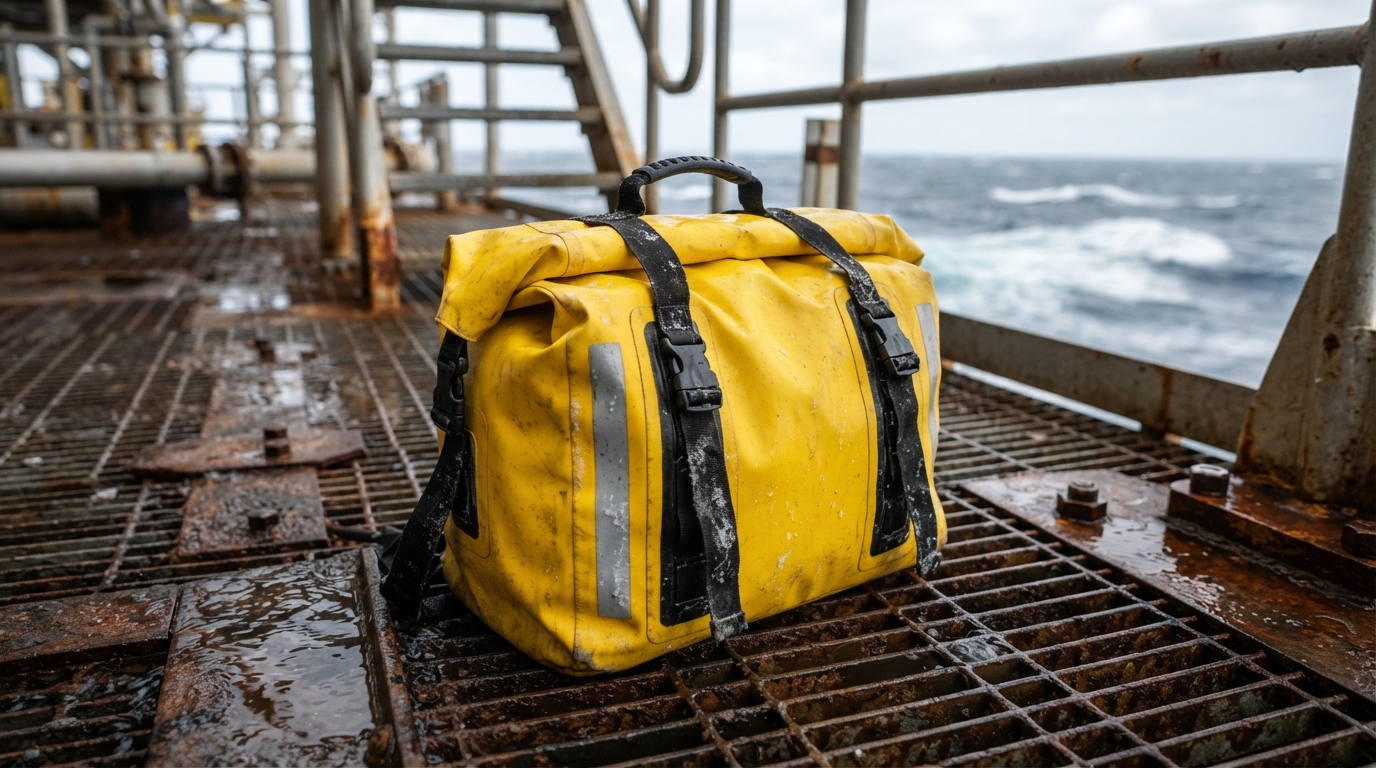
Pack every primary device inside a buoyant, high-visibility pack equipped with retroreflective tape.
If the bag sinks or traps itself inside a collapsing hardtop, your survival timeline drops from 72 hours down to your immediate personal flotation limits. Tether every critical radio, mirror, and tourniquet to the bag’s internal D-rings using 3-foot paracord lanyards. Loose gear floats away within seconds in a 4-foot sea chop while hands struggle with hypothermic shock.
Managing gear loads across harsh open-ocean trips demands strict prioritization, just like preparing a manifest for an Arapaima Expedition Packing Checklist (Printable Manifest) or planning deep-sea rigging using a Flying Gaff Tagline Sizing Chart (150-800lb Pelagics). You cannot pack for every theoretical scenario without sinking the ditch bag.
The Pelagic Extraction Matrix
Primary Active Distress
Direct electronic transmitters that alert international rescue command centers immediately.
Belongs here if: It transmits a 406 MHz satellite burst or sends automated AIS vessel coordinates.
Then: Mount externally on the ditch bag flap and test battery verification dates monthly.
Visual Line-of-Sight
Optical markers and localized pyrotechnics for approaching recovery aircraft.
Belongs here if: It requires eyes-on human observation within a 5-mile local horizon to function.
Then: Pack in a water-sealed internal sleeve; deploy only after hearing aircraft or seeing surface vessels.
Life Support Sustenance
Rationed hydration and basic physical exposure barriers for crew preservation.
Belongs here if: It prevents hypothermia, dehydration, or fatal bodily heat dissipation over 72 hours.
Then: Vacuum-seal into internal pockets, allocating fixed volumes based on maximum passenger count.
Trauma Intervention
Severe bleed control and wound stabilization gear for initial hull escape injuries.
Belongs here if: It controls arterial bleeding or treats crush trauma sustained during vessel abandonment.
Then: Position at the very top of the main compartment for single-handed deployment.
Balancing payload limits requires stripping out items that duplicate coastal conveniences. When optimizing pelagic gear spreads, whether fine-tuning offshore drift strategies or deploying high-tech equipment like The 2026 State of AI Sonar: Finding Pelagics Faster, redundant weight kills efficiency. Space inside the ditch kit belongs strictly to the tools that keep your team alive and locatable.
Review the complete equipment breakdown below to audit each medical and signaling item against your current vessel payload.
Key Takeaways
- Pack redundant signaling: a 406 MHz EPIRB, PLBs per crew member, and handheld VHF with GPS.
- Maintain 1 pint of emergency drinking water per person inside the ditch bag at all times.
- Store lithium batteries in waterproof dry-cases; inspect expiration dates every 6 months.
- Mount the grab bag near the companionway for deployment in under 30 seconds during an emergency.
Table of Contents
- Core Survival Gear Needed for 60-Mile Offshore Runs
- Selecting and Rigging the Ditch Bag Enclosure
- Satellite and Electronic Signaling Equipment Priorities
- Trauma Care, Hydration, and Hypothermia Prevention Essentials
- Manual Navigation, Signaling Mirrors, and Multi-Tool Redundancies
- Pre-Trip Inspection Protocols and Battery Replacement Schedules
- The Printable 60-Mile Pelagic Ditch Bag Packing Checklist
- Sources & Further Reading
Selecting and Rigging the Ditch Bag Enclosure
A canyon ditch bag must maintain positive buoyancy while carrying at least 25 pounds of dense emergency hardware, meaning the empty enclosure requires closed-cell foam cores that displace more water weight than the packed gear inside.
Positive buoyancy is the upward force exerted by a fluid that allows a submerged or partially submerged object to float on the surface.
BUOYANCY TARGET
|
v
Total Payload: 25.0 lbs
|
v
Minimum Reserve Buoyancy: +10.0 lbs
|
v
Required Displacement: 35.0 lbs
(0.55 cu. ft. minimum volume)
According to safety guidelines published by the BoatUS Foundation, abandoning ship often occurs in heavy sea states where survival bags face immediate submersion from boarding waves. A standard canvas or non-buoyant nylon bag filled with pyrotechnics, steel tools, and handheld electronics will sink within 90 seconds once water breaches the main zipper.
High-performance enclosures rely on high-visibility exterior fabrics like 500-denier polyurethane-coated ripstop nylon dyed in international safety orange or fluorescent chartreuse. The bag’s exterior must carry retroreflective panels certified under the International Maritime Organization’s Safety of Life at Sea (SOLAS) convention. Under searchlight sweeps, SOLAS-grade microprismatic tape reflects light back to the source at intensities exceeding 1,000 candela per lux, compared to standard reflective tape which drops below 100 candela when wet.
Exterior hydrodynamic drag dictates how a tethered enclosure behaves alongside a deployed life raft in a 35-knot gale. Smooth, cylindrical bag profiles with integrated grab loops generate less drag than square designs with flapping exterior pockets. When high winds push a life raft across open ocean swell, a high-drag ditch bag acts as a rogue drogue, ripping out attachment hardware or flipping into the raft’s boarding ladder.
Proper rigging eliminates line entanglement during a catastrophic hull breach. Tether the enclosure directly to the life raft’s primary interior equipment ring or a crew member’s personal harness using a 6-foot length of 8-millimeter hollow-braid floating polypropylene line. Floating line stays on the sea surface, which prevents it from wrapping around a crew member’s ankles during egress. Terminate both ends of the lanyard with 316-grade stainless steel snap hooks rated for at least 1,200 pounds of tensile load.
Line management inside the enclosure requires the same discipline found when rigging stand-up harnesses for 50+ lbs drag or preparing a poling skiff deck setup to stop tarpon line snags. Stow the lanyard in a quick-release daisy chain secured to the outer hull of the bag using a 2-inch hook-and-loop break-away strap. This construction keeps the line tidy until deliberate deployment, eliminating loose bights in the cockpit.
🧩 Puzzle: The Buoyant Anchor
A skipper packs an offshore ditch bag with 20 pounds of emergency gear. On the dock, the skipper places the packed bag into a test tank of salt water; the bag floats high with 5 inches of freeboard. Satisfied, the skipper loads the bag onto the boat. Twelve hours later, during a canyon run in identical water, the boat takes on water and the bag ends up in the sea. The bag instantly inverts and pulls a tethered survivor beneath the surface, functioning like an anchor. The bag took on zero water, the exterior seams did not fail, and no gear was added or removed. What inverted the bag’s behavior?
Reveal the answer
The skipper forgot to seal the airtight pressure-relief valve. Air remained trapped inside during the dock test at atmospheric pressure, but when the boat flooded, the bag fell from a flybridge rocket launcher 18 feet down into deep water before tethering tight. At depth, hydrostatic pressure compressed the interior air pockets down to a fraction of their surface volume. Without closed-cell foam to provide rigid displacement, the bag lost its positive buoyancy and became negatively buoyant relative to the hardware inside.
The transferable thinking move is testing under operating pressures rather than ambient conditions. Systems that hold buoyancy or integrity at the surface often fail completely once submerged under hydrostatic load.
Always specify closed-cell foam panels for primary buoyancy rather than relying on trapped air or airtight dry-suit zippers alone.
If you must attach the ditch bag directly to your person while boarding a life raft, run the lanyard to a dedicated quick-release chest ring on your personal flotation device rather than a leg loop or waist belt. The United States Coast Guard Rescue Swimmer Operations Manual dictates that release hardware under load must be operable with a single hand using gross motor skills. Standard spring snaps can jam under sustained line tension; use quick-release snap shackles equipped with a high-visibility pull-tab instead.
With the buoyant outer enclosure selected and tether rigging secured, verify every piece of signaling technology you drop into the primary waterproof pocket works before the vessel ever clears the inlet.
Satellite and Electronic Signaling Equipment Priorities
A 60-mile pelagic run demands two layers of satellite distress signaling: a vessel-registered Category 1 or Category 2 406 MHz Emergency Position Indicating Radio Beacon (EPIRB) paired with personal locator beacons (PLBs) for every crew member.
An Emergency Position Indicating Radio Beacon is a tracking transmitter that broadcasts a 406 MHz distress signal directly to international search and rescue satellites when triggered by water contact or manual activation.
According to data compiled by the National Oceanic and Atmospheric Administration (NOAA), the SARSAT satellite system contributed to 397 rescues in the United States territory during 2023 alone. Category 1 EPIRBs mount outside the cabin inside a bracket that automatically releases the beacon via a hydrostatic release unit when submerged between 4.9 and 13.1 feet of water.
Category 2 EPIRBs require manual deployment from their bracket, making them the standard internal ditch bag unit because they stay protected until you abandon ship. Modern ditch bag loadouts must also incorporate personal locator beacons featuring Return Link Service (RLS).
Return Link Service is an automated two-way satellite confirmation protocol that illuminates a blue LED on your beacon once ground stations receive and verify your distress alert. When you are sitting in a liferaft in 6-foot seas, that confirmation light eliminates guesswork and stops survivors from making panicky, incorrect signaling decisions.
Recommended gear
Garmin inReach® Mini 2, Satellite Communicator
A pocket-sized satellite communicator for two-way messaging and SOS from places with no mobile coverage at all.
Affiliate link
Your ditch bag also requires a dedicated floating VHF handheld radio equipped with Digital Selective Calling (DSC). Digital Selective Calling is a standardized maritime radio paging protocol that transmits an automated digital distress burst containing your exact GPS coordinates directly to all nearby vessels at the touch of a single red button.
A DSC handheld is useless if you fail to register and program its unique nine-digit Maritime Mobile Service Identity (MMSI) number through the Federal Communications Commission or an approved agency like BoatUS.
Pre-program your vessel MMSI into the handheld so offshore traffic recognizes your call sign, and practice strict battery discipline. A standard handheld lithium-ion battery provides roughly 8 to 12 hours of operational life under a standard 5-5-90 duty cycle (5% transmit, 5% receive, 90% standby). If you waste power broadcasting blindly on high-output 6-watt mode rather than reserving transmissions for vessels identified via your liferaft horizon line, the battery will die before rescue assets arrive.
For visual confirmation during the final nautical mile of an extraction, passive equipment fails. Pack multi-directional LED strobes with an output rating of at least 1 candela operating for 24 continuous hours, and an electronic laser flare compliant with US Coast Guard standard 46 CFR 161.013.
Electronic laser flares cast an expanding red or green line pattern visible up to 20 nautical miles at night without the 3-year expiration date, burn hazard, or toxic smoke of pyrotechnic flares. Keep a 20,000 mAh rugged power bank stored inside an IPX8-rated submersible dry case alongside specialized short-run charging cords to maintain juice across your handheld radio, searchlights, and backup phone.
Work the Failure Mode and Effects Analysis (FMEA) on your ditch bag electronics
Step 1: Identify critical single-point failure modes
List every electronic component in your ditch bag and write down the single physical event that prevents it from turning on or transmitting during a vessel evacuation.
Example: The DSC handheld VHF radio fails to transmit a distress message because the battery discharged during 4 months of storage.
Step 2: Assign failure severity, occurrence, and detection ratings
Score each component from 1 to 10 on how severe the loss is (S), how likely the breakdown is to occur (O), and how easily you detect it at the dock (D). Multiply these three numbers together to calculate your Risk Priority Number (RPN).
Example: VHF dead battery scores Severity 9, Occurrence 6, Detection 3, producing an RPN of 162 out of 1000.
Step 3: Establish redundant controls and preventive maintenance schedules
Set a mandatory maintenance action for any electronic component with an RPN over 100 to eliminate the failure point before leaving the inlet.
Example: Store the radio with an alkaline battery tray insert loaded with fresh lithium AA cells instead of relying on the rechargeable cradle pack.
FMEA WORKSHEET: ELECTRONICS
[DEVICE]       | [SEV] | [OCC] | [DET] | [RPN]
EPIRB Cat 2    | [   ] | [   ] | [   ] | [   ]
DSC VHF Radio  | [   ] | [   ] | [   ] | [   ]
PLB with RLS   | [   ] | [   ] | [   ] | [   ]
Power Bank     | [   ] | [   ] | [   ] | [   ]
ACTION PLAN: [Specific quarterly battery/seal inspection]
Just as you prepare specialized gear when rigging stand-up harnesses for 50+ lbs drag or reviewing the flying gaff tagline sizing chart (150-800lb pelagics), offshore electrical gear requires precise, calculated staging.
Reviewing your electronic beacons covers the long-range distress signal, but you must now address the physical trauma and exposure injuries that happen the second your crew steps off the deck and into the life raft.
Trauma Care, Hydration, and Hypothermia Prevention Essentials
Offshore canyon ditch bags require medical, hydration, and thermal gear calibrated for a minimum 72-hour survival window before extraction. Operations running 60 to 100 miles offshore place crews outside rapid helicopter hoist ranges, especially during marginal weather events. Managing this gap demands gear that stabilizes severe trauma and arrests environmental exposure inside a life raft.
Hydration: Hand Pumps Versus Static Rations
A human survivor requires a baseline of 500 milliliters of drinking water daily to sustain kidney function without physical exertion.
A reverse osmosis desalinator is a hand-operated mechanical pump that forces pressurized seawater through a semi-permeable membrane to remove dissolved salts and minerals.
Emergency rations packaged in vacuum-sealed foil pouches offer zero maintenance, but they introduce a severe weight penalty. Carrying 72 hours of water for four crew members requires 6 liters, which adds 13.2 pounds to your ditch bag. A manual unit like the Katadyn Survivor 35 weighs 7 pounds and produces 4.5 liters of potable water per hour of operation.
Pack three liters of factory-sealed drinking water alongside the pump. The sealed packets provide immediate hydration if physical trauma or exhaustion prevents a crew member from pumping during the first 12 hours. Pair that reserve with the mechanical desalinator to ensure indefinite fluid production if sea drift carries your raft outside the primary search zone. Pack an organized Everglades Solo Kayak Gear & Weight Audit (Checklist) style inventory system inside your dry bag so survival rations remain isolated from fishing tools.
Extreme Pelagic Trauma Management
Life raft trauma management focuses on two rapid killers: arterial hemorrhage and severe dehydration through seasickness.
Deep cuts from uncontrolled wiring maneuvers or dropped billfish tools turn fatal in minutes. If you already practice techniques from the Rigging Stand-Up Harnesses for 50+ lbs Drag (Checklist) or run heavy gear outlined in our Flying Gaff Tagline Sizing Chart (150-800lb Pelagics), you know heavy terminal tackle causes catastrophic limb injuries when lines break under tension.
Pack two windlass tourniquets approved by the Committee on Tactical Combat Casualty Care (CoTCCC), such as the Combat Application Tourniquet (C-A-T) Gen 7. Windlass devices apply mechanical circumferential pressure to stop bright red, spurting arterial blood flow. Complement the tourniquets with two packs of QuikClot Combat Gauze. This surgical gauze is impregnated with kaolin, an inorganic mineral that accelerates the body’s natural coagulation cascade within three minutes of wound contact. Add a four-inch Israeli emergency bandage to apply continuous direct pressure over the packing material.
Seasickness also represents a major operational emergency inside an enclosed life raft. Vomiting rapidly expels critical fluids and incapacitates survivors within six hours of boarding. The U.S. Coast Guard Navigation Center emergency procedures emphasize preserving physical hydration above all else during long-term drift. Include a 24-count blister pack of meclizine hydrochloride or transdermal scopolamine patches. Administer these antiemetic medications before symptoms manifest to prevent fluid collapse.
You decide: allocating ditch bag cubic volume
Imagine you lead an offshore tournament crew running an overnight trip 80 miles off Cape May. Space inside the 40-liter ditch bag is tight, and you must finalize the medical and hydration layout.
Decision point: Choose your primary gear configuration for medical and hydration space.
Option A — Prioritize high-volume mechanical desalinator equipment
You pack the manual desalinator pump, maintenance seals, and extra line to draw sea intake clear of the raft canopy. You cut the medical loadout to a standard first-aid kit with one basic pressure dressing.
Examine the operational trade-off
Your team gains infinite water production capabilities during extended drift, but lacks the necessary CoTCCC-rated hemostatic controls to stop high-pressure arterial bleeds caused by breaking terminal tackle during vessel abandon procedures. Prioritizing long-term sustenance exposes the crew to acute trauma risks.
Option B — Prioritize full tactical trauma inventory and static rations
You pack two C-A-T tourniquets, kaolin hemostatic gauze, chest seals, and two days of sealed water pouches, leaving the mechanical pump on the dock.
Examine the operational trade-off
Your team gains immediate control over lethal puncture wounds, billfish strikes, and deep lacerations, but caps total hydration capacity at roughly 48 hours for the entire crew. Prioritizing immediate trauma management forces reliance on rapid coast guard recovery.
Hypothermia Mitigation: Waterlogged Survival
Water conducts body heat away from skin 25 times faster than air at identical temperatures. Even across the Gulf Stream in summer, prolonged wet exposure inside a life raft canopy causes hypothermia once core temperatures drop below 95°F (35°C).
A thermal protective aid is an aluminized, waterproof full-body suit designed to reduce both conductive and evaporative heat loss from an injured or wet survivor.
Pack one vacuum-sealed SOLAS-approved (Safety of Life at Sea) thermal protective aid for every crew member aboard. Standard consumer space blankets shred instantly under 25-knot ocean winds and life raft friction. SOLAS-grade suits use a heavy composite film backing that encloses the limbs and torso while reflecting 90% of radiated body heat back to the core.
Keep these protective suits sealed inside heavy 6-mil poly bags alongside two chemical heat packs. Apply the heat packs directly to the armpits and groin before securing the suit closures around a shivering survivor.
Now verify your signaling array, electronic beacons, and emergency comms checklist below to guarantee search aircraft spot you immediately.
Manual Navigation, Signaling Mirrors, and Multi-Tool Redundancies
Manual navigation tools and non-electronic signaling gear are your absolute fail-safe when catastrophic 12-volt electrical fires or hull breaches disable primary electronics 60 miles offshore. Modern multi-function displays fail fast when submerged, meaning your survival depends entirely on analog visibility arrays and puncture-safe cutting tools.
A retroreflective sighting mirror is an emergency signaling device with a specialized mesh center-hole that projects a concentrated beam of reflected sunlight directly onto an aircraft’s cockpit or a vessel’s bridge. According to the United States Coast Guard Search and Rescue manual, a 3-by-5-inch glass signaling mirror produces an 8-million-candlepower flash visible up to 40 miles away.
Pair the mirror with a pealess marine whistle capable of producing 115 decibels across high wind and heavy surf. Add a fluorescent sea dye marker packet to this daytime kit. When ruptured, the water-soluble uranine dye creates a bright yellow-green slick visible to search-and-rescue planes for up to 60 minutes across a 1-mile drift.
Rigging inside an inflatable life raft requires strict discipline to prevent accidental equipment punctures. Blunt-tip dive shears and locking marlinspike knives are essential safety cutters designed with rounded edges to slice heavy rigging line without puncturing inflatable air chambers.
Secure every cutting tool to the bag’s structural webbing via a 36-inch coiled paracord lanyard. A loose blade dropped during raft boarding will slice hypalon fabric under rough ocean swell. While you might rely on heavy hardware for a Great White Shark Release Protocol (Checklist), ditch bag knives must prioritize zero-point inflation defense.
For communication and organization after dark, pack a 6-by-8-inch waterproof dive slate with an attached graphite pencil. Record coordinates, drift times, and crew medical statuses immediately before your handheld GPS batteries fail.
Add high-intensity, 12-hour yellow emergency chem-lights and an IPX8-rated waterproof red-light headlamp. The red-light beam preserves the crew’s night-adjusted vision while keeping your hands completely free to bail water, dress injuries, or steady the sea anchor. Just as you dial in gear via the Offshore Kite Selection Matrix: 4-35 Knots (Chart), manual offshore survival tools require precise deployment protocols.
📋 Pocket Cheat Sheet: Analog Ditch Bag Array
Use this equipment order immediately after boarding an offshore life raft.
1. TETHER (0-2 MIN)
   Clip all loose tools to internal raft D-rings.
   Lock blunt-tip dive shears to the primary lanyard.

2. DOCUMENT (2-5 MIN)
   Log ditch coordinates on the dive slate.
   Record drift direction and boarding timestamps.

3. DAY SIGNAL (SUNLIGHT)
   Aim retroreflective mirror through the sighting hole.
   Deploy uranine dye slick only when aircraft are heard.

4. NIGHT SIGNAL (DARKNESS)
   Activate red-light headlamp for raft deck tasks.
   Crack 12-hour yellow chem-light on a 6-foot tether.
Copy this into your notes app.
Analog tools secure the perimeter of your survival craft, but your immediate next task is organizing the medical redundancies and trauma gear packed directly beneath this kit.
Pre-Trip Inspection Protocols and Battery Replacement Schedules
An offshore ditch bag inspection requires a rigid 6-month cadence to ensure every critical survival item operates at full capacity when an abandoned vessel leaves you 60 miles out. A ditch bag is a dedicated, buoyant emergency pack containing essential signaling and survival equipment meant to be grabbed instantly during an offshore vessel abandonment.
Field failures happen because gear sits unmonitored in damp marine environments. The United States Coast Guard (USCG) search and rescue statistics show that equipment expiration and unmaintained lithium batteries remain top drivers of signaling failures during marine emergencies. Mark the calendar on April 1 and October 1 to audit all expirable assets.
Check every lithium cell powering your emergency lights, GPS, and secondary radios. Lithium iron disulfide (\(Li-FeS_2\)) cells have a shelf life of up to 20 years, but harsh temperature swings inside a marine console cut that window down fast. Replace standard field cells every 24 to 36 months regardless of display meters.
Inspect the hydrostatic release units (HRUs) on any auto-deploying hardware. A hydrostatic release unit is a water-pressure-activated mechanism designed to sever a vessel connection and release equipment automatically if a boat sinks to a depth of 1.5 to 4 meters. Hammar H20 HRUs carry a strict 2-year service life from installation; discard and replace them the month they expire.
Check your visual distress signals under strong light. Pyrotechnic flares carry an expiration date mandated by the USCG at 42 months from manufacture. If the red wax seals on handheld flares show cracks, replace them immediately because moisture ingress will cause misfires.
Electronic beacons require regular auditing, but an accidental live ping wastes Search and Rescue (SAR) resources and risks heavy civil fines.
EPIRB Test Flow:
[Slide Main Switch to TEST]
        |
        v
[Hold for 1 to 2 Seconds]
        |
        v
[Watch Single Strobe Flash]
        |
        v
[Check Status Light: GREEN]
        |
        v
[Release Switch Promptly]
According to Cospas-Sarsat, the international satellite-aided search and rescue initiative, the self-test function transmits an inverted, non-distress digital frame directly to ground stations. This burst verifies internal radio frequency output, battery voltage, and synthesizer lock in less than 1 second. Never leave the test switch engaged longer than manufacturer documentation states, because prolonged engagement triggers a live 406 MHz emergency beacon burst.
Run this test monthly, not weekly. Running the self-test drains roughly 15 minutes of operational emergency transmission life each time. Combine this electronics check with satellite messengers, confirming your satellite-communicator subscription is active and pinging before leaving the inlet.
Salt crust is the fastest destroyer of watertight ditch gear. Protect sub-components by heat-sealing them inside 5-mil double-gasket vacuum bags. This creates an airtight barrier that stops condensation when daytime canyon heat drops into cold nighttime spray.
Maintain the bag’s exterior pressure closure. Treat heavy-duty polyurethane or PVC airtight zippers every quarter with silicone grease or manufacturer-specified paraffin wax like McNett Zip Care. Wipe the teeth clean with a nylon brush, remove dried salt build-up, run the slider back and forth 3 times, and store the main compartment fully closed. Similar protocols appear when preparing high-exposure gear like an Arapaima Expedition Packing Checklist (Printable Manifest) for remote river work.
🃏 Draw a card: ditch bag failure-proofing exercises
Pick a number before you peek — no rerolls.
Card 1
The Blindfold Pull: Place your packed ditch bag on the deck. Put on a blindfold, start a 10-second timer, and extract your backup handheld VHF radio without looking. If you grab the wrong item, reorganise the internal pocket layout today.
Card 2
The Submersion Weigh-In: Weigh your fully packed ditch bag on a fish scale. Submerge it in a freshwater wash tub for 15 minutes, pull it out, let it drip for 30 seconds, and weigh it again. Any gain over 0.5 lbs means water passed through the main zipper seal.
Card 3
The Cold-Hand Test: Place your hands in ice water for 2 minutes, then attempt to open your vacuum-packed medical shears and turn on your signaling mirror. Modify your packaging tear tabs if numbness defeats your grip.
Card 4
The Redundant Power Audit: Empty all electronics onto a table. Match every single device to an exact backup battery source physically sitting beside it. Discard any electronic tool that relies on an unshared proprietary charging cable without an onboard adapter.
Card 5
The Aviation Approach: How would an offshore helicopter pilot inspect this gear? Create a laminated physical checklist card that lives inside the bag flap, requiring grease-pencil initialing for every item prior to clearing the sea buoy.
Card 6
The Zero-Notice Hand-Off: Hand your closed ditch bag to your least-experienced crew member. Ask them to deploy the PLB and sound the signal horn within 20 seconds. If they hesitate or ask questions, re-label the deployment tabs with high-contrast marine paint.
Once every seal, battery, and canister passes inspection, you need to turn your attention to the structural layout of the pack itself. Next, examine how the gear must sit inside the pack to keep the critical items instantly reachable in turbulent seas.
The Printable 60-Mile Pelagic Ditch Bag Packing Checklist
A 60-mile pelagic ditch bag must sustain four anglers for 24 hours while actively broadcasting your position to search-and-rescue assets. A ditch bag is an externally mounted, buoyant survival kit designed for immediate grab-and-go deployment during a catastrophic hull breach or vessel fire. If your vessel slips beneath the surface in the Washington Canyon, you will have less than 90 seconds to secure this single piece of gear.
Pelagic Ditch Bag Gear Matrix
Pack your primary survival kit inside a dedicated 40-liter buoyant container rated to maintain positive buoyancy when loaded to its 28-pound capacity.
| Item Category | Item Specification | Minimum Qty | Waterproof Rating | Stowage Slot |
|---|---|---|---|---|
| Alerting | Category 1 406 MHz EPIRB with internal GPS | 1 unit | IPX8 (Submersible) | External Quick-Release |
| Alerting | Two-way satellite communicator with SOS lock | 1 unit | IPX7 (1m for 30m) | Top Lid Pocket |
| Voice | Floating Handheld VHF Radio (6W, DSC-enabled) | 1 unit | JIS8 / IPX8 | Interior Sleeve A |
| Visual Signals | USCG-Approved Day/Night LED Visual Distress Signal | 1 unit | IP67 | Interior Sleeve B |
| Visual Signals | Solas-grade signal mirror with retroreflective viewer | 2 units | Buoyant / Impervious | Interior Sleeve B |
| Visual Signals | Pealess marine safety whistle (115+ decibels) | 4 units | Marine polymer | Webbing Anchor Loops |
| Medical | Bleeding control kit with two windlass tourniquets | 1 kit | Hermetically sealed | Center Main Cavity |
| Hydration | DFL-approved emergency drinking water rations (4.2 oz pouches) | 12 pouches | Foil laminate pouch | Bottom Base Layer |
| Navigation | Prismatic sighting compass with lanyard | 1 unit | Liquid-filled IPX8 | Interior Zip Mesh |
| Tools | Fixed-blade blunt-tip dive knife with sheath | 1 unit | 316 Stainless / Salt-safe | Shoulder Strap Molle |
When rigging your vessel for long-distance runs, your emergency gear layout demands the same structural discipline required when Rigging Stand-Up Harnesses for 50+ lbs Drag (Checklist). A loose item inside a life raft is an item that gets lost in six-foot seas. Fasten all primary signaling units to internal lanyards using 3mm nylon accessory cord.
Pre-Inlet Safety Sign-Off Sheet
Complete this physical sign-off before crossing the harbor demarcation line. The vessel master and safety officer must confirm each line item.
PRE-INLET DITCH BAG AUDIT
========================================
[ ] BATTERY HEALTH CHECK
    - EPIRB self-test: GREEN STROBE
    - Handheld VHF: 100% BATTERY / SPARE TRAY LOADED
    - Satellite Messenger: ACTIVE SUBSCRIPTION / TEST SENT
[ ] SEAL INTEGRITY
    - Bag pressure valve operational
    - Waterproof zipper lubricated with silicone
    - Hydrostatic release date verified
[ ] CREW MANIFEST MATCH
    - 1 whistle per crew member
    - 1 personal locator light per crew member
    - Thermal blankets equal to onboard headcount
[ ] ACCESSIBILITY CHECK
    - Companionway mount cleared of all tackle
    - Quick-release buckle functional
    - Hydrostatic release free of zip ties
========================================
SIGN-OFF: Master: ____________ Mate: ____________
DATE/TIME: ____________ LOC: __________________
Never leave the dock without checking battery dates. Data compiled in the United States Coast Guard Boating Safety Division annual statistics demonstrates that signal failure during offshore abandon-ship events correlates directly with deferred pre-departure battery checks. The lithium cells in your emergency radio drop charge capacity quickly when subjected to seasonal cabin heat cycles.
Vessel Emergency Role Assignment Card
Standardize actions before an engine room high-water alarm sounds. Laminate this card and mount it directly beside the bridge companionway door.
       VESSEL ABANDON-SHIP ROLES

          [ HIGH-WATER ALARM ]
                   │
                   ▼
       ┌───────────────────────┐
       │     PORT ENGINE MATE  │
       │  Primary Grab Duties  │
       └───────────┬───────────┘
                   │ Secure ditch bag
                   │ Confirm raft tether
                   ▼
       ┌───────────────────────┐
       │   STARBOARD ANGLER    │
       │     Hatch Clearing    │
       └───────────┬───────────┘
                   │ Clear deck paths
                   │ Deploy life raft
                   ▼
       ┌───────────────────────┐
       │    CAPTAIN / HELM     │
       │      EPIRB Arming     │
       └───────────────────────┘
         Broadcast MAYDAY (16)
         Arm EPIRB switch
         Kill house power
The Port Engine Mate grabs the ditch bag and confirms its tether connects to the primary life raft painter line. The Starboard Angler moves down the gunwale, kicks clear any trolling buckets or harness systems, and pulls the manual life raft release head. The Captain stays on the helm, broadcasts a Mayday on VHF Channel 16 with coordinates pulled from The 2026 State of AI Sonar: Finding Pelagics Faster multifunction display, manually switches the EPIRB to active broadcast, and cuts 12-volt battery switches before stepping down.
😈 Devil’s Advocate
The strongest objection: Packing a 40-liter dedicated ditch bag is redundant when modern commercial sportfishing yachts already carry float-free Category 1 EPIRBs, integrated SOLAS-A life raft packs, and bridge-mounted auto-telematic distress beacons.
Where it’s right: In clean capsize scenarios where an inspected vessel rolls and sinks intact, hydrostatic releases fire reliably at depths between 4 and 15 feet, freeing the life raft and EPIRB automatically without crew intervention.
The honest answer: Hull punctures and engine-room electrical fires rarely create clean capsize conditions. Fire often traps bridge safety gear, and a sinking hull’s superstructure can foul a deployed life raft canister before it surfaces. A manual ditch bag gives you positive physical possession of your life support tools before you abandon the deck.
Before you untie the dock lines for this weekend’s canyon troll, walk down to the boat today, pull your handheld VHF off the charger, run an actual battery load test, and replace every expired battery in your ditch bag distress beacons.
Sources & Further Reading
Every survival item packed into an offshore ditch bag relies on verified search-and-rescue data, maritime law, and physical operational limits established over decades of open-ocean incidents. When you fish 60 to 100 miles offshore in the continental shelf canyons, emergency response windows change from minutes to hours. The United States Coast Guard recorded 4,040 recreational boating accidents involving 564 fatalities in its 2023 Recreational Boating Statistics report, noting that drowning caused 75% of fatal outcomes.
An Emergency Position Indicating Radio Beacon (EPIRB) is an internationally standardized, battery-powered radio transmitter designed to broadcast distress alerts through orbital satellite networks directly to global search and rescue authorities during maritime catastrophes. The international Cospas-Sarsat system monitors these broadcasts across the 406 MHz frequency band. According to Cospas-Sarsat system operational documentation, a modern beacon equipped with Global Navigation Satellite System (GNSS) capability shrinks your distress location radius down to roughly 100 meters within 5 minutes of activation. Older 121.5 MHz homing signals alone required an initial search area of up to 12 nautical miles until low-Earth orbit satellites achieved visual Doppler fixes.
The operational baseline for surviving cold offshore currents rests on clinical hypothermia research. The Defense and Civil Institute of Environmental Medicine (DCIEM) established standard cold-water survival models that reveal human survival times drop below 2 hours in water temperatures between 40°F and 50°F without passive insulation. Packing a dedicated thermal protective aid or waterproof survival shelter counters these convective losses while adrift in a life raft.
- United States Coast Guard, Recreational Boating Statistics, 2023 — Provides baseline recreational maritime incident numbers, primary causes of ocean fatalities, and survival gear deployment rates.
- Cospas-Sarsat Secretariat, C/S T.001 Specification for Cospas-Sarsat 406 MHz Distress Beacons, 2021 — Defines technical transmission standards, satellite routing protocols, and accuracy tolerances for marine distress signaling.
- Michael Tipton and Frank Golden, Essentials of Sea Survival, 2002 — Documents the human physiological response to cold-water immersion, including cold shock, swim failure, and convective body cooling.
- Safety of Life at Sea (SOLAS), Chapter III: Life-Saving Appliances and Arrangements, International Maritime Organization, 1974 (as amended) — Sets rigorous construction, shelf-life, and photometric output standards for marine safety flares and visual distress signals.
- National Search and Rescue Committee, United States National Search and Rescue Supplement, 2018 — Outlines real-world aerial search patterns, drift modeling mechanics, and response asset timelines for pelagic vessel emergencies.
