Offshore Life Raft Sizing Matrix (Selection Worksheet)
As an Amazon Associate I earn from qualifying purchases. Product links on this page are affiliate links — they cost you nothing extra.
⏱ 23 min read
The Offshore Life Raft Sizing Formula and Capacity Rules
For pelagic operations beyond 50 nautical miles, offshore life raft sizing requires a minimum capacity of your maximum crew plus two persons, outfitted with an ISO 9650-1 Pack A emergency equipment pack. Sizing strictly by passenger headcount creates a structural failure point because statutory standards allocate only 4 square feet of floor space per person, an allowance that prevents prone casualty positioning, degrades thermal retention, and limits water ballast volume during extended Search and Rescue (SAR) delays. Moving to an "N+2" capacity rating provides the floor area necessary to stabilize hypothermic crew and deploy vital survival gear during operations where SAR response windows routinely exceed 24 hours.
An ISO 9650-1 Pack A is an internationally certified equipment cache packed inside an offshore life raft, containing rations, thermal protection, signaling gear, and 1.5 liters of drinking water per occupant to sustain life for more than 24 hours.
The Mathematical Failure of Statutory Floor Plans
Title 46 of the Code of Federal Regulations and ISO 9650-1 set standard raft capacity by granting each occupant 0.372 square meters—exactly 4 square feet—of floor space, assuming an average passenger mass of 165 pounds (75 kg). Data from the Centers for Disease Control and Prevention (CDC) National Health Statistics Reports shows that the average adult American male weighs 199.8 pounds (90.6 kg). When bundled into offshore storm bibs, sea boots, and inflated 35-pound-buoyancy life vests, an angler’s seated footprint expands to 6.2 square feet.
A manufacturer-rated 6-person raft provides approximately 24 square feet of usable floor area. If six geared adults enter that raft, they must sit interlocked with knees drawn to their chests. If one angler suffers trauma or incapacitating hypothermia, laying that person flat requires a minimum footprint of 11 square feet. That single medical necessity consumes 45% of the total floor, forcing the remaining five crew members to stack against the perimeter buoyancy tubes, which accelerates fatigue and compromises the raft’s structural trim.
STATUTORY 6-MAN RAFT (24 SQ FT)
+-----------------------------+
| [SEAT] [SEAT] [SEAT]        |
|                             | -> 4.0 sq ft/person
| [SEAT] [SEAT] [SEAT]        |    Zero prone space
+-----------------------------+

REAL-WORLD N+2 RAFT (8-MAN / 32 SQ FT)
+-----------------------------+
| [SEAT]  [PRONE CASUALTY]    |
| [SEAT]  [  11 SQ FT    ]    | -> 5.2 sq ft/seated
| [SEAT]  [SEAT]  [SEAT]      |    Stable trim
+-----------------------------+
Canyon Anglers vs. Commercial and Coastal Crews
Pelagic anglers pushing past the continental shelf operate in a distinct survival envelope compared to coastal cruisers or commercial shipping. Coastal vessels operate within range of VHF shore towers and fast-response assets like the 45-foot Response Boat-Medium from the U.S. Coast Guard Office of Search and Rescue, which maintain response targets under 2 hours. Commercial ships operate under SOLAS mandates requiring rigid hydrostatic systems, dedicated radio watches, and dual deep-sea survival craft.
Sportfishing vessels working the 100-fathom curve run outside VHF line-of-sight and beyond the rapid transit envelope of surface rescue craft. According to operational metrics published in the USCG Addendum to the United States National Search and Rescue Supplement, offshore helicopter deployment times for rotary assets like the Sikorsky MH-60T Jayhawk can exceed 3 to 5 hours just for transit and staging. When you push long distances based on your 100-Mile Canyon Fuel Burn Plan (With Worksheet), severe weather or multi-vessel emergencies can push actual on-scene extraction times to 18 to 36 hours.
Under an extended wait time, thermal degradation is your primary threat. ISO 9650-1 Class A rafts integrate an insulated double floor to limit conductive heat loss into cold ocean water, whereas coastal rafts use an uninsulated single layer of fabric. The extra perimeter space in an N+2 configuration allows crew members to rotate positions, empty bilge accumulation, and retain body warmth without pressing against damp outer fabric boundaries.
Under-ballasted rafts present a severe inversion hazard in breaking seas. Rafts rely on flexible underside fabric bags that fill with seawater to resist wave action and wind shear. An 8-person ISO raft holds approximately 400 liters (880 pounds) of water ballast across four to six weighted pockets, providing 33% more hydrodynamic resistance against flipping than a standard 6-person model.
Which Raft Sizing Path Fits Your Pelagic Profile?
If you run 15 to 40 nautical miles offshore on single-day trips with 4 crew members…
Select a 4-person or 6-person ISO 9650-2 (or ISO 9650-1 Pack B) life raft. Rescue times inside 40 miles generally fall within a 6-to-12-hour SAR response window, making standard ballast and emergency food reserves sufficient. Focus weight savings on a rapid-deploy valise pack mounted within arm’s reach of the helm.
If you run 50 to 100+ nautical miles for overnight canyon chunking with 4 to 5 crew members…
Purchase a 6-person or 8-person ISO 9650-1 Pack A canister-mounted raft using the crew-plus-two rule. You need the insulated floor, 1.5 liters of water per occupant, and deep ballast pockets to withstand breaking shelf seas during an extended 24-to-48-hour SAR deployment window. If your team targets pelagics using heavy electronics as outlined in our Electric Reel Amp Draw: 12V vs 24V Sizing (With Charts) guide, ensure your ditch kit carries dedicated, independent power banks that do not rely on shipboard charging.
If you run competitive offshore tournaments with 6 to 8 crew members on big sportfishers…
Step up to an 8-to-10-person ISO 9650-1 Pack A or a SOLAS-A commercial canister raft mounted on a hydrostatic cradle. Full crews in heavy gear instantly overload smaller rafts, leaving zero clearance to treat injuries sustained during an abandoning-ship emergency. Ensure your hydrostatic release is clear of bridge overhangs and outrigger halyards.
The physical displacement of the raft is only half of the offshore safety equation. Examining how canopy height, ballast geometry, and freeboard depth interact with breaking ocean swells reveals the exact deck-mounting footprint your vessel requires.
Key Takeaways
- Standard raft ratings allocate 4 square feet per person, preventing prone rest or medical care.
- ISO 9650-1 Pack B contains zero water rations, making it unsafe for holds exceeding 24 hours.
- SAR response times beyond 50 nautical miles offshore routinely average between 24 and 72 hours.
- Sizing up by 2 crew positions provides necessary floor space without sacrificing raft ballast stability.
Table of Contents
- The Offshore Life Raft Sizing Formula and Capacity Rules
- Floor Area and Ballast Dynamics During Extended Hold Times
- Emergency Equipment Packs: ISO Pack A Versus Pack B
- Calculating Realistic Search and Rescue Delay Windows Offshore
- The Pelagic Life Raft Sizing Matrix and Selection Worksheet
- Sources & Further Reading
Floor Area and Ballast Dynamics During Extended Hold Times
Floor area allocations in life rafts rated under ISO 9650-1 provide a usable deck space of merely 0.372 square meters (4.0 square feet) per survivor, forcing an interlocking fetal seating pattern that degrades physical endurance after 24 hours. The International Maritime Organization (IMO) Life-Saving Appliances (LSA) Code allows marginally more space for commercial vessels at 0.4 square meters per person, but neither standard accounts for ocean gear, cold-water survival suits, or body movement during extended pelagic drift.
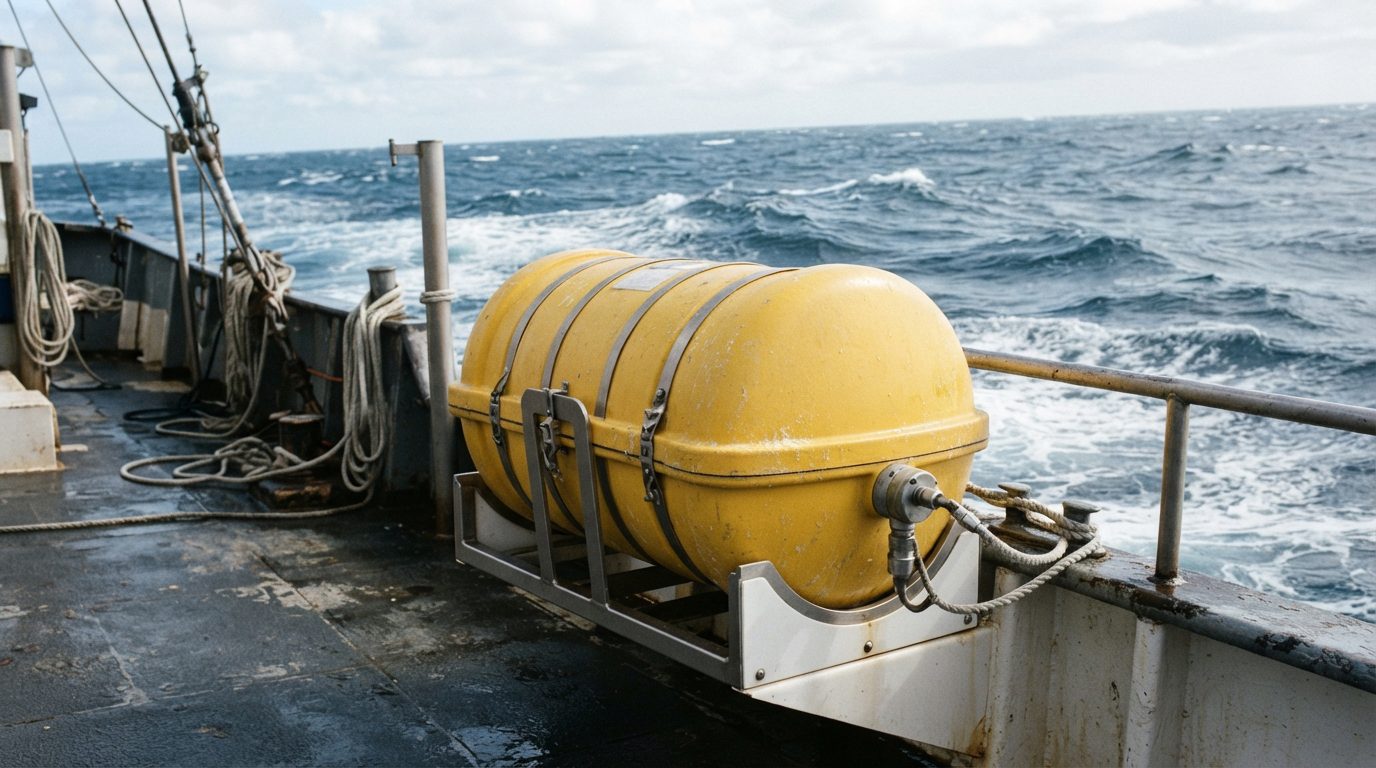
Toroidal ballast systems are continuous, ring-shaped fabric chambers attached directly beneath a raft’s bottom perimeter that flood with seawater to counter overturning forces from breaking waves.
Inside a minimum-rated floor pan, survivors cannot sit side-by-side with legs extended. Occupants must sit in alternating pairs, interlocking their shins and knees in an accordion pattern. In an 8-person offshore raft measuring roughly 2.2 meters in floor diameter, individual shoulder widths immediately overlap.
Every collective shift in position requires coordinated physical adjustment from the entire crew.
TOP-DOWN FLOOR PAN CONGESTION
[Canopy Arch Tube]
-----------------------
Surv. 1 (Knees Bent)
  [Interlocked Leg Zone]
Surv. 2 (Fetal Lateral)
  [Equipment Bag / EPIRB]
Surv. 3 (Knees Bent)
-----------------------
Available Width: ~2.2m
Individual Deck: 0.372 m²
Habitability deteriorates rapidly once environmental conditions degrade the sealed microclimate. A report by the Royal National Lifeboat Institution (RNLI) on offshore survival found that motion sickness strikes over 80% of raft occupants within the first 60 minutes of heavy sea state exposure.
Vomitus pools across the floor pan, accelerating the risk of immersion foot and hypothermia as sea temperatures drop.
Dehydration compounds muscular cramping within this tight geometry, while sealed canopies build dangerous air conditions. Research published by the US Coast Guard Research and Development Center indicates that carbon dioxide concentrations inside a closed life raft can surpass 1.5% within two hours if ventilation sleeves remain tied off against driving spray.
Elevated carbon dioxide triggers rapid breathing and anxiety, doubling oxygen demand and elevating interior humidity to 100%.
Water ballast systems control the physics that prevent a lightweight canopy from capsizing in 30-to-50 knot winds. ISO 9650-1 mandates that rafts under 6-person capacity carry at least 220 liters (approximately 485 pounds) of water ballast across four independent pockets, while larger offshore variants carry between 400 and 600 liters.
Toroidal ballast bags use bottom-mounted intake valves that deploy automatically upon inflation, pinning the hull to the water surface via hydrodynamic suction and ballast mass.
CROSS-SECTION: BALLAST MECHANICS
    /\  [Canopy Wind Load]
   /  \ ===> 40 Knots
  (====) Primary Chamber
 |------| Floor Pan
===~~~~~~=== Sea Surface
  [====] Toroidal Ballast
  (500L Seawater Mass)
       |
       v Downward Suction
Oversizing a life raft introduces an overlooked hazard: catastrophic dynamic capsize. Anglers outfitting a vessel for long runs—such as crews executing a 100-Mile Canyon Fuel Burn Plan (With Worksheet)—frequently assume an 8-man or 10-man raft offers better safety for a 4-person crew.
This assumption violates maritime naval architecture principles. An under-loaded life raft lacks the crew mass required to press the floor pan into the sea, allowing windward gusts to break under the hull profile.
When a 40-knot breaking wave lifts the windward tube of an 8-person raft occupied by only two crew members weighing 180 pounds each, the sail area of the canopy overwhelms the ballast pockets before they can develop sufficient righting moment.
Survival equipment must match your vessel’s actual crew manifests, right down to provisions like a reliable to address hydration without consuming deck space with heavy water tins.
Quick Quiz: Test Your Life Raft Physics Knowledge
1. Under ISO 9650-1 standards, what is the minimum floor deck area allocated per survivor?
A) 0.186 square meters (2.0 square feet)
B) 0.372 square meters (4.0 square feet)
C) 0.744 square meters (8.0 square feet)
Reveal answer
B) 0.372 square meters (4.0 square feet). This minimal footprint requires survivors to maintain an interlocking leg layout, making real-world hold times beyond 24 hours physically agonizing.
2. Why is deploying a 10-person offshore raft with only 2 crew members considered dangerous in heavy seas?
A) The canopy will collapse inward from insufficient interior air pressure.
B) Insufficient live ballast weight allows windward gusts to get under the hull and invert the raft.
C) The water ballast bags will fail to deploy without manual activation from four crew members.
Reveal answer
B) Insufficient live ballast weight allows windward gusts to get under the hull and invert the raft. Life rafts depend on human ballast placed along the tubes to complement ballast bags and prevent dynamic overturning moments.
3. According to survival habitability testing, what environmental hazard forms rapidly inside a fully buttoned-down canopy?
A) Hypoxia from nitrogen displacement
B) Extreme carbon dioxide concentration exceeding 1.5%
C) Total vacuum pressure caused by passing wave troughs
Reveal answer
B) Extreme carbon dioxide concentration exceeding 1.5%. Rapid CO2 buildup causes hyperventilation and disorientation unless cross-ventilation flaps are periodically cleared.
Knowing how deck floor constraints and ballast mass behave in real seas dictates how you calculate your crew matrix on the selection worksheet next.
Emergency Equipment Packs: ISO Pack A Versus Pack B
Choosing an ISO Pack A configuration over an ISO Pack B or standard coastal pack provides the 1.5-liter-per-person freshwater floor and long-range signaling pyrotechnics required to survive search-and-rescue response windows extending beyond 24 hours.
An emergency equipment pack is a sealed kit of survival rations, water, signaling devices, and medical supplies pre-staged inside or alongside an inflatable life raft to sustain occupants until rescue. While recreational vessel regulations in domestic waters may permit bare-bones safety gear, the International Organization for Standardization establishes rigorous criteria under standard ISO 9650-1 for rafts deployed in open-ocean passages.
The gear delta between these specifications determines whether a crew can survive hypothermia, shock, and dehydration during an extended hold time.
| Equipment Component | Coastal Pack | ISO 9650-1 Pack B (<24 Hours) | ISO 9650-1 Pack A (>24 Hours) | |||||||||||||||||||||||||||||||||||||||||||||||||||||||||||||||||||||||||||||||||||||||
|---|---|---|---|---|---|---|---|---|---|---|---|---|---|---|---|---|---|---|---|---|---|---|---|---|---|---|---|---|---|---|---|---|---|---|---|---|---|---|---|---|---|---|---|---|---|---|---|---|---|---|---|---|---|---|---|---|---|---|---|---|---|---|---|---|---|---|---|---|---|---|---|---|---|---|---|---|---|---|---|---|---|---|---|---|---|---|---|---|---|---|
| Freshwater per Person | 0 Liters | 0 Liters (Assumes external grab bag) | Food Rations | 0 kcal | 0 kcal | Red Parachute Rockets | 0 to 2 | 2 units (SOLAS compliant) | Red Hand Flares | 2 to 3 | 3 units | Buoyant Smoke Signals | 1 unit | 1 unit | Thermal Protective Aids | None | None | First Aid Kit | Basic splash-proof kit | ISO/SOLAS compliant compact kit | Radar Reflector | None | Optional / Compact passive | The Critical Freshwater Cutoff
The absolute dividing line between coastal gear and true pelagic survival equipment is potable water. Pack B assumes search-and-rescue (SAR) assets will locate and extract survivors within 24 hours, so it omits all integrated drinking water. Data from the United States Coast Guard Addendum to the United States National Search and Rescue Supplement confirms that offshore vessel searches past 50 nautical miles regularly experience tracking and dispatch delays exceeding 30 hours due to sea state, airframe staging, and nighttime visual degradation. For anglers running a 100-Mile Canyon Fuel Burn Plan (With Worksheet), banking on a sub-24-hour hoist is a lethal miscalculation. The U.S. Naval Flight Surgeon’s Manual establishes that an adrift human requires a minimum basal intake of 500 milliliters of water per 24-hour cycle to stave off irreversible renal damage, especially after the accelerated fluid loss caused by acute seasickness in heavy chop. The 1.5 liters per person mandated in ISO Pack A guarantees a 72-hour survival baseline at strict ration levels (500 milliliters per person per day). If your life raft deployment occurs during offshore trips where you spend entire days over deep drops targeting pelagics with setups from our Daytime Swordfish Lead Sizing: 8lb to 18lb (Chart), pack volume must account for this non-negotiable ballast. When extending pelagic hold times past 72 hours, supplemental water production becomes mandatory. Offshore crews running beyond immediate helicopter coverage frequently pack an emergency hand-operated desalinator inside their secondary ditch kit to convert seawater continuously without battery power. ⚠️ Anti-Pattern: The 24-Hour Speculation TrapWhat it looks like: Outfitting an offshore center console with an ISO Pack B life raft based on the assumption that an EPIRB distress signal ensures a retrieval crew within 12 hours. Why it’s tempting: Pack B rafts cut overall package weight by 20 to 35 pounds and reduce the canister footprint, simplifying bow or hardtop installation while reducing initial purchase price. What it costs: SAR deployment delays in deteriorating offshore conditions routinely cross the 24-hour mark, leaving hypothermic, seasick crew members adrift with zero potable water and half the pyrotechnic signaling inventory needed to vector in spotter aircraft. Do instead: Specify an ISO Pack A raft canister for all blue-water transits, or hard-mount a dedicated, buoyant grab bag carrying the 1.5-liter-per-person water deficit directly adjacent to the raft cradle. Packaging Architecture: Rigid Canister Versus ValisePacking ISO Pack A gear introduces physical volume constraints that force a technical trade-off between rigid fiberglass canisters and flexible soft valises. A typical 6-person ISO Pack A configuration weighs between 110 and 150 pounds, with the freshwater supply alone accounting for roughly 20 pounds of deadweight. A rigid canister mounted externally on a stainless-steel deck cradle provides critical protection against UV degradation, mechanical impact from green water over the bow, and continuous salt-spray exposure. Canisters also accommodate hydrostatic release units (HRUs) manufactured by companies like Hammar, enabling the raft to deploy automatically if the vessel sinks suddenly to a depth of 1.5 to 4.0 meters. A valise bag reduces total packed dimensions by roughly 10% to 15% and eliminates cradle installation requirements, but it carries strict operational penalties. Soft fabric valises offer zero structural defense against crushed medical vials or cracked flare casings when shifted in a cockpit locker. World Sailing enforces strict guidelines in their Offshore Special Regulations (OSR Section 4.20), stipulating that life rafts must be contained in rigid canisters mounted on the working deck, or stored in purpose-built, dedicated lockers opening directly onto the deck. Stowing an ISO Pack A valise deep inside a center-console cabin or underneath tackle storage defeats its purpose during a rapid swamping event, where extraction must happen in under 60 seconds. Now that the emergency pack contents and structural encasements are clear, the next critical step is matching these survival payloads directly against your vessel’s actual crew count and cockpit deck loading limits. Calculating Realistic Search and Rescue Delay Windows OffshoreCalculating a realistic Search and Rescue (SAR) delay window requires pelagic crews to budget for an unassisted 24- to 36-hour hold time rather than the nominal 2- to 4-hour timeline cited in recreational safety brochures. When a catastrophic hull failure or fire forces you into a raft along the shelf break, response timing is governed by rigid operational physics rather than dispatch speed. A Search and Rescue datum is the calculated geographic point or expanding area where a distressed vessel or drifting life raft is most likely located at a specific time after distress activation, accounting for windage and surface ocean currents. The recovery sequence breaks down into four sequential stages: beacon signal verification, asset dispatch, transit distance, and on-scene search execution. According to performance standards from the international Cospas-Sarsat Satellite System, a 406 MHz Emergency Position Indicating Radio Beacon (EPIRB) burst reaches low-altitude or geostationary satellites within minutes, but the Rescue Coordination Center (RCC) typically requires 15 to 45 minutes to verify data and contact registered shore contacts to rule out accidental activations. Once RCC validates the alert, an air station crew running an alert-duty posture takes between 30 and 120 minutes to brief flight parameters, inspect weather minimums, and launch an airframe like the Sikorsky MH-60T Jayhawk. Transit and search times expand rapidly once your coordinates shift past nearshore waters. While an MH-60T cruises at 140 knots, a 90-nautical-mile sprint to the canyons burns valuable on-scene loiter fuel, often restricting active search sweeps to less than 45 minutes before the aircraft must divert to a mainland alternate or offshore platform for Jet-A fuel.
Environmental conditions compound these delays exponentially. Data from the United States Coast Guard Addendum to the National SAR Supplement shows that high sea states slash visual sweeps; a 6-man canopy life raft in 8-foot swell drops individual sweep Probability of Detection (POD) below 15% during daytime, and near 0% without active pyrotechnics or a strobe at night. Spray, cloud ceilings below 500 feet, and thermal clutter degrade forward-looking infrared (FLIR) sensors, turning a straightforward coordinate verification into an expanding multi-leg sector search. Distance bands along the continental shelf edge amplify this isolation. When you run an offshore passage planned around a 100-Mile Canyon Fuel Burn Plan (With Worksheet) or deep-drop structure charted with a Daytime Swordfish Lead Sizing: 8lb to 18lb (Chart), surface cutters displace the primary rescue role if cloud decks drop below helicopter flight limits. A 210-foot Reliance-class cutter punching into 25-knot head seas rarely exceeds 12 knots through the water, meaning a 90-mile transit consumes over 7 hours solely in forward motion. If an alert occurs late in the afternoon, on-scene surface recovery is almost universally deferred to the following dawn. Crews operating beyond 60 nautical miles must view an emergency raft not as an hour-long life jacket alternative, but as a habitable, self-contained shelter. Carrying a backup manual satellite messenger alongside your vessel EPIRB helps reduce verification lag by feeding real-time drift coordinates directly to your shore team. Recommended gear Garmin inReach® Mini 2, Satellite Communicator A pocket-sized satellite communicator for two-way messaging and SOS from places with no mobile coverage at all. Affiliate link Determining how many hours your raft must sustain life is only the initial calculation in this sizing matrix, because survival duration is fundamentally constrained by how many cubic feet of usable space your crew occupies inside the canopy. The Pelagic Life Raft Sizing Matrix and Selection WorksheetSizing an offshore life raft requires matching the vessel’s maximum passenger count to a survival platform rated for your region’s longest historical Search and Rescue (SAR) extraction window rather than relying on manufacturer passenger labels alone. A raft rated for six people under coastal standards can fail to keep five adults stable or thermally insulated if a catastrophic hull breach occurs past the continental shelf break. A hydrostatic release unit is a pressure-activated mechanical cutting mechanism designed to sever a life raft’s securing lashings automatically when submerged to a depth between 1.5 and 4.0 meters. According to the International Organization for Standardization specification ISO 9650-1, which governs small-craft inflatable liferafts, an offshore raft must provide a minimum floor area of 0.372 square meters (4.0 square feet) per person and a minimum interior volume of 0.25 cubic meters (8.83 cubic feet) per occupant. The United States Coast Guard (USCG) Addendum to the National SAR Manual calculates deep offshore response times by layering alert delay, resource transit, and drift tracking. This baseline calculation commonly establishes a 12 to 24-hour response window for locations beyond 70 nautical miles. The sizing matrix below establishes the minimum raft specification required across crew loads, water temperature bands, and SAR extraction horizons.
Raft capacity ratings do not match actual operational footprints. If you regularly run long distances—such as executing a 100-Mile Canyon Fuel Burn Plan (With Worksheet)—carrying six adults in heavy foul-weather gear inside a standard 6-person raft reduces practical interior space below survival minimums. Sizing one seat above your maximum crew size prevents hull-side overcrowding, preserves metabolic heat, and prevents the raft floor from dipping below its intended waterline plane. Sizing and Deck Integration WorksheetFollow this four-step scoring process to verify ballast volume, mounting tolerances, and release mechanics before purchasing or mounting a canister raft:
When rerouting plumbing for high-capacity equipment like a Livewell Sea Chest Blueprint: Valve Sizing (With Specs) or fitting high-draw pumps for a Tuna Tube GPH Sizing: Skipjack vs Bonito (Worksheet), verify that through-hull routing does not discharge water over your deck-mounted life raft cradle. You decide: Canister Location Under Structural ConstraintsImagine you lead the deck refit on a 34-foot twin-outboard vessel making overnight canyon runs. Your five-man crew needs a 6-person ISO 9650-1 life raft. Your forward deck has clear clearance for deployment, but mounting the 135-pound canister there adds forward weight that forces the bow down in rough seas. The alternative is mounting it on the aft hardtop, which improves boat trim but sits 8 feet above the water near your radar scanner. Decision point: Where do you bolt the cradle? Option A — Bolt the canister to the foredeckThe forward deck placement maintains a direct 180-degree manual overboard deployment path, eliminates radar interference risks, and allows the crew to step straight off the bow into the raft if the stern floods rapidly. Accept the bow-weight penaltyThe vessel burns slightly more fuel in steep chop, but deployment is entirely clear of engines and high structures, eliminating the risk of canopy snags during an emergency evacuation. Option B — Mount the canister on the hardtopThe hardtop keeps working deck space clear, balances running trim, and isolates the canister from anchor locker foot traffic and physical impact. Install an elevated hydrostatic linkIn a rapid capsize, deploying a 135-pound canister from overhead requires lifting it clear of outriggers and antenna brackets, raising the risk that the manual deployment tether fouls on the frame before hitting the sea. Worked Scenario: 36-Foot Center Console Offshore Canyon SizingConsider a 36-foot triple-outboard center console departing from Cape May to the Wilmington Canyon—an 85-mile transit across deep water. The boat carries 5 anglers targeting pelagics. Sea-surface temperatures average 54°F (12.2°C) in late autumn, and the National Oceanic and Atmospheric Administration (NOAA) buoy reports 6-foot seas at 7-second intervals. Under these environmental parameters, survival time without an insulated platform drops below 4 hours according to USCG cold-water immersion curves. The vessel requires an ISO 9650-1 Group A, 6-person life raft packed in a rigid fiberglass container.
Five-Point Life Raft Validation ChecklistInspect your safety installation against these five mechanical metrics before casting off:
Measure your deck clearance, match your passenger limit against regional rescue horizons, and bolt your cradle down to verified structural core. Sources & Further ReadingSizing an offshore life raft requires balancing certified passenger ratings against true pelagic hold time, a metric governed by the strict engineering standards of international maritime authorities rather than coastal recreational minimums. True pelagic hold time is the actual duration an offshore crew can survive inside an unassisted life raft before severe hypothermia, dehydration, or capsizing risk overwhelms them, determined by canopy insulation, emergency rations, and water-making capabilities rather than mere floor flotation. When blue-water anglers run 80 miles beyond continental shelf drop-offs, search-and-rescue response windows routinely exceed 24 hours. The International Life-Saving Appliance Code published by the International Maritime Organization mandates a minimum floor area of 0.372 square metres per occupant for commercial safety certification. However, survival records analyzed in the United States Coast Guard Addendum to the National Search and Rescue Supplement indicate that hypothermia risks escalate rapidly if floor insulation and boarding ramps fail to isolate survivors from ambient seawater. Recreational rafts built to ISO 9650-1 standards require deep ballast bags that hold at least 220 litres of water to prevent roll-overs in breaking seas up to Force 8. For drift scenarios exceeding 24 hours, World Sailing Offshore Special Regulations specify SOLAS Pack A outfitting, which incorporates thermal protective aids and long-term emergency provisions. If your vessel operates beyond rapid air-rescue coverage lines, supplemental ditch kits must bridge the physical hydration deficit through a manual reverse osmosis desalinator.
Related Posts
 Buy me a coffee |