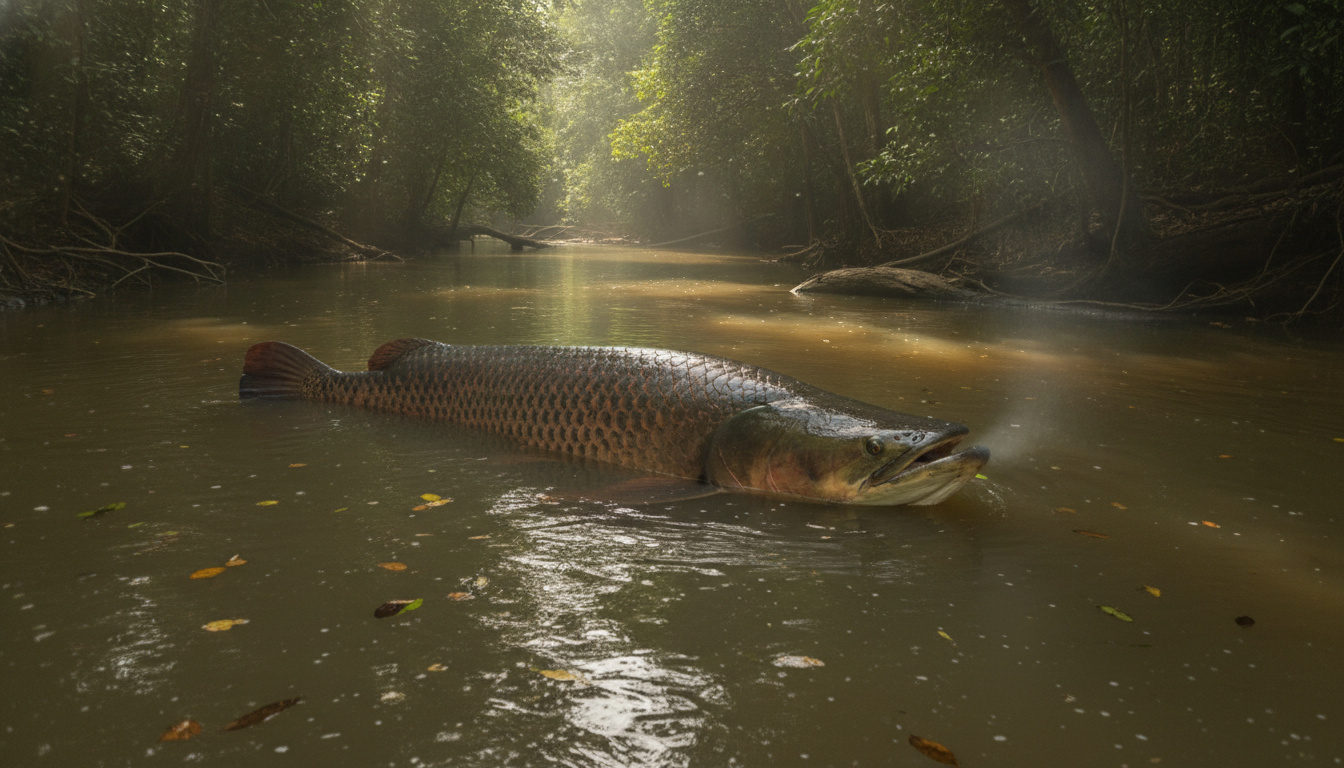
Arapaima Expedition Packing Checklist (Printable Manifest)
As an Amazon Associate I earn from qualifying purchases. Product links on this page are affiliate links — they cost you nothing extra.
The Jungle Arapaima Gear Formula: Core Manifest at a Glance
Targeting apex freshwater giants in the Amazon Basin requires a severe baseline: 12-weight fly rods or heavy casting systems spooled with 80-pound braided line, 100- to 130-pound fluorocarbon leaders, prescription jungle medical supplies, and a sub-15kg waterproof gear footprint. When fishing for arapaima, standard peacock bass tackle fails immediately. A 150-pound fish generates violent, close-quarters torque and abrasive headshakes against submerged wood that strip gears, buckle hooks, and snap graphite blanks built for lighter river predators.
A bite tippet is a short, high-strength clear leader tied between the main line and the hook to resist structural abrasion from the target species’ sandpaper-like jaw plates.
Field data published by the Mamirauá Institute for Sustainable Development confirms that mature wild arapaima routinely measure between 1.8 and 2.5 meters and exceed 200 pounds. These dimensions place structural loads on your gear that mirror bluewater and heavy inshore species rather than standard freshwater game. In fact, many anglers repurpose heavy saltwater setups—similar to shark fishing tackle or offshore shark fishing gear—to secure adequate drag pressure. Understanding what gear do you need for extreme angling starts with auditing your payload against hard logistics.
Logistical friction dictates every item in your bag. Regional charter carriers like Trans Guyana Airways operate single-engine Cessna Caravans into remote gravel strips in the North Rupununi, enforcing a rigid 15-kilogram (33-pound) total luggage limit per angler. This cap must contain your technical tackle, daily wading clothing, electronics, and emergency trauma supplies. If an item does not directly prevent line failure or severe jungle infection, it stays home.
- Pack two matched 12-weight fly rods or heavy-power 50-80lb casting rods as primary and immediate backup.
- Spool reels with minimum 80-pound hollow-core braid backed by 100-pound to 130-pound abrasion-resistant fluorocarbon shock leader.
- Restrict dry duffel capacity to 70 liters, ensuring gross packed weight stays below the mandatory 15kg bush-plane cutoff.
- Assemble a standalone, sealed medical kit containing broad-spectrum oral antibiotics, ciprofloxacin, rehydration salts, and tourniquet systems.
Building a manifest within these strict limits leaves zero margin for incorrect terminal components. Inspect the exact hook gauges, leader formulas, and drag tolerances that survival in these remote river basins demands.
Key Takeaways
- Pack minimum 12-weight fly rods or heavy casting rods rated for 80-pound braided mainline.
- Rig with 100- to 130-pound fluorocarbon shock tippet to withstand tooth patches and sunken timber.
- Jungle charter flights enforce a strict 15-kilogram (33-pound) total luggage payload per angler.
- Carry wilderness trauma supplies, broad-spectrum antibiotics, and satellite two-way communication.
Table of Contents
- The Jungle Arapaima Gear Formula: Core Manifest at a Glance
- Heavyweight Fly Tackle: Rods, Reels, Lines, and Patterns
- Conventional Casting Arsenal: Braided Lines, Leaders, and Lures
- Jungle Survival, Camp Life, and Sub-15kg Floatplane Constraints
- Expedition Medical & Wilderness Trauma Kit
- Your Printable Arapaima Expedition Packing Checklist (Guyana & Brazil Manifest)
- Sources & Further Reading
Heavyweight Fly Tackle: Rods, Reels, Lines, and Patterns
Targeting Arapaima gigas in Guyana and Brazil requires fly tackle built for brute-force extraction. You need a 9-foot, 12-weight or 14-weight fast-action fly rod built with a reinforced butt section. Field data from the International Game Fish Association records arapaima reaching weights over 200 pounds, which produces destructive torque around sunken root systems.
If you already know what gear do you need for extreme angling, you know standard freshwater blanks snap under this pressure. Saltwater blanks such as the Sage Salt R8 or Scott Sector provide the lifting power needed to redirect runs away from heavy timber.
Your reel must feature a fully sealed carbon drag system that generates at least 15 pounds of sustained, smooth resistance. Open cork systems fail quickly in Amazonian silt, and unsealed bearings corrode in high humidity within 48 hours. Spool your reel with 300 yards of 50-pound gel-spun backing to handle extended runs without adding excess bulk.
Much like heavy shark fishing tackle, spool rigidity and heat dissipation prevent mechanical failure when a fish charges downstream.
A sink-tip line is a fly line where only the front section sinks while the rear body floats, allowing you to present flies at specific depths while managing line mending on the surface.
In equatorial heat exceeding 95 degrees Fahrenheit, standard coldwater coatings melt and stick to rod guides. Load your spools with aggressive tropical sink-tip lines rated between 350 and 450 grains. Field testing by Scientific Anglers demonstrates that tropical 50-pound monofilament cores prevent stretching and line shear at water temperatures up to 100 degrees Fahrenheit.
Just as with specialized shark fishing gear, maintaining line stiffness under extreme ambient heat keeps your casting turnover clean.
When fishing for arapaima, your fly selection must match large baitfish like armored catfish and peacock bass. Pack 6- to 10-inch streamers, deceivers, and high-floating surface patterns tied on forged 6/0 to 8/0 hooks. Standard wire hooks straighten under direct rod pressure, so build your box strictly with Owner Aki or Gamakatsu SC15 hooks.
Try This Today: Test your reel drag calibration before packing. Tie your 50-pound backing to a hand scale, tighten the drag knob, and pull until the scale reads exactly 15 pounds to confirm the drag starts smoothly without spiking.
Once your fly rods and lines are set, inspect the specialized leader formulas and heavy fluorocarbon shock tippets listed in the next section.
Conventional Casting Arsenal: Braided Lines, Leaders, and Lures
Arapaima routinely exceed 100 kg (220 lb) and deliver a crushing initial strike in confined jungle lagoons. Standard heavy bass tackle shears at the reel seat or snaps at the line guide within seconds. When you are assembling your system for Fishing For Arapaima, every component from the reel spool to the hook point must withstand extreme impact loads without mechanical failure.
Rod and Reel Specifications
Select a 6’6" to 7’0" extra-heavy casting rod rated for 2-to-6-ounce lures and 50-to-100-pound braid. Blanks built from thick-walled, low-modulus graphite or composite blends handle sudden boat-side directional changes better than stiff, brittle high-modulus graphite. Pair the rod with a 300- or 400-size low-profile baitcasting reel equipped with heavy-duty brass main and pinion gears. Aluminum gears strip under the sudden shock load of a close-quarters strike.
Recommended gear
Portable Saltwater Offshore Heavy 3-Piece Travel Graphite Baitcasting Fishing Pole
A three-piece graphite casting rod that breaks down for travel while keeping the backbone needed for heavy saltwater work.
Affiliate link
A synchronized level-wind is a line-guide mechanism that moves back and forth during both the retrieve and the cast to keep line peeling straight off the spool without binding. This feature is mandatory. Non-synchronized level-winds disengage during the cast; when an 80-pound fish pulls drag at 15 kg of resistance, static guide eyes force the line into tight angles, digging the top coils into the spool bed. Reels like the Shimano Tranx 400 or Daiwa Lexa HD 400 provide the required line capacity, holding at least 180 meters of 80-pound braided line. If you are auditing your overall kit, cross-reference our core baseline on what gear do you need for extreme angling?.
Mainline and Leader Connections
Spool your reels with 80- to 100-pound four-carrier or eight-carrier hollow braid. Four-carrier braids offer superior abrasion resistance against submerged timber and razor-sharp gill plates. Eight-carrier hollow braid provides a smoother profile and allows spliced end-loops that maintain 100% linear breaking strength. According to published testing data from the International Game Fish Association, standard overhand and uni-to-uni connections can reduce line strength by up to 40% under high-shock impacts.
Connect your braided mainline to a 100- to 130-pound fluorocarbon bite leader measuring 1.5 to 2.0 meters. Arapaima possess rough, bony plates along their jaws that saw through light monofilament. Use an FG knot or a PR knot to join the lines.
An FG knot is a high-strength friction connection that wraps leader material around straight braided line without forming an overhand knot in the leader, allowing it to pass smoothly through narrow rod guides. Tie the knot under firm tension with 20 to 24 alternating half-hitches, and finish it with a burned mushroom head on the fluorocarbon tag end. This slim profile clears the tip-top guide cleanly during hard, two-handed casts.
PR / FG FRICTION CONNECTION
[Main Braid: 80-100 lb]
       |
       v
[22+ Alternating Wraps]
       |
       v
[Mushroomed Tag End]
       |
       v
[Leader: 130 lb Fluoro]
Lure Selection and Hardware Upgrades
Arapaima strike out of aggression and territory defense. Pack three proven lure profiles:
- Walk-the-Dog Surface Cruisers (6 to 8 inches): High-buoyancy topwater stickbaits displace surface water and trigger reactive strikes when fish surface to breathe.
- Bucktail Jigs (2 to 3 ounces): Heavy jigs tied with natural bucktail and dense flash material drop fast into deep lagoon pockets and hold up against repeated crush cycles.
- Lipless Glide Baits (7 inches): Sub-surface gliders mimic regional forage like pacu and small catfish when fished on a steady, pulsing cadence.
Factory lure hardware will fail. Remove all stock split rings and hooks before packing. Install 150-pound forged stainless steel split rings (such as Owner Hyper Wire) and 4X-strong treble hooks (Owner ST-66) or 5X inline single hooks (BKK Lone Diablo in size 5/0 to 7/0). These heavy wire gauges require the same terminal durability you find in offshore shark fishing gear.
Self-Assessment: Casting Tackle Readiness
Scoring: 0–3 ticks: Your tackle will fail on a 50-kg specimen; retool using dedicated Shark Fishing Tackle standards. 4–5 ticks: Close, but one weak component will cost you a trophy. 6 ticks: Expedition-ready casting arsenal.
Once your casting rods and terminal rigs are locked down, you must prepare for situations where these giant fish ignore surface lures and hold deep in structure.
Jungle Survival, Camp Life, and Sub-15kg Floatplane Constraints
Charter operators servicing the Rupununi basin in Guyana and the Rio Negro tributaries in Brazil enforce a strict 15kg (33 lb) baggage ceiling. Exceeding this limit grounds your gear at the airstrip. You must balance extreme line strength with weight discipline.
Gravel guards are stretchable neoprene ankle sleeves that fit over the tops of your wading boots to block sand, fine river silt, and gravel from grinding inside your footwear.
Luggage Engineering: The Sub-15kg Architecture
The Guyana Civil Aviation Authority enforces strict payload caps on Cessna 208 Caravans flying into remote jungle strips. Your entire personal kit must fit into a single 70L to 90L waterproof roll-top submersible duffel bag paired with one multi-rod travel case.
Target an empty duffel weight of under 1.8kg. Pack heavier terminal tackle in the bottom third of the bag to keep the center of gravity stable during dugout canoe transfers. For broader equipment considerations across harsh environments, review our breakdown on what gear do you need for extreme angling? to benchmark your weights.
| Gear Category | Target Weight (kg) | Target Weight (lbs) |
|---|---|---|
| Waterproof Duffel (Empty) | 1.8 kg | 4.0 lbs |
| Multi-Rod Hard Case (3–4 rods) | 2.5 kg | 5.5 lbs |
| Technical Jungle Apparel (3 sets) | 2.2 kg | 4.8 lbs |
| Puncture-Resistant Boots & Socks | 1.9 kg | 4.2 lbs |
| Reels, Spool Spares & Braided Lines | 2.8 kg | 6.2 lbs |
| Terminal Tackle, Leaders & Flies/Lures | 2.3 kg | 5.1 lbs |
| Electronics, Headlamp & Bivouac Essentials | 1.5 kg | 3.2 lbs |
| Total Packed Payload | 15.0 kg | 33.0 lbs |
Technical Jungle Apparel
Jungle humidity consistently exceeds 85%, which prevents sweat from evaporating efficiently. Pack three sets of fast-drying UPF 50+ long-sleeve shirts and ripstop nylon wading pants. Heavy cotton traps moisture, rots in the climate, and increases your daily pack weight.
Footwear must handle sharp granite boulders and submerged stingray barbs. Wear puncture-resistant wading boots with synthetic felt or sticky rubber soles paired with neoprene gravel guards. Never pack cleated wading boots with aluminum studs for small wooden skiffs, as they damage boat floors and compromise deck footing during critical hooksets.
Bivouac and Boat Essentials
According to the Centers for Disease Control and Prevention, factory-treated or self-applied permethrin reduces bites from disease-carrying mosquitoes and sandflies by over 90%. Treat all outerwear, socks, and your camp bug net with a 0.5% permethrin spray at least 48 hours before packing.
On the skiff, keep essential cameras, satellite messengers, and leader spools inside a compact 10L dry bag tied directly to the gunwale. Amber or copper polarized polycarbonate lenses are mandatory for tracking blackwater fish in low-contrast light. Pair your eyewear with a waterproof, IPX8-rated headlamp producing at least 450 lumens for navigating sandbar bivouacs and handling night river landings.
Frequently Asked Questions
How do terminal tackle needs compare between jungle expeditions and saltwater big-game fishing?
While target weights can run similar, jungle environments demand short, abrasion-resistant leaders to survive submerged timber. Anglers moving between freshwater and open water can compare setups with our Shark Fishing Tackle guide and our field notes on Shark Fishing Gear to contrast line classes and terminal hardware.
Can I carry spare lithium battery banks on remote jungle charter flights?
Yes, but you must carry all lithium-ion power banks inside your cabin carry-on pack rather than checked duffels. Most regional Amazonian air services cap individual power banks at 100Wh (approximately 27,000mAh) per passenger.
What specific rod configurations are needed when targeting trophy fish in these rivers?
You need short, 4-piece travel rods rated for 80lb to 100lb braided line, or 12-weight fly rods with aggressive lifting power in the butt section. Review our tactical masterclass on Fishing For Arapaima to match your line class directly to local river structures.
With your weight limits locked and your camp gear prepped, turn straight to the full, printable gear manifest below to verify every hook, leader, and medical item before you close your duffel.
Expedition Medical & Wilderness Trauma Kit
When you run operations in the Rewa River of Guyana or the Mamirauá Reserve in Brazil, medical evacuation takes 18 to 36 hours. You must manage acute trauma, secondary infections, and systemic illness on your own until a bush plane arrives. Preparing your medical kit requires the same strict inventory control as deciding what gear do you need for extreme angling? before leaving commercial hubs.
Trauma & Laceration Protocol
Large freshwater predators generate blunt-force impacts and severe puncture wounds. Hemostatic gauze is a sterile fabric dressing treated with mineral agents that rapidly accelerate blood clotting to halt severe, life-threatening arterial or venous bleeding.
Pack two Combat Application Tourniquets (CAT Gen-7) in quick-access outer pouches. Back these with QuikClot Combat Gauze, a sterile suture kit (sizes 2-0 and 3-0 nylon), antiseptic chlorhexidine scrub, and medical-grade 2-octyl cyanoacrylate skin glue. While treble hooks feature in heavy offshore setups like shark fishing tackle, a single barbless 8/0 to 10/0 hook for arapaima still causes deep tissue gouges. Wash every puncture immediately with 250 milliliters of clean water and chlorhexidine to stop biofilm formation.
Case Study: Managing Severe Hook Trauma in the Rupununi
In October 2023, a remote four-angler team operating 120 miles upriver from Georgetown faced a deep-puncture emergency. An angler suffered an 8/0 hook penetration through the palm while landing a 180-pound fish during a fishing for arapaima session.
The team followed a four-step wilderness protocol:
- 0–5 minutes: Direct pressure applied with QuikClot gauze; 0.5% povidone-iodine wash administered.
- Hour 1: Complete field wound closure using topical skin glue and butterfly strips, saving a $4,200 emergency bush flight charter.
- Days 1–5: Angler completed a 5-day course of 500 mg daily Azithromycin to prevent waterborne Aeromonas bacterial infection.
- Outcome: Zero infection, full hand mobility retained, and the team completed 100% of the 7-day expedition.
Prescription Jungle Manifest
According to the Wilderness Medical Society Clinical Practice Guidelines, bacterial diarrhea affects up to 70% of travelers on remote river itineraries. Secure doctor-prescribed antibiotics and store them in crushproof, waterproof Pelican 1060 cases.
Pack 500 mg tablets of Azithromycin for invasive gastrointestinal distress and Ciprofloxacin (500 mg) for secondary genitourinary or severe soft-tissue infections. Carry a daily regimen of 100 mg Doxycycline hyclate for insect-borne prophylaxis against malaria and leptospirosis, per the U.S. Centers for Disease Control and Prevention. Pack two Mylan EpiPen auto-injectors (0.3 mg epinephrine) to treat acute anaphylaxis from stingray strikes or wasp envenomation.
Vector Control & Skin Defense
Black flies—known locally as kaboura flies or pium—and biting midges swarm exposed skin along sandbars at dawn and dusk. Kaboura flies are small, blood-feeding black flies of the Simuliidae family that slice open capillary beds on exposed skin, leaving intensely itchy, open lesions prone to secondary bacterial infection.
Apply 20% Picaridin spray during daylight hours and reserve 100% DEET for high-density mosquito zones after sunset. Treat bites twice daily with 1% hydrocortisone cream to suppress itching and prevent open scratches. Humidity in the Amazon basin routinely exceeds 85%, so apply Zeasorb or miconazole-based antifungal drying powders to your groin and feet daily. Just as you safeguard terminal line in shark fishing gear, protecting your physical baseline prevents an early end to your trip.
Now that your medical kit is packed, check the complete river navigation and communication hardware checklist below to ensure your team never drops offline.
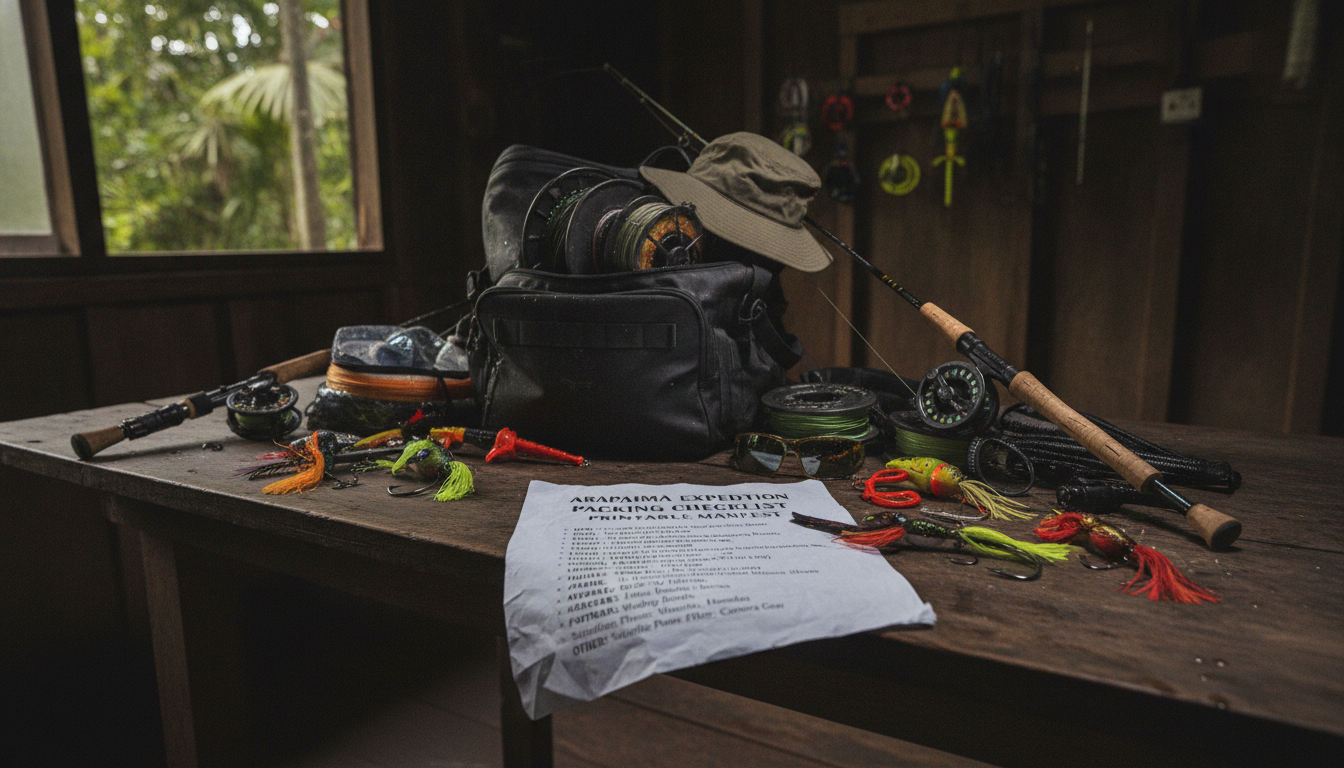
Your Printable Arapaima Expedition Packing Checklist (Guyana & Brazil Manifest)
Bush flights to remote jungle airstrips run on hard weight caps. Trans Guyana Airways limits passengers on Cessna Caravan transfers to 20 kg (44 lbs) of total baggage, including your rod tube and carry-on pack. If you overpack by 2 kg, you leave critical gear on the tarmac in Georgetown or Manaus.
Use this operational manifest to audit your kit down to the ounce before departure. When you are planning Fishing For Arapaima, borrow terminal rigging principles from proven big-game setups like Shark Fishing Tackle to withstand violent, close-quarters battles.
Expedition Manifest & Weight Allocations
A shock leader is a heavy section of monofilament or fluorocarbon line tied between the mainline and the hook to absorb the violent initial impact of a strike and prevent abrasion against submerged timber and sharp scales.
| Category | Item Description | Specification / Detail | Quantity | Target Weight |
|---|---|---|---|---|
| Heavy Tackle | Heavy Travel Rod (4-piece) | PE 6–8 (80–100 lb class), 7’0"–7’6" | 2 rods | 0.90 kg (2.0 lbs) |
| Heavy Tackle | Conventional or Spinning Reel | High-capacity, 15+ kg max drag | 2 reels | 1.60 kg (3.5 lbs) |
| Lines & Leaders | Hollow-core Braided Mainline | 80 lb to 100 lb test (300 m spool) | 2 spools | 0.45 kg (1.0 lbs) |
| Lines & Leaders | Fluorocarbon Shock Leader | 100 lb to 130 lb test | 2 spools | 0.35 kg (0.8 lbs) |
| Terminal Hardware | Welded Solid Rings & Swivels | Size #5 to #7, rated 200+ lbs | 20 pcs | 0.15 kg (0.3 lbs) |
| Lures & Flies | Deep-diving Plugs / Big Soft Baits | 15–20 cm length, through-wired | 8 lures | 0.80 kg (1.8 lbs) |
| Camp & Tools | Heavy-duty Split Ring Pliers | Aircraft aluminum or stainless steel | 1 pair | 0.25 kg (0.5 lbs) |
| Camp & Tools | Digital Hanging Drag Scale | 25 kg capacity (±0.05 kg accuracy) | 1 unit | 0.20 kg (0.4 lbs) |
| Safety & Medical | Satellite Messenger / SOS Tracker | Iridium network with active plan | 1 unit | 0.20 kg (0.4 lbs) |
| Safety & Medical | Wilderness First Aid & Meds | Trauma dressing, Ciprofloxacin, EpiPen | 1 kit | 0.80 kg (1.8 lbs) |
| Apparel & Dry Gear | Submersible Waterproof Duffel | 70–90 Liter, IPX7 rated | 1 bag | 1.90 kg (4.2 lbs) |
| Apparel & Dry Gear | UPF 50+ Expedition Clothing | Fast-drying nylon, 3 sets total | 3 sets | 2.10 kg (4.6 lbs) |
| Documents | Passport, Yellow Card, Medevac | Hard copies in waterproof pouch | 1 set | 0.10 kg (0.2 lbs) |
Review our comprehensive overview on What gear do you need for extreme angling? to match rod actions and blank strengths to heavy apex predators. For terminal wire and heavy crimps, apply the rigging methods detailed in our guide to Shark Fishing Gear.
Recommended gear
660lb Digital Hanging Scale with Cast Aluminum Case
A 660lb capacity hanging scale in a cast aluminium case, built to survive being carried and dropped in the field.
Affiliate link
7-Day Pre-Departure Readiness Protocol
Do not test gear in the jungle. Complete this protocol at home to eliminate mechanical failure points before boarding your international flight.
[T-7: DRAG CALIBRATION]
        |
        v
[T-6: KNOT BREAK-TESTING]
        |
        v
[T-5: SPOOLING & LINE AUDIT]
        |
        v
[T-4: SATELLITE COMMS TEST]
        |
        v
[T-3: MEDICAL & MEDEVAC CHECK]
        |
        v
[T-2: WATERPROOF DRY-PACKING]
        |
        v
[T-1: DOCUMENT LOCK-IN]
- Day 7: Drag Stress-Testing. Lock your reel into a rod, run 80 lb braid through the guides, and tie off to a digital hanging scale anchored at ground level. Pull the rod to a 45-degree angle and calibrate your strike drag to exactly 6.0 kg (13.2 lbs) and your maximum drag to 10.0 kg (22.0 lbs). Run 30 meters of line off the spool under high load to ensure drag washers do not stick or stutter.
- Day 6: Knot Break-Testing. Tie three consecutive PR knots or FG knots connecting your 80 lb mainline braid to your 100 lb fluorocarbon shock leader. Test each knot against a fixed anchor with your scale. Discard and retie any connection that slips or fractures below 85% of line rating.
- Day 5: Line Inspections and Spooling. Strip old line and pack fresh hollow-core braid under firm, consistent thumb tension. Soft-packed braid digs into itself under 10 kg of fish pull and snaps immediately.
- Day 4: Satellite Messenger Activation. Power on your two-way satellite messenger. Check your subscription on the Garmin inReach portal and transmit three test messages to your emergency contact to confirm operational uplink.
Recommended gear
Garmin inReach® Mini 2, Satellite Communicator
A pocket-sized satellite communicator for two-way messaging and SOS from places with no mobile coverage at all.
Affiliate link
- Day 3: Medical and Evacuation Audit. The Centers for Disease Control and Prevention mandates Yellow Fever vaccination proof at least 10 days before entering endemic river basins in Guyana and Brazil. Pack a physical International Certificate of Vaccination (Yellow Card), 14 days of Malarone prophylaxis, and print out your Global Rescue or Ripcord medevac policy numbers.
- Day 2: Dry Bag Packing and Weigh-In. Pack your 70L submersible duffel. Hang the fully loaded bag from your digital scale. Ensure the weight stays under 18.0 kg (39.6 lbs), leaving a 2.0 kg buffer for wet boots and dirty laundry on return legs.
- Day 1: Document Verification. Place your passport, Brazilian or Guyanese entry paperwork, physical sport fishing permits, and printed emergency contacts in a double-sealed, airtight document pouch. Store this pouch in your primary waterproof carry-on.
Frequently Asked Questions
What is the strict baggage allowance for Guyana and Brazil charter flights?
Charter planes like the Cessna 208 Caravan operated by Trans Guyana Airways enforce a strict 20 kg (44 lb) maximum limit per passenger for all cargo combined. Some smaller four-seat bush charters restrict baggage to 15 kg (33 lbs). Always weigh your duffel with a calibrated digital scale before leaving home.Can I pack my hooks, leaders, and fishing tools in carry-on luggage?
No. Aviation security authorities, including the TSA and Brazilian ANAC, prohibit hooks, terminal tackle, pliers, and braided lines in cabin baggage. Pack all fishing hardware, knives, and tools inside your checked waterproof duffel. Carry only fragile electronic items and reel bodies (spooled without line) in your backpack. Review our extreme angling equipment guide for packing protocols.Which medical items are non-negotiable for remote Amazon expeditions?
You must carry a valid Yellow Fever International Certificate of Vaccination, prescription anti-malarial medication (such as Atovaquone-proguanil), broad-spectrum oral antibiotics (such as Ciprofloxacin for waterborne bacterial infections), prescription antihistamines for severe insect stings, and trauma tourniquets. You should also hold an active remote evacuation membership through providers like Global Rescue.Print this manifest, set your drag scale on your workbench today, and run your Day 7 stress-tests before packing a single duffel.
Sources & Further Reading
The tactical specifications and medical gear configurations in this manifest rest on field-tested jungle logistics, fisheries biology, and expedition medicine.
An obligate air-breather is a fish species that must periodically surface to gulp atmospheric air through a modified swim bladder to survive, as its gills cannot extract enough oxygen from warm, stagnant water.
Field research led by Dr. Leandro Castello through the Mamirauá Institute demonstrates that an adult Arapaima gigas surfaces every 5 to 15 minutes depending on water temperature and physical exertion. Because strenuous rod battles rapidly deplete their oxygen stores, our heavy-tackle specifications—such as 80-pound minimum braided mainline and 100-pound fluorocarbon shock leaders—are engineered to bring fish boatside in under 10 minutes to minimize lactic acid mortality.
Pack your kit into heavy-duty submersible dry duffels to survive open boat transits and relentless equatorial downpours.
Medical protocols follow the travel health standards established by the Centers for Disease Control and Prevention for the Amazon and Guiana Shield basins, which mandate daily atovaquone-proguanil or doxycycline regimens for chloroquine-resistant Plasmodium falciparum malaria. Regional data from the Rewa Village Community Development Project confirms that local conservation angling guidelines have protected over 100 kilometers of the Rupununi River, increasing local arapaima counts by more than 300% since systematic catch-and-release enforcement began.
- Castello, L. et al. (2009), Managing Amazonian fisheries for biodiversity conservation — Provides empirical data on Arapaima gigas surfacing intervals, capture stress physiology, and floodplain lake habitat structures.
- Centers for Disease Control and Prevention, CDC Yellow Book: Health Information for International Travel (2024) — Grounding source for jungle prophylaxis, waterborne pathogen treatment, and tropical field medical kit requirements.
- Goulding, M., Barthem, R., & Ferreira, E. (2003), The Smithsonian Atlas of the Amazon — Details seasonal flood pulses, blackwater river chemistry, and logistical mapping across the Rio Negro and Essequibo river systems.
- International Game Fish Association (IGFA), International Angling Rules & Official World Record Requirements — Dictates standard leader-to-mainline breaking strengths and single-hook barbless terminal tackle ethics for large gamefish.
- Rewa Eco-Lodge & North Rupununi District Development Board (NRDDB), Sport Fishing Operational Guidelines for Catch-and-Release Arapaima Conservation — Establishes community-mandated boat handling limits, landing cradle procedures, and river zone closures.