Tarpon Fly Sinking Rates: Lead Distance Math (Chart)
As an Amazon Associate I earn from qualifying purchases. Product links on this page are affiliate links — they cost you nothing extra.
⏱ 21 min read
The Core Mathematical Formula for Tarpon Interception
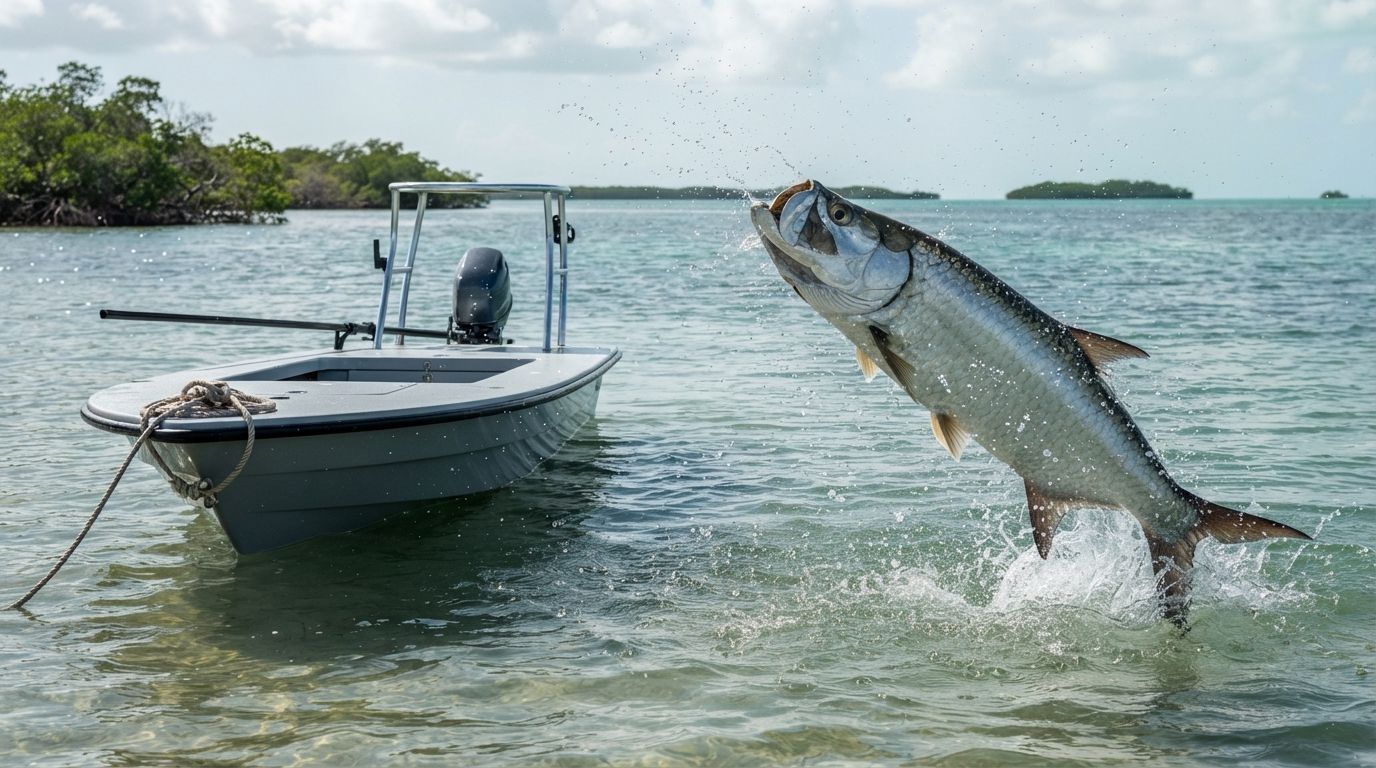
Intersecting a migratory giant tarpon (Megalops atlanticus) on the flats requires calculating lead distance using the formula \(\text{Lead Distance} = (\text{Target Depth} \div \text{Fly Sink Rate}) \times (\text{Cruising Speed} \pm \text{Current Velocity})\), with the terminal delivery positioned precisely 12 to 24 inches above the fish’s eye line. Adult tarpon travel across clear shallows at sustained rates of 2.5 to 4.0 knots (4.2 to 6.7 feet per second). If a cast fails to account for descent time, the fly either bypasses the fish entirely or plummets below its visual plane. Committing this vector formula to muscle memory enables anglers to place the pattern at the exact coordinate where depth, movement, and retrieve intersect.
Sink rate is the vertical velocity at which a submerged fly and fly line descend through the water column, measured in inches per second under neutral line tension.
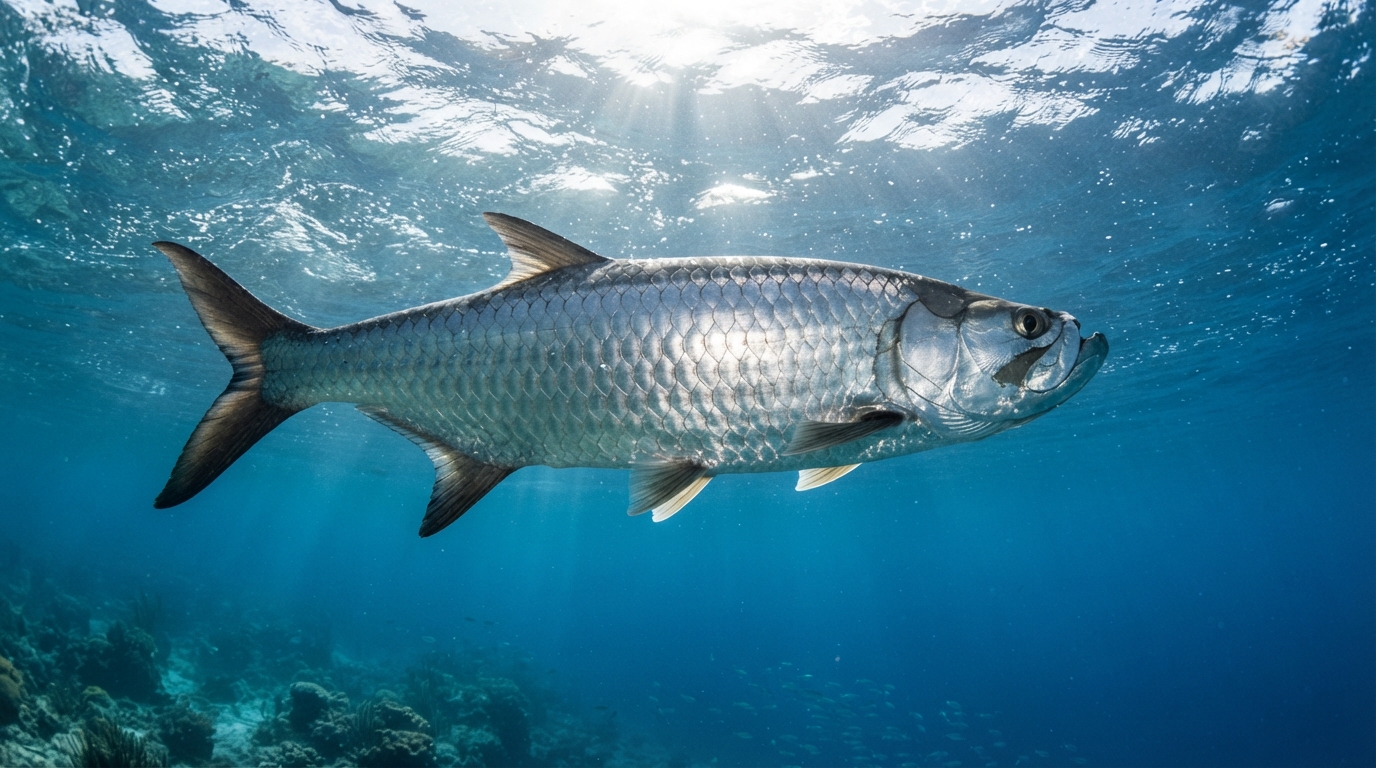
Cranial anatomy governs why terminal depth tolerances are uncompromisingly narrow. Morphological research published by the Florida Fish and Wildlife Conservation Commission details the species’ superior mouth structure, characterized by an oblique, upward-clearing lower jaw and dorsally tilted orbits. In his technical flats documentation, A Passion for Tarpon, author Andy Mill emphasizes that adult fish feed strictly across an upward 45-degree cone. A fly tracking 18 inches above a fish elicits a predatory turn; a fly descending 6 inches beneath its ventral line causes an immediate spook or directional refusal.
Tidal current introduces hydrodynamic drag that distorts this linear calculation. When casting across tidal flows, such as ocean passes highlighted in Tarpon Fishing Islamorada or channels rigged for deep migratory corridors, water friction catches the floating or intermediate running line. This lateral pressure creates a prominent downstream belly. The resulting drag accelerates horizontal fly movement while cutting actual vertical descent rates by 30% to 50%, pulling buoyant synthetics straight upward out of the interception zone.
To overcome severe tidal drag in passes dropping beyond 10 feet, specialized terminal modifications become mandatory to anchor the descent. Anglers frequently swap standard tapers for dense tungsten sink tips adapted from high-flow river systems to achieve penetration against lateral currents.
Recommended gear
50pcs Tungsten Slotted Beads for Fly Tying
Slotted tungsten beads that sink a fly faster than brass for the same size, supplied across a range of diameters.
Affiliate link
Adjusting the vector for tidal flow requires adding current speed when casting up-current of cruising fish, and subtracting it when the fish travel down-tide against the flow. Modern telemetry data from the Bonefish & Tarpon Trust indicates tarpon navigating passes often reduce cruising energy expenditure against currents exceeding 2 knots (3.38 feet per second), hovering close to boundary layers. Proper rigging setups, as detailed in our guide to Tarpon Fishing Rigs, must balance leader density against these fluid dynamics.
📋 Pocket Cheat Sheet: Tarpon Interception Vectors
Use when calculating lead cast distances on cruising tarpon.
1. Identify Target Depth (ft converted to inches)
2. Determine Fly Sink Rate (typical: 2 to 6 in/sec)
3. Calculate Sink Time: Target Depth / Fly Sink Rate
4. Estimate Cruising Speed (standard flat: 4.5 ft/sec)
5. Add/Subtract Current Velocity (1 knot = 1.69 ft/sec)
6. Lead Distance = Sink Time * Net Fish Velocity
7. Critical Window: Keep fly 12 to 24 in above eye line
8. Abort Rule: Zero tolerance for fly below chin depth
Copy this into your notes app.
Executing this baseline formula establishes the correct landing point, but how fast you strip once the fish tracks the feather profile dictates whether that lead distance results in an aggressive eat or a sudden breakaway.
Key Takeaways
- Position flies 12 to 24 inches above cruising depth to match tarpon’s upward-oriented peripheral vision.
- Intermediate saltwater lines sink at 1.5 to 2.0 inches per second in standard tropical salinity.
- A 3-knot cross-tide current triples necessary lead distance compared to slack-water setups.
- A cadence of 6-inch strips at 1-second pauses maintains neutral hover for unweighted toad patterns.
Table of Contents
- The Core Mathematical Formula for Tarpon Interception
- Sink Rate Profiles of Saltwater Lines and Fly Materials
- Calculating Current Vectors and Fish Cruising Speed
- Strip Cadence Adjustments to Regulate Fly Altitude
- The Giant Tarpon Lead Distance and Depth Chart
- Sources & Further Reading
Sink Rate Profiles of Saltwater Lines and Fly Materials
Manufacturer-rated line sink rates decline by 8% to 14% in coastal flats environments because hyper-saline ocean water has a higher specific gravity than the freshwater test tanks used during factory calibration. The National Oceanic and Atmospheric Administration establishes baseline open-ocean salinity at roughly 35 practical salinity units (PSU), yielding a fluid density near 1.025 grams per cubic centimeter.
Sink rate measures the terminal downward velocity of a submerged fly line or fly pattern through a static water column, expressed in inches per second.
When calculating delivery windows for ocean-side migratory fish, standard intermediate lines rated at 1.5 to 2.0 inches per second (ips) sink at a reduced rate of 1.3 to 1.7 ips in these high-salinity zones. Density-compensated sink-tips rated from 3.0 to 4.0 ips achieve an actual descent of 2.6 to 3.5 ips. Heavy, full-sinking integrated heads rated between 6.0 and 8.0 ips drop at 5.3 to 7.1 ips in high-salinity passages such as the bridges of Tarpon Fishing Islamorada Florida or Government Cut.
| Line & Hardware Configuration | Factory Freshwater Rating | Saltwater Sink Rate (35 PSU) | 5-Second Free-Fall Depth |
|---|---|---|---|
| Clear Intermediate Head (Mono Core) | 1.50–2.00 ips | 1.32–1.74 ips | 6.6–8.7 inches |
| Type 3 Density-Compensated Sink-Tip | 3.00–4.00 ips | 2.65–3.55 ips | 13.2–17.7 inches |
| Type 7 Heavy Full-Sinking Head | 7.00–8.00 ips | 6.15–7.10 ips | 30.7–35.5 inches |
| Unweighted Bunny Strip on Intermediate Line | Neutral drag profile | 0.85–1.10 ips | 4.2–5.5 inches |
| 1/24 oz Lead Dumbbell on 12-ft Leader | Negative descent anchor | 3.80–4.40 ips | 19.0–22.0 inches |
Fly construction materials exert dramatic mechanical lift or descent against the line’s natural path. According to hydrodynamics testing published by the Cortland Line Company, broad profile materials create parasitic drag that decelerates downward velocity far more than overall fly weight predicts.
Spun deer hair contains hollow, air-filled vascular cells that impart positive buoyancy, delaying the descent of a 1.5 ips intermediate line by up to 40% until the fibers reach full waterlogging. Conversely, crosscut rabbit strips absorb water rapidly, but their pliable fur fibers flare outward during forward strips, generating boundary-layer drag that holds the fly higher in the water column than a streamlined synthetic baitfish pattern of identical mass.
To punch through the upper surface layers on deep cruising paths, the addition of hardware ballast becomes mandatory. Plated brass bead-chain eyes add approximately 0.35 grams of weight, yielding a gentle downward glide profile that preserves horizontal hover during pause intervals. Substituting lead dumbbell eyes (typically 1/24 ounce or 1.18 grams) overrides the natural buoyancy of deer hair collars or bulky synthetic collars, driving an aggressive downward dive angle that sinks the pattern at 3.8 to 4.4 ips regardless of line profile.
Leader construction further dictates whether your fly tracks true or tracks upward. A standard 10-to-12-foot tarpon leader constructed with a nylon monofilament butt section and midsection introduces hydrodynamic lift during the retrieve. Nylon carries a specific gravity of roughly 1.14 grams per cubic centimeter, sinking marginally faster than seawater, but its supple surface creates friction that lifts the rig when stripped horizontally.
Replacing nylon bite tippets with heavy fluorocarbon eliminates this trailing surface resistance. Fluorocarbon exhibits a specific gravity of approximately 1.78 grams per cubic centimeter, cutting through horizontal hydraulic drag without riding up toward the surface film during hard strips.
Recommended gear
Reaction Tackle 100% Pure Fluorocarbon Fishing Line
A full spool of pure fluorocarbon, low in visibility underwater and firm enough to use as leader material rather than main line.
Affiliate link
Integrating a 60-to-80-pound fluorocarbon shock tippet directly onto your standard Tarpon Fishing Rigs maintains an uninterrupted downward leader slope that lets weighted flies achieve their calibrated depth target up to two seconds faster than all-monofilament leader systems.
Mastering these component descent speeds establishes baseline drop rates, but factoring in dynamic cross-tides and strip-retrieve cadences determines whether your fly intercepts an approaching tarpon’s optical strike zone or drifts harmlessly above it.
Calculating Current Vectors and Fish Cruising Speed
Calculating the precise lead distance for giant tarpon (Megalops atlanticus) requires resolving the resultant vector of water velocity, strip cadence, and the fish’s actual groundspeed over the bottom. When you misjudge current velocity by as little as 1 knot (1.69 feet per second), a sinking fly drifts 8.4 feet off target across a standard 5-second descent window. This spatial deviation shifts the fly out of the tarpon’s 30-degree forward binocular vision cone, turning an interception presentation into an immediate line refusal.
       [Target Interception]
                 |
                 v
         * Intercept Point
                ^ ^
               /   \
   Fly Drift  /     \  Fish Vector
  (Current)  /       \ (Groundspeed)
            /         \
       Cast Entry    Fish Origin
Tarpon movement patterns generate three distinct kinematic baselines that dictate your interception math:
- Laid-Up Fish (0 mph groundspeed): Stationary tarpon suspend in slack water or point into minor eddy flows, typically on protected mud flats or beneath mangrove canopies. Your lead distance relies entirely on water depth, requiring an entry point 6 to 8 feet beyond the fish and 3 to 4 feet ahead to avoid surface-impact spooking.
- Ocean Cruisers (2 to 4 mph / 2.9 to 5.9 fps groundspeed): Migrating pods moving along outer oceanic fringes maintain steady cruising velocities across uniform depths. Data published by the Bonefish & Tarpon Trust reveals that unpressured migrating tarpon maintain an average cruising velocity of 3.1 mph (4.55 feet per second), demanding a forward lead of 15 to 25 feet depending on fly sink rate.
- Tide-Runners (4 to 6 mph / 5.9 to 8.8 fps groundspeed): Fish riding spring flood or ebb currents through structural bottlenecks, such as Bahia Honda or the 7 Mile Bridge, compress your reaction window. In locations famous for tarpon fishing Islamorada Florida, a tide-runner traversing a 3-knot current reaches speeds exceeding 8 feet per second over the substrate, cutting interception windows to under 2 seconds.
A current vector is the mathematical representation of water flow that combines both its physical direction and horizontal speed into a single measurable path.
When presenting a fly across tidal flows, line belly drag immediately overrides hook weight. Casting perpendicular to a 2-knot cross-current accelerates fly sweep, pulling the pattern downstream and away from an approaching cruiser’s eye line. To calculate your required compensation angle (\(\theta\)), solve for the relative velocity vector:
\(\theta = \arcsin\left(\frac{V_{\text{current}}}{V_{\text{fly}}}\right)\)
In cross-current presentations, you must cast up-current of the visual sighting point by an offset equal to the current speed multiplied by the sink time. If your weighted fly requires 4 seconds to sink 5 feet to eye level in a 1.5-knot current (2.53 fps), the water displaces the line 10.1 feet down-tide before your first retrieve strip engages. Failing to add those 10.1 feet up-tide causes the fly to sweep behind the fish, crossing its lateral line and triggering a flight response.
Down-current presentations—casting directly down-tide toward fish traveling up-current against the flow—magnify relative closing speeds. A tarpon pushing at 3 mph against a 2-knot (2.3 mph) tidal flow exhibits a net groundspeed of roughly 0.7 mph (1.0 fps). However, the water sweeps past the fish at 3.38 fps, meaning any stationary fly is swept into the fish’s face at high velocity. In this scenario, shorten your lead to 4 to 6 feet; longer leads allow the current to push excess fly line directly over the fish’s head before the fly sinks to depth.
Conversely, up-current presentations—casting up-tide to fish traveling with the current—require massive leads. The fish’s net groundspeed combines its swimming propulsion with the current velocity, accelerating ground coverage to between 7.3 and 10.2 feet per second. In deep channels, switch to rapid-descent terminal systems like heavy tungsten-sink-tips paired with unweighted flies to get down before the school overruns the drop point.
Current dynamics alter drastically between shallow flats and deep channels due to bed shear stress. The National Oceanic and Atmospheric Administration (NOAA) documents that boundary layer friction reduces bottom current velocity by up to 60% compared to surface velocity in depths under 6 feet, while deep channels maintain near-uniform vertical velocity profiles. Use the empirical adjustment multipliers below to calculate your target lead offset based on local flow conditions:
| Current Velocity (knots) | Shallow Flat Lead Multiplier (<6 ft) | Deep Channel Lead Multiplier (>12 ft) | Sweep Offset per Second of Sink |
|---|---|---|---|
| 0.5 kt (0.84 fps) | \(1.15\times\) | \(1.25\times\) | 0.84 ft / sec |
| 1.5 kt (2.53 fps) | \(1.40\times\) | \(1.75\times\) | 2.53 ft / sec |
| 2.5 kt (4.22 fps) | \(1.85\times\) | \(2.30\times\) | 4.22 fps / sec |
| 3.5 kt (5.91 fps) | \(2.20\times\) | \(3.10\times\) | 5.91 ft / sec |
To apply the multiplier, take your baseline slack-water lead distance (groundspeed in fps multiplied by target sink time in seconds) and multiply it by the channel or flat factor. For example, intercepting a 3 mph (4.4 fps) cruiser in a 1.5-knot deep channel requiring a 3-second sink time yields a baseline lead of 13.2 feet (\(4.4 \times 3\)). Applying the \(1.75\times\) deep channel multiplier establishes an adjusted physical cast lead of 23.1 feet ahead of the fish’s projected track. Matching this calculation to heavy-tide migratory routes encountered during tarpon fishing in Key West keeps your fly tracking naturally inside the strike strike window rather than swinging unnaturally against the current vector.
🕰️ How It Really Happened: Stu Apte’s Down-Current Interception Breakthrough
During the early 1960s on the ocean flats of Little Torch Key, guide Stu Apte repeatedly watched migrating tarpon turn away from flies presented across tidal currents. As documented in Andy Mill’s historical compendium A Passion for Tarpon (Wild River Press, 2010), Apte realized that standard cross-tide presentations caused floating fly lines to belly down-current, dragging the fly sideways at an unnatural angle that consistently spooked large fish. Rather than poling along the edges of channels and casting across the current vector, Apte deliberately repositioned his skiff up-current and directly in line with approaching pods.
By casting down-tide and leading approaching cruisers by no more than five feet, Apte used the oncoming current to keep the fly swimming straight down the fish’s feeding lane with zero belly drag. The technique eliminated line sweep entirely, generating an unprecedented string of fly-rod records, including a 147-pound giant tarpon on 12-pound test tippet in 1967. Apte’s mechanical adjustment established the modern doctrine of vector-aligned tarpon presentations.
Source: Andy Mill, A Passion for Tarpon (Wild River Press, 2010)
Establishing the entry target accounts for horizontal drift, but you must balance this against vertical descent rates across variable strip cadences. Check the step-by-step sink rate matrix and leader grain calculations detailed in the next section to align your fly’s descent profile directly with the tarpon’s running depth.
Strip Cadence Adjustments to Regulate Fly Altitude
Strip speed dictates fly altitude because hydrodynamic lift generated during the pull directly opposes the gravitational sink rate of the fly and leader assembly. Strip cadence is the rhythm, acceleration, and pause duration an angler applies to the fly line during retrieve, which governs the swimming depth and profile of an unweighted or weighted fly pattern in the water column. When an unweighted or bead-chain fly travels through saltwater with an average density of 1.025 grams per cubic centimeter, forward acceleration forces water under the fly’s collars and wing materials, driving the fly upward toward the surface.
Short, sharp 4-inch strips create instantaneous upward deflection, lifting the pattern 2 to 4 inches while compressing deer hair or marabou collars. When forward propulsion stops, water resistance ceases to generate lift, and gravity pulls the hook bend downward. According to velocity profiles documented by Andy Mill in A Passion for Tarpon, typical weighted patterns sink at 6 to 11 inches per second during uninhibited freefall. Prolonging the pause between strips from 0.5 seconds to 2.0 seconds triples the vertical drop distance, shifting the presentation from an evasive darting action to a dying plunge.
Target Depth Established
       |
       v
Strip: 4-6 in. (Fast)
  [Introduces Lift]
       |
       v
Glide: 1.0-1.5 sec.
  [Level Float Plane]
       |
       v
Pause: Sink 4-8 in.
  [Drop to Target Eye-Line]
       |
       v
Fish Closes: Short Twitches
To establish a repeatable hover cadence that positions the fly directly in the visual window of a cruising fish, follow this systematic four-step procedure:
- Calculate Entry Sink Time: Estimate local depth and current velocity upon splashdown; in 5 feet of water with a standard lead-eyed pattern sinking at 8 inches per second, count a 3-second freefall to place the fly roughly 24 inches down before initiating line movement.
- Engage Line Tension Immediately: Strip out excess slack until the rod tip bends slightly to eliminate the belly in your intermediate or floating running line, ensuring that hand movement transmits 100% of its kinetic energy to the hook shank.
- Execute the Hover Ratio: Apply a 6-inch smooth pull followed by a 1.2-second pause. This 1:2 acceleration-to-glide ratio offsets the downward gravity vector by creating an upward climb that exactly cancels the descent during the pause, holding the fly at a constant depth plane across the fish’s intercept track.
- Compress Strip Amplitude on Approach: As the tarpon’s closing distance narrows inside 6 feet, shorten strip length to 2-inch micro-bumps without increasing pause time. This maintains fly elevation while preventing the pattern from charging toward or past the fish’s lateral field of vision.
Matching depth to the predator’s approach angle demands precise coordination across your gear setups, which you can review in depth within our guide to Tarpon Fishing Rigs. To manage these line-speed adjustments and execute rapid strip-strikes, anglers rely on a dedicated 11- or 12-weight rod setup.
Mismatched strip cadences produce clear behavioural cues in fish that signal an immediate need for tactical adjustment:
- Panic Tracking: The tarpon elevates its pectoral fins, increases its tail-beat frequency beyond 2 Hz, and follows the fly rapidly without flaring its premaxilla. This tracking behaviour indicates your strip speed is too high; the fly is fleeing faster than a natural prey item would travel, forcing the fish into an investigative chase rather than an ambush strike.
- Bottom-Plowing: Sediment clouds bloom around the fly, or the hook point collects turtle grass (Thalassia testudinum). Prolonged pauses or excessive lead eyes drag the rig into the benthic substrate, taking the fly below the fish’s downward blind spot.
- High-Riding Non-Commitment: The fish tracks for 10 to 15 feet and then banks hard away without opening its mouth. Feeding mechanics documented by the Bonefish & Tarpon Trust confirm that Megalops atlanticus possesses an upturned superior mouth configured to inhale prey level with or slightly above its head; a fly stripped too rapidly rides in the top 4 inches of the water column, forcing the fish into an uncomfortable surface break that frequently breaks commitment.
| Myth | Fact |
|---|---|
| Stripping faster makes a tarpon strike harder out of predatory instinct. | Accelerating a strip when a tarpon is hot on the fly frequently pulls the pattern completely out of the strike cone, causing the fish to lose tracking lock and abort. |
| Weighted flies maintain a uniform depth regardless of strip speed. | Every forward pull generates dynamic hydrodynamic lift across the fly collar, actively elevating the fly toward the surface unless compensated by calculated pauses. |
| A sinking tip line eliminates the need to time pauses between strips. | Sinking lines anchor the belly of the system, but the leader and fly still plane upward during rapid retrieves unless strip intervals match the line’s sink rate. |
Cadence mechanics vary dramatically between shallow tidal channels, ocean migration routes, and backcountry flats. Understanding how current speed modifies sink rates across varying depths—such as those encountered during Tarpon Fishing Islamorada or across the deep current channels documented in Tarpon Fishing In Key West—is critical to dialing in presentation depth.
Next, you will examine the exact lead-distance formulas required to place your fly at this hover cadence before the fish enters your peripheral blind zone.
The Giant Tarpon Lead Distance and Depth Chart
Intercepting a migratory giant tarpon requires matching the fly’s sink rate against both fish travel velocity and ambient water depth to calculate the exact lead distance before the presentation begins.
Lead distance is the horizontal linear footage an angler places a fly ahead of a cruising fish along its projected travel vector to allow the pattern to descend to eye level without spooking the target.
In Andy Mill’s foundational study A Passion for Tarpon, behavioral observations confirm that an adult fish possesses an upward-oriented field of vision, meaning a pattern riding 6 to 12 inches above eye level draws feeding reactions, whereas an offering sinking below its pectoral plane triggers an immediate refusal.
       TARGET DROP WINDOW (CROSS-SECTION)
Surface ~~~~~~~~~~~~~~~~~~~~~~~~~~~~~~~~~~~~~~~~~
             [ Fly Path: 6-12" Above Eye ]
                  \
                   v  *Strike Window*
Fish Line:      [Eye Plane] ------------------>
             [ Belly Plane: Refusal Zone ]
Bottom __________________________________________
To establish predictable depths, patterns must be categorized by their specific gravity in saltwater (1.025 g/cm³):
- Unweighted Toads (spun deer hair, bunny strip, synthetic yarn): sink rate of 1.5 to 2.5 inches per second (ips) on a neutral floating line.
- Bead-Eye Patterns (medium bead chain or small glass eyes): sink rate of 4.5 to 6.0 ips.
- Brass-Eye Whistlers (lead eyes, heavy brass barbell, or tungsten hourglasses): sink rate of 9.0 to 14.0 ips.
Primary Reference Matrix: Lead Distance vs. Depth and Current
The following baseline metrics assume an average cruising velocity of 3.5 knots for an unstressed ocean-run fish traveling across open bottom, calibrated against data collected by the Florida Fish and Wildlife Conservation Commission on migratory movement rates.
| Depth (Feet) | Current Speed (Knots) | Unweighted Toad Lead (ft) | Bead-Eye Pattern Lead (ft) | Brass-Eye Whistler Lead (ft) |
|---|---|---|---|---|
| 3 ft | 0.0 (Slack) | 6 – 8 | 4 – 5 | 2 – 3 |
| 3 ft | 1.0 – 1.5 | 9 – 12 | 6 – 8 | 4 – 5 |
| 6 ft | 0.0 (Slack) | 12 – 15 | 8 – 10 | 5 – 6 |
| 6 ft | 1.0 – 1.5 | 16 – 20 | 11 – 14 | 7 – 9 |
| 6 ft | 2.0 – 3.0 | Not Recommended | 16 – 22 | 10 – 13 |
| 9 ft | 0.0 (Slack) | 20 – 25 | 14 – 17 | 8 – 10 |
| 9 ft | 1.0 – 1.5 | 26 – 32 | 18 – 23 | 12 – 15 |
| 9 ft | 2.0 – 3.0 | Exceeds Window | 25 – 30 | 16 – 20 |
| 12 ft | 1.0 – 1.5 | Exceeds Window | 28 – 35 | 18 – 22 |
| 12 ft | 2.0 – 3.0 | Exceeds Window | Exceeds Window | 24 – 30 |
| 15 ft | 1.0 – 2.0 | Exceeds Window | Exceeds Window | 28 – 36 (Sink-Tip) |
| 15 ft | 2.5 – 3.0 | Exceeds Window | Exceeds Window | 35 – 45 (Sink-Tip) |
Note: Entries labeled "Exceeds Window" denote conditions where current velocity lifts the fly body faster than terminal gravity can sink it, requiring integration of specialized tungsten sink tips or high-density lines rather than floating weight-forward profiles.
Field Calculation 1: Ocean Flat Cruisers in 5 Feet of Water
Consider a pod of three fish swimming across white sand flats during incoming tide conditions common to tarpon fishing Islamorada Florida.
The fish advance at 3 knots against a 0.5-knot tide, creating a net closure speed across the bottom of 2.5 knots (4.2 feet per second). The target depth is 4 feet beneath the surface to hold the fly 12 inches above their eye level in 5 feet of total water.
Using an unweighted toad with a sink rate of 2 inches per second, reaching 4 feet (48 inches) of depth requires 24 seconds of unstripped hang time. In that 24-second window, the fish will travel 100.8 linear feet, rendering an unweighted pattern tactically impossible without line belly drift.
Switching to a bead-eye pattern with a sink rate of 5.5 inches per second compresses required sink time to 8.7 seconds. Multiplying 8.7 seconds by the closure speed of 4.2 feet per second dictates an exact lead distance of 36.5 feet directly ahead of the lead fish’s nose. Strip cadence begins only once the fish closes to within 6 feet of the pattern.
Field Calculation 2: Inlet Channel Passes in 12 Feet of Moving Water
In deeper tidal highways encountered during tarpon fishing Miami or out towards tarpon fishing in Key West, fish hold near the floor of a 12-foot pass facing into a 2.0-knot outgoing ebb.
According to hydrodynamic flow data published by the National Oceanic and Atmospheric Administration, friction along bottom structure drops current speeds in the lower third of the water column by up to 40% compared to surface velocity.
Tarpon holding in the lower layer (at 10 feet of depth) hold stationary against the bottom wash, moving over ground at 0 knots while water slips over them at 1.2 knots.
To drop an offering down to 9 feet to intercept these holding fish, a standard floating line and unweighted toad are rendered entirely useless by hydro-drag. Deploying a brass-eye whistler sinking at 11 inches per second requires 9.8 seconds to hit the 9-foot mark.
Because surface current runs at 2.0 knots (3.37 feet per second), the angler must cast 33 feet up-current of the staging fish mark, feeding slack immediately to prevent current bow from hoisting the fly upward out of the strike lane. Tuning your tarpon fishing rigs with a low-diameter fluorocarbon leader significantly mitigates this hydraulic drag.
Which Stripping and Delivery Style Are You?
Tick every statement that sounds like you. Your most-ticked group is your default. (An informal reflection, not an assessment.)
The Surface Rusher
The Anchor Dropper
The Cadence Calculator
Your profile: The Surface Rusher
Blind spot: Stripping immediately prevents flies from achieving the required 6-to-12-inch strike plane above the fish, skimming patterns uselessly over their backs. Counter-move: Force a mandatory five-second dead drift count after splashdown before throwing your first initial engagement strip.
Your profile: The Anchor Dropper
Blind spot: Overweighting payloads creates acoustic surface signatures that alert pressured fish while running excessive risk of bottom hang-ups. Counter-move: Drop hook mass down to a bead-chain format and increase lead distance by 40% to achieve identical depth purely through extended hang time.
Your profile: The Cadence Calculator
Blind spot: Over-indexing on theoretical drop mathematics causes missed casting opportunities when cruising fish suddenly change trajectory. Counter-move: Establish a fixed two-boat-length lead cast baseline, adjusting hook-eye sink mass quickly with modular weights rather than altering casting timing.
Drop your weighted patterns into a measured three-foot test cylinder or a calm boat slip today, run a smartphone stopwatch across five drops to log their precise sink rates per second, and write those rates on your fly-box foam before your next tide.
Sources & Further Reading
Calculating fly sink rates and lead distances for giant tarpon rests on empirical oceanographic measurements of tidal flow and published descent trials rather than dockside guesswork. Sink rate is the measured downward velocity of a submerged fly line or weighted leader in motionless water, expressed in inches per second to determine how quickly a fly reaches cruising fish. Understanding these mechanics ensures you present flies into the bottom third of the water column where cruising fish intercept fleeing prey.
In A Passion for Tarpon (Wild River Press, 2010), author Andy Mill documents how an unweighted tarpon bunny descends at less than 1.5 inches per second, whereas a 400-grain integrated sink tip drops at 7.0 inches per second. In a 3-knot current through an ocean pass, this discrepancy alters your required lead distance by more than 25 feet. Chico Fernandez reinforces these delivery metrics in Fly Fishing for Tarpon (Stackpole Books, 2008), demonstrating that current sheer deflects unweighted mono leaders upward unless the fly incorporates lead eyes or tungsten-wrapped shanks.
Rigging modular tungsten sink tips allows you to reach migratory fish holding deep along channel drop-offs without swapping full spools on the water.
Migratory telemetry published by the Bonefish & Tarpon Trust proves that post-spawn tarpon stage in tidal cuts between 12 and 22 feet deep. To target these fish, Scientific Anglers hydro-dynamically calibrated its sinking series to account for saltwater salinity and core buoyancy. Pull out your current fly box today, run a timed sink test in a 5-gallon bucket to calculate your pattern’s true drop rate per second, and write those numbers directly onto your fly patch before your next tide.
- Andy Mill, A Passion for Tarpon (2010) — establishes foundational field metrics for presentation angles, strip speed, and tarpon leader turnover in fast ocean passes.
- Chico Fernandez, Fly Fishing for Tarpon (2008) — details the hydrodynamic physics of saltwater fly descent, leader sinking mechanics, and tidal interception angles.
- Bonefish & Tarpon Trust, Acoustic Telemetry Tagging Program (2020) — tracks the specific vertical depth distribution and pass migrations of adult Megalops atlanticus.
- Lefty Kreh, Fly Fishing in Salt Water (1974) — codifies early deep-water saltwater presentation strategies and weighted line delivery over structure.
- Scientific Anglers, Fly Line Density & Sink Rate Specifications (2022) — provides precise laboratory drop rates in inches per second across uniform density-compensated cores.