Wolf Fish Prop-Bait Hardware (Complete Upgrade Chart)
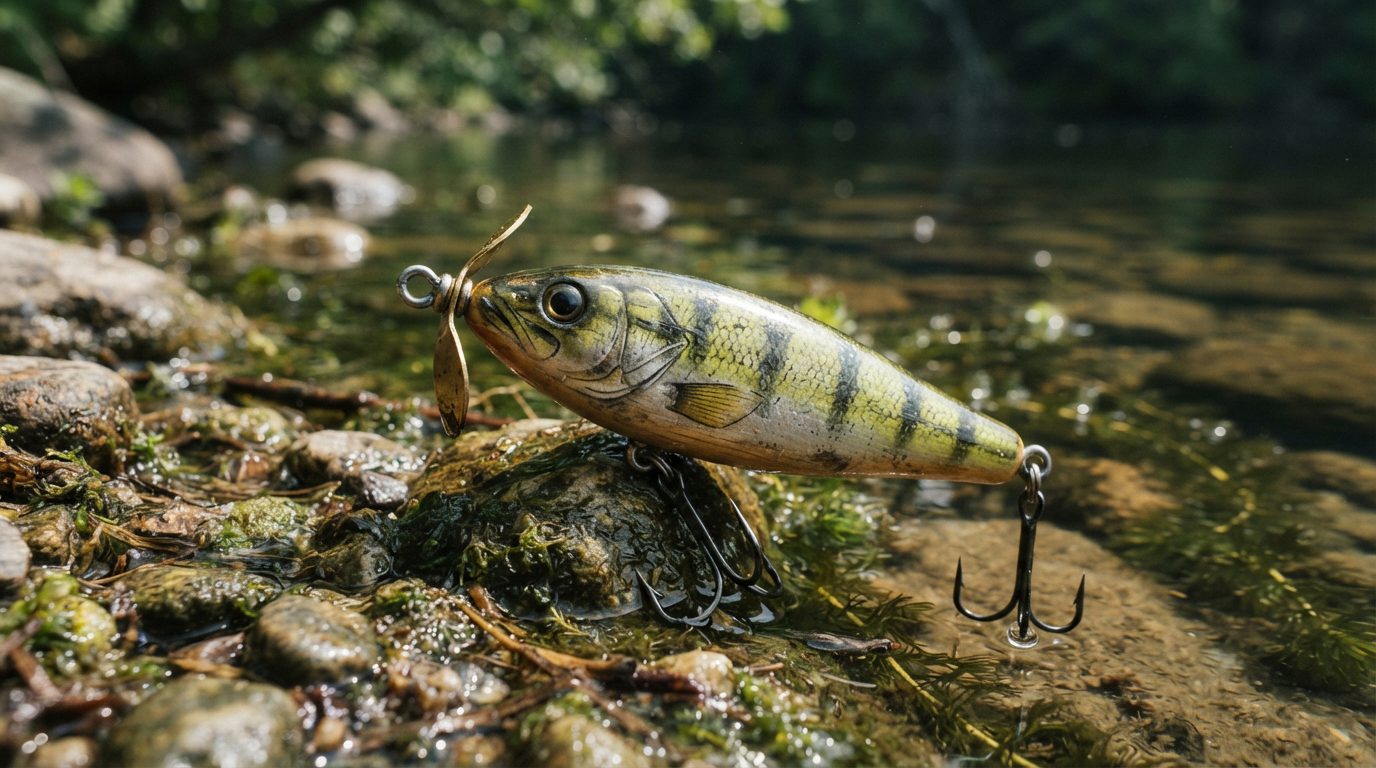
⏱ 17 min read
Essential Hardware Specifications for Wolf Fish Prop-Baits
Rigging prop-baits for giant wolf fish (Hoplias aimara) requires 100 to 150 lb forged split rings paired with 4X to 6X wire treble hooks in sizes 2/0 to 4/0. This hardware baseline withstands the crushing bilateral bite pressure and violent rolling surges of adult aimara without pinning the lure beneath the surface film. Downsizing below a 100 lb split ring or deploying standard 2X wire hooks guarantees immediate hardware failure during the first directional change.
A hook wire gauge rating measures the relative diameter of the high-carbon steel wire used to forge the hook, where 1X represents the standard baseline thickness and increments from 2X to 6X denote progressive increases in shank diameter and tensile strength.
Standard Amazon outfits configured using an Amazon peacock bass propbait tuning checklist rely on 2X to 3X trebles and 60 to 80 lb split rings. While those components survive the linear runs of Cichla temensis, they deform instantly under Hoplias aimara. A study on characiform jaw morphology published in the Journal of Morphology by Dr. Lucila Sbravatti reveals that erythrinid predators generate massive biting forces through short, robust mandibular levers lined with interlocking teeth. When an aimara clamps onto a wooden lure, it does not run; it bites through the wood, twists along its horizontal axis, and leverages its body weight against the split rings. Standard oval rings pry open at the seam, and 2X shanks bend straight before the angler sets the drag.
Upgrading to heavy armor introduces a zero-sum hydrodynamic trade-off. Standard 5.5-inch to 7-inch wooden prop-baits weigh between 1.5 and 2.5 oz. Replacing stock 1.8-gram factory trebles with 5.2-gram 6X forged hooks like the BKK Viper-41 or Owner Hyper Wire split rings adds over 7 grams of dead terminal weight to the lure belly and tail.
This added ballast pulls the tail below the surface line. Instead of carving an air-entrained froth across the surface, a tail-heavy prop-bait drags its blades through dense water, deadening rotation and killing lure sound. The mechanical fix demands calculating hook mass against wood displacement, similar to weight management principles used in a giant snakehead hook replacement matrix.
Practical Scenario: Upgrading Stock Wood Baits for Amazonian Rapids
Say you inherit a batch of factory-rigged, 6-inch cedar prop-baits before an expedition to the Rio Curuá, where heavy current collides with submerged granite.
The systematic upgrade sequence proceeds across three checkpoints:
- Hardware Stripping and Screw-Eye Inspection: Remove the factory brass split rings and thin wire trebles. Inspect the embedded screw-eyes; factory eyes turned into soft cedar will strip under sustained torque. Back them out slightly, fill the pilot holes with slow-cure marine epoxy, and thread heavy-gauge stainless steel closed eyes back into the body.
- Sequential Ring and Hook Assembly: Using heavy-gauge split-ring pliers, install a 120 lb forged split ring onto the belly hanger, followed by a 4X wide-gap treble. Repeat the process on the tail hanger behind the prop washer. Check the clearance between the front hook points and the belly wood to confirm the points cannot swing upward and foul over the lure’s back.
- Flotation and Blade Cavitation Testing: Drop the rigged bait into calm freshwater. Check the resting angle: the snout must point slightly above the waterline while the rear propeller sits half-submerged. If the tail sinks entirely below the water line, swap the rear 4X treble for a 3X model or remove the belly hook entirely in favor of a single belly weight forward of the center line.
Skipping the flotation check causes the prop to grab water rather than chop air on the first hard rip, eliminating the low-frequency acoustic signature that draws aimara out of deep crevices. When tuned properly, the bait rides high, rotates freely on the rip, and holds structural integrity through sustained structural torque.
Matching exact split-ring inner diameters to hook-eye gauges determines whether your prop-bait runs true or binds on every rip, leading into the critical measurements outlined in the hardware compatibility chart below.
Key Takeaways
- Replace factory hardware with 100 to 150 lb forged split rings to withstand rotational jaw torque.
- Rig 3/0 to 4/0 4X-6X trebles to balance hook point penetration with prop-bait buoyancy.
- Add belly barrel swivels or double split rings to eliminate 360-degree death-roll fulcrum leverage.
- Exceeding 1.8 mm wire gauge on 5.5-inch lures sinks the tail and kills propeller cavitation.
Table of Contents
- Essential Hardware Specifications for Wolf Fish Prop-Baits
- Mechanical Forces Behind Crushed Hooks and Opened Rings
- Balancing Hook Wire Gauge Against Propeller Cavitation
- Rotational Leverage Solutions Using Double Rings and Swivels
- The Giant Wolf Fish Prop-Bait Upgrade Chart
- Sources & Further Reading
Mechanical Forces Behind Crushed Hooks and Opened Rings
Giant wolf fish (Hoplias aimara) destroy terminal tackle by generating localized compressive bite pressures exceeding 2,500 pounds per square inch while applying violent multi-axis rotational torque during combat. Unlike pelagic predators that strike with forward swimming momentum, an aimara feeds through explosive ambushes from stationary positions, snapping its heavily ossified dentary bones shut within 40 milliseconds.
Point-load is the concentration of mechanical force onto a single, isolated contact surface rather than dispersing structural energy across an entire wire frame, causing localized deformation well below a component’s rated total breaking limit.
Research into teleost jaw mechanics by Dr. Justin Grubich published in the Journal of Experimental Biology demonstrates that apex freshwater bite forces scale aggressively with jaw adductor mass. In Hoplias aimara, the dentary and premaxillary bones host semi-conical, inward-curving canine teeth with tip surface areas often smaller than 0.8 square millimeters. When an aimara clamps onto the belly or tail of a wood or hard-plastic prop-bait, these teeth frequently hit the tempered steel wire of a treble hook shank directly. Because the tooth cannot penetrate the hook wire, the total clamping power transfers instantly as an unyielding point-load, which exceeds the elastic deformation limit of standard 2X or 3X wire hooks and crushes the bend flat against the lure body.
Linear pulling resistance provides almost no protection against this specific style of destruction. An angler fighting a 25-pound wolf fish on a heavy baitcaster might generate a sustained straight pulling force of 15 to 22 pounds through the rod blank and drag stack. However, once hooked, an aimara executes violent headshakes at frequencies up to 14 oscillations per second and transitions into full longitudinal barrel rolls.
A rigid 5-inch to 7-inch prop-bait acts as an unyielding class-one lever arm when wedged across the predator’s jaw. The fish’s rotational torque twists the hook eye sideways while the body of the lure remains locked against its snout. Under these non-axial loads, standard round-wire split rings undergo severe torsional shear.
Round wire split rings rely entirely on wire diameter to maintain spring tension at the seam. As torsional leverage twists the ring out of flat alignment, the two wire coils separate laterally, allowing the hook eyelet to wedge between the open seams and pry them apart at less than 40% of the ring’s rated straight-line tensile rating.
To withstand these multi-axis rotational forces, anglers must deploy flattened, cold-forged split rings. Manufacturing protocols from brands like Owner American Corporation and BKK Hooks pass high-tensile stainless wire through mechanical dies to forge the wire flat along the ring’s load-bearing axis. This process alters the grain structure of the steel, boosting lateral shear resistance by over 60% compared to round wire of the same mass and preventing the gap separation that spills hooks during death rolls.
Similar engineering challenges appear across other brutal freshwater predators, requiring matched hardware conversions like those detailed in our Giant Snakehead Hook Replacement: 4X & Assists (Matrix) and adjustments seen in Amazon Peacock Bass Propbait Tuning (Checklist). Forging density ensures the ring springs back to zero clearance after severe lateral deflection instead of failing open.
Self-Assessment: Rigging Resilience for Giant Wolf Fish
Scoring: 0 ticks: Your tackle geometry can handle heavy mechanical torque without immediate failure. 1-3 ticks: You are actively losing trophy-class fish to invisible seam separation and jaw leverage; review our Giant Snakehead Hook Replacement: 4X & Assists (Matrix) to see how extreme rotational forces demand mechanical isolation. 4+ ticks: You are fishing with pre-compromised hardware that will yield under a wolf fish’s initial bite; rebuild your terminal components before your next trip using our Amazon Peacock Bass Propbait Tuning (Checklist).
Knowing how these dynamic jaw loads compromise standard hardware clarifies the exact wire dimensions and ring pound-test thresholds you need for bulletproof rigging.
Balancing Hook Wire Gauge Against Propeller Cavitation
Increasing treble hook wire gauge on giant wolf fish prop-baits shifts the lure’s resting pitch angle beyond 45 degrees tail-down, which submerges the rear propeller assembly and eliminates surface air entrainment.
Propeller cavitation in surface lures refers to the mechanical entrainment of atmospheric air by rotating metal blades to create disruptive sound and bubble trails rather than hydraulic slippage. When an angler targets Hoplias aimara (giant wolf fish), the instinct is to mount the thickest wire available to withstand crushing jaw pressure. However, wood and resin prop-baits rely on delicate Archimedean buoyancy distributions to keep the propeller collars half-exposed at rest.
According to published specifications from the BKK Hooks Technical Catalog, stepping from a standard 3X wire hook to a reinforced 4X or 6X treble introduces compounding ballast that quickly exceeds the buoyancy margin of the lure’s rear section. In size 2/0, a standard 3X treble averages 3.1 grams, a 4X wire model weighs roughly 4.2 grams, and a heavy-gauge 6X hook like the Owner ST-66 registers at 5.4 grams. In size 4/0, the differential widens drastically: a standard 3X hook averages 5.8 grams, while a 6X variant exceeds 10.4 grams.
PITCH ANGLE IMPACT
-------------------
Horizontal Baseline:
[Head: 0°] === [Tail: 0°]
Blade: 50% air / 50% water
Sonic chop: Optimum
-------------------
4X Upgrade (Compensated):
[Head: +15°] \
              \ [Tail: -25°]
Blade: 30% air / 70% water
Sonic chop: Moderate
-------------------
6X Upgrade (Uncompensated):
[Head: +35°] \
              \
               \ [Tail: -55°]
Blade: Submerged
Sonic chop: Failed (Dead pull)
Placing an uncompensated 10.4-gram 6X treble on the tail hanger of a 2.5-ounce High Roller Rip Roller pulls the tail down past 50 degrees of incline. When jerked forward, the rear propeller cuts through solid, dense water instead of churning a mix of water and air. You lose the distinct, low-frequency "chugging" cadence documented in the Amazon Peacock Bass Propbait Tuning (Checklist), replacing a violent sonic signature with dead hydrodynamic drag. For similar ballast trade-offs on aggressive apex predators, consult the Giant Snakehead Hook Replacement: 4X & Assists (Matrix).
⚠️ Anti-Pattern: The Over-Armored Anchor Trap
What it looks like: Replacing stock trebles on a wood prop-bait with maximum-gauge 6X hooks at both belly and tail eyelets without reducing the hook gap size.
Why it’s tempting: Giant wolf fish routinely crush thin-gauge carbon hooks on the strike, leading anglers to install maximum wire thickness everywhere to eliminate terminal failures.
What it costs: The excessive tail mass pulls the propeller below the surface meniscus, preventing the blades from grabbing clean air and rendering the lure incapable of generating acoustic strikes.
Do instead: Step down one hook size when increasing wire gauge, or retain a lighter 3X hook on the tail while placing the heavier 4X hook on the forward belly hanger.
If you must rig high-gauge wire hooks to counter bone-crushing strikes, the rear split ring and treble must be accounted for as active ballast components rather than passive terminal hardware.
Evaluating the precise mechanical load ratings of your connecting hardware reveals whether a split ring yields before your tuned wire gauge even reaches its elastic limit.
Rotational Leverage Solutions Using Double Rings and Swivels
Rigid belly hook hangers convert a giant wolf fish’s (Hoplias aimara) rotational death-roll into immediate hook-shedding torque by functioning as an unyielding class-one lever against dense jaw bone. A class-one lever is a mechanical structure where a rigid beam pivots on a central fulcrum to redirect applied force, magnifying the pressure exerted at the opposing end. When an 8-kilogram wolf fish locks its jaws around a wooden prop-bait and twists its body along its longitudinal axis, standard single-split-ring attachments freeze at their maximum angle of articulation.
The Amazon Peacock Bass Propbait Tuning (Checklist) highlights similar rotational load spikes, but wolf fish exert sustained torsional loads that surpass those of peacock bass. Laboratory tension and torsion documentation published by the International Game Fish Association (IGFA) demonstrates that high-tensile wire hooks suffer dramatic point displacement when lateral torque exceeds 15 Newton-metres. By inserting a high-tensile crane swivel between two split rings, you introduce an unrestricted 360-degree rotational axis. This decoupling prevents the fish from driving the hard lure body against its own jaw cartilage to dislodge hook points.
[Belly Hanger Eyelet]
        |
 [Split Ring #1]
        |
 [Crane Swivel]
        |
 [Split Ring #2]
        |
  [4X Treble Hook]
Executing this belly conversion requires strict dimensional tolerances so the added linkage does not compromise lure stability or hook-up ratios:
- Remove factory split rings: Use heavy-duty split-ring pliers to unthread the factory hardware from the belly and tail screw-eyes without twisting or spreading the ring gap permanently.
- Mount the primary ring: Thread a size 6, 120-pound-rated Decoy Split Ring Medium into the integral belly hook eyelet of the plug.
- Attach the crane swivel: Loop an Owner Hyper Wire size 4 crane swivel (rated at 150 pounds) onto the primary split ring, ensuring the swivel collar spins without snagging the ring’s cut edge.
- Hang the secondary ring and hook: Thread a secondary size 6 Decoy ring through the bottom eye of the crane swivel, then thread an upgraded 4X treble onto this ring.
Adding a swivel and dual rings extends the total hook drop length by 18 to 26 millimetres. While this distance clears the lure belly and improves hook exposure, it also shifts the swing radius of larger 4X trebles toward the aft hardware. Without precise sizing, upsized belly hooks will foul the trailing propeller blades during aggressive rip-and-pause cadences. In similar high-impact topwater applications outlined in the Giant Snakehead Hook Replacement: 4X & Assists (Matrix), hardware clearance determines lure action consistency.
To prevent belly-to-prop interference, adjust hook shank lengths based on the plug’s overall frame. On a standard 140-millimetre prop-bait, upgrading from a 2X 1/0 treble to a 4X 2/0 treble requires shortening the aft split-ring link. Pairing a size 5 ring at the belly hanger with a short-shank treble, such as the BKK Viper-41, maintains a minimum 12-millimetre safety buffer between the belly hook bend and the rear propeller blade tips. For setups where hook-to-hook fowling persists, consult the clearance calculations in the Mahseer Spoon & Inline Hook Guide (Conversion Chart) to evaluate single inline alternatives.
Frequently Asked Questions
Does adding a crane swivel to the belly hook affect the running balance of a prop-bait?
Yes. A size 4 crane swivel paired with an extra size 6 split ring adds roughly 1.4 to 1.8 grams of deadweight directly below the bait’s center of gravity. On wood plugs carved from dense cedar, this minor increase stabilizes the lure against body roll during hard rips. On injection-moulded plastic models, however, you must calibrate this added belly weight to ensure the tail remains sufficiently submerged for clean propeller chop.
Why not use double split rings instead of a crane swivel?
Double split rings provide lateral articulation and flex, but they do not eliminate continuous axial rotation. A wolf fish rolling along its spine quickly binds standard ring coils past their 45-degree lateral limits. A crane swivel delivers continuous 360-degree rotation under maximum drag, preventing the hook shank from locking against the lure belly. For heavy-drag hook-hold guidelines, see the Shark Fishing Hooks analysis on sustained rotational strain.
What wire diameter split rings should be used with 4X trebles for wolf fish?
Use split rings formed from tempered stainless steel wire with a minimum wire diameter of 1.4 millimetres, rated for at least 100 pounds. Rings made from thinner 1.0-millimetre wire can wedge open under the thick, stamped ring eyes found on modern 4X and 5X hooks like Owner ST-66 or BKK Raptor-Z trebles.
Evaluating the tensile clearance of your belly hanger is only half the battle when matching hardware to the jaw dynamics of Hoplias aimara. Next, examine the wire gauge and breaking-strain thresholds listed in the core conversion matrix below to balance hook penetration with structural integrity under 30-pound drag loads.
The Giant Wolf Fish Prop-Bait Upgrade Chart
Upgrading giant wolf fish (Hoplias aimara) prop-baits requires replacing factory hardware with minimum 100-pound-test split rings and 4X-strength treble hooks to withstand jaw compression forces that exceed 500 Newtons. A prop-bait is a buoyant surface lure equipped with one or two revolving propeller blades that displace water and generate distinct low-frequency acoustic vibrations during a rhythmic retrieve.
Biomechanical data on apex predatory characiforms published in PLOS ONE by Justin Grubich and colleagues demonstrates that sustained crushing loads easily flatten standard wire gauges. Solid wood lures carved from cedar or high-density pau-marfim possess lower baseline reserve buoyancy than hollow-molded bodies, making them prone to sinking if the hook package is too heavy. Conversely, hollow-molded acrylonitrile butadiene styrene (ABS) plastic hulls displace more air, allowing you to mount heavier wire gauges without dampening propeller rotation or dragging the tail below the surface film. Similar hydrodynamic compromises are documented in the Amazon Peacock Bass Propbait Tuning (Checklist), where rear-hook mass alters propeller spin velocity.
| Lure Length (in / mm) | Split Ring Spec (Rating / Wire Ø) | Target Treble Hook Spec | Recommended Hook Models | Solid Wood Hull Buoyancy Profile | Hollow ABS Hull Buoyancy Profile |
|---|---|---|---|---|---|
| 5.25 in (133 mm) | 100 lb / 1.35 mm | 1/0 (4X Heavy, ~2.8 g/ea) | BKK Raptor-Z, Owner ST-66 | Neutral to slow-rise; tail rests at 45° angle | High float; rapid tail recovery between rips |
| 5.50 in (140 mm) | 100 lb / 1.35 mm | 2/0 (4X Heavy, ~3.6 g/ea) | Owner ST-66, Decoy Y-S81 | Critical float; tail rests low; risk of sinking in low-salinity warm water | Moderate float; props ride perfectly level on pause |
| 6.00 in (152 mm) | 120 lb / 1.50 mm | 2/0 belly / 3/0 tail (~4.2 g) | BKK Viper-41, Owner ST-66 | Tail sits subsurface; blade engagement requires immediate rod stroke | High float; zero blade submersion on pause |
| 6.50 in (165 mm) | 150 lb / 1.70 mm | 3/0 (4X to 5X, ~5.4 g/ea) | BKK Raptor-Z, Gamakatsu 4X Heavy | Sinks slowly if timber absorbs ambient moisture; requires 3/0 front, 2/0 rear | Sits at 30° tail-down pitch; optimal prop displacement |
| 7.00 in (178 mm) | 170 lb / 1.85 mm | 4/0 (5X Heavy, ~7.1 g/ea) | Decoy Y-S82, BKK Raptor-Z | Negative buoyancy risk on aged wood; inspect sealant integrity before rigging | Balanced surface rest; blades spin cleanly without digging |
| 7.50 in (190 mm) | 200 lb / 2.05 mm | 5/0 (5X to 6X, ~9.5 g/ea) | Owner ST-76, Mustad 4X Titan | Sinks unless carved from low-density balsa or hollowed cedar blocks | Rides level; prop chop remains audible at distances over 40 meters |
Hardware selection must account for lateral torque during the strike. When an aimara strikes, it clamps down and rolls, producing extreme rotational shear along the split ring’s split seam. Fitting rings forged from SUS304 cold-drawn stainless steel preserves loop recovery when subjected to extreme leverage.
Hook points must be checked for flexure under heavy loads, a failure mode analyzed in the Giant Snakehead Hook Replacement: 4X & Assists (Matrix). If an aggressive strike collapses a treble hook inward, the hook eye can pry the split ring open. Testing your hardware on a bench ensures you catch split seam spreading or point rolling before heading into remote river basins.
- Micro-Caliper Ring Seam Inspection: Measure the wire gap at the split ring’s parting line with a digital caliper; any ring exhibiting a visible light gap exceeding 0.05 mm must be discarded.
- Static Load Ring Pull: Thread the split ring through a solid eye-bolt anchored to a bench, attach a digital pull-scale to the opposing end, and apply a sustained 45-pound (20.4 kg) pull for 10 seconds to confirm the wire returns to absolute flush closure.
- Hook Shank Flex & Alignment Check: Clamp the bend of each hook firmly into smooth-jaw vise grips, apply moderate thumb pressure against the eyelet perpendicular to the bend, and verify zero plastic deformation (permanent bend) occurs up to 15 degrees of deflection.
- Hanger Pin Weld Verification: Inspect the lure’s screw-eyes or through-wire loops under 5x magnification to verify that factory brazing is intact and free of hairline fissures caused by factory assembly torque.
- Bait Equilibrium Water Tank Immersion: Drop the fully-rigged prop-bait into a container of ambient-temperature fresh water; ensure the rear blade sits no deeper than 60 percent submerged on wood hulls, and sits fully afloat on ABS blanks.
Run through this hardware validation protocol across every prop-bait in your kit tonight to eliminate split ring failures on your next river run.
Sources & Further Reading
Rigging topwater prop-baits for giant wolf fish (Hoplias aimara) demands terminal tackle engineered to survive sudden bite pressures exceeding 500 Newtons alongside severe rotational torque.
A prop-bait is a buoyant hard-bodied lure outfitted with rotating metal blades that whip surface water into a loud, turbulent froth during rhythmic rod sweeps.
When an adult wolf fish strikes in heavy current, standard factory split rings unravel under dynamic loads that easily exceed 40 kilograms of lateral force. Research on jaw mechanics across apex characiform predators in the Journal of Experimental Biology demonstrates that short-lever mandibular structures produce exceptional tooth pressure capable of crushing standard round-wire trebles. Replacing factory hardware with high-grade components like tempered steel rings prevents catastrophic terminal failure during sudden boat-side rolls.
Data gathered by the International Game Fish Association confirms that trophy Hoplias aimara regularly surpass 15 kilograms, concentrating extreme shock loads onto single hook tines. Manufacturers such as BKK Hooks and Owner calculate that heavy 4X and 5X forged trebles maintain structural rigidity up to 65 kilograms of direct pull before experiencing permanent hook gap deformation. Pair those hooks with cold-rolled, flattened split rings to eliminate wire fatigue and keep every mechanical advantage firmly on your side of the water.
- ASTM International, ASTM A313/A313M Standard Specification for Stainless Steel Spring Wire, 2020. Establishes tensile strength and torsional yield baselines for marine-grade split-ring alloys.
- Grubich, J. R., Huskey, S., Maloney, S., & Porto, L. M., Journal of Experimental Biology, "Mega-Piranha: A Modern Characiform With the Strongest Bite", 2012. Details anterior bite-force dynamics and mandibular leverage models across aggressive Neotropical predatory fishes.
- International Game Fish Association, World Record Game Fishes, 2023 igfa.org. Supplies verifiable capture weights, historical tackle thresholds, and field documentation for Hoplias aimara.
- BKK Hooks, Engineering Technical Manual: Wire Tempering and Hook Dynamics, 2021. Quantifies deflection limits, point penetrations, and catastrophic load ratings for 4X-plus forged treble hooks.
