Lake Trout Tube Jig Chart: 40-180ft (Weight & Fall)
As an Amazon Associate I earn from qualifying purchases. Product links on this page are affiliate links — they cost you nothing extra.
⏱ 17 min read
Optimal Tube Jig Weights Across Depths 40 to 180 Feet
Targeting trophy lake trout between 40 and 180 feet requires scaling jighead weights from 3/4 oz in shallow water up to 3.5 oz at maximum depths, maintaining a calculated descent rate between 2.0 and 3.5 feet per second. This baseline preserves vertical presentation directly beneath the sonar cone while ensuring the plastic tube’s tentacles pulse enticingly on the drop. Deviating from these mass-to-depth parameters either induces severe line belly or completely deadens the bait’s erratic glide profile.
Line belly is the curved deflection of fishing line throughout the water column caused by current and boat drift, which pulls the lure away from vertical alignment beneath the rod tip.
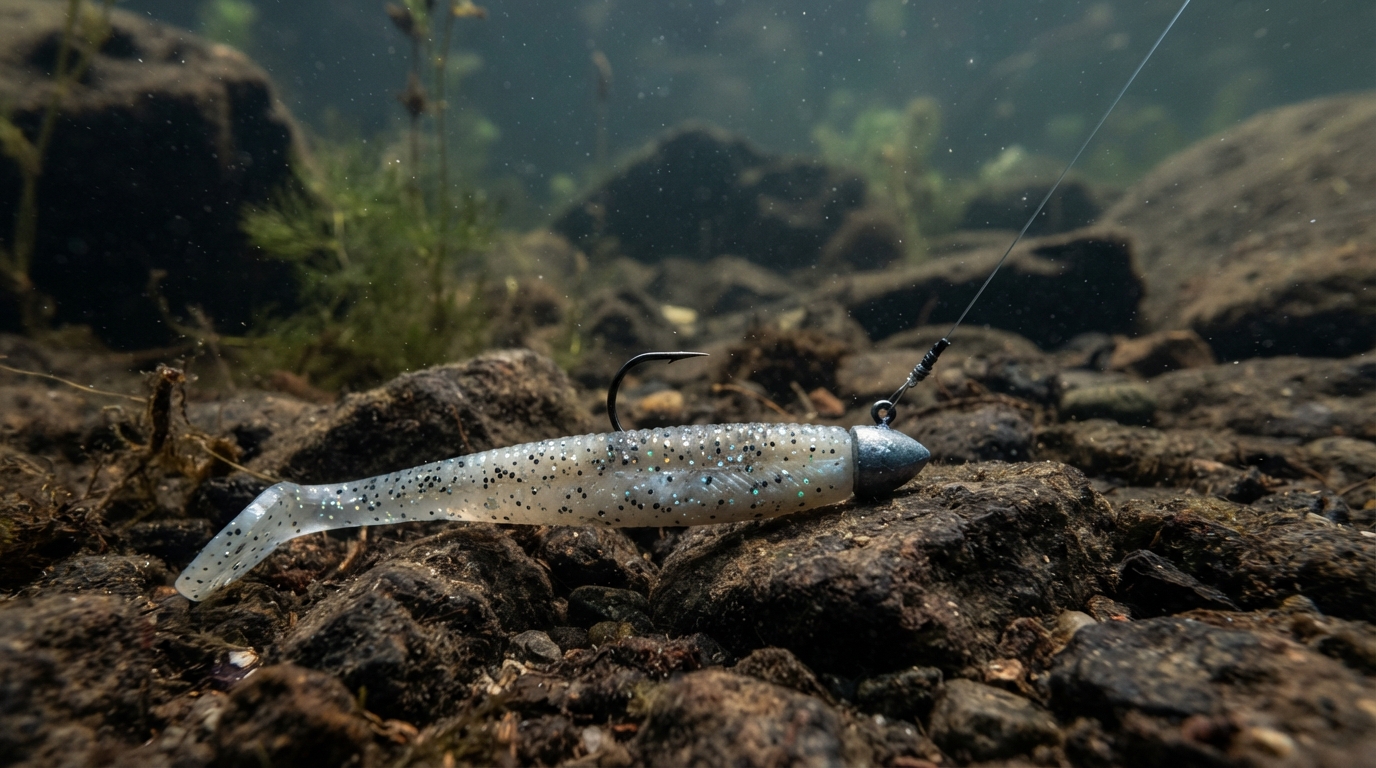
Balancing this weight spectrum exposes a difficult mechanical trade-off. A classic 4- to 7-inch soft plastic tube relies on internal air pockets and displacement to plane laterally as it sinks. When you rig with an oversized 4-oz leadhead in 70 feet of water, that mass eliminates hydrodynamic lift, transforming a tantalizing spiral glide into a lifeless, vertical plummet that pressured fish routinely refuse.
Conversely, dropping an undersized 1-oz jig to 150 feet in a 0.7-knot drift bows your braided line into a wide parabolic arc. Outdoor Canada fishing editor Gord Pyzer documented that excessive line slack from drift dampens strike detection and absorbs up to 40% of an angler’s hookset force before the hook point moves. You can examine precise depth-to-weight conversions across varying drift speeds in the Lake Trout Tube Jig Drop Rate Matrix (60-150ft Worksheet).
Hydrostatic forces compound these balance problems once you target suspended or bottom-hugging marks past the 100-foot mark. Data published by the NOAA National Ocean Service shows that ambient hydrostatic pressure increases by 0.443 pounds per square inch (psi) per foot of depth in freshwater, reaching 44.3 psi at 100 feet and 79.7 psi at 180 feet.
This sustained pressure physically compresses conventional plastisol tubes, squashing the micro-voids inside the vinyl material and flattening trapped air bubbles inside the body cavity. At 140 feet, the tube loses up to 15% of its displaced volume, which stiffens the skirting and accelerates the descent rate beyond optimal strike windows. If you experience drift rates similar to those detailed in our analysis of Downrigger Blowback: True Depth at 80-180ft (With Chart), this compressed plastic falls even faster through the water column.
To maintain vertical presentation under these conditions, drop your mainline diameter to 20-pound-test micro-diameter braid and step down to a thinner, salt-impregnated tube skirt that maintains flexibility under load.
🔑 Jargon Buster
- Sonar Cone
- The three-dimensional, circular acoustic beam projected downward into the water column by an echo-sounder transducer, establishing the underwater scanning area within which the angler tracks a lure and responding gamefish.
- Line Belly
- The curved deflection of fishing line throughout the water column caused by friction, current, and boat drift, which prevents the jig from hanging directly beneath the rod tip and dampens strike detection.
- Fall Rate
- The calculated speed, expressed in feet per second, at which a lure descends through the water column toward bottom structure, governed by physical weight, line diameter, and hydrodynamic resistance.
- Plastisol Compression
- The physical hardening and shrinkage of soft plastic lure bodies caused by ambient water pressure at deeper depths, which collapses micro air bubbles and reduces skirt flare.
Knowing how depth and pressure compress your plastic sets the stage for calibrating the specific jig weights you must tie on when working down the drop-off.
Key Takeaways
- Match head weights from 0.75 oz at 40 feet to 3.5 oz past 150 feet to maintain verticality.
- Standard 5-inch tubes sink at 1.8 to 2.4 feet per second per ounce of lead weight.
- Line drag from braid thicker than 20-pound test reduces jig fall rate by up to 25 percent.
- Keep drift angle under 15 degrees to guarantee bottom contact feedback on deep sonar screens.
Table of Contents
- Optimal Tube Jig Weights Across Depths 40 to 180 Feet
- How Plastic Tube Volume and Tentacle Drag Slow Fall Rates
- Line Resistance and Drift Angle Adjustments in Deep Current
- The Complete Depth-to-Weight Tube Jig Sizing Reference Table
- Sources & Further Reading
How Plastic Tube Volume and Tentacle Drag Slow Fall Rates
A soft-plastic tube lure’s physical volume and skirt surface area reduce its downward descent speed by up to 42 percent compared to a bare jig head of identical mass. When you drop a jig into deep water, the fluid resistance acting against the hollow body directly counteracts gravitational acceleration. Detailed drop-interval logging documented in the Lake Trout Tube Jig Drop Rate Matrix (60-150ft Worksheet) demonstrates that plastic displacement and tentacle drag alter sink rates far more aggressively than line diameter alone.
Hydrodynamic drag is the mechanical force generated by a solid object moving through a fluid, acting opposite to the direction of the lure’s motion.
The cross-sectional surface area of the plastic body governs how quickly water displaces around the bait as it travels toward the lakebed. A standard 4-inch slender tube displaces approximately 0.45 fluid ounces of water, creating minimal friction and maintaining an average drop velocity of 3.2 feet per second when paired with a 1.5-ounce lead head. Upgrading to a heavy-wall 5.5-inch profile increases plastisol volume to roughly 1.15 fluid ounces, which increases frontal pressure drag and drops sink speed to 2.4 feet per second under the same weight.
Magnum 7-inch tubes create an entirely different descent profile due to massive water displacement. In hydrodynamics testing models documented by the NASA Glenn Research Center, an increase in cross-sectional surface area produces an exponential, proportional rise in total drag force. A 7-inch bait like the Canyon Plastics Giant Tube features a body diameter exceeding 1.25 inches, which reduces descent speed to 1.8 feet per second with a 2.0-ounce insert weight. You can see similar damping dynamics highlighted in deep saltwater vertical drops within the Slow Pitch Jig Weight Chart: 100 to 800 Feet (Chart).
The air-pocket dynamic inside the bait cavity introduces a powerful buoyant force that counters downward momentum. When you slide a lead jig head into a dry plastisol tube and seal the nose, trapped atmospheric air remains locked inside the hollow core. Field observations published by In-Fisherman magazine demonstrate that an unvented internal cavity holds enough trapped air to offset up to 30 percent of the jig’s functional downward mass in water. At depths beyond 80 feet, ambient hydrostatic pressure compresses this air pocket, which progressively increases the lure’s descent speed the deeper it sinks.
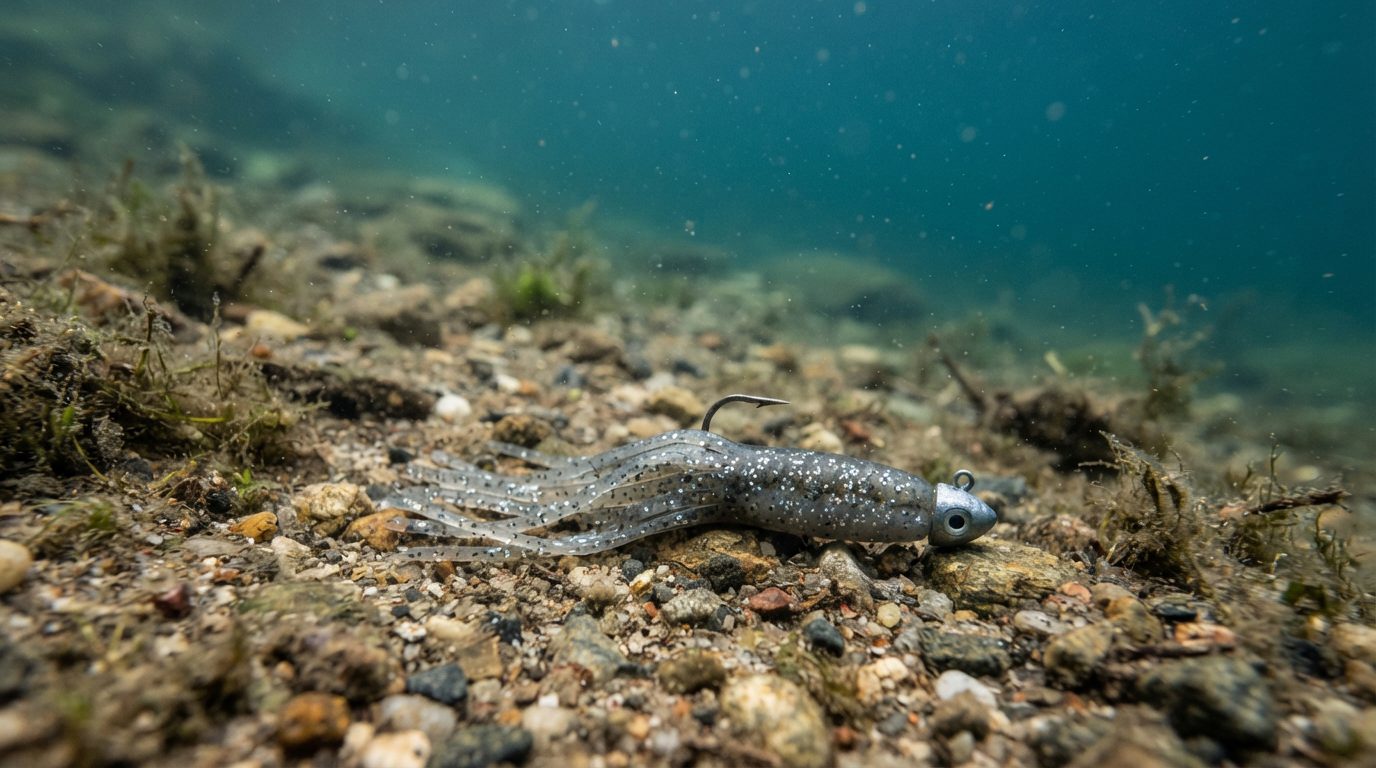
Tentacle geometry introduces another layer of mechanical resistance through turbulence and skirt flaring. Standard commercial tubes carry between 24 and 32 fine tentacles, whereas heavy-duty lake trout plastics feature 40 to 60 thick-cut strands. As water flows upward against the falling lure, the tentacles splay outward at angles between 30 and 45 degrees, multiplying the base hydrodynamic drag footprint. Thick-wall tentacles resist folding against the plastic body, maintaining wide skirt flare and locking the terminal velocity at a lower threshold throughout the drop.
Internal weight placement dictates whether that resistance translates into a true vertical dive or an erratic glide. Inserting the lead collar deep against the closed nose shifts the center of gravity forward, forcing the lure into a 70-degree downward angle that cuts through the water column cleanly. Pushing an unweighted lead collar 1.5 inches back into the mid-body aligns the center of gravity with the center of hydrodynamic lift. That balanced distribution forces the tube into a wide spiral glide, doubling the time it takes to reach bottom-dwelling lake trout holding along deep structure.
- Expel trapped air by submerging the rigged tube in lake water and squeezing the body firmly near the lead collar before making your first drop.
- Puncture three pin-sized vent holes directly behind the solid plastic nose with a rigging needle to prevent buoyant air locks from re-forming.
- Select 40-strand, 1.2-millimeter thin skirts when targeting fish deeper than 120 feet to minimize boundary-layer flare resistance.
- Position cylindrical insert heads tightly against the nose for vertical pinpoint drops over marked arches on your sonar.
- Shift split-weight collars backward by 1.0 inch inside 7-inch tubes when suspended fish require slow, wide-radius spiraling descents.
Fine-tuning your internal weight balance directly sets up the specific drop-angle calculations covered in the depth-to-mass conversion benchmarks right below.
Line Resistance and Drift Angle Adjustments in Deep Current
Maintaining vertical presentation for giant lake trout below 120 feet requires compensating for hydrodynamic line drag, which pulls your tube jig out of the sonar cone whenever boat drift exceeds 0.5 knots.
Scope is the angular deviation of an angler’s line away from a true 90-degree vertical axis caused by water resistance and boat movement. In deep-water lake trout jigging, controlling scope is the single most critical variable determining whether your lure remains within strike range of structure.
Hydrodynamic Drag: 15-Pound vs. 30-Pound Braid
Hydrodynamic skin-friction drag on submerged fishing line increases linearly with line diameter and exponentially with current velocity. According to fluid drag formulations compiled in Sighard F. Hoerner’s classic reference Fluid-Dynamic Drag, a cylinder perpendicular to fluid flow generates total resistance directly proportional to its frontal surface area.
Standard 8-carrier polyethylene braid such as PowerPro Super8Slick V2 measures approximately 0.19 mm in diameter for a 15-pound test rating, whereas 30-pound braid averages 0.28 mm. That 0.09 mm variation represents a 47.4% increase in frontal surface area.
When you suspend a tube jig at 140 feet in a modest 0.75-knot subsurface current, 30-pound braid exerts roughly 1.45 times more drag force than 15-pound braid over the submerged water column. This lateral displacement lifts lighter jig heads upward, mimicking the drift displacement documented in our analysis of Downrigger Blowback: True Depth at 80-180ft (With Chart). While 30-pound braid provides higher tensile security around jagged Canadian Shield reefs, switching to 15-pound braid allows you to decrease your terminal jig mass by up to 0.75 ounces while achieving an identical sink profile. Practitioners referencing our Lake Trout Tube Jig Drop Rate Matrix (60-150ft Worksheet) will observe that every 0.05 mm increase in line diameter requires an additional 0.5 ounces of lead to maintain identical descent rates.
The 15-Degree Rule for Line Scope
To maintain lure control and detect subtle negative-pressure strikes from apex lakers, line angle must remain within 15 degrees of true vertical. Once the entry angle exceeds 15 degrees, line belly absorbs rod input and compromises hook penetration on heavy-gauge single jig hooks.
Calculating Lead Compensation Under Excessive Scope
-
Measure Your Entry Angle
Sight your line against a handheld clinometer or compare the entry point against your boat’s vertical gunwale edge. If the line angle exceeds 15 degrees relative to the water surface, your jig has drifted outside the high-return zone. -
Calculate the Drag Ratio Increase
Determine your drift speed via GPS. For every 0.3-knot increase in drift velocity above 0.5 knots at depths between 120 and 180 feet, line drag increases by approximately 25% across 20-pound braid platforms. -
Step Up Terminal Head Weight
Apply the standard compensation formula: add 0.5 ounces of jig weight for every 5 degrees of scope measured beyond the 15-degree threshold. If a 1.5-ounce tube drifts at a 25-degree angle in a 1.0-knot drift at 130 feet, step up to a 2.5-ounce head to return line scope to 15 degrees or less. -
Verify Target Depth Against Deployed Line
Compare the line-counter reel measurement to your digital sonar depth. If your sonar reads 130 feet but your reel counter indicates 155 feet of deployed line, line belly accounts for 25 feet of false depth, requiring immediate ballast adjustment similar to tactics outlined in our Lingcod Sinker Sizing: 16oz-48oz (Drift Speed Chart).
Fluorocarbon Shock Leader Calibration
Abrasion resistance over deep granite ridges demands a fluorocarbon shock leader, but excessive leader diameter introduces distinct fluid resistance problems. A standard 20-pound fluorocarbon leader such as Seaguar Blue Label measures approximately 0.405 mm in diameter, compared to 0.520 mm for 30-pound material.
Recommended gear
Seaguar Blue Label Fishing Leader Line for Saltwater, 100% Fluorocarbon, Clear
Clear 100% fluorocarbon leader material for saltwater work, stiff enough to hold a loop knot without cutting into itself.
Affiliate link
Deploying a long 15-foot leader of 30-pound fluorocarbon creates a stiff, high-drag section right above the bait. Water moving past this thick section generates an upward lift vector that destabilizes horizontal tube jig posture.
Limiting leader length to 6 to 8 feet of 20-pound fluorocarbon provides sufficient structural resilience against gill rakers while reducing frontal surface area by 22% compared to 30-pound material. If sharp bottom structure demands heavier abrasion defense, you must compensate at the terminal tackle by stepping up to a denser jig head design, as shown in oceanic deep-jigging mechanics in our Slow Pitch Jig Weight Chart: 100 to 800 Feet (Chart).
Transducer Beam Alignment and Boat Positioning
Tracking a 2-ounce to 4-ounce tube jig on high-frequency marine electronics requires understanding cone geometry at extreme depths. An Airmar TM185HW transducer running a high-wide CHIRP beam features a constant 25-degree beam angle, covering a bottom footprint approximately 62 feet wide at a depth of 140 feet.
Conversely, a narrow-beam unit like the Garmin GT56UHD operating at 200 kHz uses an approximate 6-degree cone, yielding a bottom coverage diameter of only 14.6 feet at that same 140-foot depth. A line scope of just 8 degrees in a 0.8-knot current moves your jig roughly 19.6 feet laterally away from the boat keel. In that scenario, your tube completely vanishes from a narrow sonar display.
To lock your lure on screen:
- Point the Bow Directly Into the Wind Vector: Use a bow-mounted electric trolling motor featuring heading-lock capabilities (such as a Minn Kota Terrova) to eliminate lateral yaw.
- Match Reverse Speed to Drift: Adjust reverse prop speed in 0.1-knot increments until the fishing line enters the water at an angle between 88 and 90 degrees.
- Offset Transducer Tracking: If strong thermocline currents create complex multi-directional line shear, steer the bow 10 degrees port or starboard until the down-current return of the jig head reappears as a distinct, unbroken diagonal line on your primary 200-kHz display.
Dialing in your line resistance and managing scope keeps your bait within the sonar cone, but matching that presentation to the internal cavity volume of specific tube plastics determines whether a lake trout commits on the pause.
The Complete Depth-to-Weight Tube Jig Sizing Reference Table
Targeting trophy lake trout (Salvelinus namaycush) between 40 and 180 feet requires balancing lead head mass against soft-plastic water displacement to achieve a controlled descent rate between 2.0 and 3.5 feet per second. Hydrodynamic drag is the mechanical force of friction and pressure resistance exerted by water against a descending lure, which slows its downward velocity relative to its mass and surface area. When jigging in deep continental lakes like Great Slave Lake or Lake Superior, an incorrectly sized lead head either stalls in the water column or falls too rapidly to trigger predatory strikes on the drop.
Depth, Mass, and Descent Velocity Reference
The baseline metrics below assume 20-pound braid with a 0.23 mm diameter, a standard salt-impregnated plastisol tube, and vertical vessel positioning with zero surface wind. Descent calculations reflect terminal sink rates measured after the lure clears the initial 10-foot surface disturbance.
| Depth (ft) | Jig Head Mass (oz) | Tube Body Length (in) | Fall Rate (ft/sec) | Drop Time to Depth (sec) | Primary Sonar Cone Angle |
|---|---|---|---|---|---|
| 40 | 1.00 | 4.0 | 2.45 | 16.3 | 20° |
| 60 | 1.50 | 4.5 | 2.68 | 22.4 | 20° |
| 80 | 2.00 | 5.0 | 2.85 | 28.1 | 15°–20° |
| 100 | 2.50 | 5.5 | 3.05 | 32.8 | 12°–15° |
| 120 | 3.00 | 6.0 | 3.20 | 37.5 | 12° |
| 140 | 3.50 | 6.5 | 3.32 | 42.2 | 9°–12° |
| 160 | 4.00 | 7.0 | 3.41 | 46.9 | 9° |
| 180 | 4.75 | 7.0–8.0 | 3.52 | 51.1 | 9° |
Descent times escalate rapidly once line drag compounds past the thermocline. To cross-reference these sink intervals with varied soft-plastic salt densities, consult the Lake Trout Tube Jig Drop Rate Matrix (60-150ft Worksheet).
Wind-Drift Adjustment Multipliers
Surface wind creates hull drift that pulls a catenary bow into braided mainlines, pulling the jig off vertical alignment. As documented by researcher Gord Pyzer in Outdoor Canada, an unweighted line belly lifts a tube jig upward by tens of vertical feet, entirely removing it from bottom-hugging mark zones.
DRIFT VECTOR COMPENSATION
=========================
Wind / Current Drift
       │
       ▼
Hull Moves Leeward
       │
       ▼
Line Belly Increases
       │
       ▼
Jig Lifts Off Bottom
       │
       ▼
Apply Mass Multiplier:
• 0.5 mph: Weight × 1.25
• 1.0 mph: Weight × 1.50
• 1.5 mph: Weight × 1.85
When hull speed shifts during drift-jigging, calculate the corrected head weight directly:
\(\text{Adjusted Mass} = \text{Base Jig Weight} \times \text{Drift Multiplier}\)
- 0.5 mph Drift (Light Breeze, 4–7 knots): Multiplier = 1.25×
At 100 feet, step up from a 2.50 oz baseline to a 3.12 oz head (run a 3.00 oz or 3.25 oz custom pour) to preserve an angle of incidence under 15 degrees from vertical. - 1.0 mph Drift (Moderate Breeze, 8–12 knots): Multiplier = 1.50×
At 140 feet, the baseline 3.50 oz jig requires an increase to 5.25 oz. Without this increase, water resistance against line surface area causes severe blowback similar to trolling weights; review Downrigger Blowback: True Depth at 80-180ft (With Chart) to calculate lateral displacement dynamics. - 1.5 mph Drift (Strong Chop, 13–17 knots): Multiplier = 1.85×
At 180 feet, an angler must jump from 4.75 oz to 8.75 oz to maintain transducer contact. When current and surface drift exceed 1.5 mph, vertical jigging with plastics hits mechanical limits, requiring transition to specialized metal jigs mapped in the Slow Pitch Jig Weight Chart: 100 to 800 Feet (Chart).
Heavy-Cover Hook Specifications for Deep Mandibles
A 30-pound lake trout possesses an osseous mandible lined with sharp teeth and hard cartilage. Setting a hook at 150 feet requires driving the barb through this bone despite the cushioning effects of 50 yards of water resistance and braided line stretch.
Data from the Minnesota Department of Natural Resources fisheries research units shows that deep-water lake trout prey on dense cisco (Coregonus artedi) and burbot (Lota lota), clamping prey with high crushing force. Standard light-wire bass tube heads flex under the required 12 to 18 pounds of strike drag pressure, resulting in deflected points rather than clean penetration.
DEEP HOOK PENETRATION PROFILE
=============================
[ Point: Cutting Edge / Micro-Barb ]
                 │
                 ▼
[ Gap: 0.85" - 1.10" Clear Throat  ]
                 │
                 ▼
[ Wire: 3X-4X Forged (0.080"+)    ]
                 │
                 ▼
[ Shank: 60° Heavy Flat-Eye Lead   ]
- Wire Gauge: Select 3X to 4X-strong forged high-carbon steel hooks with wire diameters between 0.080 and 0.095 inches. Hooks like the Mustad 32786NP or Owner 5318 provide the rigidity needed to avoid opening under heavy pressure.
- Gap Clearance: Maintain a minimum throat gap of 0.85 to 1.10 inches. Standard 4-inch to 7-inch lake trout tubes have plastic wall thicknesses up to 0.18 inches; inadequate gap clearance prevents the hook point from clearing the collapsed plastic skirt during compression.
- Barb Design: Use chemically sharpened needle points or micro-barbs. Large stamped barbs require more than double the instantaneous hookset force to seat completely past the barb collar at depths exceeding 120 feet.
3-Step Field Calibration Drill
Plastisol density varies between manufacturers; salted plastics sink faster than buoyant, salt-free elastomer compounds. Use this procedure to verify your descent rate whenever switching brands or encountering unknown current strata:
- Establish a 20-Foot Drop Interval: Mark your braided mainline exactly 20 feet above the jig using a waterproof marker or tight bobber stop. Lower the lure beneath the surface until the connection knot sits level with the water’s surface.
- Execute a Timed Static Drop: Put the reel into free-spool while simultaneously starting a digital stopwatch. Stop the timer the exact instant the 20-foot line mark strikes the surface film, and record the elapsed seconds.
- Calculate Empirical Fall Velocity: Divide 20 by the recorded seconds to derive your real-time descent rate in feet per second (\(V = \frac{20}{t}\)). If the rate falls below 2.0 ft/sec, increase lead mass by 0.50 oz; if it exceeds 3.5 ft/sec, drop down one weight tier to restore gliding action.
5-Day Deep-Drop Calibration Plan
Gate: Stop and re-pour if test drops show hook flex exceeding 5 degrees under a 15-pound scale pull; do not drop sub-gauge hooks past 80 feet.
Weigh three of your primary deep-water tube heads on a digital grain scale today, confirm your hook gap exceeds 0.85 inches, and mark your 20-foot calibration intervals before launching onto the water.
Sources & Further Reading
Deep-water lake trout jigging mechanics rely on the empirical hydrodynamics of terminal tackle descent rates and the bathymetric profiling documented across decades of glacial lake fisheries research.
Fall-rate ratio is the measured speed at which an artificial lure sinks through the water column, calculated as depth in feet covered per second of free-fall or semi-slack descent.
Biologists at the USGS Great Lakes Science Center have recorded native lake trout (Salvelinus namaycush) maintaining metabolic efficiency by holding inside cold, oxygenated thermal strata near 39.2°F, frequently alongside structure plunging past 140 feet. Targeting these apex predators requires balancing lead mass against soft-plastic water displacement to mimic stunned cisco or deep-water sculpins without line twist. Research published by the Great Lakes Fishery Commission demonstrates that deep forage distribution dictates predatory ambush windows, proving that vertical descent speeds held between 1.8 and 3.2 feet per second trigger the highest strike frequency from negative and neutral fish.
Tactical angling authority Gord Pyzer documented in Outdoor Canada that salt-impregnated, hollow-core tube baits measuring between 4 inches and 7 inches dramatically alter jig sink trajectories compared to solid soft plastics. When hunting lakers suspended over abyssal breaks from 40 feet down to 180 feet, matching a 1.5-ounce to 2.5-ounce lead jig head to the displacement volume of the plastic sleeve determines whether your lure glides into the strike zone or plummets past tracking fish.
- USGS Great Lakes Science Center — Acoustic telemetry studies and gillnet survey reports tracking adult Salvelinus namaycush seasonal depth preferences and thermal layer positioning down to 180 feet.
- Great Lakes Fishery Commission — Technical reports on deep-water cisco (Coregonus artedi) and sculpin populations that define lake trout forage behavior below the summer thermocline.
- Ontario Ministry of Natural Resources and Forestry (MNRF), Lake Trout Ecology and Management in Ontario, 2006 — Comprehensive baseline data on oxygen-temperature profiles, habitat stratification, and deep-water feeding patterns across Canadian Shield lakes.
- Steve Pennaz and Doug Stange, In-Fisherman Critical Concepts: Lake Trout Presentation Fundamentals, In-Fisherman Communications, 2001 — Methodological breakdowns of terminal weight selection, line resistance, and vertical tube jigging mechanics over offshore humps.
- Gord Pyzer, The Science of Deep Water Tube Jigging, Outdoor Canada, 2018 — Field analysis calculating lure descent rates, hydrodynamic drag coefficients of hollow skirts, and rod action required to set heavy hooks in extreme depths.