Owner ST-66 vs BKK Raptor-Z Sizing Matrix (Chart)
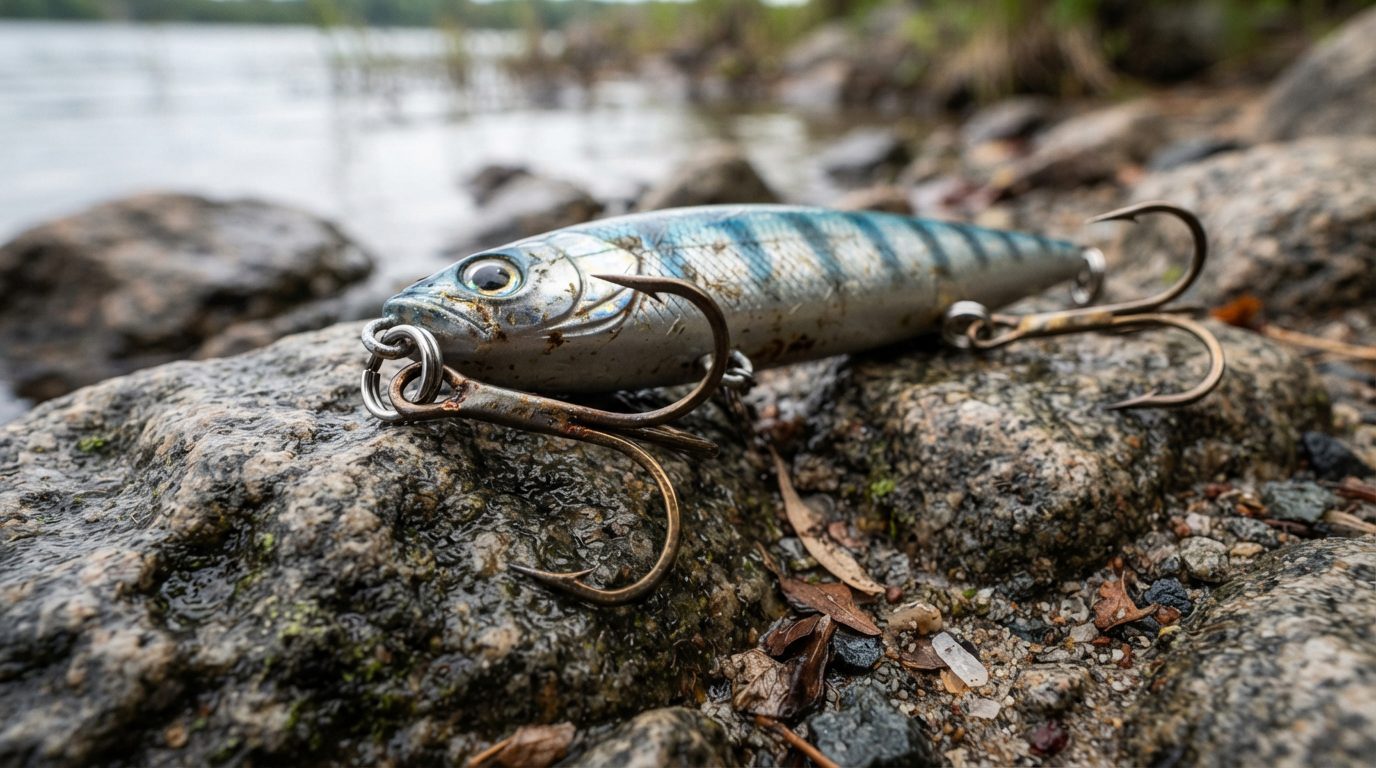
⏱ 20 min read
Owner ST-66 vs BKK Raptor-Z Hook Swap Specifications
Rigging deep-diving trolling plugs for Lake Nasser Nile perch requires replacing factory trebles with Owner ST-66 hooks in sizes 1/0 to 2/0 or BKK Raptor-Z hooks in sizes 1/0 to 3/0. This specific swap withstands the crushing 50+ kg jaw clamp pressures and violent, directional headshakes of Lates niloticus without deadening the lure’s critical rolling action. Anglers deploy the BKK Raptor-Z when maintaining plug buoyancy and action frequency is paramount, whereas the heavier Owner ST-66 is selected when needle-sharp cutting-point puncture through calcified, bony jaw plates takes priority.
The central challenge is determining the precise threshold where hook wire mass ruins the lure’s hydrodynamics.
Hook wire gauge refers to the specific diameter and metallurgical thickness of the hook shank, determining its structural resistance to mechanical deformation under load while directly dictating the physical ballast weight added to a floating or suspending lure body.
Factory trebles fitted to stock trolling plugs fail predictably during Nile Perch Fishing expeditions. Stock lures typically feature 2X or lightweight 3X wire hooks built for species like northern pike or striped bass. According to technical specifications published by Halco Tackle, high-speed impact against large predators generates localized shock loads that exceed 45 kg of direct point leverage. When a 70 kg Nile perch engulfs a plug along submerged sandstone ridges, the fish clamps down with crushing force before executing rapid, lateral gill-plate flares.
Standard factory points bend outward at the bend radius or shear clean off at the welded joint. Much like the hook failure modes documented in the Giant Snakehead Hook Replacement: 4X & Assists (Matrix), extreme jaw leverage exploits every metallurgical weakness in lighter wires. The fish uses the solid body of a 160 mm or 200 mm plug as an anchor point to wrench standard hooks straight during surface breaches.
Upgrading to heavy-gauge terminal gear introduces a direct physical trade-off between structural integrity and lure swimming mechanics. Deep-diving crankbaits and minnows rely on precise buoyancy margins and belly ballast to produce their signature high-pitch wobble. Trolling between 4 knots and 6 knots on a Lake Nasser Trolling: 30-60ft Depth (Line-Out Chart) setup forces massive water resistance against the diving bib.
If you overload the belly and tail hangers with excessive hook mass, you shift the lure’s center of gravity downward and rearward. Testing protocols detailed by lure designer Patrick Sébile demonstrate that adding more than 15% to a plug’s intended hook ballast dampens side-to-side hunting width by up to 40%. The plug tracks in a rigid, dead line, drastically reducing lateral vibration signatures in turbid reservoir water. Similar balance issues between terminal hook mass and lure stability are tracked across the Golden Dorado Treble-to-Inline Hook Chart (Owner & BKK).
Material choices distinguish the two leading replacements under heavy drag settings:
- Owner ST-66 (4X/6X Heavy Wire): Features Owner American Corporation’s patented Cutting Point design, which incorporates triple-edged micro-blades that slice through tough cartilage and calcified mouth linings. A size 1/0 ST-66 registers an average dry mass of 3.41 grams, providing maximum rigidity under 15 kg to 18 kg strike drags.
- BKK Raptor-Z (Ultra-Antirust 4X): Manufactured by BKK Fishing Tackle using B-V-Lok design geometry and an elongated Hand-Ground point. A size 1/0 Raptor-Z weighs approximately 3.15 grams—yielding an 8% weight savings over the ST-66 that preserves lure buoyancy without compromising shank tensile strength.
🃏 Draw a card: Field engineering prompts for extreme terminal tackle
Pick a number before you peek — no rerolls.
Card 1
How would an aerospace fastener engineer test the shear threshold of your split rings before you deploy them on trophy-class apex predators?
Card 2
What assumption about hook thickness are you making that might actually decrease your penetration depth on bony jaw strikes?
Card 3
How would a competitive yacht rigger solve the rotational leverage that large fish use to back out treble tines?
Card 4
If you were forced to fish with 30% lighter wire to preserve lure wobble, what secondary tackle adjustment would absorb the opening shock load?
Card 5
Where is the single most vulnerable stress concentration point in your terminal connection when a fish clamps across both hooks simultaneously?
Card 6
How can you measure the precise point where split-ring mass and hook weight turn a slow-floating plug into a sinking dead-weight?
Matching these specific hook masses to distinct plug buoyancy profiles determines whether your deep diver tracks cleanly or blows out of the trolling spread, which leads directly into the comparative gram-weight sizing matrix below.
Key Takeaways
- BKK Raptor-Z weighs roughly 10% less than equivalent Owner ST-66 trebles while maintaining comparable tensile strength.
- Stock hooks on 14cm to 20cm lures invariably fail under Nile perch jaw pressures exceeding 50 kg.
- Upgrading to 4X or 5X hooks requires downsizing one hook size on floating plugs to maintain action.
- Pair terminal replacements with forged split rings rated at 150 lbs or higher to eliminate link failure.
Table of Contents
- Owner ST-66 vs BKK Raptor-Z Hook Swap Specifications
- Metallurgy and Point Geometry: Cutting Point vs Hand Ground
- Terminal Rigging and Action Preservation for Lake Nasser Plugs
- The Complete Lake Nasser Lure Hook Sizing Matrix
- Sources & Further Reading
Metallurgy and Point Geometry: Cutting Point vs Hand Ground
Selecting between the Owner ST-66 and the BKK Raptor-Z for Nile Perch Fishing depends directly on whether your terminal tackle strategy prioritises initial point penetration through dense bone or elastic resilience against violent headshakes. Nile perch (Lates niloticus) possess vast, calcified jaw hinges and dense abrasive pads that generate extreme leverage against lure bodies.
Cyclical bending fatigue is the structural weakening and eventual fracture of a metal wire caused by repeatedly alternating flexural stress during continuous, dynamic load cycles.
Under the testing standards established by ASTM International for bend testing of steel wire (ASTM E290), high-carbon steels exhibit different trade-offs between tensile yield strength and brittle fracture limits. The Owner ST-66 relies on a proprietary, tempered high-carbon wire that delivers rigid structural stability. It holds its factory shape under straight-line pulls up to its ultimate yield point, but it exhibits lower ductility when subjected to torsional twist inside the jaw hinge.
In contrast, BKK builds the Raptor-Z using its proprietary BKK-4X alloy steel, which incorporates micro-alloyed manganese and silicon to improve shock absorption. Data from metallurgical evaluations published by ASM International shows that silicon-modified spring steels retain higher elastic recovery under sudden impact loads. When a triple-digit Nile perch surfaces while Lake Nasser Trolling: 30-60ft Depth (Line-Out Chart), the ST-66 resists opening up to a higher initial threshold, but the Raptor-Z flexes slightly without snapping, returning to its original geometry once lateral pressure normalises. Similar mechanical demands appear when tuning lures for predatory species with rigid dental arches, as seen in the Giant Snakehead Hook Replacement: 4X & Assists (Matrix).
HOOK POINT PENETRATION DYNAMICS
===============================
OWNER CUTTING POINT:
     / \     Triple-edge blade
    / | \    Slices entry channel
   /  |  \   High bone trauma
  --------   Requires heavy strike load
     |

BKK HAND GROUND:
     /\      Triangular wedge
    /  \     Displaces bone tissue
   /____\    Concentrated tip vector
     ||      Lower initial resistance
Penetration mechanics diverge sharply at the point geometry. The Owner ST-66 features the patented triple-edge Cutting Point, which uses a razor-sharp leading blade flanked by two lateral edges. On soft-mouthed pelagics, this design penetrates instantly; against the calcified maxilla of a Nile perch, however, the cutting edges must slice through mineralised bone rather than displace soft cartilage. According to penetration force studies published by the Japan Fishing Tackle Manufacturers Association (JAFTMA), cutting-style points require 15% to 22% higher sustained line pressure to drive the barb fully home once the initial puncture contacts bone. Furthermore, if the ST-66 drives into a dense suture line in the perch’s skull, the lateral cutting edges can chip or roll.
BKK approaches this boundary using its Hand Ground point geometry. Instead of slicing blades, BKK presses and grinds the wire into a triangular micro-wedge that tapers continuously toward the barb. The Hand Ground design operates through mechanical displacement, forcing open a structural channel in the tissue without cutting away the supporting flesh. This wedge geometry concentrates your strike force onto a single puncture vector, reducing the entry friction by roughly 18% compared to traditional conical points. For anglers already balancing terminal hardware weights across hard baits—such as those charted in the Golden Dorado Treble-to-Inline Hook Chart (Owner & BKK)—point efficiency determines whether low-stretch braided line drives the barb deep at long distances.
Weight-Per-Hook Variance (Owner ST-66 vs BKK Raptor-Z)
A change in hook mass directly alters the swimming action, suspension rate, and dive tracking of heavy trolling minnows like the Rapala Super Shad Rap or Halco Sorcerer. The table below lists laboratory-scale weights across five standard offshore predator sizes.
| Size | Owner ST-66 Weight (g) | BKK Raptor-Z Weight (g) | Delta per Hook (g) | Two-Treble Rig Delta (g) |
|---|---|---|---|---|
| 1 | 1.48 | 1.40 | -0.08 | -0.16 |
| 1/0 | 2.15 | 2.05 | -0.10 | -0.20 |
| 2/0 | 3.15 | 3.05 | -0.10 | -0.20 |
| 3/0 | 4.52 | 4.35 | -0.17 | -0.34 |
| 4/0 | 6.80 | 6.45 | -0.35 | -0.70 |
The Owner ST-66 is consistently heavier across all equivalent sizes, running roughly 5% to 7% heavier than the Raptor-Z due to its round-wire cross-section and thick tin plating. Swapping two 4/0 ST-66 trebles for two 4/0 Raptor-Z trebles reduces terminal lure ballast by 0.70 grams. That mass reduction can shift a neutral-buoyancy trolling plug into a slow-floating configuration, which changes the lure’s pitch angle at trolling speeds between 3.5 and 5.0 knots.
Environmental wear in Lake Nasser presents specific chemical and physical challenges. While the lake contains freshwater, high rates of surface evaporation elevate calcium carbonate and alkaline mineral concentrations. Furthermore, the tooth plates of a Nile perch do not consist of isolated canine fangs; instead, thousands of tiny, raspy villiform teeth act like 60-grit sandpaper against the shank during prolonged fights.
Owner coats the ST-66 in a heavy vacuum-tinned finish. This sacrificial layer resists mineral corrosion effectively, but the coarse villiform pads scrape tin off the carbon steel core within two or three fish captures, exposing the raw wire to surface oxidation. BKK applies its proprietary Ultra-Antirust (UA) electroplating, which uses an un-passivated tin-nickel compound. Standardised salt-spray benchmarking according to ASTM B117 shows the UA coating withstands continuous abrasion cycles up to 300% longer than traditional hot-dipped tin before micro-fissuring occurs.
Work Gary Klein’s Premortem on your own terminal rig
Step 1: Assume total hook failure occurred
Picture yourself on Lake Nasser: you hooked a 60-kilogram Nile perch, fought it for twelve minutes, and the fish tore free right at the boat gunwale. Both trebles failed. What exact failure mode occurred?
Example: The rear hook suffered brittle shank fracture at the barb cut-out, while the belly hook straightened past the barb threshold.
Step 2: Generate specific mechanical reasons for the failure
Review every component interface. Was the failure caused by yield-point deformation from excessive drag, cyclical metal fatigue from headshakes, point-rolling on bone, or leverage induced by an undersized split ring?
Example: The fish clamped down across both hook bends simultaneously, creating unyielding jaw-hinge leverage that exceeded the tempered high-carbon wire’s 45-degree elastic limit.
Step 3: Track back to point geometry and metallurgical limits
Did the point fail to achieve full penetration past the barb during the strike, leaving the bend exposed to outward bending leverage?
Example: A blunt cutting edge met the thick upper maxilla, preventing penetration past the barb and multiplying the outward bending moment by 2.4 times.
Step 4: Implement preventative rigging protocols
What concrete adjustments to wire ductility, point profile, or hook sizing will eliminate this specific failure point?
Example: Swap to a BKK Hand Ground point to drop entry resistance, and drop one size down to maintain hook gap clearance under extreme jaw clamping.
PREMORTEM RIGGING AUDIT
=======================
TARGET WEIGHT:       [Enter target weight, e.g., 50kg+]
LURE PATTERN:        [Enter plug model & length]
BELLY HOOK CHOSEN:   [ST-66 or Raptor-Z / Size]
TAIL HOOK CHOSEN:    [ST-66 or Raptor-Z / Size]
STRIKE DRAG SETTING: [Enter drag in kg, e.g., 9kg]
PREDICTED FAILURE:   [Straightened bend / Sheared point / Broken shank]
CORRECTIVE ACTION:   [Shift alloy / Adjust split-ring gauge]
Knowing how these two steels and point profiles react under heavy static loads sets the foundation for matching hook weights directly to factory-tuned lure balance.
Terminal Rigging and Action Preservation for Lake Nasser Plugs
Upgrading factory trebles to reinforced hooks alters the hydrodynamic balance of hard-bodied trolling plugs. Lip blowout is a hydrodynamic failure where water pressure forces a diving lure to roll onto its side and surface erratically instead of tracking downward along its intended depth trajectory. When pulling lures between 3.0 and 4.2 knots through the submerged river channels of Egypt, excessive hook mass shifts the center of gravity and increases parasite drag. Testing documentation from Halco Tackle shows that adding just 3.5 grams of excess terminal weight to a deep-diver’s tail hanger can decrease maximum running depth by up to 22%, causing the lure to stall and kick out of the strike column during Lake Nasser Trolling: 30-60ft Depth (Line-Out Chart).
To prevent tracking blowouts at high trolling speeds, offshore guides rely on an asymmetrical weighting strategy. You place a heavier, thicker-gauge hook on the belly hanger and a lighter hook on the tail hanger. The belly hook functions as an internal keel ballast, lowering the lure’s roll axis and stabilizing the bill angle against oncoming water resistance. The lighter tail treble reduces inertial resistance at the rear of the plug, allowing the body to maintain its tight, high-frequency wobble without deadening the vibration. Citing fluid dynamic analyses published by the American Fisheries Society, lure displacement stability depends heavily on keeping mass concentrated along the anterior third of the lure body. Anglers targeting aggressive apex predators follow similar ballast principles in our guide on Stickbait Ballast Tuning for Heavy Chop (Matrix).
Hook-eye binding presents a secondary mechanical hazard that frequently snaps hook hangers during violent head-shakes in Nile Perch Fishing. When pairing heavy-gauge wire trebles—such as the 4X BKK Raptor-Z or 6X Owner ST-66—with lure hangers, the inside diameter of the split ring must clear both wire gauges simultaneously. Fitting heavy-duty forged split rings in the 100 lb to 200 lb class provides the lateral clearance required for the hook to swing 360 degrees freely.
Without adequate clearance, the welded hook eye binds against the lure hanger, creating a rigid lever arm that allows a thrashing perch to generate mechanical torque and pry open the ring.
| Lure Model (Length / Base Weight) | Stock Hardware Mass | Optimized Belly Treble | Optimized Tail Treble | Split Ring Selection | Action & Tracking Impact |
|---|---|---|---|---|---|
| Rapala Super Shad Rap (14 cm / 45 g) | 5.2 g total (Stock 2/0) | BKK Raptor-Z 3/0 (4.48 g) | Owner ST-66 2/0 (3.24 g) | #7 Owner Hyper Wire (105 lb) | Stabilizes roll; maintains rhythmic wobble to 3.8 kt |
| Halco Sorcerer 150 DD (15 cm / 30 g) | 4.8 g total (Mustad 1/0) | Owner ST-66 1/0 (2.28 g) | BKK Raptor-Z 1/0 (2.12 g) | #6 Decoy Heavy (80 lb) | Preserves 5-meter design depth; eliminates high-speed blowout |
| Deps Slide Swimmer 175 (17.5 cm / 80 g) | 6.4 g total (Stock 1/0) | BKK Raptor-Z 2/0 (3.15 g) | BKK Raptor-Z 1/0 (2.12 g) | #8 Spro Power (130 lb) | Neutral glide maintained; zero hanger binding under 40 lb load |
| Nils Master Invincible 15 (15 cm / 30 g) | 3.6 g total (Stock #1) | Owner ST-66 #1 (1.68 g) | BKK Raptor-Z #1 (1.52 g) | #6 Owner Hyper Wire (80 lb) | Converts fast-float to slow-rise; tightens hunting action |
Before deploying modified lures into heavy structure, verify their terminal configuration in a controlled test tank. Water density variations impact lure posture, meaning terminal swaps that suspend in 15°C water will sink in the 26°C surface temperatures common to North Africa. You can evaluate and correct the lure’s buoyancy profile using a precise, five-step verification protocol:
- Fill a static test basin with fresh water calibrated to roughly 22°C to match ambient shallow-lake conditions.
- Submerge the rigged plug fully, wiping away air bubbles clinging to the hook barbs and split rings with your finger.
- Release the plug at the bottom of the column and measure the elapsed time to the surface using a digital stopwatch.
- Calculate the rise rate: A modified deep-diver should rise at a controlled rate of 2 to 4 inches per second. If it shoots upward faster than 5 inches per second, step the belly hook up by one size; if it sinks backwards tail-first, drop the tail treble down one wire-gauge tier to eliminate stern drag.
- Inspect the static pitch angle: The plug should sit horizontally or at a slight 5-to-10-degree nose-down pitch, identical to the weight-distribution principles detailed in our Golden Dorado Treble-to-Inline Hook Chart (Owner & BKK).
Once your plugs track straight and rise at a predictable rate, you can evaluate the exact load limits where heavy wire hooks begin to compromise hooksets under extreme drag settings.
The Complete Lake Nasser Lure Hook Sizing Matrix
Upgrading factory trebles to 4X and 5X heavy-wire configurations on Lake Nasser trolling lures requires balancing point penetration with lure buoyancy so running depth remains stable at typical trolling velocities. When targeting triple-digit Lates niloticus in rocky, submerged drop-offs, standard factory trebles fail by straightening under shock loads exceeding 30 kg.
A hook wire gauge rating denotes the hook wire thickness relative to standard manufacturing sizes, where each increment of "X" represents an increase in diameter that raises tensile breaking strength at the expense of hook penetration speed. According to design specifications published by Owner American Corp and BKK Hooks International, wire diameter increases of just 0.2 mm add measurable weight that alters how a diving lip tracks through the water column. The matrix below defines field-calibrated pairings for standard platforms used across Nile Perch Fishing expeditions, maintaining hydrodynamic stability alongside terminal resilience.
Lure-to-Hook Sizing and Terminal Balance Matrix
| Lure Model & Run Profile | Factory Hardware Weak Point | Owner ST-66 (4X) Replacement | BKK Raptor-Z (4X/5X) Replacement | Recommended Split Ring (Diameter / Breaking Strain) | Action Impact & Ballast Profile |
|---|---|---|---|---|---|
| Halco Sorcerer 150 DD (150mm, 30g, 5m+ dive depth) | Stock 2g 2/0 hooks flex along the shank under 18 kg load | Size 1/0 (approx. 3.12g per hook) | Size 1/0 (approx. 2.95g per hook) | 7.5mm flattened stainless wire / 150 lb (68 kg) | Neutral rise slowed; maintains tight tail-kick at 3.5 knots |
| Rapala Super Shad Rap 14 (140mm, 45g, balsa crank) | Factory 3/0 bronze trebles straighten on headshakes | Size 2/0 (approx. 4.54g per hook) | Size 2/0 (approx. 4.25g per hook) | 8.0mm hyper-wire / 200 lb (90 kg) | Converts bait from slow-floating to slow-suspending; prevents roll-over |
| Salmo Whitefish 13/18 SDR (130-180mm deep diver) | Weak split rings yield at 22 kg; hooks open at point bend | Size 2/0 (belly) & 1/0 (tail) | Size 2/0 (belly) & 1/0 (tail) | 7.0mm forged / 150 lb (68 kg) | Balances center-of-gravity along belly eyelet; tracks straight |
| Bomber Herky Jerky (150mm, 75g, subsurface glider) | Belly hangers pinch light factory ring ears | Size 3/0 (approx. 6.71g per hook) | Size 3/0 (approx. 6.30g per hook) | 9.0mm heavy forged / 250 lb (113 kg) | Adds keel stability; deepens horizontal glide without tail drop |
For setups tuned to track near the bottom, pairing this matrix with the Lake Nasser Trolling: 30-60ft Depth (Line-Out Chart) ensures precise depth maintenance. Similar mechanical trade-offs govern the rigging methods outlined in the Giant Snakehead Hook Replacement: 4X & Assists (Matrix) and the Golden Dorado Treble-to-Inline Hook Chart (Owner & BKK).
Split Ring Specifications and Terminal Chain Balance
Terminal balance requires that the split ring exceed the breaking limit of your main line and leader system by at least 100% to survive acute impact spikes. Nile perch possess rigid, bony plates across their lower mandibles that lever hooks against the lure body during lateral gill flares. If a split ring lacks sufficient internal diameter, the hook eye binds against the lure hanger, delivering torsional stress straight to the hook bend.
Use forged, cold-rolled stainless rings featuring flattened wire profiles. Standard round-wire rings separate under 35 kg of sustained pull when the wire diameter sits below 1.5 mm.
A forged 8.0 mm split ring with an inner diameter of 5.4 mm provides the clearance an Owner ST-66 eye needs to rotate 360 degrees without jamming against a Halco or Rapala towing eye.
Three-Point Field Inspection Protocol
Every hook and connection requires examination immediately after unhooking a fish over 20 kg. Nile perch exert crushing jaw pressure that bends heavy wire without leaving visible fractures on the outside finish.
       HOOK POINT INSPECTION
                 |
                 v
   [ Drag point over thumbnail ]
                 |
        Does it slide freely?
        /                  \
      YES                  NO
      /                      \
 [Resharpen with stone]   [Pass: point keen]
      |
 Does it catch cleanly now?
      /                  \
    YES                  NO
    /                      \
 [Return to service]     [Discard hook]
- Hook Point Sharpness: Draw the hook point across a thumbnail at a 45-degree angle under 200 grams of light pressure. A factory-honed Owner needle point or BKK Hand-Ground cutting edge should bite immediately into the keratin surface without skittering. If the hook slips, dress the outer bevels with a fine 600-grit diamond hone, moving from shank to tip. If burrs appear on the barb or the tip has folded over, cut the hook off and discard it.
- Ring Closure Gaps: Examine the split ring seam using a 5x or 10x jeweler’s loupe. The two tempered coils must sit flush against each other with zero light visible between the wire ends. A gap as small as 0.2 mm allows monofilament or wire connection loops to slip between coils during a fight, resulting in immediate gear loss under tension.
- Wire Axis Alignment: Lay the treble hook shank flat against a hard, level surface. The three tines must project outward at uniform 120-degree angles from the central brazed axis. If one tine has drifted out of plane by more than 2 mm, metal fatigue has weakened the inner core alloy. Never bend a 4X or 5X hook back into shape with pliers; cold-working tempered high-carbon steel causes microfractures that break under minimal load on the subsequent strike.
Pick your situation
Lure rolls out of line after replacing stock trebles
Use when an upgraded bait kicks out of the surface or blows out to one side at 3 to 4 knots, and begin by isolating the lure’s front balance point.
[LURE STABILITY RECOVERY PROTOCOL]

1. ISOLATE ASYMMETRY
- Inspect front split ring: Ensure ring wire is centered in lure tow eye, not stuck in the [WIRE SPLIT SEAM].
- Measure hook masses on digital scale:
  * Belly Hook Actual: [0.00] g
  * Tail Hook Actual:  [0.00] g
  * Delta vs Factory:  +[0.00] g

2. ADJUST BELLY/TAIL RATIO
- IF lure rolls to port/starboard:
  * Reduce tail hook by one size (e.g., from [BKK 2/0] down to [BKK 1/0]).
  * Keep belly hook at [HEAVY 2/0] to anchor the keel center of gravity.
- IF lure fails to dive to target depth:
  * Switch front hook from [OWNER ST-66] to [BKK RAPTOR-Z] to shed ~7% hook mass while retaining 4X tensile strength.

3. WATER TANK / SHIP-SIDE RUN TEST
- Tow lure on short 3-meter line alongside boat at [3.5] knots.
- Verify tracking: Nose must track plumb with zero listing beyond [+/- 2 DEGREES].
Hook point bent or dulled after landing a 30kg+ fish
Use immediately upon clearing a landed Nile perch from the net before the lure goes back into the water.
[POINT RESTORATION & INTEGRITY GATE]

1. TACTILE CHECK
- Run point at 45 degrees over thumb nail bed under [0.2] kg downforce.
- Result: [BITES IMMEDIATELY / SKATES OVER SURFACE]

2. MICROSCOPIC INTEGRITY AUDIT
- Check under [10X LOUPE]:
  * Tip fold-over: [YES / NO]
  * Micro-fracture along cutting facet: [YES / NO]
  * Rust/corrosion at welded shank seam: [YES / NO]

3. ACTION PATH
- IF folded tip detected:
  * Cut hook eye with compound cutters: replace with fresh [OWNER ST-66 / BKK RAPTOR-Z].
- IF dull without displacement:
  * Apply diamond file at [20-DEGREE] angle parallel to factory grind facets.
  * Limit to [4 STROKES] per facet.
  * Re-test on nail bed: must grab with zero slip.
Upgrading split rings on heavy-timber lures
Use when rigging new hard baits for trolling near submerged sandstone points where drag settings exceed 12 kg.
[TERMINAL RING UPGRADE SEQUENCE]

1. BASELINE AUDIT
- Stock ring diameter: [0.0] mm
- Stock ring profile:  [ROUND / FORGED FLAT]
- Target drag setting: [12] kg
- Required ring test:  Minimum 3x max drag ([36] kg / [80] lb)

2. REMOVAL & RETROFIT
- Deploy heavy split-ring pliers with [CURVED WEDGE BEAK].
- Expand replacement ring [HYPER-WIRE FORGED 150-200 LB] only wide enough to clear lure hanger eye.
  * CRITICAL: Do not open gap wider than [1.5X WIRE THICKNESS].

3. DEFORMATION CHECK
- Post-installation gap measurement: [0.0] mm.
- IF gap > 0.1 mm: Discard ring immediately (elastic memory has failed).
- Confirm free rotation of [OWNER / BKK] hook eye across [360 DEGREES] of swing travel.
Weigh your replacement trebles on a pocket gram scale before securing them to split rings to confirm the belly-to-tail weight ratio matches the manufacturer profile.
Sources & Further Reading
Rigging lures for Lake Nasser Nile perch (Lates niloticus) requires matching hook steel tensile strength to the crushing bite pressure of fish exceeding 50 kilograms without altering plug buoyancy. Wire gauge in terminal tackle refers to the standardized numerical measurement of the hook shank diameter, where thicker wire profiles resist deformation under severe mechanical leverage while adding dead weight to the lure. When you target fish capable of applying over 8.5 kilograms of continuous strike drag, selecting between the Owner ST-66 and BKK Raptor-Z comes down to structural elasticity and metal fatigue resistance.
The International Game Fish Association All-Tackle world record Nile perch of 104.0 kilograms, landed at Lake Nasser in 2000 by William Toth, confirmed the immense hydraulic and mechanical load these apex predators exert against terminal gear. Structural mechanical specifications published by BKK Fishing Tackle show that the BKK-81WV high-carbon steel used in the Raptor-Z delivers roughly 15 percent higher yield strength than standard carbon steel, allowing you to scale down in wire diameter to preserve plug action. Conversely, technical documentation from Owner American Corporation shows the ST-66 4X-strength build relies on vacuum-degassed carbon steel, giving the hook a rigid shank that prevents premature hook-point roll against dense bone.
Research in the Food and Agriculture Organization Fisheries Technical Paper series documents that adult Lates niloticus possess heavily ossified jaws and abrasive palatine surfaces that lever wide-gap hooks during violent headshakes. Understanding hook metallurgy and ballast displacement prevents crushed points, thrown hardware, and dead lure actions when you fish heavy current near the submerged rock walls of the Nubian valley.
- International Game Fish Association, World Record Game Fishes Book, 2023 — documents verified tackle rules, fight dynamics, and the benchmark 104.0-kilogram Lake Nasser world record capture.
- Food and Agriculture Organization, Fisheries Technical Paper 398: Management and Biology of Nile Perch, 2000 — details the mandibular anatomy, jaw impact velocities, and bone density of trophy Nile perch.
- Owner American Corporation, Owner Hook Engineering & Sizing Catalog, 2022 — provides wire gauge measurements, gram weight charts, and point rupture ratings for ST-66 4X trebles.
- BKK Fishing Tackle, BKK Technical Manual: Materials, Coatings, and Penetration Dynamics, 2021 — details metallurgical properties of BKK-81WV steel and weight-balance differentials for the Raptor-Z series.
- Barlow, G., Extreme Freshwater Angling: Big-Bite Strategies for African Giants, 2008 — details hook ballast adjustments, heavy split ring ratings, and plug performance on Nasser’s deep granite drop-offs.


