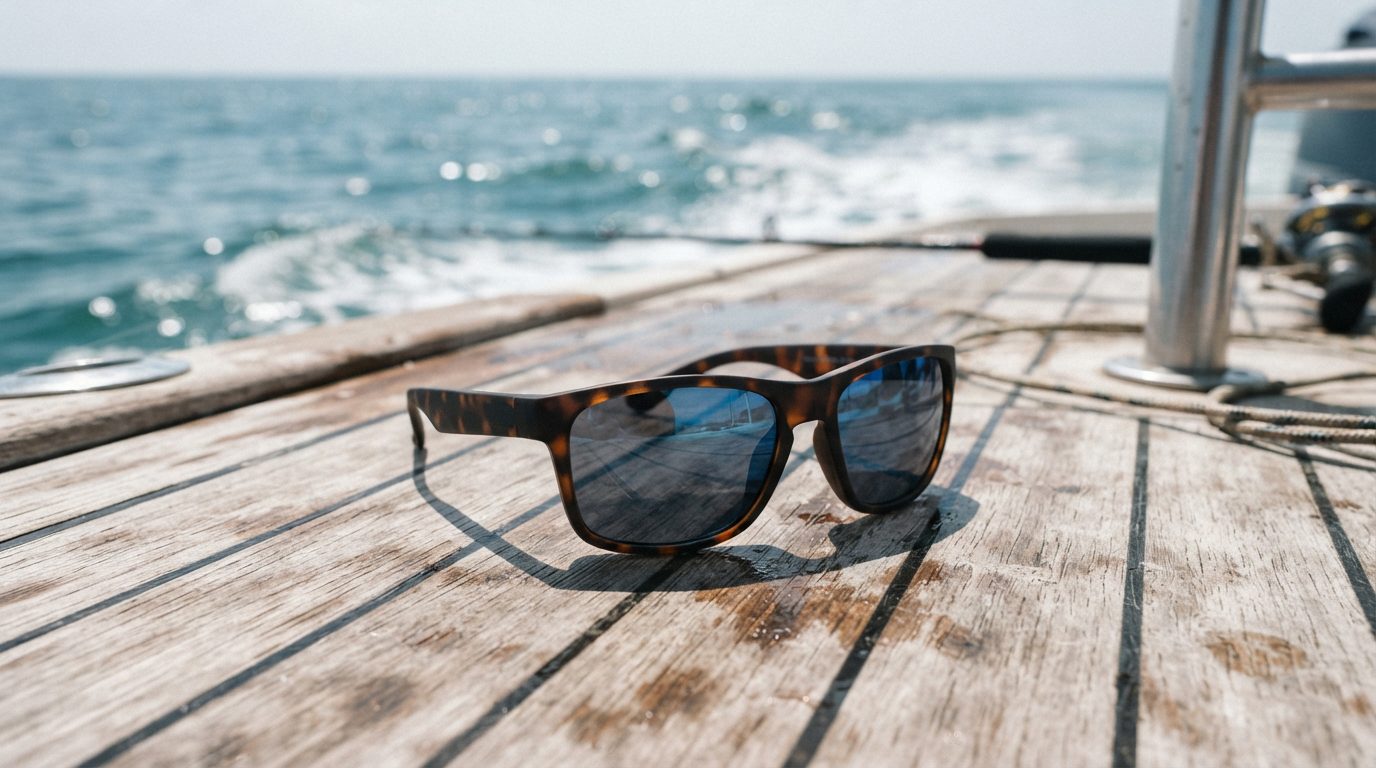
Wrap Prescription Spec Sheet for Anglers (Template)

⏱ 22 min read
The Essential Optical Measurements for Sight-Casting Wrap Frames
To achieve zero optical distortion in curved 8-base fishing sunglasses, optical laboratories must digitally compensate the wearer’s prescription using four position-of-wear fitting parameters: wrap angle, pantoscopic tilt, back vertex distance, and monocular pupillary distance. Surfacing standard flat lens curves into high-wrap sports frames introduces induced prism and unwanted cylinder power, directly shifting your visual target away from its true coordinate. Freeform digital surfacing recalibrates the prescription point-by-point via computer-numerical-control (CNC) generators to counter the curvature of the wrap, giving you an exact 1:1 spatial line of sight.
Pantoscopic tilt is the vertical angle at which the sunglass eyewire sits relative to the wearer’s facial plane, measured in degrees as the bottom rim tilts inward toward the cheek.
[Target: True Location]
           ^
          /  <-- 0.75 Prism Shift
         /
[Perceived Target Location]
         ^
         |
[Uncompensated 8-Base Lens]
         ^
         |
    [Angler's Eye]
When an optometrist cuts standard prescription curves into an 8-base frame without digital compensation, optical refraction bends light off-axis before it hits your cornea. According to Prentice’s Rule, angling a curved ophthalmic lens off the visual axis creates unwanted base-out prism and changes the effective spherical and cylindrical power.
At a typical sight-casting distance of 40 feet, an uncompensated wrap that generates just 0.75 prism diopters displaces the visual image by approximately 11 inches. Add water refraction and light scatter across variable flats depth, and you will consistently drop your presentation 1 to 2 feet behind cruising targets. Pairing an uncompensated wrap with high-contrast polarised lenses—detailed in our Sight Fishing Lens Tint Matrix: Water vs Light (Field Guide)—yields clear contrast, but places the fly completely outside the fish’s feeding lane.
The primary limitation rests inside standard optical retail clinics: their testing hardware assumes flat, everyday frames. The American Optometric Association dispensing benchmarks document that conventional phoropters and digital pupilometers evaluate refractions on a strictly flat visual plane, usually calibrated for 0 to 4 degrees of frame wrap.
High-wrap sports wraps feature a frame wrap between 15 and 22 degrees. Because typical optical staff rarely stock digital position-of-wear measurement tools—such as the digital measuring towers developed by Shamir Optical Industry or Carl Zeiss Vision—they simply transmit nominal flat prescriptions to basic finishing labs. The lab edges an uncompensated lens, and the downstream error lands entirely on your forward cast.
🤖 A Prompt Worth Stealing
Use this prompt in any AI chat assistant to convert your standard clinic prescription into a precise laboratory spec sheet before meeting your optician.
I need a technical optical lab spec sheet for prescription polarised sunglasses built for sight-fishing in an 8-base wrap frame.

Here are my clinical prescription details:
- Right Eye (OD): Sph [SPHERE], Cyl [CYLINDER], Axis [AXIS]
- Left Eye (OS): Sph [SPHERE], Cyl [CYLINDER], Axis [AXIS]
- Standard Distance PD: [TOTAL PD] mm

Target Frame Model: [FRAME BRAND & MODEL]
Frame Base Curve: [BASE CURVE, E.G., 8-BASE]

Generate a clean, professional instruction slip to hand my optician that:
1. Lists the four mandatory position-of-wear (POW) digital compensation measurements required by freeform lens software (Wrap Angle, Pantoscopic Tilt, Back Vertex Distance, and Monocular Pupillary Distance).
2. Explains the exact laboratory surfacing method required (ray-traced digital freeform surfacing) to eliminate induced base-out prism.
3. Provides blank measurement fields formatted precisely for optical clinic staff to fill out during frame fitting.
Print the generated output or save it to your phone, then hand it directly to your optician before frame measurements begin. To refine the prompt, reply with the exact frame model and base curve you selected to let the assistant tailor the nominal parameter ranges.
Knowing which four parameters determine your visual accuracy is only half the battle; capturing those physical angles on an aggressive 8-base frame requires precise mechanical and optical tools at the dispensing desk.
Key Takeaways
- Standard prescriptions in high-wrap 8-base frames induce unwanted cylinder power and prism swim.
- Digital ray-path compensation recalculates power point-by-point using wrap angle, vertex distance, and tilt.
- Monocular pupillary distance measured to 0.5mm accuracy prevents false depth perception during flats casting.
- Specifying exact frame fitting parameters eliminates the peripheral fishbowl distortion that ruins sight-casting.
Table of Contents
- The Essential Optical Measurements for Sight-Casting Wrap Frames
- Why High-Base Wrap Frames Create Vision Distortion on Water
- Four Frame Measurements Your Optometrist Must Calculate Manually
- Optimum Lens Substrates and Polarisation Filters for Extreme Clarity
- How to Instruct Optical Labs to Prevent Order Rejection
- The Printable Optometrist Spec Sheet for Fishing Wraps
- Sources & Further Reading
Why High-Base Wrap Frames Create Vision Distortion on Water
Standard prescription lenses ground for flat, 4-base frames generate severe optical aberrations and target misplacement when steepened into an 8-base wrap frame without digital compensation.
Base curve refers to the front surface radius of curvature of an eyeglass lens, measured in diopters where higher numbers indicate a steeper, more pronounced spherical wrap around the wearer’s face.
[Target: Bonefish at 30ft]
          |
          v
[8-Base Lens: Tilted at 18°]
    /           \
  (Ray A)     (Ray B)
   /             \
[Prism Vector]  [Oblique Power Error]
  |               |
  v               v
[Apparent Target] [Retinal Blur]
Shifted 4.2 inches
When an optical laboratory fits an uncompensated spherical or standard toric prescription into an 8-base frame, the lens sits tilted relative to the eye’s visual axis at an angle between 15 and 20 degrees. According to Martin’s Rules of Tilt—the standard geometric equations published in the optical textbook System for Ophthalmic Dispensing by Clifford W. Brooks and Irvin M. Borish—tilting a lens induces both an artificial sphere power change and unwanted oblique astigmatism.
Oblique astigmatism is an optical aberration that occurs when light strikes a curved lens surface at an angle, causing rays in different planes to focus at separate focal points and blurring the retinal image.
For an angler wearing a -3.00 diopter prescription mounted in an 8-base frame with an 18-degree wrap angle, Martin’s equations establish that the lens induces an unwanted +0.31 diopter sphere power increase alongside a +0.29 diopter induced cylinder error at axis 90 degrees. That uncorrected cylinder degrades visual acuity from 20/20 down to approximately 20/30, flattening the visual contrast you need to distinguish cruising fish against mottled turtle grass. Pairing the correct base curve with the appropriate lens shade, as detailed in the Sight Fishing Lens Tint Matrix: Water vs Light (Field Guide), cannot overcome this fundamental optical blur if the tilt geometry remains uncalculated.
🕰️ How It Really Happened: The U.S. Army Apache Visor Distortion Study
In 1998, optical physicist Clarence E. Rash and his research team at the U.S. Army Aeromedical Research Laboratory published USAARL Report No. 98-35 to determine why AH-64 Apache aviators suffered severe depth misjudgments and eye fatigue when tracking terrain through curved protective visors. The researchers measured high-curvature wrap visors and discovered that uncorrected horizontal base curves introduced up to 0.75 prism diopters of unwanted prismatic displacement across the lateral field of view.
The published data proved that lateral wrap angles physically bent incoming light rays away from the pilot’s true line of sight, forcing flight crews to visually miscalculate obstacle clearances by up to 1.2 meters at short operational distances. USAARL concluded that high-base curved transparent surfaces require deliberate decentration and surface-molding corrections to cancel out induced prismatic shifts before human visual tracking degrades.
Source: U.S. Army Aeromedical Research Laboratory Report No. 98-35 (Clarence E. Rash et al., 1998)
Prismatic displacement causes an equally severe physical consequence: it shifts where structure and fish appear in the water column.
Prismatic displacement describes the physical bending of light toward the thicker base of a tilted or curved lens, causing an object to appear displaced toward the lens apex away from its actual spatial location.
According to Prentice’s Rule (\(P = c \times F\), where \(P\) is prism diopters, \(c\) is decentration in centimeters, and \(F\) is lens power), tilting a high-curvature lens without shifting its optical center introduces unwanted horizontal prism. The American National Standards Institute (ANSI) Z80.1 standard permits up to 0.67 prism diopters of horizontal imbalance in standard prescription eyewear, but an uncompensated 8-base frame easily exceeds 1.20 prism diopters at the pupil.
At a casting distance of 30 feet, an uncorrected displacement of 1.0 prism diopter shifts the perceived position of a permit or redfish by roughly 3.6 inches away from its true location. If you present a crab pattern to where your eyes tell you the fish is swimming, the fly lands outside the fish’s feeding corridor, or worse, lines the fish across its dorsal fin.
The optical penalty worsens when you drift across a flat aboard an elevated skiff platform or scan shorelines from a stable casting hull like the Ranger 1860 Angler. As your eyes track fish by glancing into the temporal periphery, light strikes the polycarbonate lens at angles exceeding 35 degrees.
This extreme entry angle produces the "fishbowl swim" sensation: a disorienting, nauseating feeling where flat surfaces appear spherical and stationary bottom structure seems to accelerate as your head rotates. Dr. Colin Fowler and colleagues at Aston University’s School of Optometry documented in Ophthalmic and Physiological Optics that peripheral gaze shifts through uncompensated high-wrap lenses introduce dynamic magnification differentials exceeding 8% between central and peripheral fields. Your vestibular system perceives dynamic movement that contradicts your inner-ear balance organs, producing visual fatigue within two hours of scanning open water.
Correcting these errors requires specific numerical inputs that standard refraction exams leave off your paper prescription script.
Four Frame Measurements Your Optometrist Must Calculate Manually
Eliminating peripheral distortion and target displacement in high-wrap fishing eyewear requires your optometrist to calculate four position-of-wear parameters manually rather than relying on default phoropter assumptions: frame wrap angle, pantoscopic tilt, back vertex distance, and monocular fitting measurements. When an optical lab cuts high-index or polycarbonate lenses based on default bench alignments, sight-casters experience spatial mislocalization, where a cruising redfish appears several inches away from its true physical coordinates.
1. Frame Wrap Angle (Face-Form Tilt)
Face-form tilt is the horizontal angle at which an eyeglass frame curves back toward the temples relative to the flat frontal plane of the wearer’s face, usually specified in degrees.
Standard dress frames feature a subtle wrap angle between 4 and 6 degrees, whereas marine wrap sunglasses sit between 15 and 22 degrees to shield the eye from lateral glare. According to optical theorist Mo Jalie in The Principles of Ophthalmic Lenses, bending a spherical lens across the face introduces unwanted cylinder power and changes the effective spherical power. For example, a standard uncompensated -4.00 diopter (D) lens fitted into a frame with a 20-degree wrap induces approximately -0.45 D of unwanted oblique astigmatism on an axis perpendicular to the tilt.
Without manual trigonometric compensation calculated by your doctor or modern digital ray-tracing software like that engineered by Carl Zeiss Vision, the optical center shifts. This distortion makes flat flats appear concave and causes artificial target movement whenever you scan your head horizontally across a shoreline.
2. Pantoscopic Tilt
Pantoscopic tilt is the vertical angle formed between the flat optical plane of an eyeglass lens and the vertical plane of the wearer’s face when the frame bottom tilts inward toward the cheeks.
Extreme angling environments require heavy pantoscopic tilt, typically between 8 and 12 degrees, to prevent peripheral light leaks bouncing off open water. Martin’s Rule of Tilt demonstrates that every 2 degrees of uncompensated pantoscopic tilt induces roughly 0.10 D of cylinder power while shifting the optical center downward. Sight casters routinely depress their gaze between 15 and 30 degrees below the horizon to spot fish in surface chop. If your optometrist takes your height measurements while you look straight ahead at a distance chart, looking downward through the lower third of the lens produces severe vertical coma and prism aberrations.
3. Back Vertex Distance (BVD)
Back vertex distance is the physical gap measured in millimeters between the anterior surface of the human cornea and the posterior surface of the corrective spectacle lens.
In an examination lane, the phoropter typically measures your prescription at a vertex distance between 12 mm and 14 mm. Deep-base wraparound fishing frames sit much closer to the face, frequently between 8 mm and 10 mm, to maximize optical coverage and lash clearance. A 4 mm forward or backward error alters the focal length of the optical system. As documented in the American National Standards Institute (ANSI) Z80.1 prescription standards, vertex alterations on prescriptions exceeding 4.00 D shift the effective power by 0.12 D to 0.25 D, stripping clarity right at the focal threshold needed to differentiate submerged structure from gamefish.
4. Monocular Pupillary Distance and Fitting Height
Monocular pupillary distance is the individual measurement in millimeters from the center of the nasal bridge to the visual axis of each separate pupil.
Labs frequently build budget lenses using a single binocular pupillary distance (such as 64 mm) split equally into 32 mm per eye. Real human faces exhibit facial asymmetry: clinical surveys published in the Journal of Optometry show that over 70% of individuals have an asymmetry of 0.5 mm or greater between their right and left eyes. Decentered lenses create prismatic deviation defined by Prentice’s Rule:
Prism Diopters (\(\Delta\)) = Decentration (cm) × Lens Power (D)
A 3 mm horizontal alignment error on a -4.00 D lens induces 1.2 prism diopters. At a cast distance of 15 meters, 1.2 prism diopters displaces the perceived location of a cruising fish by 18 centimeters (7.1 inches). That distance turns a precision presentation into an immediate spook or a missed strike.
Quick Quiz: Test Your Wrap-Angle Optics Knowledge
Question 1: An angler spots a permit at 10 meters but consistently casts 15 centimeters behind it using new -5.00 D wrap sunglasses. What is the most probable optical error?
A) The lens polarization axis is tilted 15 degrees off horizontal.
B) The optometrist used a binocular PD instead of monocular measurements, inducing prism error.
C) The back vertex distance was over-corrected by 0.5 mm.
Reveal answer
B) The optometrist used a binocular PD instead of monocular measurements, inducing prism error. Prentice’s Rule dictates that lateral decentration creates prismatic shift, translating directly into physical target displacement at casting distance.
Question 2: Standard everyday street frames typically feature a wrap angle of 4 to 6 degrees. What is the typical wrap angle range for marine-grade performance wrap frames?
A) 8 to 12 degrees
B) 15 to 22 degrees
C) 25 to 35 degrees
Reveal answer
B) 15 to 22 degrees. Marine wraps require this steep curvature to seal out lateral light reflecting off water surfaces, which demands digital optical compensation to eliminate induced oblique cylinder. For lens color selection once your geometry is set, read the Sight Fishing Lens Tint Matrix: Water vs Light (Field Guide).
Question 3: According to Martin’s Rule of Tilt, what happens when a frame incorporates pantoscopic tilt without adjusting the lens optical center?
A) The lens gains positive sphere and induces cylinder power along the horizontal axis.
B) The polarization film separates due to excessive mechanical stress.
C) The effective vertex distance increases to infinity.
Reveal answer
A) The lens gains positive sphere and induces cylinder power along the horizontal axis. For every 1 degree of tilt, the optical center must be dropped approximately 0.5 mm to match the eye’s visual axis.
Getting these four measurements calculated manually requires bringing the actual fishing frame directly into the exam lane before your doctor writes the final laboratory order. How you convey these exact numbers to the lab determines whether your finished glasses arrive with zero edge-blur, which brings us to the plug-and-play specification template detailed below.
Optimum Lens Substrates and Polarisation Filters for Extreme Clarity
Trivex provides the highest optical clarity among high-impact lens substrates for sight casting, delivering an Abbe value of 45 compared to polycarbonate’s Abbe value of 30.
Abbe value is a standardized optical metric that quantifies how much a transparent material disperses light wavelengths, where higher numbers indicate less color fringing around the borders of viewed objects.
When tracking cruising fish against broken bottom structure, chromatic aberration directly degrades edge contrast. Data published by PPG Industries demonstrates that standard polycarbonate generates 0.70 prism diopters of transverse chromatic aberration at a 30-degree lateral viewing angle, whereas Trivex holds aberration to 0.46 prism diopters under identical deflection. While 1.60 high-index polyurethane matches Trivex with an Abbe value of 42 and offers a thinner profile for prescriptions exceeding -4.00 diopters, it lacks the certified ANSI Z87.1 high-velocity impact rating inherent to Trivex and polycarbonate. For high-speed flats tracking or casting heavy terminal tackle, Trivex balances high tensile strength with visual acuity, avoiding the chromatic scatter that causes a redfish tail or cruising bonefish to blur into surrounding turtle grass. Once you establish substrate clarity, matching the material to ambient surface conditions requires referencing our Sight Fishing Lens Tint Matrix: Water vs Light (Field Guide).
Standard flat-lens surfacing algorithms fail when optical blanks are cut into aggressive 8-base wrap frames. Free-form digital ray-tracing calculation engines, such as those developed by IoT (Indo Optical Tooling) and Carl Zeiss Vision, resolve this geometric distortion by recalculating the power profile across 10,000 discrete points on the lens’s concave back surface.
Optical shearing is an unwanted visual distortion caused when uneven stress or misaligned layers stretch light rays asymmetrically through a manufactured lens.
A wrap angle of 18 to 22 degrees induces unwanted prism and off-axis astigmatism if ground with standard toolpaths. Free-form software compensates for the pantoscopic tilt, wrap angle, and vertex distance unique to the angler’s frame fit. According to technical documentation from the Optical Laboratories Association (now part of The Vision Council), uncompensated base-curve wrap creates up to 0.50 diopters of induced oblique cylinder on a simple -2.00 sphere order. Digital point-by-point recalculation reduces this lateral power error to less than 0.03 diopters across the entire horizontal field of view.
Polarising efficiency hinges entirely on the orientation of the embedded polyvinyl alcohol (PVA) film. To extinguish the blinding reflective glare bouncing off water surfaces, the absorption axis of the PVA filter must sit at precisely 90 degrees relative to horizontal light scatter. An alignment deviation of just 3 degrees degrades light extinction efficiency from 99.5% down to roughly 85%, admitting the very specular glare that obscures sub-surface targets.
Laboratory testing guidelines outlined in ISO 12312-2 require polarizing filters to exhibit uniform stretch alignment without internal stress patterns. When optical laboratories edge and mount polarized blanks into curved nylon frames under excessive mechanical tension, the frame bevel can pinch the lens substrate. This mechanical pinch warps the PVA sheet, inducing birefringent shearing visible as rainbow rings or opaque blotches when scanning an open flat.
Self-Assessment: Polarised Lens Setup Evaluation
Scoring: 0-1 ticks: Your optical setup delivers pure target clarity. 2-3 ticks: Optical shearing and base-curve prism are actively cutting your fish-spotting distance on bright flats; consult the custom optical resources on Extreme Angler to troubleshoot your optical specifications. 4-5 ticks: You are sight-fishing through severe induced astigmatism and glare leak that degrades depth perception.
To ensure your optometry provider cuts your prescription without inducing this mechanical stress, you must specify the exact edge-bevel bevel angle and wrap-compensation figures detailed on the optical spec sheet below.
How to Instruct Optical Labs to Prevent Order Rejection
Optical processing laboratories routinely reject prescription eyewear exceeding ±2.50 diopters in high-wrap sports frames because standard surfacing software cannot resolve lens power variations across steep curves. Retail optometry chains often route orders through automated central finishing lines calibrated strictly for flat 4-base and 6-base dress frames. When an 8-base wrap frame arrives, automated screening algorithms flag excessive edge thickness and off-axis prism as non-compliant errors, automatically cancelling the build.
Free-form digital surfacing is an optical manufacturing process that uses computer-controlled three-axis diamond-point cutters to carve custom, micro-calculated prescriptions directly onto the back surface of an individual lens blank.
To bypass automatic lab rejection, your optician must mark the order as a custom sport wrap and assign it to a digital free-form generator rather than a standard stock-lens queue. Lens designs such as Shamir Attitude III Sport or Younger Optics NuPolar calculate point-by-point power compensations across the entire lens. The lab’s software mathematically adjusts your prescribed sphere, cylinder, and axis to neutralize the oblique astigmatism created when a curved lens sits tilted in front of the eye. Pairing this digital cut with proper polarized filtration—selected using the Sight Fishing Lens Tint Matrix: Water vs Light (Field Guide)—guarantees maximum visual acuity and glare reduction across the water surface.
Pro-Tip: Have your optician specify a 1.60 or 1.67 high-index resin rather than standard polycarbonate if your total prescription exceeds -3.00 diopters. High-index substrates reduce peripheral edge mass by up to 20%, keeping the finished lens inside the frame’s retaining bevel channel without compromising optical clarity.
Frame fit failure is the secondary cause of lab rejections, occurring when thick prescription edges prevent wrap frames from retaining their designed curve. High-wrap nylon frames rely on a flush internal fit to maintain the lateral gasket seal against blinding ambient sunlight. Standard centered V-bevels force the frame eyewire to splay outward, which widens the frame, alters the measured wrap angle by as much as 6 degrees, and exposes your eyes to peripheral glare.
Data documented by the optical laboratory trade group The Vision Council demonstrates that uncompensated frame splay alters perceived cylinder power by up to 0.50 diopters off-axis. Prevent this mechanical failure by instructing the optician to mandate an asymmetrical step bevel or rear shelf bevel on the laboratory work ticket. A step bevel removes excess rear lens bulk while placing a 0.5 mm crest along the true front curve of the 8-base frame groove.
Pro-Tip: Request an explicit minimum edge thickness of 2.2 mm along the thinnest lens meridian. This additional buffer gives the edging wheel adequate structural material to cut a clean step bevel without chipping the internal polarizing film layer.
Setting these mechanical parameters correctly prevents the lab from altering your frame’s geometry, which leads directly into configuring the exact millimeter measurements demanded on the final dispensary order ticket below.
The Printable Optometrist Spec Sheet for Fishing Wraps
Eliminating peripheral distortion and optical swim in high-wrap fishing sunglasses requires an optical dispensary order specifying measured position-of-wear coordinates rather than standard phoropter refractions.
Position-of-wear refers to the exact three-dimensional physical orientation of an eyeglass lens relative to the wearer’s eye when mounted inside a specific frame, encompassing frame curve, vertical tilt, and corneal clearance.
When an 8-base wrapped frame sits on your face, its curved geometry rotates the lens plane relative to your visual axis. According to clinical documentation published by Shamir Optical Industry on Freeform ray-tracing algorithms, an uncompensated -3.00 D spherical lens placed in an 8-base wrap angle introduces up to 0.37 diopters of induced oblique astigmatic error and 0.25 prism diopters of unwanted lateral prism. The Extreme Angler prescription guide requires that your optician translate your standard distance values into compensated digital surfacing instructions to prevent blurred sight-casting targets and spatial disorientation on the water.
+-------------------------------------------+
|    WRAP RX LAB FABRICATION SPEC SHEET     |
|       (Deliver Directly to Dispenser)     |
+-------------------------------------------+
Patient Name: _______________________________
Order Date:   _______________________________
Frame Model:  _______________________________

1. DISTANCE MANIFEST REFRACTION
OD (Right): Sph: _____ Cyl: _____ Axis: _____
OS (Left):  Sph: _____ Cyl: _____ Axis: _____

2. MEASURED POSITION-OF-WEAR (POW) VALUES
- Frame Wrap Angle (Face-Form Tilt): ___ deg
  (Standard sport wrap ranges: 10° to 16°)
- Pantoscopic Tilt:                 ___ deg
  (Angle of bottom rim toward cheek: 6° to 10°)
- Back Vertex Distance (BVD):       ___ mm
  (Ocular surface to corneal apex: 10 to 13mm)
- Monocular Pupillary Distance (OD): ___ mm
- Monocular Pupillary Distance (OS): ___ mm
  (Binocular totals are strictly unacceptable)
- Fitting Height / Segment Height:   ___ mm
  (Measured to pupil centre in fitted frame)

3. LENS SURFACING SPECIFICATIONS
- Base Curve: True 8-Base matched blank
- Surfacing: Atoric Free-Form Digital Cut
- Ray-Path Optimization: Active Compensation
- Material: Trivex (1.53) / Poly (1.59)
- Polarization: 99.9% Efficiency Polarized Film
- Axis of Polarization: Fixed 90° Vertical ±1°
+-------------------------------------------+
Pantoscopic tilt represents the vertical tilt of the sunglass chassis toward your cheekbones. When paired with incorrect back vertex distance, poor tilt induces unwanted vertical cylinder error that degrades line-of-sight tracking. Ensure your optician pairs this form with the specific hue profiles outlined in the Sight Fishing Lens Tint Matrix: Water vs Light (Field Guide) so that chromatic filtering aligns with your target depth and bottom substrate.
The American National Standard for Ophthalmics (ANSI Z80.1-2020) permits an axis tolerance of up to ±3 degrees on cylinder powers between 0.50 D and 0.75 D. In high-wrap sport optics, that variance produces focal plane degradation at the lens periphery. To verify that your laboratory surfaced your wrap lenses correctly before leaving the dispensary, complete this three-step inspection protocol on-site.
1. The Metric Orthogonal Grid Test
Position yourself 40 cm away from a high-contrast printed grid sheet or orthogonal window pane. Center your gaze on the middle crosshair, then rotate your head smoothly 45 degrees left and 45 degrees right while fixing your eyes on the central target.
If the horizontal grid lines bow upward or downward like a pincushion at the lateral extremities, the lab used standard flat transposition rather than calculated ray-path optimization. The lines must maintain strict 90-degree intersections through the temporal edges of the lens.
2. The Horizontal True-Level Surface Check
Hold the sunglasses 30 cm away from your eyes at arm’s length. Align the top horizontal edge of the lens frame against a known horizontal reference, such as an exterior roofline or a calm water surface.
Slowly pitch the sunglasses along their horizontal axis. If the reference line breaks, jumps vertically, or shifts laterally between the lens and open air by more than 2 mm at the frame boundary, prism thinning was calculated unevenly. Reject any pair that fails this alignment, as vertical prismatic imbalance causes headaches within 20 minutes of scanning water flats.
3. Rapid Saccadic Dynamic Lock
Put the frame on, secure the retention strap, and focus on a small target 15 metres away. Rapidly alternate your direct line of sight between the distance target and an object positioned 70 degrees into your temporal periphery.
Zero-distortion digital free-form lenses provide instantaneous binocular fusion without an intermediate swimming sensation. If the peripheral target appears to displace laterally or change spatial depth as your eyes cross the frame edge, the fitting height or monocular pupillary distance was entered incorrectly into the finishing edger.
🃏 Draw a card: Wrap-Lens Diagnostic Prompts
Pick a number before you peek — no rerolls.
Card 1
Inspect the frame bevel: Has the finishing lab altered the front lens bevel placement, forcing an 8-base lens into a 6-base frame groove and causing physical torque?
Card 2
Check your Abbe value: Are you experiencing optical aberrations from high-index materials instead of prism error? Trivex (Abbe 45) resolves chromatic fringing that standard polycarbonate (Abbe 30) generates at high angles.
Card 3
Evaluate frame splay: Do the temple arms flare outward when resting against your temples, artificially increasing the measured wrap angle by 3 to 5 degrees past your recorded bench measurement?
Card 4
Examine lens decentration: If your monocular PD is narrow (under 30 mm per eye) in a wide 65 mm lens frame, excessive temporal thickness will induce prism imbalance regardless of software compensation.
Card 5
Verify polarization integrity: Place the lenses across a second polarized filter at 90 degrees to check for internal strain birefringence patterns that distort focal points under salt-marsh conditions.
Card 6
Audit the compensated card: Did the laboratory ship an invoice showing both your ‘Ordered Refraction’ and the calculated ‘Compensated Rx’? If both sections list identical numbers, the lab failed to apply digital ray tracing.
Print out the specification form, book a physical fitting appointment with a certified dispensing optician, and make the order contingent on passing all three bench verifications.
Sources & Further Reading
Optometric wrap compensation requires mathematically recalculating sphere, cylinder, and axis values to neutralize the induced prismatic error and oblique astigmatism created by steep, curved eyewear. Vertex distance is the physical space in millimeters between the front surface of the cornea and the back surface of an eyeglass lens inside the chosen frame. When an angler shifts from a standard flat 4-base street frame to an 8-base wrap style, that 15-degree to 20-degree frame curve alters effective focal length and induces unwanted cylinder power—frequently distorting underwater target depth by 12 inches or more at standard casting range.
Freeform digital surfacing systems, established across optical engineering laboratories by manufacturers like Carl Zeiss Vision and Younger Optics, grind complex atoric back-surfaces that cancel these distortions across your entire field of view. The clinical guidelines published by the American Optometric Association and standards established under ANSI Z80.1 set strict tolerances for these induced powers to prevent eye fatigue and depth-perception errors. Handing an optometrist a completed wrap-angle specification sheet eliminates the guesswork, turning high-wrap sight-fishing sunglasses into precision instruments.
- Brooks, Clifford W. and Borish, Irvin M., System for Ophthalmic Dispensing (3rd Edition, Butterworth-Heinemann, 2007) — provides the foundational optical formulas for Martin’s Rule of Tilt, which calculates induced cylinder power and sphere changes caused by wrap angles and pantoscopic tilt.
- Jalie, Mo, The Principles of Ophthalmic Lenses (5th Edition, Association of British Dispensing Opticians, 2016) — details the ray-tracing mathematics and atoric lens surface designs required to eliminate marginal astigmatism in high-base curved eyewear.
- American National Standards Institute, ANSI Z80.1-2020: Ophthalmics – Prescription Ophthalmic Lenses – Recommendations (ANSI, 2020) — establishes national manufacturing tolerances for prescription power, prism imbalance, and axis orientation in finished prescription lenses.
- Carl Zeiss Vision, Individual Lens Technology and Position of Wear White Paper (Carl Zeiss Vision, 2010) — documents how real-world fitting parameters, including vertex distance, pantoscopic angle, and face-form wrap, alter perceived lens power.
- Meister, Darryl, Compensating Prescription Lenses for Pantoscopic Tilt and Wrap (OptiCampus Technical Library, 2005) — demonstrates the exact calculation steps labs use to convert measured refractions into compensated prescription powers for wrap frames.