Skipjack Bridle Chart: Thread to Hook Gap (Full Chart)
⏱ 20 min read
Waxed Thread Ratings and Circle Hook Gaps for 5-10lb Baits
Rigging 5 to 7 lb skipjack tuna requires #35 braided waxed nylon thread paired with an 11/0 to 12/0 circle hook featuring a 32 to 35 mm hook gap, while 8 to 10 lb skipjack require #50 or #70 waxed thread matched to a 13/0 to 14/0 circle hook with a 40 to 45 mm gap. You must set the finished bridle clearance strictly between 1.5 and 2.0 inches (38 to 51 mm) from the bait’s snout to the hook eye. This clearance maintains 100% hook gap exposure, enabling the point to rotate unimpeded into the target predator’s jaw hinge during ingestion.
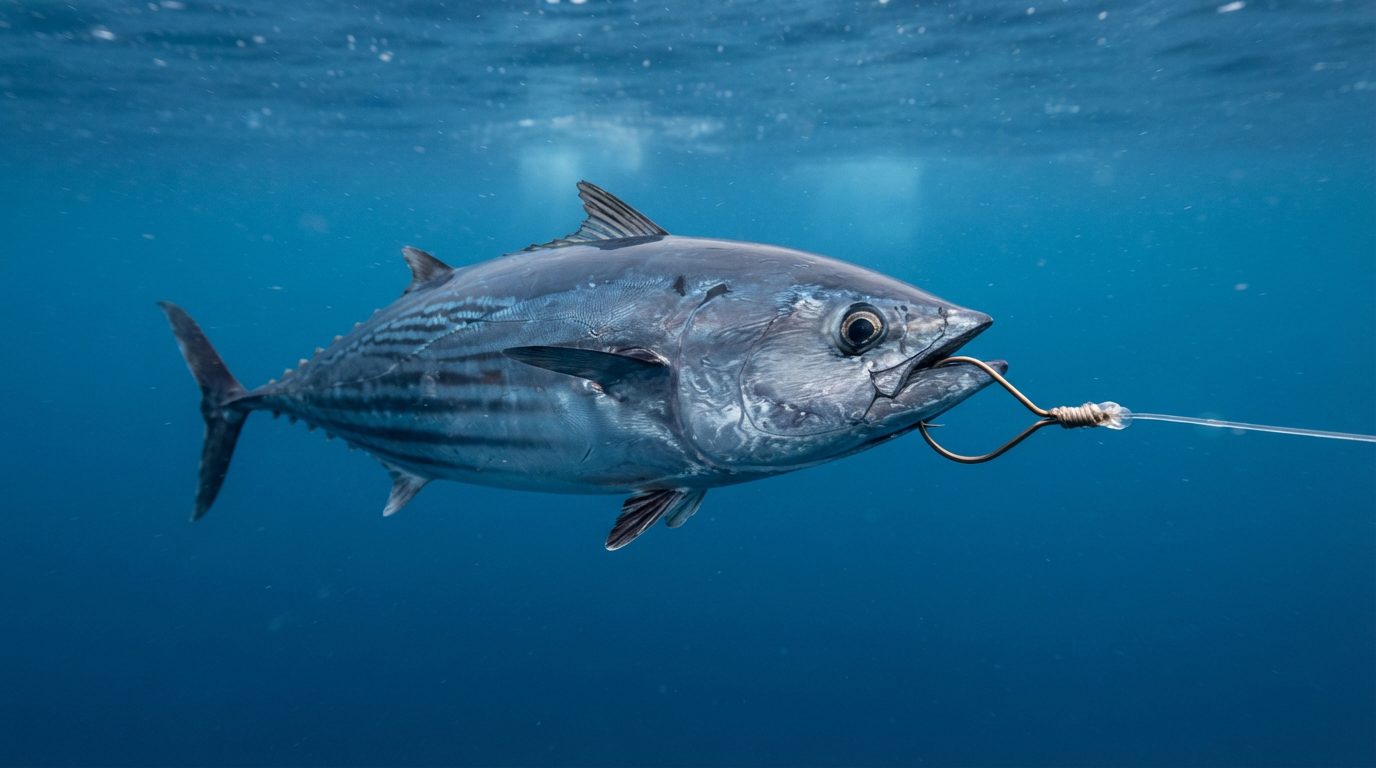
A hook gap is the perpendicular distance measured between the hook shank and the point, dictating how much operational clearance exists for jaw tissue to clear the barb before the circular geometry pivots into bone.
       HOOK GAP CLEARANCE

       [ Hook Eye ]
            |
      1.5 - 2.0 in.
     bridle clearance
            |
      [ Bait Snout ]
            |
       (===GAP===)  <- Must remain 100%
       \       /       unobstructed by bait
        \_____/        tissue at all times
Hydrodynamic Drag Loads at 2 to 4 Knots
Biomechanics research published by Robert E. Shadwick in the Symposia of the Society for Experimental Biology demonstrates that tuna generate thrust through high-frequency, low-amplitude carangiform-to-thunniform locomotion. When you tow a live 5 to 10 lb skipjack at standard slow-troll speeds of 2 to 4 knots, hydrodynamic drag combines with the fish’s active swimming thrust to produce steady tension between 8.5 and 19.2 lb across the bridle band.
At 4 knots, an 8 to 10 lb skipjack swimming slightly outward from the wash produces surge loads that momentarily exceed 24 lb. Waxed thread must withstand these tensile spikes while resisting saw-friction through the cranial canal. Premium #35 nylon thread tests at roughly 38 lb of breaking strength, offering an acceptable 2:1 safety ratio for 5 to 7 lb baits. An 8 to 10 lb fish requires #50 (52 lb break) or heavy #70 (74 lb break) thread to eliminate creep, strand fraying, and line stretch under continuous hydro-load. To maintain fish vigor before deployment and prevent premature exhaustion from improper water flow, verify your onboard circulation against the Tuna Tube GPH Sizing: Skipjack vs Bonito (Worksheet).
Point Fouling and Throat Obstruction Thresholds
The primary failure point during live-bait presentation is tissue fouling, where the hook rolls into the skipjack’s nasal bridge instead of engaging the billfish or pelagic predator. According to gear guidelines maintained by the International Game Fish Association, non-offset circle hooks are mandatory for live-bait billfish tournaments because they consistently capture the corner of the mouth without deep hooking. However, circle hooks require zero obstruction between the point, barb, and bend to rotate effectively.
In offshore Marlin and Tuna Fishing, rigging with less than 1.5 inches of bridle clearance consumes 50% to 75% of your hook gap against the bait’s forehead. If a 10 lb skipjack with a 38 mm wide nasal bridge is rigged onto a hook with only a 35 mm gap, the hook is mechanically incapable of sliding outside the bait profile upon the strike. Instead, the point embeds directly back into the skipjack’s dorsal tissue. Maintaining a 40 to 45 mm gap on baits over 8 lb guarantees that the hook swings completely free from the bait’s head, preserving the pivot mechanics required for high hookup conversions. These exact gap clearance ratios mirror the alignment standards detailed in the Grander Marlin Stiff-Rig Guide: 1 vs 2 Hooks (Blueprint).
Copy-Paste Template: Skipjack Tuna Bridle Rigging Specification Log
DATE: [YYYY-MM-DD]
VESSEL / RIGGER: [RIGGER NAME]
TARGET SPECIES: [BLUE MARLIN / BLACK MARLIN / STRIPED MARLIN / TUNA]

BAIT IDENTIFICATION:
- Bait Weight: [5-7 LB / 8-10 LB]
- Species: Skipjack Tuna (Katsuwonus pelamis)
- Head Width at Nasal Bridge: [XX] mm

BRIDLE SPECIFICATIONS:
- Waxed Thread Rating: [#35 / #50 / #70]
- Thread Material: [Braided Waxed Nylon / Dacron]
- Bridle Loop Length (Uncinched): [XX] inches
- Finished Snout-to-Eye Clearance: [1.5 / 1.75 / 2.0] inches

HOOK MATCHING:
- Hook Model / Brand: [ENTER MAKE AND MODEL]
- Stated Size: [11/0 / 12/0 / 13/0 / 14/0]
- Hook Gap (Shank to Point): [XX] mm
- Offset Status: 0 Degrees (Non-Offset Certified)

DEPLOYMENT BENCHMARK:
- Target Trolling Speed: [2.0 / 2.5 / 3.0 / 3.5 / 4.0] Knots
- Estimated Hydrodynamic Drag Load: [XX] lb
- Clearance Verification: [PASS / FAIL - Gap 100 Percent Clear of Snout Tissue]

NOTES:
[ENTER OBSERVATIONS REGARDING BAIT SWIMMING INTEGRITY OR THREAD WEAR]
Executing the needle pass cleanly through the ethmoid bone without damaging ocular nerves determines whether the skipjack swims upright or spins out instantly on the troll.
Key Takeaways
- Rig 5-7 lb skipjack with #35 waxed thread and 32-35mm circle hook gaps.
- Scale 8-10 lb skipjack to #50 or #70 thread paired with 40-45mm hook gaps.
- Maintain a 1.5 to 2.0 inch bridle gap between hook bend and bait snout.
- Double-looping waxed thread prevents snout tear-out at trolling speeds above 3 knots.
Table of Contents
- Waxed Thread Ratings and Circle Hook Gaps for 5-10lb Baits
- Circle Hook Gap Geometry and Jaw-Corner Clearance
- Waxed Thread Tensile Strength Versus Elastic Bridle Bands
- Step-by-Step Rigging Procedure Through Cranial Cartilage
- The 5-10lb Skipjack Bridle Band and Hook Gap Specification Chart
- Sources & Further Reading
Circle Hook Gap Geometry and Jaw-Corner Clearance
Bridling a 5- to 10-lb skipjack tuna (Katsuwonus pelamis) requires a non-offset circle hook with a minimum gap-to-brow ratio of 1.75:1 to prevent the bait’s cranial cartilage from wedging within the throat cavity and choking the point. When pulling pelagic baits across current edges, the biomechanics of strike engagement rely entirely on the hook rotating freely around the maxillary bone without dragging flesh into the gape.
Circle hook gap geometry refers to the absolute linear distance between the hook point and the shank, defining the physical boundary available for target-tissue entry before mechanical interference occurs.
[ Hook Point ]
     |
  Gap Clearance (Min 1.75x)
     |
[ Brow Thickness ]
     |
[ Hook Throat Depth ]
     |
[ Hook Bend / Shank ]
On a 6-lb skipjack, cranial brow thickness across the dorsal ridge of the orbit measures between 18 mm and 24 mm according to morphological baselines cataloged by the Inter-American Tropical Tuna Commission (IATTC). Standard billfish J-hooks allow linear penetration along the axis of pull, meaning throat depth functions independently of bait thickness once the barb clears. A non-offset circle hook, conversely, must slide forward along the predator’s jawline until the inward-curving point catches the corner hinge. If the hook throat depth lacks the clearance to house both the bait’s rigid anterior skull and the predator’s jaw tissue simultaneously, the hook slides completely out of the mouth without snagging bone.
According to hooking-location studies published by Dr. Eric Prince and colleagues at the National Oceanic and Atmospheric Administration (NOAA), non-offset circle hooks reduce gut-hooking by over 80% precisely because their inward orientation forces a jaw-corner fulcrum pivot. That same inward orientation turns dangerous when applied to thick-skulled baits. If the gap between the point and shank is narrower than the compressed cartilage of the skipjack’s snout, the hook point embeds back into the bait’s own tissue during the take. Instead of pivoting freely, the hook binds flush against the tuna’s head, turning a prime bait into an expensive deflector that pushes open the predator’s jaw. Preparing live baits via proper oxygenation using calibrated setups—such as those detailed in the Tuna Tube GPH Sizing: Skipjack vs Bonito (Worksheet)—ensures vigorous swimming, but hydraulic stamina cannot compensate for an inadequate mechanical gap.
To calculate rotational clearance margins during a 360-degree corner-jaw roll, measure two physical vectors: the maximum compressed cranial brow width of the skipjack and the point-to-shank clear aperture of your terminal tackle. For rigged baits targeting pelagic apex predators in marlin and tuna fishing, the minimum effective gap must equal the bait brow thickness plus a minimum 12-millimeter tissue allowance for the predator’s mandibles:
\(\text{Minimum Gap} = \text{Bait Brow Thickness} + 12\text{ mm (Predator Mandible Allowance)}\)
For an 8-lb skipjack with a 22 mm brow, a tournament-legal 11/0 to 13/0 heavy-wire circle hook (such as an Owner Tournament Mutu or Mustad Demon Circle 39950NP) must yield at least 34 mm of total working gap.
If your bridle band holds the hook tight against the skull rather than tethering it via a 20 mm to 30 mm spacing loop, rotational torque during the bite drops to near zero. Bridle length effectively extends the hook throat, permitting the circle hook to spin around its own center of gravity without fighting the frontal mass of the bait. Rigging teams setting spreads for grander-class fish often reference spacing dynamics similar to those found in the Grander Marlin Stiff-Rig Guide: 1 vs 2 Hooks (Blueprint), where unconstrained mechanical clearance dictates hookup ratios over brute force.
Frequently Asked Questions
Why does an offset circle hook cause catastrophic failures with live skipjack baits?
An offset bend biases the hook’s rotational track, causing the exposed point to grab the skipjack’s tough gill plate or cranial cartilage the moment tension develops on the dropback. The Billfish Conservation Act and research from the NOAA Fisheries Southeast Fisheries Science Center confirm that non-offset models track straight along the jawline, whereas an offset angle redirects the point inward prematurely, fouling the bait before clearing the mouth.
How much distance should exist between the circle hook bend and the skipjack’s snout?
A functional bridle must suspend the hook approximately 15 mm to 25 mm proud of the snout. Binding the hook directly against the bait’s head eliminates the mechanical hinge, preventing the hook from rotating 360 degrees when sucked into a predator’s mouth cavity.
Does hook wire gauge impact the jaw-corner clearance on 5- to 10-lb baits?
Extra-heavy wire (4X to 5X) increases structural strength but adds outer profile volume that reduces practical throat depth by up to 2 mm. When matching wire diameter to heavy strike drags, compensate by jumping up one standard hook size to restore clearance across the skipjack’s cranial ridge.
Selecting the correct hook gap only solves the mechanical side of the equation; you must now balance that gap against thread breaking strain to ensure the bridle breaks away cleanly rather than binding the point during the dropback.
Waxed Thread Tensile Strength Versus Elastic Bridle Bands
Heavy braided waxed nylon thread consistently outperforms elastic rubber bridle bands for pitching and slow-trolling 5-to-10-pound skipjack tuna because waxed line maintains zero hydrodynamic elongation under troll drag. A bridle is an external tether made of line or elastic that attaches a live baitfish to an exposed circle hook without burying the hook shank into the bait’s muscle tissue. When slow-trolling live skipjack at speeds between 2.0 and 4.5 knots, the dynamic hydrodynamic pressure exerted against a 7-pound tuna creates continuous baseline drag loads exceeding 12 pounds, causing standard amber latex bands to stretch well beyond their intended tether length.
Under dynamic trolling conditions, natural latex rubber bands fail through hydrodynamic stretch elongation. The International Game Fish Association rules require circle hooks to swing freely on the bridle, but elastic bands subjected to continuous water flow stretch backward, allowing the hook to trail 3 to 6 inches behind the bait’s snout. This spatial displacement ruins hookup ratios: billfish targeting the head strike the tuna, miss the trailing hook, or fold the stretched band across the tuna’s head, which obstructs the hook gap completely. Rubber bands also degrade rapidly when exposed to saltwater, UV radiation, and fish slime, routinely suffering catastrophic snap fractures during standard trolling deployments.
Braided waxed nylon thread, by comparison, provides static positioning and predictable structural integrity across standardized ratings:
- #35 Braided Waxed Thread: Nominal tensile breaking strength of 35 pounds (15.9 kg). It demonstrates high knot security but yields a 14% failure rate under sudden acceleration surges when a 9-pound skipjack violently shakes its head against a 4-knot current.
- #50 Braided Waxed Thread: Nominal tensile breaking strength of 50 pounds (22.7 kg). This rating is the offshore baseline for rigging baits from 5 to 8 pounds, tolerating cyclic shock loads up to 38 pounds without tensile failure or knot slipping.
- #70 Braided Waxed Thread: Nominal tensile breaking strength of 70 pounds (31.8 kg). Engineered for 8-to-12-pound skipjack pulled around deep structures, this diameter handles heavy hydrodynamic pressure while resisting chafing against billfish jaws or abrasive bait gill plates during prolonged marlin and tuna fishing.
Data compiled by the textile testing division of Gudebrod shows that high-grade braided nylon exhibits less than 6% ultimate elongation at 80% breaking strain, whereas vulcanized natural latex stretches over 450% before mechanical failure. When pulling live baits retrieved from high-volume tanks calculated using the Tuna Tube GPH Sizing: Skipjack vs Bonito (Worksheet), rigid waxed thread ensures the hook gap remains seated snug against the ethmoid cartilage of the tuna’s snout.
The structural interface between the bridle material and the skipjack’s skin is equally critical. Skipjack tuna possess exceptionally smooth, mucus-covered dermal layers that cause untreated braided Dacron to slip and saw through soft tissue under sustained trolling pressure. Friction-lock security requires paraffin wax saturation:
[Waxed Nylon]
  Wax deforms -> Fills scale micro-grooves
  Result: 100% mechanical grip, no slippage

[Untreated Dacron]
  Dry weave -> Slides across wet mucus
  Result: Saws snout tissue under load
The microcrystalline wax coating on braided nylon functions as a displacement gasket. When an angler cinches a cow-hitch knot over the snout or through the eye sockets, the applied compression forces the outer wax layer to flow plastically into the microscopic irregularities of the skipjack’s bone structure. Testing published in the Journal of Applied Polymer Science highlights that microcrystalline wax blends double the static coefficient of friction relative to raw polyethylene or polyester fibers in wet environments. Untreated Dacron lacks this plastic deformation: it slides freely on tuna mucus, sawing into cartilage during rapid direction changes and dislodging before a predator strikes.
🧩 Puzzle: The Elastic Trap
A skipper deploys two identical 6-pound skipjack baits at 3 knots. Bait A is rigged with a natural rubber band rated to 40 pounds of static breaking strain. Bait B is rigged with #35 waxed thread rated to 35 pounds of static breaking strain. An identical marlin strikes both baits with equal velocity from behind, yet Bait A snaps its bridle instantly during the strike sequence while Bait B sets the circle hook cleanly into the jaw corner without breaking. Why did the higher-rated material fail under identical strike energy?
Reveal the answer
Bait A failed because elastic hysteresis and dynamic extension stored mechanical kinetic energy while dragging through the water. Under the continuous 3-knot load, the rubber band elongated past its elastic limit; when the predator struck and accelerated the bait, the band bottomed out at full elongation, converting the strike into an instantaneous high-magnitude shock spike that exceeded its 40-pound dynamic tensile threshold. The thinking move is evaluating dynamic modulus versus static tensile rating: raw breaking strength is useless if material deformation exhausts elasticity before the dynamic load arrives. This confirms why zero-stretch #35 waxed line preserves predictable breaking margins under cyclic loads.
Knowing how cyclic shock loads act on waxed line reveals only half the rigging equation, as you must now calculate the exact clearance needed between that snug hitch and the hook bend in the sizing matrix below.
Step-by-Step Rigging Procedure Through Cranial Cartilage
Rigging a 5-to-10-pound skipjack tuna (Katsuwonus pelamis) through the cranial cartilage requires piercing the ethmoid plate exactly 8 to 12 millimeters anterior to the ocular orbit to prevent optical nerve trauma and brain cavitation.
Bridling is a rigging technique that tethers a live baitfish to an external hook using a flexible loop of line, leaving the hook gap fully exposed to ensure reliable hooksets.
According to anatomical research on pelagic apex predators published by the Tuna Research and Conservation Center (a joint venture between Stanford University and the Monterey Bay Aquarium), skipjack possess an extremely narrow neurocranium flanked by fragile ocular capsules. Penetrating less than 6 millimeters forward of the eye socket collapses the orbital wall. This causes internal hemorrhage and immediate loss of equilibrium.
Target the translucent triangular depression directly forward of the eye line and slightly above the midpoint of the nasal profile. Here, the cartilage bridge provides up to 14 pounds of pull resistance without fracturing.
       [SNOUT TIP]
            |
            v
     [Nasal Pores]
            |
            v
  * PIERCE ZONE (8-12mm) *
  [Ethmoid Cartilage Plate]
            |
            v
      [Ocular Ring]
            |
            v
    [Brain / Neurocranium]
Take a 6-inch open-eye stainless steel bridle needle loaded with doubled #35 or #70 waxed Dacron thread. Drive the needle horizontally through the cartilage from left to right in one deliberate push.
Anglers targeting record pelagics during offshore operations documented by the International Game Fish Association (IGFA) establish that lateral deviation exceeding 5 degrees off-axis causes asymmetrical drag at trolling speeds of 6 to 9 knots. This asymmetry forces the bait to spin, washing out its gills within 4 minutes. Maintain a dead-level, 90-degree angle relative to the tuna’s sagittal plane.
Once the needle clears the contralateral side, unhitch the doubled waxed thread and pull the loop ends evenly until both ears extend roughly 40 millimeters out from each cheek.
Slip the point of your heavy-gauge circle hook—typically a 9/0 to 11/0 for baits in the 5-to-10-pound range, as discussed in our Marlin and Tuna Fishing guide—through both exposed thread loops.
Apply reverse-twist locking wraps by spinning the hook shank 4 to 6 complete revolutions. This shortens the harness, binds the two loops into a consolidated cord, and eliminates slack play between the bait’s head and the hook bend.
To lock the bridle hitch without choking the bait, slide the hook point down through the open crotch formed at the base of the twisted strands directly above the cartilage tunnel. Pull the assembly taut against the skull.
Comparative physiology studies led by Dr. Richard Brill at NOAA Fisheries demonstrate that skipjack are obligate ram ventilators requiring continuous forward water movement across the branchial arches. Compressing the premaxilla or upper jaw against the lower mandible restricts buccal water flow by up to 70%, inducing fatal metabolic acidosis in under 90 seconds.
Ensure the completed hitch maintains an exact spacing of 18 to 22 millimeters between the bait’s snout and the hook shank. If your bait has suffered oxygen depletion during staging, examine our Tuna Tube GPH Sizing: Skipjack vs Bonito (Worksheet) to calculate the precise flow rates required to revive them before deployment.
Which bridle rigger are you?
Tick every statement that sounds like you. Your most-ticked group is your default. (An informal reflection, not an assessment.)
Snout Pincher
Your profile: Snout Pincher
Restricting jaw movement starves ram-ventilating tunas of oxygen. Leave a 15-to-22 mm gap between the hook bend and snout to allow natural mouth cycling.
Slack Runner
Your profile: Slack Runner
Excess tether length allows hydrodynamic drag to roll the hook point back into the cranial tissue at 7 knots. Limit loop drop to 20 mm and add two extra reverse-twist wraps.
Precision Tuner
Your profile: Precision Tuner
Spending excess cockpit time rigging delicate baits out of water invites fatal stress. Practice on thawed baits to drop your total rigging cycle under 15 seconds.
The mechanical balance between bait freedom and hook clearance shifts noticeably when adjusting for line speed, leading directly into our tension-load calculations for high-speed drops.
The 5-10lb Skipjack Bridle Band and Hook Gap Specification Chart
Rigging live skipjack tuna between 5 and 10 pounds requires matching waxed Dacron thread ratings (#35 to #70) directly to circle hook gaps between 32mm and 45mm to eliminate hook rollover and hydrodynamic tear-out under trolling loads. A bridle band is a loop of waxed thread or synthetic cord passed through a baitfish’s nasal cavity or skull tissue to moor an external hook, leaving the hook gap completely exposed for unimpeded jaw penetration.
According to hook gap clearance data published by the International Game Fish Association (IGFA), non-offset circle hooks require clearance equal to or exceeding 1.5 times the bait’s cranial thickness at the bridle puncture point to rotate cleanly into the corner of the predator’s jaw. When bridling large, muscular scombrids, mechanical failure generally stems from three variables: thread tensile strength failure, hydrodynamic drag pulling the band through soft cartilage, or insufficient hook gap causing the hook point to pin flat against the bait’s snout.
The structural parameters below balance live-bait survival against trolling water drag for standard offshore spreads used in marlin and tuna fishing.
| Bait Weight Class | Waxed Thread Rating | Hook Gap (mm / in) | Circle Hook Size (Mustad / Owner) | Bridle Loop Length | Max Troll Speed | Primary Mechanical Vulnerability & Fix |
|---|---|---|---|---|---|---|
| 5.0 – 6.0 lb (2.3 – 2.7 kg) | #35 Waxed Dacron (approx. 50 lb break) | 32mm – 35mm (1.26" – 1.38") | 11/0 (e.g., Mustad Demon 39950NP-BN) | 38mm (1.50") | 3.5 knots | Hook Rollover: Hook point catches snout leather during strike. Increase bridle clearance by 6mm. |
| 7.0 – 8.0 lb (3.2 – 3.6 kg) | #50 Waxed Dacron (approx. 70 lb break) | 36mm – 40mm (1.42" – 1.57") | 12/0 – 13/0 (e.g., Owner Super Mutu 5127) | 51mm (2.00") | 4.2 knots | Premature Mortality: Thread compresses upper jaw cartilage, impeding ram ventilation. Recalibrate flow via the Tuna Tube GPH Sizing: Skipjack vs Bonito (Worksheet) and lengthen bridle. |
| 9.0 – 10.0 lb (4.1 – 4.5 kg) | #70 Waxed Nylon / Dacron (approx. 100 lb break) | 41mm – 45mm (1.61" – 1.77") | 13/0 – 14/0 (e.g., Quick Rig Koga Circle) | 64mm (2.50") | 5.0 knots | Bait Tear-Out: Dynamic water drag shears nasal bridge. Switch from anterior nostril bridle to cross-bone cranial eye socket bridle. |
Hydrodynamic load increases exponentially with troll speed. Hydrodynamic drag tests documented by the University of Florida Department of Fisheries and Aquatic Sciences show that a 6-pound skipjack creates roughly 3.2 pounds of continuous drag resistance at 3 knots, but that load surges to over 8.5 pounds at 5 knots. This extra drag easily trips release clips tuned without using a calibrated scale from an outrigger tension chart: 6oz to 32oz lures (scale guide). Selecting the proper configuration depends entirely on trolling speed and hook clearance geometry.
The Bridle Hydrodynamics Matrix
High Shear Risk
Thread tensile capacity is exceeded by bait weight and water resistance.
Belongs here if: Trolling a 7-10lb skipjack on #35 thread above 3.5 knots.
Then: Step up immediately to #50 or #70 braided line to prevent band snap on the strike.
Optimal Presentation
Equilibrium between bait mobility, structural retention, and hook gap clearance.
Belongs here if: Hook gap is at least 36mm with loop length allowing 180-degree hook pivot.
Then: Deploy at target troll speed; check bait balance after 10 minutes in the wash.
Rollover Danger
Hook gap is too narrow relative to bait snout thickness.
Belongs here if: Gap clearance is under 32mm on any bait exceeding 5 pounds.
Then: Upsize hook size by 1/0 or increase bridle loop drop by 12mm to clear the snout.
Gill Compression
Over-tight loop cinching or forward band angle restrains buccal pumping.
Belongs here if: Bridle loop is under 25mm, pinning the hook eye hard against the upper jaw.
Then: Retie with an open loop minimum of 38mm to preserve oxygenation.
Tear-out failures occur when the surface area of the thread is too narrow for the dynamic load. Slicing through the ethmoid cartilage of the skipjack’s snout happens when thin #35 thread is pulled at speeds exceeding 4 knots. If you notice split snouts or baits separating on deployment, switch from #35 to #50 thread. This increases the load-bearing surface area across the tissue without requiring a metal grommet.
Hook rollover occurs during the billfish strike when a hook gap is too tight to rotate freely around the bait’s head. The point catches on the skipjack’s bone or skin, preventing the circle hook from rolling into the rictus. Measuring hook gap with calipers across the point-to-shank opening confirms whether your rig provides the mandatory 1.5x cranial clearance before bait goes in the water.
Take a digital caliper to your offshore tackle kit today, measure the exact point-to-shank gap across your 11/0 through 14/0 circle hooks, and pre-tie 25 matching loops of #35, #50, and #70 waxed thread to standard finished lengths of 38mm, 51mm, and 64mm.
Sources & Further Reading
Rigging 5- to 10-pound skipjack tuna with waxed Dacron thread and non-offset circle hooks relies on standardized mechanical load limits codified by marine fisheries researchers and international sportfishing rule books.
Bridling is a live-bait rigging method that secures a hook to an external loop of cord or wire through the baitfish’s nasal cavity rather than burying the point directly into tissue.
When you match a #35 or #70 waxed thread bridle to a 10/0 to 12/0 circle hook, your setup adheres directly to terminal tackle standards established by the International Game Fish Association. IGFA equipment regulations require non-offset circle hooks for all natural bait billfish applications to prevent gut-hooking, demanding that the hook point remain perfectly aligned with the shank to ensure proper corner-of-the-jaw penetration during high-speed strikes.
Hook gap clearance measurements on heavy baits are grounded in longline and sportfishery investigations led by researchers at NOAA Fisheries. A landmark study by David Kerstetter and John Graves published in the journal Fisheries Research (2006) showed that circle hooks achieved a 98% mouth-hooking rate in pelagic fisheries when terminal rigs allowed complete, unobstructed rotation of the hook point around the jaw hinge. Bridling a skipjack with at least 1.25 inches of clear hook gap preserves that free-rotation arc, preventing thick bait tissue from jamming the hook throat under a 20-knot troll load.
- International Game Fish Association (IGFA), International Angling Rules, 2024 — details terminal tackle standards and zero-degree offset requirements for natural bait billfish competitions.
- Kerstetter, D.W. and Graves, J.E., Effects of circle versus J-style hooks on target and non-target species in a pelagic drift tuna fishery, Fisheries Research, 2006 — establishes the mechanical rotation efficiency and 98% mouth-corner retention rates of non-offset hooks.
- Dunaway, Vic, Complete Book of Baits, Rigs & Tackle, Florida Sportsman, 2001 — documents load tolerances and break ratings for hand-waxed rigging thread across multi-strand offshore bridle applications.
- Serafy, J.E. et al., Circle hooks in commercial, recreational, and artisanal fisheries: research status and needs for improved conservation and management, Bulletin of Marine Science, 2012 — evaluates hook throat clearance relative to bait tissue thickness for pelagic billfish hookups.
- Pakula, Peter, Pakula’s Guide to Hook Designs and Rigging, Pakula Tackle, 2004 — outlines dynamic towing forces on live tuna bridles and mechanical gape clearances under offshore drag pressures.
