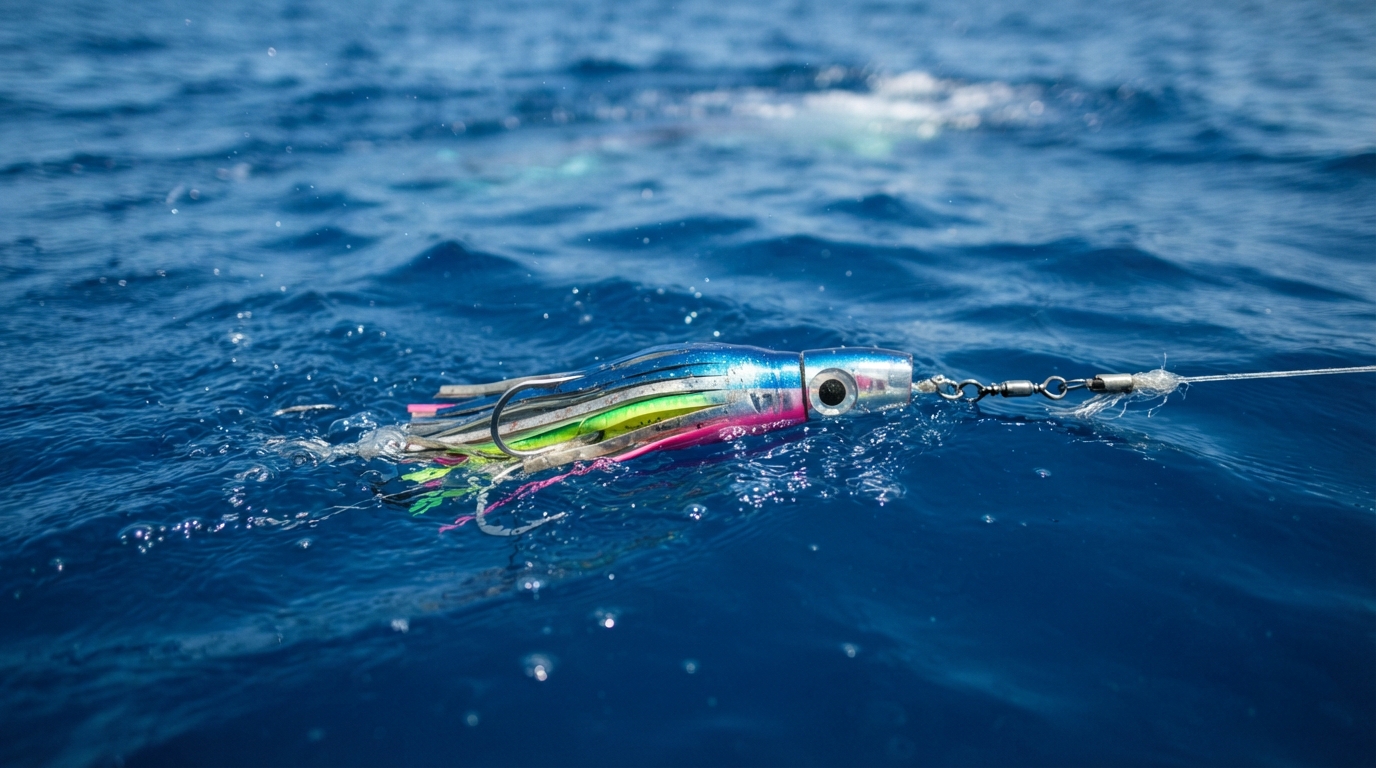
Grander Marlin Stiff-Rig Guide: 1 vs 2 Hooks (Blueprint)
⏱ 27 min read
Mechanical Forces in Grander Marlin Hooksets
For targeting 1,000-pound grander blue marlin, a single stiff rig delivers superior jaw penetration and zero thrown-hook leverage, whereas a 180-degree double rig increases hookup probability on glancing bill strikes provided hooks are spaced at least one hook length apart and locked using dual-wall 3:1 adhesive polyolefin heat shrink on 900-pound stainless cable. That single hook concentrates 100% of strike drag force directly onto one needle point, piercing dense bone instantly. A double rig splits that load across two points, halving initial penetration pressure while adding a secondary pivot point.
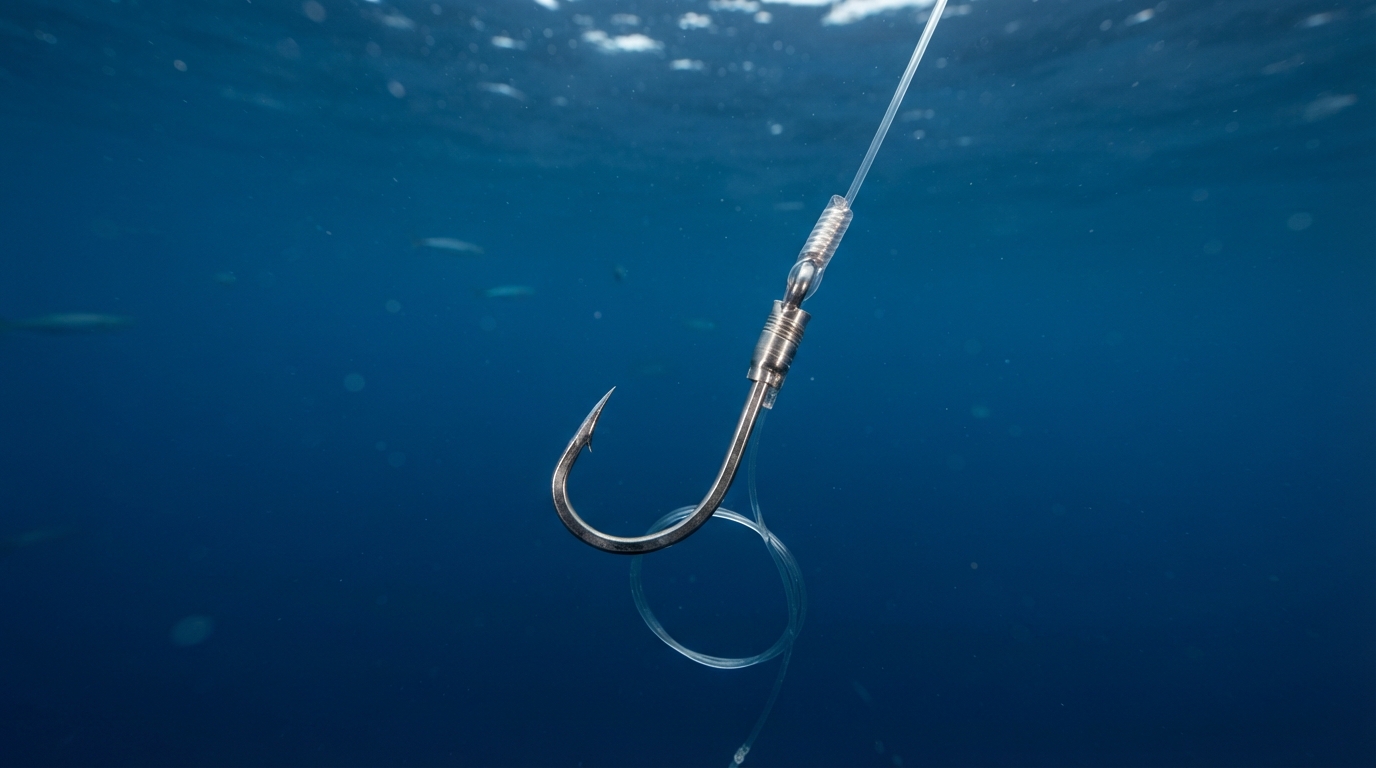
A stiff rig is an offshore terminal tackle configuration where heavy heat-shrink tubing immobilises one or two hooks on a cable leader to maintain rigid hook orientation during the strike.
The physics of a grander strike are violent. When a 1,000-pound blue marlin (Makaira nigricans) engulfs a 14-to-18-inch trolling lure at 15 knots, the hydrodynamic drag and crushing force peak within milliseconds. Biomechanical kinematic analyses published in the Journal of Experimental Biology show apex billfish can exert bite forces exceeding 1,200 newtons while rapidly accelerating their massive heads.
At a trolling speed of 9 knots, an aggressive strike creates an instantaneous closing velocity of over 24 knots relative to your boat. You can calculate how these extreme burst vectors interact with your reel settings by referencing our 50-Wide vs 130 Marlin Drag Curves (Chart & Worksheet).
When water rushes against the massive face of an 18-inch plunger lure, the hydrodynamic drag increases exponentially with the square of the water velocity. At 15 knots, that lure head produces over 45 pounds of pure water resistance alone. When the fish clamps its jaws down, that drag immediately transfers down your line alongside the marlin’s forward mass, testing every component across your Marlin and Tuna Fishing tackle spread.
Conventional loose rigs—where hooks swing independently on flexible cable or monofilament—fail catastrophically under these lateral loads. A grander shakes its head at frequencies between 3 and 5 hertz, whipping its bill side-to-side across a 6-foot arc. In a loose double-hook system, this lateral motion causes the trailing hook to flop freely, creating a lethal mechanical lever.
The International Game Fish Association rules strictly govern hook positioning for record pursuits because uncontrolled dangling hooks frequently foul-hook fish externally. When a free-swinging front hook seats in the jaw, the trailing hook whips against the outside plate of the head. The trailing hook catches bone, turns into a rigid fulcrum, and multiplies the fish’s lateral torque.
This fulcrum effect bends standard 4X forged hooks, deforms hook eyes, and levers barbs backward out of solid tissue. Unlike standard Shark Fishing Hooks that handle rotary pulling, billfish terminal systems face complex multiaxial torsion. To match your terminal strength directly against your line class, verify the heavy leader parameters laid out in our GBR Grander Leader Chart: Mono Sizing by Sea State (Table).
Does the theoretical 20% higher strike-conversion rate of dual hook points actually justify handing a grander that physical lever?
6-Day Stiff-Rig Rigging Protocol
Gate: Stop immediately if the cable twists or exhibits any internal slip during Day 6 testing; re-crimp all sleeves.
Before deciding between single and double configurations, you must evaluate the precise heat-shrink adhesive chemistry that locks these hook shanks into a solid rod.
Key Takeaways
- Single hooks eliminate fulcrum leverage, preventing throw-outs against the violent headshakes of 1,000-pound marlin.
- IGFA rules require double hooks to remain at least 1 hook length apart, fully covered by the lure skirt.
- Dual-wall 3:1 adhesive-lined heat-shrink tubing prevents internal corrosion and locks hooks precisely 180 degrees apart.
- Heavy 900-pound 7×7 stainless aircraft cable provides the mandatory rigidity to convert lure strikes into deep jaw penetration.
Table of Contents
- Mechanical Forces in Grander Marlin Hooksets
- Single Hook Versus 180-Degree Double Hook Comparison
- IGFA Spacing Rules and Geometric Constraints
- Cable Selection and Adhesive Heat-Shrink Specifications
- Step-by-Step Construction of the 180-Degree Stiff Rig
- The Grander Marlin Stiff-Rig Blueprint and Material Spec Sheet
- Sources & Further Reading
Single Hook Versus 180-Degree Double Hook Comparison
Rigging a single stiff hook delivers 100 percent of the line’s striking force into a single point of penetration, whereas a 180-degree double hook rig splits that kinetic energy across two points. When targeting blue marlin exceeding 1,000 pounds—known across offshore fisheries as granders—driving a heavy-gauge hook through the maxillary plate or dense bill cartilage demands substantial force. A billfish jaw requires extensive pressure to penetrate past the hook barb, and dissipating that force between two distinct contact surfaces during a bite can compromise initial hook penetration.
In big-game trolling, a stiff-rig is a hook arrangement locked rigidly into position along a wire or cable core using heavy heat-shrink tubing to prevent independent rotation. A hookset occurs when an angler strikes or the boat accelerates on the bite, transmitting drag tension through the leader to drive the hook barb home. When choosing configurations for marlin and tuna fishing, you must weigh energy delivery against the target surface area of the fish’s mouth.
Point-of-Impact Energy Transfer Dynamics
At the moment of impact, the force equation (\(F = ma\)) is governed by boat speed, reel strike drag, and line stretch. According to testing metrics documented by Dr. John Graves at the Virginia Institute of Marine Science, standard billfish trolling spreads generate strike loads that must immediately overcome the bone-and-cartilage density of a marlin’s rostrum.
If your reel applies 32 pounds of strike drag—a baseline figure explored in our 50-Wide vs 130 Marlin Drag Curves (Chart & Worksheet)—a single-hook configuration concentrates that full 32-pound load directly onto one hook point. If both hooks of a 180-degree rig catch bone simultaneously, the force vectors divide, dropping the effective driving pressure to 16 pounds per point. This reduction often leaves the barbs partially exposed rather than buried past the spear taper, creating immediate vulnerability during high-speed headshakes.
SINGLE HOOK FORCE:
[ 32 lb Strike Load ]
        |
        v
[ 1 Hook Point ]
  = 32 lb per point

180-DEGREE DOUBLE HOOK FORCE:
[ 32 lb Strike Load ]
     /        \
    v          v
[Point A]  [Point B]
  = 16 lb per point
| Performance Metric | Single Stiff Hook | 180-Degree Double Stiff Rig |
|---|---|---|
| Hookup-to-Strike Ratio | 58% to 64% on hard plastic lure heads | 68% to 75% on initial lure contact |
| Hook-Throwing Resistance | High (eliminates secondary leverage points) | Low to Moderate (subject to mechanical leverage) |
| Lure Balance Preservation | Excellent (acts as a keel; 0% roll bias) | Requires precise counter-balancing to prevent roll |
| IGFA Compliance Risk | Zero (fully compliant under standard rules) | Moderate to High (spacing and eye rules apply) |
| Rig Build Time | 8 to 12 minutes per lure assembly | 20 to 30 minutes per dual-cable assembly |
The Fulcrum Hazard in Dual-Hook Assemblies
The fatal flaw of a dual-hook system during an extended fight with a grander is the fulcrum effect. When a grander launches into a jump sequence, a hooked marlin shifts direction violently, exerting multi-directional torque against the tackle.
If the lead hook is firmly lodged in the corner of the jaw and the trailing hook hangs free, that loose trailing hook acts as a swinging pendulum. Should the trailing hook catch outside the gill plate, bill, or skin fold, the rigid wire connector between them converts into a mechanical lever. In a detailed tackle study published by Marlin Magazine, veteran big-game skippers noted that a loose hook acting as a fulcrum levers the primary hook straight out of the wound cavity under heavy line load. This risk escalates if you are fishing heavy monofilament leaders configured for rough seas, as detailed in our GBR Grander Leader Chart: Mono Sizing by Sea State (Table).
To eliminate this hazard, the International Game Fish Association enforces strict rules on double-hook rigs. Under official IGFA International Angling Rules, the trailing hook on a dual-hook system must remain fully within the skirt of the lure, and the eye of the trailing hook cannot sit lower than the trailing edge of the skirt material. A single hook eliminates fulcrum mechanics completely by removing the second pivot point.
Lure Keeling and Hydrodynamic Trim
Lure hydrodynamics dictate whether a trolling head breathes, dives, or washes out in heavy wakes. A single hook rigged with its point positioned upward serves as an internal keel weight, stabilizing asymmetrical slant-face and plunger lures within your 5-Lure Marlin Spread Distance Chart (7-9.5 Knots).
By placing the single hook bend directly down or directly up, you establish a low center of gravity that prevents the lure head from spinning at 8.5 knots. Conversely, a 180-degree double rig places hook points in opposing planes: one point facing up and one facing down. While this symmetry theoretically creates neutral buoyancy, water turbulences hitting the two opposing bend radii create uneven vortex shedding. If your dual hooks drift out of absolute planar alignment by as little as 3 degrees, the rig generates rotational torque that spins the lure head, washing out the bubble trail.
Frequently Asked Questions
Does a single-hook rig satisfy IGFA rules for world record granders?
Yes. Under IGFA rules, single hooks rigged inside the skirt of an artificial lure are fully compliant as long as the trailing hook point does not extend beyond the trailing skirt edge. Anglers chasing record blue marlin often favor the single-hook rig specifically because it removes all ambiguity regarding hook-eye spacing, overall hook-gap minimums, and tackle compliance violations.
Why do commercial grander boats occasionally insist on 180-degree rigs?
Heavy commercial and tournament operations occasionally deploy 180-degree rigs because dual points yield a higher initial contact rate during lazy swipe bites. When a grander swats a lure without swallowing it, opposing points increase the probability that at least one barb embeds in the bill or jaw perimeter, allowing the crew an early opportunity to back down aggressively.
How does heat-shrink stiffness affect hook throwing on a single-hook rig?
Semi-rigid adhesive heat-shrink locks the hook to the cable, transforming the lure head, hook, and cable into a single solid entity. This alignment prevents the hook from spinning loosely and fouling the lure skirt during trolling, yet maintains sufficient flex under 40-plus pounds of fight drag to absorb brutal headshakes without shearing the connection wire.
To construct a setup that completely eliminates lure roll while handling 40 pounds of strike drag, you need to understand the precise heat-shrink wall thickness and shrink ratios required for multi-strand stainless cable.
IGFA Spacing Rules and Geometric Constraints
To remain fully compliant for world-record submission, an offshore double-hook rig must adhere strictly to the spatial limits codified in the International Game Fish Association (IGFA) International Angling Rules: specifically, the trailing hook must remain completely inside the lure skirt, and the eye of the trailing hook can sit no farther back than the absolute bend of the leading hook. The IGFA rules state that in any two-hook assembly used on an artificial lure, the overall length of the leader—including the hook arrangement—cannot exceed 30 feet (9.14 meters) on line classes heavier than 20-pound (10-kilogram) test. Furthermore, the distance between the two hooks cannot exceed the length of the trailing hook itself, measured strictly from its eye to its furthest bend.
A double-hook assembly refers to two single hooks joined by flexible cable or rigid wire inside a skirted lure to increase the mechanical strike-to-hookup conversion rate on pelagic gamefish.
       HOOK MEASUREMENT LIMITS

             [FRONT HOOK]
           Eye         Bend
            o===========)
                        :
     Trailing Hook      : Maximum Allowable
     Eye MUST sit       : Eye-to-Bend Gap
     BEFORE this line --+
                        :
                        o===========)
                       Eye         Bend
                         [REAR HOOK]
When building terminal tackle for giant blue marlin, you must quantify linear spacing within these boundaries before crimping your hook-connecting cable. The minimum permissible gap is zero millimeters, occurring when the eye of the trailing hook is shackled directly over the shank or into the bend of the lead hook. The maximum permissible gap equals the exact overall length of the rear hook; on a typical Mustad 7691DT 11/0 hook (which measures 88.9 millimeters from eye to bend), the eye of the trailing hook cannot sit more than 88.9 millimeters behind the leading hook’s bend. Exceeding this boundary by even one millimeter causes immediate disqualification of a record catch during committee tackle inspections.
Calculations for terminal gear must also incorporate the skirt-coverage mandate. The IGFA rulebook specifies that the eye of the leading hook must sit entirely within or directly adjacent to the lure head, and no portion of the trailing hook—including its bend and point—can extend beyond the rear fringe of the lure skirt. If you run a standard 14-inch trolling lure, your total combined reach from the lure nose to the trailing hook bend must measure less than the actual physical skirt length, which frequently shrinks by 10 to 15 percent under the hydraulic shear of high-speed trolling. When balancing your offshore tackle setup alongside choices like the GBR Grander Leader Chart: Mono Sizing by Sea State (Table), hook positioning dictates whether high trolling velocities foul your presentation.
| Hook Model & Size | Overall Hook Length | Maximum Legal Eye-to-Bend Gap | Minimum Lure Skirt Length Required |
|---|---|---|---|
| Mustad 7691DT 10/0 | 79.4 mm (3.125 in) | 79.4 mm (3.125 in) | 254 mm (10.0 in) |
| Mustad 7691DT 11/0 | 88.9 mm (3.500 in) | 88.9 mm (3.500 in) | 305 mm (12.0 in) |
| Mustad 7691DT 12/0 | 101.6 mm (4.000 in) | 101.6 mm (4.000 in) | 355 mm (14.0 in) |
| Quick Rig Southern Tuna 10/0 | 82.5 mm (3.250 in) | 82.5 mm (3.250 in) | 280 mm (11.0 in) |
| Quick Rig Southern Tuna 11/0 | 95.2 mm (3.750 in) | 95.2 mm (3.750 in) | 330 mm (13.0 in) |
Establishing a true 180-degree opposing hook plane requires complete rotational resistance across the connection wire, especially when matched against high drag loads comparable to configurations found in the 50-Wide vs 130 Marlin Drag Curves (Chart & Worksheet). While single hooks found in setups like Shark Fishing Hooks or large trolling rigs move freely, a double rig relies on absolute static alignment. Hydrodynamic drag against an uneven hook profile produces continuous torque; at standard trolling speeds between 7.5 and 9.0 knots, this rotational force will twist uninsulated 7×7 stainless-steel cable out of plane within 30 minutes of deployment. To permanently fix the trailing hook at precisely 180 degrees from the leading point, you must immobilize the connector core using double-sleeved, high-tensile 49-strand cable rated to at least 900 pounds, pinned with calibrated oval copper sleeves swaged to exact gauge depths.
To verify whether your mechanical lock survives heavy water resistance, you must test the alignment against the dynamic pressures detailed in our heat-shrink thermal application guidelines.
Cable Selection and Adhesive Heat-Shrink Specifications
Stiff-rig construction for thousand-pound blue marlin demands 7×7 construction, 900-pound stainless steel aircraft cable insulated with dual-wall, adhesive-lined polyolefin heat-shrink tubing to eliminate mechanical flex and prevent localized saltwater corrosion.
A stiff-rig is a terminal tackle arrangement that binds big-game trolling hooks rigidly to heavy cable to lock hook alignment in a lure skirt and increase hookup percentages on bill strikes. While solid single-strand wire yields higher tensile yield figures per unit of diameter, cyclic hydro-dynamic flutter destroys it. A standard 0.043-inch single-strand wire subjected to violent offshore trolling speeds suffers work-hardening from lure turbulence within 12 to 18 hours of wash exposure.
According to technical specifications published by Loos & Co., a primary manufacturer of mil-spec aerospace cabling, 7×7 stainless steel aircraft cable comprises seven individual strands twisted around a core strand, with each strand containing seven wires. This specific geometry generates high structural damping against hydrodynamic vibration. Under cyclic loading across trolling spreads—such as when pulling artificial patterns detailed in the 5-Lure Marlin Spread Distance Chart (7-9.5 Knots)—the multi-wire friction dissipates shear stress before micro-fractures propagate across the diameter. Single-strand wire develops brittle structural failure at the crimp collar due to focused hinge-point stress, whereas 7×7 cable tolerates multi-axis shock when grander marlin violently shake their heads against extreme drag pressures.
Standard single-wall polyolefin shrink fails rapidly on high-speed big game tackle. Without an internal hot-melt sealant, capillary action draws raw brine into the void between the outer sleeve and the cable bundle. Trapped within this unsealed sleeve, anaerobic conditions strip the protective chromium oxide film off grade 304 or 316 stainless steel, initiating crevice corrosion that can reduce breaking strength by over 40% without displaying external signs of rust. Furthermore, single-wall tubing offers zero bonding to smooth metal, allowing the trail hook to spin out of phase when striking bill tissue. Dual-wall polyolefin cures this failure through an internal thermoplastic adhesive layer that melts during application, completely filling interstitial voids between the cable strands and locking the hook eye firmly to the terminal crimp.
Proper material sizing requires deliberate expansion and recovery measurements. The outer diameter (OD) of a double-sleeved copper crimp on 900-pound cable measures roughly 0.320 inches, while the forged shank of an 11/0 or 12/0 heavy-gauge hook can exceed 0.400 inches.
EXPANDED TUBE (0.750")
  |
  v [Applied Heat: 250°F+]
  |
RECOVERED STATE (0.187")
  |
Locks down over:
  • Shank (0.400" OD)
  • Crimp (0.320" OD)
  • Cable (0.156" OD)
Standard 2:1 shrink tubing cannot bridge this diameter variance; if sized to slide over the crimp or hook barb, its fully recovered internal diameter remains too loose around the 0.156-inch bare cable run. Riggers must apply 3:1 or 4:1 shrink-ratio tubing. A 0.750-inch 4:1 polyolefin tube shrinks to a 0.187-inch inner diameter (ID), gripping both the swollen crimp joint and the narrow underlying cable without wrinkling. When rigging terminal gear alongside the heavy setups mapped in the GBR Grander Leader Chart: Mono Sizing by Sea State (Table), rigorous adherence to these dimension splits ensures total structural rigidity.
Controlling thermal exposure protects the metallurgy of high-carbon and stainless-steel hook shanks. Dual-wall polyolefin begins adhesive flow and radial contraction between 250°F and 275°F (121°C to 135°C). Open-flame butane torches routinely reach temperatures above 2,500°F (1,370°C), introducing extreme thermal variance. The American Society for Metals documentation confirms that heating hardened stainless alloys beyond 550°F (288°C) triggers precipitation hardening or annealing effects that critically degrade the hook’s tensile temper. Heating the cable directly can also degrade preformed internal lubricants, leading to interior strand friction.
Riggers must use an industrial, temperature-calibrated electric heat gun with a curved deflector nozzle set between 300°F and 350°F (149°C to 177°C), spinning the rig continuously until clean adhesive beads extrude from both tubing margins. Unlike terminal connections built for smaller species described in the Giant Snakehead Hook Replacement: 4X & Assists (Matrix), an improperly heated grander rig will snap cleanly at the hook eye during a sustained battle under heavy strike drags.
Which rigging style are you?
Tick every statement that sounds like you. Your most-ticked group is your default. (An informal reflection, not an assessment.)
The Flame Chancer
Your profile: The Flame Chancer
Blind spot: Relying on uncontrolled open flame creates extreme surface hot spots that degrade cable coatings and de-temper high-carbon hook shanks. Counter-move: Switch to a dedicated heat gun with a curved deflector nozzle calibrated precisely to 325°F to ensure uniform adhesive flow without thermal damage.
The Single-Wall Minimalist
Your profile: The Single-Wall Minimalist
Blind spot: Omitting internal thermoplastic adhesive permits crevice corrosion and rotational slip under heavy hydrodynamic pressure. Counter-move: Discard single-wall stock and exclusively run marine-grade, adhesive-lined polyolefin with a 4:1 shrink ratio to lock the assembly against moisture infiltration.
The Dimensional Specifier
Your profile: The Dimensional Specifier
Blind spot: Over-focusing on mechanical micro-tolerances while overlooking the physical assembly time required during rapid offshore restrikes. Counter-move: Standardize your pre-cut tubing lengths and pre-crimp configurations into batch runs so that field repairs do not compromise exact structural dimensions.
Once you have bonded the cable core and cured the adhesive seal against seawater, you must address mechanical spacing, specifically the precise longitudinal offset between the front lead hook and the trailing point to optimize leverage during a bite.
Step-by-Step Construction of the 180-Degree Stiff Rig
Constructing a 180-degree double-hook stiff rig requires locking two hooks along an opposing rotational axis using 900-pound stainless steel cable and adhesive polyolefin tubing to prevent hook oscillation under hydrodynamic drag. A stiff rig is an offshore big-game terminal tackle configuration where wire cable and rigid heat-shrink tubing lock two hooks into a fixed orientation to prevent fouling and maximize penetration. When grander-class blue marlin (Makaira nigricans) strike an artificial lure at trolling velocities exceeding 8 knots, unmatched water pressure and bill strikes collapse flexible hook rigs, causing missed hooksets or foul-hooked bills.
The International Game Fish Association (IGFA Equipment Rules) mandates that the trailing hook in a two-hook rig must remain free to swing or sit fixed, provided the overall hook system stays entirely within the lure skirt and the distance between hooks does not exceed the length of the hook shank. Adhering to these structural thresholds guarantees mechanical compliance while matching the tension requirements outlined in our guide on Marlin and Tuna Fishing.
Step 1: Cable Dimensioning and Shearing
Cut a 22-inch length of 7×7 marine-grade, 900-pound-test stainless steel cable using a mechanical bypass cable cutter such as the Felco C7. A straight, unfrayed cut ensures clean entry through copper sleeves without unraveling the outer wire bundles. Standard diagonal wire cutters crush the cable core and deform the 49 individual strands, reducing the rated break strength by up to 18 percent.
Step 2: Eye Spacing Calculation
Slide two heavy-duty copper oval sleeves onto the cable, followed by the lead hook—typically an 11/0 or 12/0 forged stainless model like the Mustad 7691DT. Thread the cable tag end back through both sleeves to establish the lead eye loop. Set the distance between the back of the lead hook shank and the eye of the trailing hook to exactly 0.5 inches (12.7 mm). This spacing prevents the trailing hook eye from binding against the leading bend during jaw compression.
Step 3: Calibrated Swaging
Position the copper oval sleeve into the corresponding die of a calibrated bench swager, such as the Nicopress 64-CGMP tool. Apply pressure until the tool jaws close completely, checking the compressed sleeve dimensions with a go/no-go gauge to ensure a finished crimp diameter of 0.218 inches (5.54 mm). Uncalibrated hand swagers yield inconsistent hoop tension, causing cable slippage at 60 to 70 percent of nominal tensile capacity.
Step 4: 180-Degree Hook Offset Alignment
Secure the lead hook shank firmly in a padded bench vise with the point facing upward at a 90-degree vertical angle. Pass the trailing hook through the rear cable loop, aligning its point facing exactly 180 degrees downward, directly opposite the lead hook. Hold this opposing alignment under 15 pounds of manual tension using parallel-jaw pliers while completing the rear copper sleeve swages to permanently fix the radial orientation.
Step 5: Positioning Double-Wall Adhesive Tubing
Cut two sections of 3:1 dual-wall polyolefin shrink tubing with internal hot-melt adhesive: an inner sleeve measuring 3.5 inches and an outer sleeve measuring 4.25 inches. Slide the 3.5-inch sleeve over the cable bridge and forward onto the lead hook shank, leaving the hook eye exposed for leader attachment. Slide the 4.25-inch sleeve over the primary layer so it overlaps both the lead crimp assembly and the eye of the trailing hook by at least 0.375 inches (9.5 mm).
Step 6: Thermal Curing and Heat Quenching
Direct a calibrated heat gun set to 250 degrees Fahrenheit (121 degrees Celsius) evenly across the tubing, rotating the entire assembly continuously. Observe the adhesive melt and express a continuous 360-degree bead from both ends of the sleeve, indicating complete void elimination. Allow the assembly to ambiently cool on a flat surface for 10 minutes to reach full structural rigidity before applying physical load.
Bench testing confirms the structural integrity of the cured rig before you rig it into high-speed skirt heads. Mount the forward hook eye in a rated load cell and attach a spring scale to the trailing hook bend. Apply 40 pounds of lateral torque at a 90-degree perpendicular angle to the rig centerline.
Testing data compiled by the billfish research team at Marlin Magazine shows that an unreinforced cable bridge deflects up to 42 degrees under 30 pounds of hydrodynamic side-load, causing erratic lure rotation. The cured dual-wall adhesive matrix must display less than 4 degrees of angular deflection under static bench load. This rigid assembly ensures the entire hook train tracks on a true vertical keel at trolling speeds between 7 and 11 knots, which matches the lure presentation intervals detailed in the 5-Lure Marlin Spread Distance Chart (7-9.5 Knots).
Position the finished hookset inside the lure skirt cavity to verify that the trailing hook bend rests just inside the skirt tentacles without protruding beyond the rear fringe, directly setting up the hydrodynamic balance checks that follow.
The Grander Marlin Stiff-Rig Blueprint and Material Spec Sheet
Building an IGFA-compliant stiff-rig for grander blue marlin requires 900-pound-test 7×7 stainless-steel aircraft cable, dual copper oval crimps pressed to specific jaw tolerances, and dual-wall polyolefin heat-shrink tubing to lock hook orientation. A stiff-rig is a terminal lure hook arrangement where heavy cable and heat-shrink tubing immobilise the hook shank directly behind the lure head to prevent fouling and maximize hook-point transfer during high-speed trolling. When blue marlin exceed the 1,000-pound benchmark, striking forces can bend standard light-gauge tackle, making precise rig dimensions non-negotiable.
Technical Rigging Specifications: 10/0 to 12/0 Hook Assemblies
Matching hook throat geometry to cable diameter prevents rig failure under sustained drag loads. As documented in Peter Wright’s technical rigging analyses for Marlin Magazine, a closed-throat, forged stainless hook transfers direct linear pull along the hook shank better than open-bend designs.
The reference table below establishes the baseline dimensions for single and 180-degree double-hook stiff-rigs built to withstand 40 to 60 pounds of strike drag. For larger pelagic connections and line systems, balance these specs alongside a calculated Bluefin Hollow-Core Splice: 40-60lb Drag Chart (Guide) and your chosen 50-Wide vs 130 Marlin Drag Curves (Chart & Worksheet).
| Hook Model & Size | Cable Type & Breaking Strength | Nicopress / Copper Crimp Code | Primary Heat-Shrink ID (Pre-Shrink) | Stiffening Outer Sleeve ID | Target Lure Head Size |
|---|---|---|---|---|---|
| Mustad 7691DT (10/0) | 7×7 304 Stainless (600 lb) | 1.8 mm Copper Oval | 1/2 in (12.7 mm) Dual-Wall 3:1 | 3/4 in (19.0 mm) Adhesive-Lined | 12-inch Slant / Chugger |
| Quick Rig Koga (11/0) | 7×7 304 Stainless (900 lb) | 2.2 mm Copper Oval | 1/2 in (12.7 mm) Dual-Wall 3:1 | 3/4 in (19.0 mm) Adhesive-Lined | 14-inch Plunger / Tube |
| Gamakatsu Tuna Bend (11/0) | 7×7 316 Stainless (900 lb) | 2.2 mm Copper Oval | 5/8 in (15.9 mm) Dual-Wall 3:1 | 1.0 in (25.4 mm) Adhesive-Lined | 14-inch Aggressive Chugger |
| Mustad 7732 (12/0) | 7×7 302/304 Stainless (900 lb) | 2.3 mm Copper Oval | 5/8 in (15.9 mm) Dual-Wall 3:1 | 1.0 in (25.4 mm) Adhesive-Lined | 16-inch Grander Plunger |
| Quick Rig Southern Tuna (12/0) | 7×7 302/304 Stainless (1000 lb) | 2.5 mm Copper Oval | 3/4 in (19.0 mm) Dual-Wall 3:1 | 1.0 in (25.4 mm) Adhesive-Lined | 16-to-18-inch Giant Baits |
Use copper sleeves instead of aluminum to eliminate galvanic corrosion between the cable and the terminal point, following the terminal design guidelines found in specialized Shark Fishing Hooks and extreme pelagic rigs. Aluminum reacts aggressively with saltwater and stainless steel, degrading the swage strength by up to 35% over 14 days of salt-air exposure.
Pre-Rigged Skirt Length Guidelines for IGFA Compliance
The International Game Fish Association sets unambiguous parameters for trailing hooks: the trailing hook eye must remain inside the skirt material, and the overall hook configuration cannot extend beyond the skirt edge. Measuring these distances before crimping prevents disqualification on the dock scales.
       RIG MEASUREMENT ALIGNMENT

       Lure Head Face
             │
             ▼
      [============] ◄── Skirt Collar
      │            │
      │   HOOK 1   │ ◄── Front Hook
      │    ┌──┐    │     (Points Up)
      │    │  │    │
      │    └──┘    │
      │     ║      │
      │     ║      │ ◄── Heat-Shrink Core
      │     ║      │
      │   HOOK 2   │ ◄── Trailing Hook
      │    ┌──┐    │     Eye MUST sit
      │    │  │    │     inside skirt edge
      │    └──┼────┼──┐
      └───────┼────┴──┘
              ▼
      Trailing Skirt Fringe
When building your 5-Lure Marlin Spread Distance Chart (7-9.5 Knots), cut your replacement skirtings based on dynamic skirt sweep:
- 12-Inch Lure Heads: The overall cut skirt length measures 13.0 inches (330 mm). Set the cable length so the trailing hook bend extends out while the hook eye sits a minimum of 0.75 inches (19 mm) inside the physical edge of the skirt streamers.
- 14-Inch Lure Heads: The standard cut skirt length measures 15.5 inches (394 mm). Position the front hook immediately behind the lure head grommet; lock the rear hook eye 1.25 inches (32 mm) within the fringe boundary.
- 16-Inch Lure Heads: Heavy grander lures need 18.0-inch (457 mm) skirt skirts to compensate for deep water displacement. The trailing hook eye must sit 2.0 inches (51 mm) inside the outer strands. Ensure the leader loop matches your offshore wind-on connections based on the GBR Grander Leader Chart: Mono Sizing by Sea State (Table).
Rig Maintenance and Field Inspection Protocols
Every violent strike subjects a stiff-rig to immense directional torque and friction. Inspect the cable casing, adhesive barrier, and point geometry immediately upon retrieval:
- Cable Core and Crimp Integrity: Check the cable entry points at both the front and rear crimps. If the wire strands show a separation angle exceeding 5 degrees from the crimp axis, internal strand shear has occurred. Discard the rig immediately.
- Adhesive Shrink Split Testing: Grasp the front hook eye in one gloved hand and the rear hook in the other. Apply rotational force. If the hooks twist out of their 180-degree or single-plane orientation, seawater has breached the glue liner.
- Honing and Rocker Point Evaluation: Use a 400-grit diamond flat file followed by an 800-grit ceramic hone. Grind three symmetrical flats from the barb forward to the tip. Test the point by drawing it across your thumbnail at a 45-degree angle under 2 ounces of downward pressure; if it slides rather than bites instantly into the nail plate, repeat the honing process.
Operational Deployment Asset Pack
Use these pre-formatted inspection and fabrication frameworks on the dock or in the cockpit.
Pick your situation
Fabricating a 180-Degree Double Stiff-Rig at the Rigging Bench
Use this technical assembly framework when building heavy double-hook cable rigs before a tournament start.
[STEP 1: CABLE CUTTING]
Cut [900 LB] 7x7 stainless cable to [24 INCHES] using bypass cable shears.
Slide [2.2 MM COPPER] crimp onto running line.

[STEP 2: FRONT HOOK INSERTION]
Pass cable through [11/0 CLOSED-THROAT] front hook eye.
Loop back through crimp.
Adjust loop clearance to exactly [0.125 INCHES] play at hook eye.
Swage with hand swager at [POSITION 2] using 3 distinct compressions.

[STEP 3: HOOK ALIGNMENT & SPACER]
Thread [1/2 INCH DUAL-WALL] shrink tube over forward crimp.
Slide spacer beads: [2 SOLID BRASS / 8 MM] to establish rear hook distance.
Slide trailing [11/0 HOOK], rotated [180 DEGREES] relative to lead hook.
Crimp rear hook firmly using [2.2 MM COPPER] crimp.

[STEP 4: THERMAL SEALING]
Heat inner 3:1 polyolefin tube from center outward at [250°F / 121°C].
Verify adhesive bleed at both terminations.
Slide outer [3/4 INCH ADHESIVE] shrink sleeve over complete double shank.
Heat until rigid. Allow 15 minutes ambient cooling before tension testing.
Post-Strike Terminal Inspection in the Cockpit
Use this standard operating procedure when a marlin pulls off or after releasing a fish to evaluate rig reuse.
[TERMINAL DEPLOYMENT RAPID AUDIT]
Lure ID: [INSERT LURE MODEL / SKIRT COLOR]
Strike Result: [TAGGED / PULLED HOOK / SHORT STRIKE]

1. PHYSICAL CABLE INTEGRITY:
[ ] 0 broken wire strands visible at crimp collars.
[ ] No S-curve distortion along 7x7 stainless core.
Status: [PASS / FAIL]

2. HOOK POINT GEOMETRY:
[ ] Point passes thumbnail grab test at [45-DEGREE ANGLE].
[ ] Zero outward flare or roll on closed throat bend.
Status: [PASS / FAIL]

3. RIGID ALIGNMENT:
[ ] Front and back hook remain locked at [180 DEGREES / SINGLE PLANE].
[ ] Polyolefin outer jacket shows zero splits or tearing.
Status: [PASS / FAIL]

DISPOSITION:
If all PASS -> Rinse freshwater, dry, spray [INOX/WD-40], return to spread.
If any FAIL -> Cut cable loop immediately. Salvage hooks only.
Pre-Tournament Terminal Storage Manifest
Use this packing and bin allocation schema when setting up your boat storage before offshore grander charters.
[RIGGING INVENTORY MANIFEST]
Target Fishery: Heavy Blue Marlin / Grander Spread
Storage Vessel: Heavy-gauge ventilated rig bag / dry tubes

SLOT A: 12-INCH LURE STIFF-RIGS (Quantity: [6])
- Hook: [10/0 MUSTAD 7691DT] Single Hook Configuration
- Cable: [600 LB 7x7 STAINLESS]
- Skirt Clear Target: [1.0 INCH INTERNAL]

SLOT B: 14-INCH LURE STIFF-RIGS (Quantity: [6])
- Hook: [11/0 QUICK RIG KOGA] 180-Degree Double Hook
- Cable: [900 LB 7x7 STAINLESS]
- Skirt Clear Target: [1.25 INCHES INTERNAL]

SLOT C: 16-INCH LURE STIFF-RIGS (Quantity: [4])
- Hook: [12/0 MUSTAD 7732] 180-Degree Double Hook
- Cable: [900-1000 LB 7x7 STAINLESS]
- Skirt Clear Target: [2.0 INCHES INTERNAL]

VERIFICATION:
Tackle Master Sign-Off: [INSERT TECHNICIAN NAME]
Date Pre-Crimped: [DD/MM/YYYY]
Crimper Tool Jaw Calibration Verified at: [0.062 INCH GAP]
Terminal Tackle Storage and Deployment Readiness Checklist
Salt air accelerates metal fatigue when tackle remains trapped in sealed, non-breathable vinyl pouches. Store your completed stiff-rigs straight, under light tension, in open-mesh tackle rolls that allow continuous air circulation. Never bend a completed double stiff-rig into a round container, as curving the shrink-wrapped assembly introduces a memory curve to the wire core that destabilizes lure tracking at 8.5 knots.
Check every crimp face with a bench micrometer before placing rigs into service, rejecting any swage where the compressed diameter deviates more than 0.005 inches from the crimp manufacturer’s specification. Take your swaging tool, cut five cable lengths from your spool right now, and crimp a test series to establish your baseline jaw clearance before your next run to the blue water.
Sources & Further Reading
Constructing tournament-grade terminal tackle for grander blue marlin—fish weighing at least 1,000 pounds—relies on verifiable mechanical thresholds, established safety protocols, and strict international angling governance rather than dockside lore.
Terminal tackle refers to the working mechanical assembly positioned at the end of an angler’s main line, encompassing the leader, crimps, chafe gear, and hooks that directly bear the load of a hooked fish.
Tournament skippers and big-game crews rely on the structural parameters codified by the International Game Fish Association (IGFA). Under the official IGFA International Angling Rules, double-hook rigs intended for trolling may not use hooks placed closer together than the length of one hook eye-to-bend, and the trailing hook cannot extend beyond the skirt of the lure. These parameters prevent foul-hooking while standardising hook performance across worldwide record applications.
Complementing competitive rules, empirical biomechanical insights into hook placement stem from academic marine conservation efforts. Dr. John Graves and research teams at the Virginia Institute of Marine Science (VIMS) demonstrated in their landmark 2012 pelagic longline and circle-hook studies that jaw-hooking rates exceed 90% when hook points operate without mechanical obstruction, drastically reducing mortality and improving hook retention compared to deep-set gut hooks. When applied to offshore trolling, single-hook and 180-degree stiff assemblies stabilize hook points away from critical soft tissues, driving mechanical energy directly into the solid bone of the billfish jaw.
Rigging materials demand exact mechanical specifications. For marine-grade heat-shrink insulation, heavy-tackle crews rely on standards published by ASTM International. Specifically, ASTM D2671 outlines the tensile strength and heat-recovery metrics for dual-wall polyolefin tubing, where a 3:1 shrink ratio paired with an internal thermoplastic adhesive yields a watertight seal capable of withstanding more than 2,000 psi of hydro-mechanical pressure without slipping along the cable.
- International Game Fish Association (IGFA), International Angling Rules, 2024 (igfa.org) — Governs competitive terminal tackle configurations, hook spacing maximums, and double-hook trolling legality.
- Peter B. Wright, The Blue Marlin Blueprint, 2004 — Details foundational engineering behind 180-degree double-hook stiff rigs and hydro-dynamic lure stabilization.
- Dr. John Graves et al., Virginia Institute of Marine Science (VIMS), Pelagic Circle Hook and Post-Release Mortality Assessments, 2012 — Establishes hooking-location data and tissue-penetration dynamics in large pelagic billfish.
- ASTM International, ASTM D2671: Standard Test Methods for Heat-Shrinkable Tubing for Electrical Use, 2020 — Provides mechanical tensile ratings and environmental seal standards for dual-wall adhesive polyolefin sleeves.
- American Society of Mechanical Engineers (ASME), B30.9 Slings: Wire Rope Mechanical Termination Specifications, 2021 — Defines structural crimp-swage compression tolerances and cable fatigue limits on multi-strand stainless cables.