Offshore Kite Selection Matrix: 4-35 Knots (Chart)
As an Amazon Associate I earn from qualifying purchases. Product links on this page are affiliate links — they cost you nothing extra.
⏱ 21 min read
The 4 to 35-Knot Fishing Kite Selection Framework
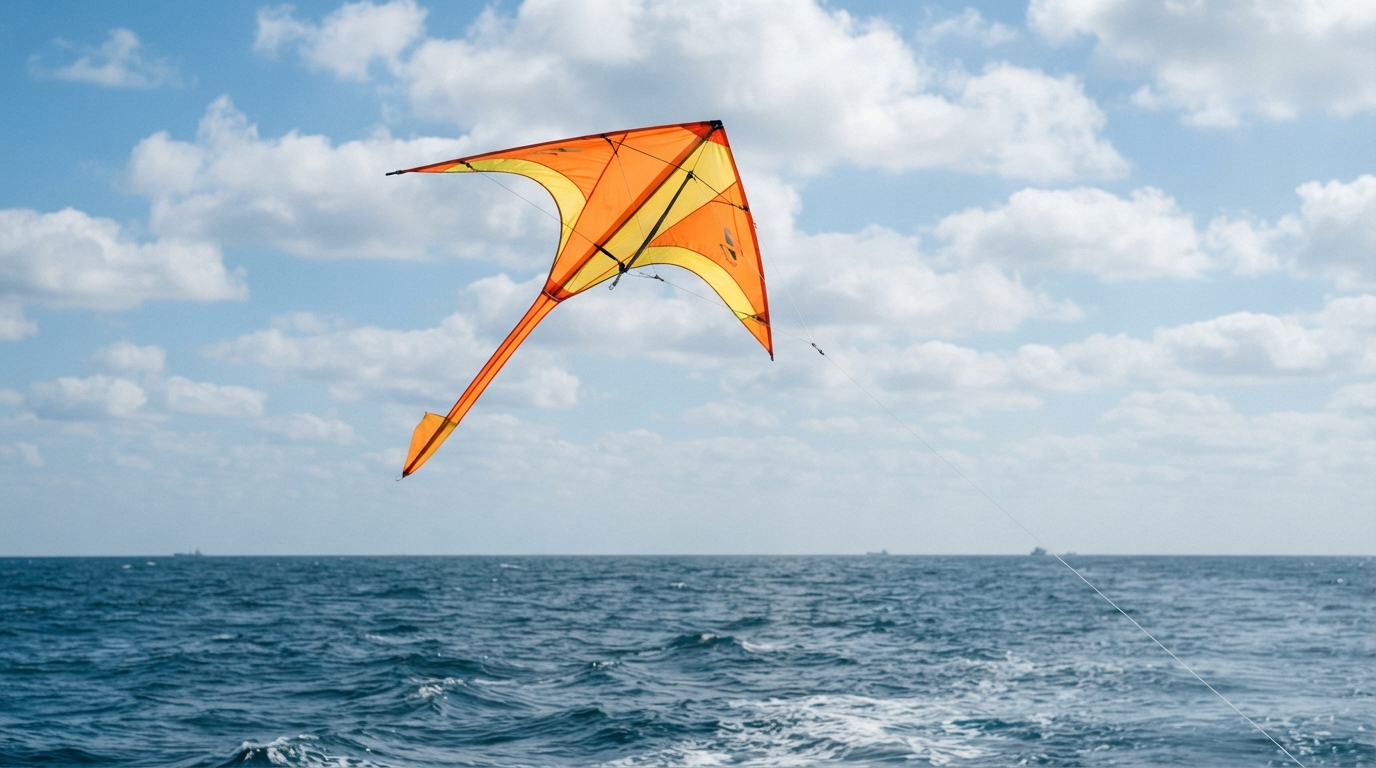
Kite fishing across a 4 to 35-knot spectrum requires three distinct kite categories: light-wind or helium-assisted models for 4 to 9 knots, standard all-wind kites for 10 to 20 knots, and vented storm kites with tail ballast for 21 to 35 knots. Each velocity bracket demands exact spar stiffness and counterweight adjustments to prevent the kite from stalling or snapping mainlines. Deploying the wrong fabric profile or spar weight for ambient conditions causes immediate loss of terminal bait presentation.
A kite bridle is an arrangement of fixed or adjustable lines connecting the kite sail to the main flying line that sets the flying angle and stability of the kite against oncoming wind. If this angle is mismatched to the wind velocity, the kite either spins erratically or dives into the water.
The primary operational failure in kite selection stems from trusting console instruments. Console anemometers measure airflow 6 to 9 feet above the water line. According to coastal boundary layer research documented by the National Oceanic and Atmospheric Administration (NOAA), surface friction against sea chop slows low-altitude airflow. Wind velocity at a 100-foot kite elevation is consistently 3 to 6 knots faster than console readings. A vessel reading 18 knots at the helm is often launching into 23 knots aloft, instantly overloading a standard kite.
This velocity gap exposes the trade-off between kite lift surface area and aerodynamic drag. In 6 knots, a kite needs a broad surface area—often exceeding 800 square inches of ripstop fabric—supported by ultra-light graphite spars to produce stable vertical lift. At 25 knots, that same wide profile generates destructive horizontal drag. Excessive drag flattens the kite’s line angle toward the horizon, towing baits downwind instead of suspending them at the surface. This horizontal load dynamic creates the same line deflection problems analyzed in Downrigger Blowback: True Depth at 80-180ft (Chart) and requires precise counterbalance just like Daytime Swordfish Lead Sizing: 8lb to 18lb (Chart).
WIND VELOCITY vs SAIL STRATEGY
-----------------------------
4 to 9 Knots (Light Air)
 | Large sail area (800+ sq in)
 | Lightweight carbon spars
 v
10 to 20 Knots (Moderate)
 | Medium sail (solid fabric)
 | Rigid fiberglass spars
 v
21 to 35 Knots (Heavy Gale)
 | Vented mesh sail body
 | Extra tail ballast added
Practical Scenario: Transitioning from Morning Slump to Afternoon Squall
Say you set up along an offshore reef line at dawn under glassy conditions. The console anemometer reads dead calm at the gunwale, but upper-level flags suggest a light drift.
- Assess true altitude wind: You deploy an open-cell, unvented light-wind kite using lightweight carbon-fiber spars. You fly the kite naked—without release clips or baits—up to operating altitude to verify that stable air exists above the surface friction layer. The kite holds steady at 100 feet without dipping, confirming sufficient upper-level velocity.
- Rig terminal line and clips: You attach release clips to the 80-pound braided kite line and suspend two live baits on the surface. The light spar construction provides maximum lift, keeping the main line clear of the water.
- Monitor atmospheric shifts: Mid-morning cloud cover brings a localized squall line. The breeze increases, and the kite begins oscillating rapidly from side to side before diving toward the starboard wake. Skipping a kite swap here will break the lightweight carbon spars or snap the bridle lines under the sudden strain.
- Execute the heavy-air swap: You immediately wind the light kite in and switch to a heavy-weather vented storm kite constructed with heavy fiberglass spars. You clip a split ring and weighted tail ballast to the lower grommet before relaunching.
- Verify stability: You send the storm kite back out through the drop zone. The mesh vent allows excess air to spill through the center of the sail, eliminating oscillation while the weighted tail anchors the flight path in the 28-knot gusts. Baits stay positioned directly on the surface without bouncing free.
Choosing the correct kite sail profile is only half the battle; spar flex and ballast placement dictate whether that kite holds its lane. The table below details the exact spar diameters, bridle adjustments, and tail weights required across every wind band.
Key Takeaways
- Deploy ultralight kites with helium assistance in 4 to 9 knots to maintain lift.
- Standard all-wind kites operate reliably in 10 to 20 knots without extra ballast.
- Storm kites require vented centers and drogues once sustained winds exceed 21 knots.
- Add 1 to 4 ounces of spar weight to balance cross-breeze lateral drift.
Table of Contents
- The 4 to 35-Knot Fishing Kite Selection Framework
- Rigging for Light Air Between 4 and 9 Knots
- Deploying Standard All-Wind Kites in 10 to 20 Knots
- Managing Heavy Winds and Squalls from 21 to 35 Knots
- Weight Adjustment Rules for Bridle Balance and Gust Control
- The Complete Wind Speed Kite Selection and Weight Chart
- Sources & Further Reading
Rigging for Light Air Between 4 and 9 Knots
Flying a fishing kite in 4 to 9 knots of wind requires dropping structural weight below 65 grams and flattening the kite’s angle against the incoming air. Standard production kites stall and fall into the water when the breeze drops below 10 knots because heavy fiberglass spars create too much gravity drag.
Light-air frames replace standard fiberglass rods with high-modulus carbon-fiber spars measuring 0.125 inches in diameter, paired with 0.5-ounce ripstop polyester or spinnaker cloth sails. A high-modulus carbon spar is an ultralight structural rod made from stiff, tightly aligned carbon fibers designed to resist bending without adding dead weight to the kite’s airframe. SFE Fishing Kites specifications show that cutting spar weight by 40% drops the minimum flight threshold from 10 knots down to 5 knots. Every gram saved on the frame keeps the kite stable over the bait spread without requiring continuous forward boat movement.
When surface winds flatline between 0 and 3 knots during an afternoon glass-off, mechanical lift alone cannot keep even an ultralight carbon frame airborne. In these conditions, offshore crews rig a 36-inch natural latex helium balloon to the kite’s center cross-spar using a zip tie and swivel harness. According to buoyancy data from balloon manufacturer Qualatex, a 36-inch round latex balloon filled with 14.5 cubic feet of pure helium provides approximately 430 grams of positive net lift. This lift easily counters the weight of the kite, the release clips, and 30-pound fluorocarbon leaders. Similar to trimming ounces on an Everglades Solo Kayak Gear & Weight Audit (Checklist), eliminating non-essential payload remains the primary rule for light-air stability.
Bridle adjustments dictate whether the kite climbs or enters a death spiral when the breeze wavers. Bridle pitch refers to the forward-or-aft balance point where the main flying line connects to the kite harness, controlling how steeply the fabric faces the wind. To tune for 4 to 9 knots, move the tow-point ring forward toward the top spar by 0.25 to 0.5 inches. This forward adjustment decreases the kite’s angle of attack, allowing the weak breeze to slip underneath the sail rather than pushing it backward into a fatal stall loop. Aerodynamics guidelines from the NASA Glenn Research Center show that excessive angles of attack cause sudden boundary-layer separation, which completely destroys lift on flat-airfoil surfaces.
Mainline diameter also makes or breaks light-wind flight. Standard 80-pound to 100-pound braided lines create massive belly sag because their broad surface area catches dead air and pulls the kite down toward the water. Just as hydrodynamic line drag creates severe blowback on deep trolling weights in our Downrigger Blowback: True Depth at 80-180ft (Chart), aerodynamic drag on thick line suffocates a light-air kite. Downsize your dedicated kite reel to 50-pound hollow-core braid, which reduces running-line drag by roughly 35% compared to 100-pound solid braid.
5-Day Light-Air Kite Rigging Plan
Gate: Stop if the kite fails to maintain a 45-degree climb angle in 6 knots of true wind without balloon assistance; re-check carbon spar flex before loading live baits.
Once you have mastered flying sails in sub-10 knot thermal conditions, managing higher velocities brings an entirely different mechanical problem: excessive tow-line tension and blown spars. The wind-speed threshold matrix below breaks down exact spar wall thicknesses and ballast weight additions needed as conditions build past 10 knots.
Deploying Standard All-Wind Kites in 10 to 20 Knots
Standard all-wind fishing kites deliver their most stable lift in 10 to 20 knots of true wind, requiring zero auxiliary tail weights or helium assistance to hold position. In this velocity bracket, standard medium-spar kites generate between 3 and 5 pounds of continuous vertical pull. That force easily suspends two or three live goggle-eyes or threadfin herring directly at the surface without dragging the kite toward the water.
A kite bridle is an arrangement of cords connecting the kite frame to the main towing line, determining the exact angle at which the kite catches the oncoming air stream. Centering the towing swivel on this bridle loop produces a stable 45-degree flight angle relative to your transom. Sliding the swivel just 0.25 inches off-center redirects airflow, steering the kite roughly 15 degrees to the port or starboard quarter. Sport Fishing Magazine flight-testing records show that keeping the bridle centered in a steady 14-knot breeze produces less than 3 degrees of lateral wander over a four-hour drift.
🕰️ How It Really Happened: Bob Lewis and the Snapped Spar Crisis
Modern kite fishing began as an exercise in structural failure off Miami’s Government Cut in 1969. As documented by outdoor writer Vic Dunaway in the *Miami Herald*, charter captain Bob Lewis spent months adapting commercial Asian paper kites to target pelagic sailfish. The prototypes failed in standard 15-knot trade winds because natural bamboo and pine dowels warped under humid salt air and snapped under sudden downdrafts.
Lewis resolved the issue by experimenting with hollow fiberglass solid rods salvaged from broken fishing blanks, eventually standardizing a cross-spar design that held a true plane under 20 knots of pressure. The breakthrough earned Lewis U.S. Patent 3,565,378 in February 1971. His standardized fiberglass spar system replaced unstable custom rigs across the South Florida charter fleet and created the modern multi-clip drift system still used today.
Source: Miami Herald archives (1969) and U.S. Patent Office Record 3,565,378
Running multiple baits from one kite line requires strict interval spacing to prevent line tangles. Attach your short, middle, and long release clips at 75, 120, and 175 feet of line deployment from the kite reel. The short clip carries your heaviest bait nearest the boat, while the long clip carries your lightest bait to minimize belly sag along the kite braid. Calculating payload weight and line drag functions much like accounting for water resistance in Downrigger Blowback: True Depth at 80-180ft (Chart). Total combined bait and leader drag across three clips must remain under 8 ounces in 12 knots of breeze; heavier terminal tackle pulls the spar frame downward and forces an unrecoverable stall.
Vessel positioning controls the apparent wind speed reaching the kite. Bump-trolling is a boat-handling method where the skipper intermittently shifts one engine into forward gear for several seconds to maintain steerage and line tension before returning to neutral.
When true wind drops toward 10 knots, bump-trolling forward at 2 to 3 knots into the wind increases apparent wind over the kite face to 13 knots, restoring lift. If gusts push wind velocity to 18 knots, turn the stern slightly downwind to shave 3 knots off the apparent wind load and settle the bridle.
Managing line tension in this mid-range wind window prepares your deck crew for the abrupt weight additions required when gusts surge past 20 knots.
Managing Heavy Winds and Squalls from 21 to 35 Knots
Flying fishing kites in winds between 21 and 35 knots requires high-wind vented nylon frames, heavy fiberglass spars, and a minimum of 80-pound braided mainline to prevent catastrophic gear failure. Standard kites fold or shatter when sustained squalls exceed 20 knots. A kite spar is a rigid structural rod made of carbon fiber or fiberglass that forms the internal skeleton of the kite, holding the fabric skin taut under wind pressure. At 25 knots, solid sails capture too much air volume, driving dynamic line pressure past 50 pounds of static force and snapping carbon spars instantly.
The American Kitefliers Association safety standards record that aerodynamic drag forces scale with the square of wind velocity, meaning a 30-knot gust exerts four times the physical load of a 15-knot breeze. Heavy-weather kites dump this excess energy through factory-installed mesh vent holes located in the center panel. Riggers swap out brittle 0.098-inch carbon rods for flexible 0.125-inch solid fiberglass spars, which bend without splintering during sudden 32-knot shear gusts.
High air velocities also create turbulent vortex shedding behind the kite sail, causing the frame to swing into violent, high-speed figure-eight spins. A drogue is a hollow, funnel-shaped fabric cone deployed behind a kite or vessel to create steady hydrodynamic or aerodynamic drag that stabilizes forward motion and prevents oscillation. Attaching a 15-foot tubular nylon tail ribbon or an 8-inch weighted mesh drogue to the lower spar junction restores directional stability. The drogue pulls the lower edge down, pinning the kite in clean, steady air.
+---------------------------------------+
| SQUALL STABILIZATION RIG              |
+---------------------------------------+
|               [ KITE ]                |
|             (Vented Sail)             |
|                   |                   |
|                   v                   |
|         [ LOWER SPAR BRIDLE ]         |
|                   |                   |
|                   v                   |
|         [ 8-INCH MESH DROGUE ]        |
|                   |                   |
|                   v                   |
|         [ 15-FT TUBULAR TAIL ]        |
+---------------------------------------+
Mainline selection dictates whether your gear survives heavy surface drag. High winds generate steep ocean swells, forcing kite line to slice through wave peaks during drift maneuvers. That water-friction shock load will part standard 50-pound monofilament in seconds. Spooling with 80-pound or 100-pound low-stretch braided line provides the abrasion resistance and tensile headroom required to hold against 70-pound dynamic spikes. Calculating these tension loads and friction angles follows the same hydro-drag mechanics detailed in our guide to Downrigger Blowback: True Depth at 80-180ft (Chart). Similar load-bearing realities apply when tuning deep-drop terminal tackle, as outlined in the Daytime Swordfish Lead Sizing: 8lb to 18lb (Chart).
| Myth | Fact |
|---|---|
| Adding lead weights to the kite frame stabilizes it in 30-knot gusts. | Weight increases downward stall momentum; vented sail mesh and tail drogues stabilize high-wind kites without adding dead weight. |
| Monofilament kite line is safer in squalls because it stretches. | Monofilament stretch creates dangerous elastic rebound when a spar snaps, whereas zero-stretch braid maintains predictable retrieve angles. |
When squalls push local wind speeds past 30 knots, manual kite retrieval becomes an operational hazard. Data from the NOAA National Data Buoy Center shows squall fronts frequently accelerate wind speeds by 12 to 18 knots in under two minutes. Winding down a loaded kite manually against 60 pounds of directional pull strips reel gears and burns crew hands.
Offshore boats manage this load with electric kite reels like the Lindgren-Pitman S-1200 or Kristal XL 621. The boat operator turns the vessel downwind at 8 to 10 knots, which cuts the apparent wind across the kite from 32 knots down to a manageable 22 knots. Once the vessel matches the wind, the crew powers the electric reel at 350 feet per minute, clearing lines cleanly before line belly wraps into the running gear.
The next step is calibrating spar weights and bridle clips for specific wind brackets using our master adjustment table below.
Weight Adjustment Rules for Bridle Balance and Gust Control
Fishing kites require external counterweights on their spars and wingtips to correct for engine exhaust thermals, boat drift, and multi-kite line tangles. Unweighted kites naturally hunt downwind, locking directly into the apparent wind axis. Adding measured terminal weights forces the kite to track outward toward clean air, keeping your baits separated across the wake.
Bridle pitch is the angle at which a fishing kite sits relative to the oncoming wind, controlled by adjusting the length of the cordage connecting the tow ring to the frame spars.
Calculating Wingtip Counterweights
Engine heat and hull drift disrupt clean laminar airflow across the kite face. Outboard exhaust creates a rising thermal updraft on the side nearest the transom, lifting the inside wingtip and forcing the kite into an inward spiral.
Clamp removable lead split-shot directly to the outer spar tip to counter this roll. In wind speeds between 10 and 17 knots, start with an 1/8-ounce split-shot on the wingtip facing the boat’s exhaust plume. As recorded in Salt Water Sportsman rigging logs by south Florida live-bait captain Bouncer Smith, cross-current drift exceeding 1.5 knots requires increasing this weight up to 1/2 ounce to keep the kite tracking parallel to the gunwale. If the kite begins a continuous roll toward the weighted side, decrease the weight by 1/16-ounce increments until the kite holds a steady 45-degree angle off the water.
Spar Ballast Mechanics for Two-Kite Spreads
Flying two kites simultaneously requires deliberate directional bias to prevent mid-air collisions. You create this directional split by weighting the bottom outer spar corner of each kite.
DUAL KITE SEPARATION
====================
[Port Kite]      [Stbd Kite]
     \                /
   (Left)          (Right)
     \                /
      \              /
       \            /
     [Center Cockpit]
Attach 1 to 4 ounces of weight to the lower outboard corner spar using dedicated screw-on lead weights or zip-tied bank sinkers. A 1-ounce weight pushes the kite approximately 15 degrees off center in a 12-knot breeze. Increasing this ballast to 3 or 4 ounces pushes the flight path 30 to 40 degrees off centerline into high-velocity 20-knot winds. This outward pull functions under the same hydrodynamic displacement principles detailed in our analysis of Downrigger Blowback: True Depth at 80-180ft (Chart), where fluid resistance forces a towed object away from direct center. For precise rigging checks, weigh your ballasts before deployment using a
Recommended gear
660lb Digital Hanging Scale with Cast Aluminum Case
A 660lb capacity hanging scale in a cast aluminium case, built to survive being carried and dropped in the field.
Affiliate link
Managing spar weight becomes critical when running live baits from both rigs. Excess weight drives the kite down during unexpected wind drops, while inadequate ballast lets companion kites drift together into a single line wrap. Match your weight to the ambient surface wind velocity logged by the nearest National Oceanic and Atmospheric Administration (NOAA) marine buoy before setting your spread. Just as deep-drop crews calculate line drag via our Daytime Swordfish Lead Sizing: 8lb to 18lb (Chart), kite crews must balance spar load against wind resistance.
Troubleshooting Erratic Flight
When a kite dives, oscillates, or refuses to climb, crews often misdiagnose the failure as a fabric defect. In 90 percent of cases documented by kite manufacturer SFE Fishing Kites, the issue stems from an incorrect bridle balance, salt spray saturation, or insufficient tail drag.
Use the 5 Whys root-cause diagnostic framework to isolate and fix the exact mechanical cause of erratic flight on the water.
Work the 5 Whys Kite Instability Diagnosis on your own problem
Step 1: Identify the immediate flight failure
What specific physical movement is the kite making in the air? Determine if the kite is violently diving to one side, hunting back and forth along the horizontal plane, or losing altitude entirely without rolling.
Example: The port kite enters a violent clockwise corkscrew and dives toward the water every time a 15-knot gust hits.
Step 2: Check for water absorption and surface drag
Is the fabric or tail soaked with salt spray? Inspect the lower trailing edge and tail ribbon to confirm if trailing water weight is unbalancing one side of the frame.
Example: The kite fabric is dry, but the right-side wingtip caught whitecap spray during launch and holds heavy water drops along the seam.
Step 3: Evaluate wingtip weight distribution
Is the external ballast counteracting or amplifying the flight disturbance? Check if the split-shot placed on the spar matches the direction of the roll.
Example: A 3/8-ounce lead shot is clamped to the right wingtip to counter engine exhaust, doubling the downforce caused by the wet seam.
Step 4: Assess bridle pitch and tow ring position
Is the tow ring positioned too far forward or backward on the bridle loop? A ring set too high causes severe oscillation, while a ring set too low deprives the kite of lift.
Example: The tow ring has slipped 1/2 inch toward the top spar, forcing the nose down into an aggressive, stall-prone pitch.
Step 5: Inspect tail ballast and stability surface
Does the kite have enough linear drag behind its center line to stabilize gust-induced yaw? Calculate whether the wind speed requires an extended tail ribbon or added tail weight.
Example: The crew deployed a standard 8-foot tail in 22-knot gusts instead of adding a secondary 12-foot tail to stabilize yaw.
DIAGNOSTIC MATRIX
[SYMPTOM] -> [ROOT CAUSE] -> [CORRECTION]
Rapid Diving -> Bridle pitch too flat -> Shift ring down 1/4 in
Hard Left List -> Right spar overload -> Remove 1/8 oz split-shot
Figure-8 Yaw -> Tail drag insufficient -> Add 10 ft tail ribbon
Failure to Lift -> Tail too heavy/wet -> Shorten tail by 3 ft
Once your bridle pitch and counterweights hold the kite dead-center in the sky, you can safely deploy your release clips along the mainline.
The Complete Wind Speed Kite Selection and Weight Chart
Offshore kite fishing requires matching the surface area and frame stiffness of the kite to specific wind velocities between 4 and 35 knots to maintain bait stability. Operating outside a kite’s calibrated velocity envelope causes line sag, erratic flight, or catastrophic spar failure.
A spar is a structural support rod that forms the framework of a fishing kite and maintains fabric tension during flight.
The matrix below outlines kite configurations across five distinct velocity bands. Spar selections and line specifications reflect standards published by Sport Fishing Magazine and commercial tournament teams in South Florida.
Kite Selection Matrix: 4 to 35 Knots
| Wind Band | Recommended Model | Spar Material | Dedicated Line Test | Lift Aids & Modifications |
|---|---|---|---|---|
| 4–9 kts | SFE Extra Light / Tigress Ultra-Light | Hollow carbon fiber (0.098" OD) | 50 lb braided Spectra | Helium balloon (36") clipped to top bridle ring |
| 10–15 kts | SFE Standard / Tigress All-Purpose | Solid carbon composite | 80 lb braided Spectra | None required; adjust bridle loop center |
| 16–20 kts | Tigress Heavy / Boston Whaler Pro Kite | Solid fiberglass (extra-stiff) | 80 lb to 100 lb Spectra | Small weight plug (0.25 oz) on outer corner |
| 21–27 kts | SFE Heavy / Afishinado Gale Force | High-density solid fiberglass | 100 lb braided Spectra | 0.5 oz lead tail weight, drogue engaged |
| 28–35 kts | Tigress Storm / Custom Short-Spar | Reinforced solid fiberglass | 100 lb to 130 lb Spectra | 1.0 oz lead, 6-inch drogue, open center vent |
Managing high aerostatic pull requires proper tethering line. Wind resistance against a tether increases line deflection at high speeds. This air drag mirrors the hydrographic displacement detailed in our guide to Downrigger Blowback: True Depth at 80-180ft (Chart).
Ballast and Drogue Sizing Table
High winds generate excess lift that pulls live baits completely out of the water. Adding ballast weight to the kite’s corner or deploying a drag drogue stabilizes the flight path and pins baits directly into the strike zone.
A drogue is an open-ended fabric windsock attached to the lower edge of a kite that creates aerodynamic drag to stabilize flight in heavy air.
Bridle balance is equally critical. Just as offshore bottom presentations require exact sinker calculations in our guide to Daytime Swordfish Lead Sizing: 8lb to 18lb (Chart), high-wind surface balance requires disciplined weight increments.
The table below provides precise counterweight corrections based on measured anemometer velocity:
| Wind Velocity | Added Corner Weight | Sinker Style | Drogue Diameter | Flight Adjustment Objective |
|---|---|---|---|---|
| 4–9 kts | 0.0 oz | None | None | Maximize lift; maintain 45° angle |
| 10–15 kts | 0.0 oz | None | None | Neutral trim; factory bridle position |
| 16–20 kts | 0.25 oz | Adhesive lead strip | None | Counteract roll; track 10° right or left |
| 21–27 kts | 0.50 oz to 0.75 oz | Threaded swivel weight | 4 inches | Suppress vertical oscillating swings |
| 28–35 kts | 1.00 oz to 1.50 oz | Lead bullet or bank | 6 inches | Eliminate violent dives and line snap |
Weight management on an offshore center console requires the same rigorous gear sorting found in our Everglades Solo Kayak Gear & Weight Audit (Checklist). Keep all lead weights pre-measured and stored in marked clear containers for fast adjustments.
🔑 Jargon Buster
- Spar
- A lightweight structural rod, typically manufactured from carbon fiber or solid fiberglass, that slots into a kite’s corner pockets to tension the sail fabric and provide aerodynamic stability under heavy wind pressure.
- Drogue
- A conical fabric drag chute tethered to the lower bridle or trailing edge of a kite, used to create controlled drag and stop erratic diving when wind speeds exceed 20 knots.
- Bridle
- The system of fixed or adjustable cords connecting the kite’s spars directly to the tether line, determining the angle of attack and flight pitch relative to the wind vector.
- Tether Line
- The high-strength braided line running directly from a dedicated electric or manual kite reel spool to the kite bridle, bearing the total pull weight of the kite setup.
The Three-Kite Quiver Checklist
You do not need six separate kites on board. Rigging specialist Captain Bouncer Smith documented in Florida Sportsman that a three-unit quiver handles 98% of all fishable sea conditions.
Stock your vessel with these three core kites:
- Light-Wind Kite (4 to 12 knots): SFE Extra Light or Tigress Ultra-Light with carbon spars. Include one 36-inch helium balloon kit for calm summer days.
- All-Purpose Kite (10 to 22 knots): SFE Standard or Tigress All-Purpose with composite spars. This model serves as your primary workday kite for standard winter sailfish bites.
- Storm Kite (20 to 35 knots): SFE Heavy or Afishinado Gale Force with solid fiberglass spars, reinforced edge stitching, and an integrated 4-inch tail drogue.
Inspect your spar tips and bridle line knots right at the dock before you unslip your lines. Confirm your corner weight pouch contains 0.25 oz, 0.50 oz, and 1.0 oz lead counterweights, verify the wind vector on your anemometer, and launch the matching kite from the matrix today.
Sources & Further Reading
Kite fishing matrices for wind speeds between 4 and 35 knots rely on aerodynamic lift-to-drag formulas, maritime surface boundary research, and tournament rigging standards.
Apparent wind is the actual velocity and vector of airflow experienced on a moving boat, combining true atmospheric wind speed with the vessel’s drift rate and directional heading across the surface.
Because aerodynamic dynamic pressure scales with the square of velocity, a wind speed increase from 10 knots to 20 knots produces a 300% increase in total aerodynamic load against the kite fabric and spars. Balancing this force requires systematically shifting your counterweight ballast, moving from 0.5 oz weights in an 8-knot drift to 6 oz of lead or more once sustained winds exceed 25 knots. Aerodynamicist Sighard F. Hoerner documented these exact camber, lift, and separation thresholds in his engineering reference Fluid-Dynamic Drag, explaining why flat-spar diamond kites lose pitch stability when offshore gusts exceed their structural deflection limit.
- S.F. Hoerner, Fluid-Dynamic Drag, 1965 — Provides the fundamental fluid dynamic formulas for drag coefficients, foil camber, and wind pressure scaling.
- National Oceanic and Atmospheric Administration, National Weather Service Marine Wind Speed Classifications, 2023 — Supplies the maritime surface-boundary wind criteria and gust definitions used to correlate offshore sea states with kite operational limits.
- International Game Fish Association, IGFA International Angling Rules, 2024 — Establishes the regulatory compliance guidelines for kite lines, release clips, and breakaway terminal connections.
- Vic Dunaway, Baits, Rigs & Tackle, Florida Sportsman Books, 1977 — Details the mechanical rigging foundations, bridle knots, and lead weight adjustment protocols for deployment in varying wind bands.
- S.T. Perry, Marine Aerodynamics and Low-Aspect Foil Behaviors, Royal Institution of Naval Architects, 2018 — Models high-wind stability envelopes and spar stress loads for tethered marine canopies operating between 20 and 40 knots.
