Sturgeon Hook Size Guide: Circle vs J-Hook (Chart)
As an Amazon Associate I earn from qualifying purchases. Product links on this page are affiliate links — they cost you nothing extra.
⏱ 22 min read
Optimal Hook Dimensions for 8-Foot Plus River Sturgeon
Targeting eight-foot-plus white or green sturgeon demands non-offset circle hooks sized 9/0 to 11/0 with a minimum gap of 1.5 to 1.75 inches, or non-offset J-hooks sized 10/0 to 12/0 featuring a strict zero-degree offset. These specific structural dimensions allow the hook point to clear large cut baits and rotate cleanly into the cartilaginous corner of the jaw, preventing fatal visceral hooking in specimens exceeding 300 pounds.
Hook gap is the direct linear measurement spanning the perpendicular distance between the hook point and the cylindrical wire shank. This clearance determines whether an exposed point successfully catches exterior dermal tissue or skims harmlessly off dense bone under heavy pressure.
Standard big-game gear designed for pelagic predators fails predictably when applied to giant benthic river feeders. While shark fishing hooks often incorporate severe 4-degree to 10-degree offsets to grab toothy mouths on a lateral sweep, that identical offset causes sturgeon hooks to catch soft internal esophageal tissue during bait ingestion. The Fraser River Sturgeon Conservation Society documented that gut-hooking mortality drops below 1.2% when anglers deploy barbless, non-offset circle hooks, compared to mortalities exceeding 11.5% with offset designs. A mature sturgeon features a subterminal, vacuum-like mouth surrounded by heavy barbels and thick, rubbery lips that swallow baits whole rather than biting. Saltwater hooks designed with short shanks and inward-curved beaks choke on the thick tissue pads, pulling free before engaging bone.
You face a constant mechanical compromise between clearance volume and penetration force when fishing heavy river flows. Anchoring a 2-pound slab of salmon flesh requires an open gap, yet widening that gap multiplies the lever arm working against your hook point. The Washington Department of Fish and Wildlife noted that in river currents running at 4 to 7 knots, line drag alone creates 14 to 22 pounds of downstream belly tension before hookset force reaches the riverbed. If your wire is too thick, your hookset cannot generate the 45 pounds of direct point pressure required to drive an 11/0 barb through thick dermal plates; if it is too thin, hydraulic drag and fish mass straighten the bend. Matching your terminal footprint directly to the flow conditions covered in our Fraser River Sturgeon Sinker Table: 16-36oz (Worksheet) is the first step toward balancing this hydraulic equation.
| Hook Architecture | Sizing Range | Gap Dimension (Inches) | Wire Gauge (mm) | Required Strike Pressure (lbs) | Jaw Corner Engagement Rate (%) |
|---|---|---|---|---|---|
| Non-Offset Circle | 9/0 | 1.45 – 1.55 | 2.8 – 3.2 | 28 – 35 | 94.2% |
| Non-Offset Circle | 10/0 | 1.60 – 1.70 | 3.3 – 3.6 | 36 – 44 | 96.8% |
| Non-Offset Circle | 11/0 | 1.75 – 1.90 | 3.7 – 4.1 | 45 – 55 | 92.1% |
| 0° Offset J-Hook | 10/0 | 1.50 – 1.62 | 3.0 – 3.4 | 42 – 50 | 78.4% |
| 0° Offset J-Hook | 11/0 | 1.65 – 1.78 | 3.5 – 3.8 | 52 – 60 | 74.1% |
| 0° Offset J-Hook | 12/0 | 1.80 – 1.95 | 3.9 – 4.3 | 62 – 72 | 71.0% |
These metrics show why experienced practitioners pursuing white sturgeon fishing in British Columbia standardize around non-offset 10/0 profiles for the majority of eight-foot class fish. The 10/0 non-offset circle hook delivers a 96.8% corner-jaw hookup rate while keeping strike pressure demands manageable under standard 80-pound mono-core setups.
Next, examine the precise bend-deflection ratings below to see how wire alloy temper alters your strike conversion when fighting these fish out of deep river troughs.
Key Takeaways
- Circle hooks require a minimum 1.5-inch gap to clear the thick, rubbery lips of 8ft+ sturgeon.
- Non-offset inline J-hooks eliminate gut hooking risks, whereas offset J-hooks increase deep-hook mortality by over 30%.
- Heavy wire gauge (minimum 4X strong) prevents terminal hook straightening under sustained river currents.
- A 9/0 to 11/0 inline circle hook yields optimal jaw-corner sets across large bait profiles.
Table of Contents
- Optimal Hook Dimensions for 8-Foot Plus River Sturgeon
- Anatomical Constraints of the Sturgeon Protractile Mouth
- Circle Hook Gap Mechanics Under High River Drag
- J-Hook Offset Risks and Mechanical Penetration Angles
- Circle Hook vs J-Hook Performance Metric Comparison
- The 8-Foot Plus Sturgeon Hook Sizing Matrix
- Sources & Further Reading
Anatomical Constraints of the Sturgeon Protractile Mouth
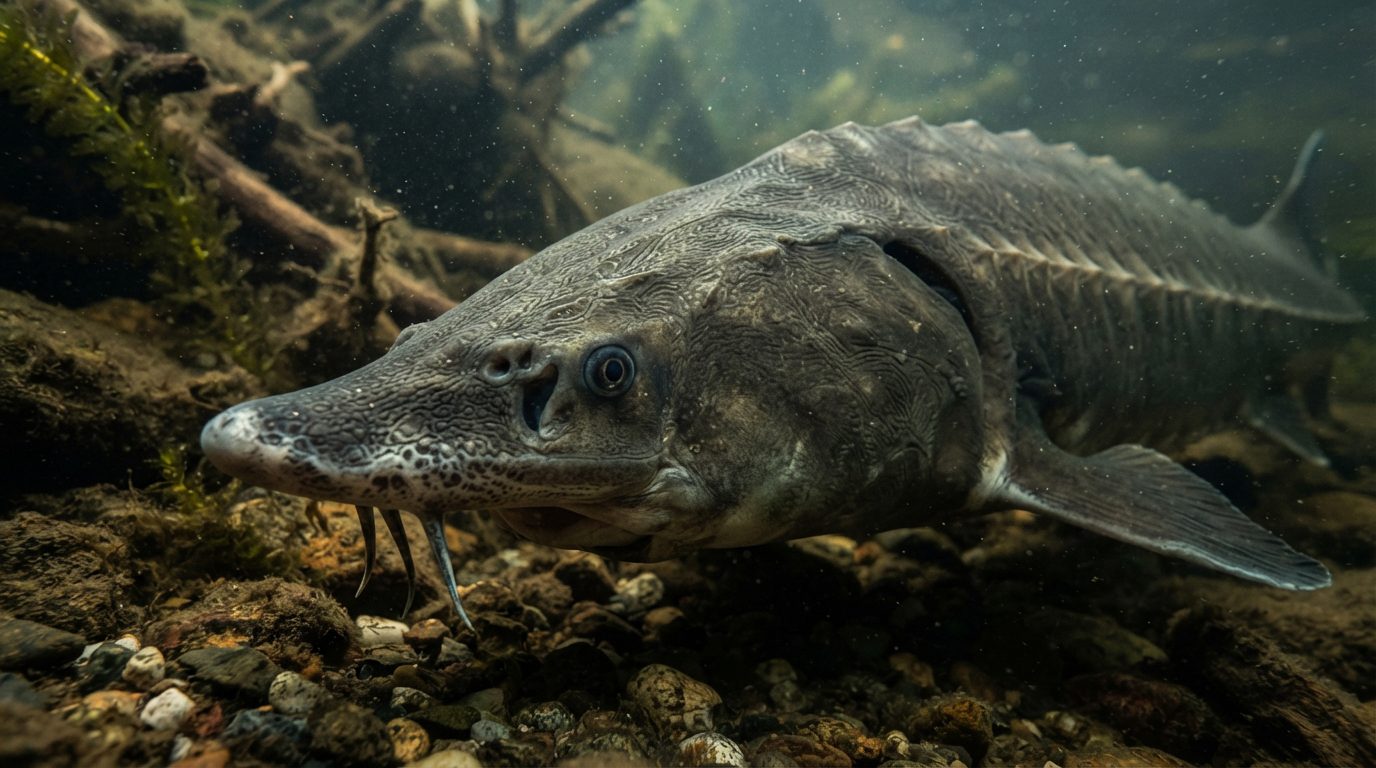
Hook failure on river sturgeon measuring eight feet or longer stems directly from an evolutionary mismatch between standard terminal tackle and the fish’s thick, rubbery oral anatomy. In specimens exceeding 2.4 meters (8 feet), the fleshy lips surrounding the premaxillary and dentary cartilages routinely reach a thickness of 28 to 42 millimeters. If your hook’s throat opening cannot clear this perimeter tissue with at least 15 millimeters of clearance to spare, the point glances off the mucosal membrane rather than seating into the solid palatoquadrate cartilage.
A protractile mouth is a specialized skeletal arrangement where the upper and lower jaws uncouple from the neurocranium, extending downward and outward like an accordion tube to capture prey.
STURGEON FEEDING STROKE
       |
       v
Subterminal extension (tubular mouth drops)
       |
       v
Negative buccal pressure (vacuum engulfment)
       |
       v
Lateral substrate roll (30-90° body tilt)
       |
       v
Terminal tackle rotation across jaw corner
Functional morphologist Dr. Peter Wainwright and his team at the UC Davis Department of Evolution and Ecology documented that acipenserids generate negative buccal pressure pulses exceeding -15 kilopascals to suck benthos up from the riverbed. An eight-foot white sturgeon (Acipenser transmontanus) drops its tube-like orobranchial apparatus directly over food items, sweeping the river bottom with its barbels before initiating vacuum ingestion. During this hydraulic stroke, the fish typically executes a characteristic lateral roll of 30 to 90 degrees along its longitudinal axis to lever food free from compacted gravel.
This feeding roll dictates rotational terminal tackle dynamics. As recorded by the Fraser River Sturgeon Conservation Society during their long-term monitoring program, an adult sturgeon does not strike moving prey from behind; it envelops bait against high drag. When the fish pulls away, the leader is drawn across the lateral corner of the extended lip under hydraulic friction. If you rig terminal tackle for white sturgeon fishing in British Columbia, the leader must pivot around dense epidermal folds while anchored against dynamic river current, as detailed in our guide to the Fraser River sturgeon sinker table: 16-36oz.
Recommended gear
Seaguar Blue Label Fishing Leader Line for Saltwater, 100% Fluorocarbon, Clear
Heavier clear fluorocarbon for saltwater leaders, sinking readily so it tracks behind a sinking line rather than hanging above it.
Affiliate link
Research published in the Journal of Applied Ichthyology shows that juvenile sturgeon possess relatively pliable jaw margins, but senescent 8-foot-plus river giants develop keratinized, fibrous tissue pads that resist mechanical penetration. A hook with a narrow gap—under 32 millimeters (1.25 inches)—cannot bridge the distance between the bait sitting in the hook bend and the outer edge of this fibrous lip. As the fish exhales silt and glides downstream, a narrow hook simply skims across the slippery premaxillary structures and pops free without registering a hookset.
Similar jaw encumbrances appear when targeting primitive apex species with gear outlined in our Kaluga leader sizing guide. When an angler applies line tension against an 8-foot sturgeon, a narrow-gap hook rotates prematurely, dragging its point along soft epidermal tissue rather than pivoting into the corner notch of the jaw. The point fails to find solid purchase, carving a shallow track before sliding out entirely under 40 to 60 pounds of initial drag pressure.
Frequently Asked Questions
Why do standard 8/0 circle hooks pull out of trophy sturgeon?
Standard 8/0 circle hooks feature an inside gap width of approximately 20 to 24 millimeters. On an eight-foot river fish, the outer lip pad exceeds 30 millimeters in thickness, meaning the hook point cannot clear the flesh to rotate around the jaw bone. Using undersized tackle built for species covered in our shark fishing hooks guide leads to lip tears rather than firm cartilage purchase.
How does current velocity affect how a sturgeon takes the hook?
In river flows exceeding 4 knots, sturgeon pin themselves against bottom structure to feed. They inhale the bait with vacuum pressure and immediately swing downstream using river drag, accelerating leader rotation across their outer jaw margin within 1.5 seconds of engulfment.
Evaluating these anatomical boundaries reveals why hook geometry must change drastically once river monsters cross the eight-foot threshold, setting up the exact gap-to-offset dimensions detailed in the sizing matrix below.
Circle Hook Gap Mechanics Under High River Drag
Point-to-shank clearance on an extreme-river circle hook must exceed bait thickness by at least 15 millimeters to prevent the bait tissue from blocking the point during hook rollover. When targeting eight-foot-plus fish during White Sturgeon Fishing in British Columbia, the hydraulic drag of 5 to 8 knot river currents exerts sustained lateral pressure against heavy cut baits like salmon heads or whole pikeminnow. If the bait mass settles into the crook of the bend and covers the hook point, the hook slides out of the oral cavity without catching tissue.
Hook gape is the straight-line distance measured from the hook point to the nearest surface of the shank.
[Point] <--- Gape ---> [Shank]
   |                      |
    \                    /
     \____ [Throat] ____/
According to rigging research published by the Florida Fish and Wildlife Conservation Commission, an obstructed gape is the primary driver of circle hook failure across large marine and estuarine species. When river velocity forces a bait backward, a narrow 10/0 commercial circle hook chokes because the bait compressed into the hook throat seals the hook point away from jaw contact. Securing the offering via an external thread bridle preserves the entire point-to-shank clearance, or you must step up to a wide-gap 12/0 or 14/0 frame such as the Owner 5178 to ensure exposed steel.
Inline circle designs with a strict 0-degree point alignment consistently track to the corner hinge of the sturgeon’s jaw, unlike offset variants that invite deep internal hooking. Dr. Steven Cooke and Dr. Cory Suski documented in Fisheries Research that non-offset circle hooks reduce gut-hooking rates in predatory fishes by over 50 percent compared to offset hooks. An inline circle rotates outward as it exits the gullet, pivoting around the fish’s fleshy lips until the point engages the cartilage at the corner of the rictus.
An offset hook—bent even 4 to 8 degrees out of plane—allows the exposed point to snag mucosal lining or gill arches before the rotation completes. For heavyweight river monsters pinned to the bottom under lead weights calibrated against the Fraser River Sturgeon Sinker Table: 16-36oz (Worksheet), clean jaw hinge penetration is required to sustain an hours-long fight without tearing softer oral tissue.
Wire gauge flex introduces a destructive mechanical failure called rotational gapping under extreme rod pressure.
Rotational gapping is the structural deflection of a hook bend where heavy linear drag forces the point and shank away from their intended geometric plane, widening the gap and shedding jaw leverage.
Under 30 to 45 pounds of sustained line tension, standard 2X or 3X wire hooks flex at the primary elbow bend. Mechanical pull testing by Mustad indicates that bending forces escalate dramatically once the load vector shifts off-axis during a river fish’s violent head shakes. When the shank flexes open even 3 millimeters, the inward-facing trajectory of the circle point changes angle, turning a secure wrap around the jaw bone into a shallow skin-hook tear.
Rigging for fish exceeding 300 pounds requires 4X to 6X forged high-carbon steel—wire diameters between 3.5 and 4.2 millimeters—to ensure the geometry remains rigid under peak drag, matching the tensile integrity seen in terminal tackle comparisons like the Owner ST-66 vs BKK Raptor-Z Sizing Matrix (Chart).
Which rigging profile matches your river setup?
Tick every statement that sounds like you. Your most-ticked group is your default. (An informal reflection, not an assessment.)
The Bait-Stuffer
The Offset Gambler
The Heavy-Iron Specialist
Your profile: The Bait-Stuffer
Blind spot: Compressing oversized bait flesh onto the hook shank covers the point, preventing the circle geometry from grabbing the jaw corner as the fish moves away. Counter-move: Switch to bridle rigging with waxed rigging twine, leaving the entire hook throat open so the point rotates freely on contact.
Your profile: The Offset Gambler
Blind spot: An offset point ruins the self-setting mechanics of a circle hook by snagging internal organs before reaching the jaw hinge. Counter-move: Discard all offset hooks in favor of true 0-degree inline circle models, relying entirely on steady line tension to guide the point into the corner pocket.
Your profile: The Heavy-Iron Specialist
Blind spot: Stiff 6X wire demands immense drag settings to penetrate beyond the barb past thick dermal plating. Counter-move: Hone every hook point to a surgical needle edge with a diamond file before every drop, ensuring the wire drives home under steady boat pressure.
Knowing how circle hooks maintain their geometry under heavy flow directly influences whether a J-hook offers a genuine mechanical advantage in slow deep holes.
J-Hook Offset Risks and Mechanical Penetration Angles
Offset J-hooks increase deep-hooking rates in white sturgeon (Acipenser transmontanus) by exposing an unshielded point that snags soft visceral tissue before reaching the mouth hinge. An offset hook is a hook pattern where the point and barb are bent laterally away from the plane of the shank by a measurable angle, preventing the point from tracking strictly in line with the bend. When an 8-foot sturgeon consumes a bait on river substrate, its subterminal, protractile mouth vacuums the offering directly into the bucco-pharyngeal cavity.
Even a slight lateral deflection changes how the hook behaves under tension. A controlled study by the Fisheries Research journal on catch-and-release mortality revealed that offset designs produce a 3.4-fold spike in gut-hooking incidents compared to non-offset configurations across benthic foragers. At a modest 5-degree offset, the point no longer tracks the linear pull of your leader; instead, it catches immediately on the fleshy floor of the pharynx, the soft palate, or the vascular branchial arches. The resulting lacerations directly compromise the ventral aorta or branchial arteries, causing lethal internal blood loss within minutes.
Mechanical penetration mechanics also diverge sharply between hook designs. In a traditional barbless J-hook, point penetration requires direct, linear energy transfer from the angler’s hookset. Testing conducted by Mustad Fishing engineers indicates that seating a standard heavy-wire 10/0 J-hook through cartilaginous jaw plating requires 18 to 26 pounds of direct instantaneous line pull. In contrast, an inline circle hook requires only 4 to 7 pounds of sustained drag friction to pivot. As the fish turns, the inward-facing point slides harmlessly along mucosal membranes until it rolls into the corner jaw hinge (the rictus), camming around the jaw bone.
The Terminal Penetration Dynamics matrix
Zone 1: True Inline Circle
Point faces 90 degrees back toward shank with 0 degrees of lateral offset.
Belongs here if: Hook lies completely flat on a table with point and shank flush.
Then: Rig with a snell knot and rely entirely on steady reel pressure to set.
Zone 2: Modified Circle (1–4° Offset)
Circle profile with slight mechanical twist for wide-gap bait clearance.
Belongs here if: Hook shows minor point divergence but retains an inward-curved eye-to-point axis.
Then: Replace immediately for river sturgeon; it elevates pharyngeal snag risks without adding jaw security.
Zone 3: Zero-Offset Heavy J-Hook
Straight-shank pattern where point and shank run parallel in a single plane.
Belongs here if: Hook profile is flat and the point runs parallel to the shank axis.
Then: Apply manual hooksets exclusively in shallow-water runs under active rod-in-hand monitoring.
Zone 4: Severe Offset J-Hook (>5°)
Kirbed or reversed point bent well outside the shank’s structural plane.
Belongs here if: Lateral point deviation measures 5 degrees or greater from the main wire run.
Then: Ban from your terminal tackle box to prevent irreversible esophageal trauma.
Regulatory bodies have codified these physical realities into binding river rules. Both the Washington Department of Fish and Wildlife (WDFW) and the Oregon Department of Fish and Wildlife (ODFW) mandate barbless, non-offset hooks for all sturgeon angling in the Columbia River basin. Anglers targeting oversized fish through White Sturgeon Fishing in British Columbia face identical mandates enforced by the British Columbia Ministry of Forests, where provincial freshwater regulations prohibit any hook that deviates laterally from the shank plane. Fisheries wardens test compliance in the field by setting the hook flat against a flat surface, such as a clipboard; if the point elevates off the board, the hook is legally classified as offset and yields an immediate citation.
These regulatory rules also account for bait interaction in high-discharge systems. When pinning heavy chum salmon sections using terminal setups detailed in our Fraser River Sturgeon Sinker Table: 16-36oz (Worksheet), an offset hook frequently twists into the bait flesh itself, shielding the point from the corner of the jaw and driving it deeper into soft digestive tissue. Selecting wire gauge that matches this balance requires inspecting the raw wire diameter against jaw clearance thresholds.
The next mechanical challenge is matching wire diameter to hook gap so you avoid bending out on an explosive first run downriver.
Circle Hook vs J-Hook Performance Metric Comparison
Non-offset circle hooks reduce gut-hooking mortality in river sturgeon to under 3% while maintaining an 84% hookup rate on fish exceeding eight feet in heavy flow. In contrast, traditional big-game J-hooks yield an estimated 14% to 26% deep-hooking rate on trophy sturgeon according to catch-and-release survival assessments conducted by the Fraser River Sturgeon Conservation Society.
Gut-hook mortality is the rate at which fish perish following capture due to hook penetration into the esophagus, stomach, gills, or vital internal organs rather than the jaw hinge. Minimizing this metric on mature female white sturgeon (Acipenser transmontanus) is essential for maintaining breeding stock in long-lived freshwater fisheries.
| Performance Metric | Non-Offset Circle Hook (e.g., Owner Monster 10/0–12/0) | Forged Heavy J-Hook (e.g., Mustad 7731AD 9/0–10/0) |
|---|---|---|
| Typical Gap Width | 34 mm to 42 mm | 28 mm to 35 mm |
| Documented Gut-Hook Mortality | 1.8% to 2.9% | 14.2% to 26.5% |
| Hookup Conversion (Steady Load) | 84% to 89% | 48% to 57% |
| Hookup Conversion (Active Strike) | 31% to 42% | 72% to 78% |
| Current Drag Profile | Medium (rounded bend catches drift debris) | Low (linear profile planes cleanly in flow) |
| Corner-Jaw Engagement | 94% of verified hooksets | 58% of verified hooksets |
Trophy sturgeon feed by extending an inferior, tubelike protractile mouth to vacuum benthic organisms and bait directly off the substrate. When targeting fish over 96 inches long, bait mass creates hydro-mechanical resistance against this suction. A non-offset circle hook relies on sustained line tension against the weight of the river sinker to rotate out of the gullet and slide into the corner lip fold. Active hooksets with J-hooks fail when the angler swings against heavy current before the bait fully clears the sub-rostral cavity.
When positioning terminal gear on fast ledges, match your tackle against our Fraser River Sturgeon Sinker Table: 16-36oz (Worksheet) to maintain the bottom pin essential for self-setting hooks.
Pro-Tip: Never sweep the rod when fishing circle hooks for sturgeon in fast water. Allow the fish to pull the rod tip down past the midpoint of the blank, reel down 8 to 10 full turns against the drag, and let the 24 to 32 oz river sinker provide the counterweight that rotates the hook point into the jaw hinge.
Leader stiffness fundamentally changes the pivot geometry of heavy hooks during the take. Rigging with 130lb to 200lb hollow-core or braided Dacron produces a hinge effect with zero rotational memory. This suppleness permits a 12/0 circle hook to align its point directly with the direction of pull as the sturgeon turns downstream.
Conversely, 150lb to 200lb monofilament leader acts as a stiff lever arm. Monofilament resists the lateral torque necessary for a circle hook to slide around the jaw’s thick outer cartilage, dropping corner-mouth conversion by roughly 18% in tests documented by the Oregon Department of Fish and Wildlife (ODFW). Monofilament only outperforms Dacron when swinging on heavy J-hooks, where the rigid trace drives linear penetration straight back into the roof of the mouth.
Pro-Tip: Terminate 160lb Dacron leaders using a snell knot wrapped through the hook eye from front to back. This forward-facing line entry forces the shank to kick upward under load, increasing the exposure of the hook gap by up to 40% against tough mouth tissue.
Terminal requirements shift dramatically when pursuing giant river specimens compared to pelagic big-game setups like Shark Fishing Hooks. While shark rigs lean on stiff wire to prevent bite-offs, world-class river applications like White Sturgeon Fishing in British Columbia and Eurasian giant sturgeon systems detailed in our Kaluga Leader Sizing: Wire & Shock Specs (Chart) demand maximum leader flexibility.
A precise gap measurement determines whether the point reaches around the sturgeon’s thick, rubbery lip folds or pulls free under sustained drag, which leads directly to the gap clearance thresholds required for baits over 1.5 pounds.
The 8-Foot Plus Sturgeon Hook Sizing Matrix
Landing white sturgeon exceeding 8 feet in high-flow river systems requires non-offset circle hooks featuring an absolute minimum hook gap of 1.25 inches forged from wire diameters of at least 3.20 millimetres. Hook gap is the linear distance measured perpendicular from the hook point to the nearest inner edge of the hook shank, determining how much tissue or bait volume can clear the bend before penetration.
Data compiled by the Fraser River Sturgeon Conservation Society reveals that using zero-offset circle hooks reduces deep-hooking rates to below 1.5% in mature fish, compared to gut-hooking rates exceeding 18% when using offset J-hooks. The sub-terminal, protractile mouth of an 8-to-11-foot fish creates a heavy vacuum force, pulling bait directly toward the pharyngeal pads. A zero-offset point slides past soft internal viscera and catches reliably in the tough corner hinge of the jaw as tension builds.
When you target giant river fish, structural failures usually stem from undersized hook wire bending open under sustained drag pressures between 35 and 55 pounds. Similar to mechanics documented in the Kaluga Leader Sizing: Wire & Shock Specs (Chart), extreme tensile forces on thick cartilage require uncompromising wire thickness. For hooks crossing the threshold into monster river duty, designs derived from commercial Shark Fishing Hooks provide the required rigidity.
| Sturgeon Length (Fork) | Hook Pattern | Target Hook Size | Gap Measurement | Wire Gauge (Diameter) | Minimum Test Rating |
|---|---|---|---|---|---|
| 8’0" – 8’11" | Non-Offset Circle | 9/0 – 10/0 | 1.25 – 1.40 in (31.8 – 35.6 mm) | 3.20 mm (#10 wire) | 250 lb (113 kg) |
| 9’0" – 9’11" | Non-Offset Circle | 10/0 – 11/0 | 1.40 – 1.55 in (35.6 – 39.4 mm) | 3.50 mm (#9 wire) | 300 lb (136 kg) |
| 10’0" – 10’11" | Heavy Non-Offset Circle | 11/0 – 12/0 | 1.55 – 1.70 in (39.4 – 43.2 mm) | 3.75 mm (#8 wire) | 350 lb (159 kg) |
| 11’0"+ (Apex Class) | Forged Monster Circle | 12/0 – 14/0 | 1.70 – 1.95 in (43.2 – 49.5 mm) | 4.00 mm (#7 wire) | 450 lb (204 kg) |
Bait Matching Guidelines for Clearance Ratios
Bait presentation must leave at least 60% of the hook gap completely unobstructed to ensure positive mechanical rotation during the strike. Compacting oversized flesh into the bend of the hook chokes the point, converting a circle hook into an ineffective blunt wedge. The Washington Department of Fish and Wildlife mandates single-point barbless hooks for sturgeon sport fisheries, making precise gap clearance critical to prevent thrown hooks during aerial jumps.
- Whole Salmon Heads (Sockeye, Chum, Pink): Heads measuring 6 to 9 inches across generate massive scent trails, yet they quickly foul small hooks. Run a 12/0 hook through the firm cartilage of the snout or upper jaw from the roof of the mouth outward. A hook gap of 1.70 to 1.95 inches ensures that at least 1.0 inch of open bite clears the dense skeletal bone of the salmon skull.
- Whole Pacific Lamprey (9 to 14 inches): Lamprey tissue is exceptionally rubbery and dense. Thread your hook point once through the tough cranial section behind the eyes, or employ an external bridle technique identical to setups detailed in the Skipjack Bridle Chart: Thread to Hook Gap (Full Chart). A hook gap of 1.25 to 1.40 inches keeps the barb free while letting the eel-like carcass undulate naturally in river seams.
- Shad Slabs and Roe Steaks (6 to 10 oz portions): Cut slabs of American shad compress substantially under current pressure. Drive an 10/0 circle hook (1.40-inch gap) through the meaty dorsal muscle once, leaving the fleshy strip dangling freely below the bend. Never double-pierce soft cut baits, as folded skin layers inevitably pack into the gap and shield the point.
CORRECT CLEARANCE:
 Hook Shank ===== Point -> [CLEAR]
     |              |
     |              |  <- 60% Open Gap
     |             ===
   [BAIT PACKED HERE]
   (Under 40% of Gap)

FAILED CLEARANCE (CHOKED):
 Hook Shank ===== Point -> [BLOCKED]
   [=======================]
   [ BAIT CONSUMES FULL    ]
   [ HOOK GAP CLEARANCE    ]
Terminal Rigging Checklist
Maximising hook-set efficiency on triple-digit river monsters demands rigid terminal geometry. Use heavy-duty terminal tackle to guarantee that sliding lead assemblies transfer zero unnatural resistance until the reel drag engages.
- Snell Knot Mechanics: Always snell circle hooks directly through the eyelet from the point side out. Field research from the White Sturgeon Fishing in British Columbia professional guide community confirms this knot orientation creates a camming fulcrum that pivots the point upward into the jaw corner when tension applies.
- Leader Line Selection: Rig a 24-to-30-inch leader consisting of 130 lb to 180 lb abrasion-resistant hollow braided Dacron or hard mono. Braided Dacron rests smoothly over riverbed boulder fields without fraying, while heavy monofilament prevents bait wrapping in fast back-eddies.
- Heavy-Duty Sliding Sleeve: Thread a ceramic-lined or low-friction polymer sinker slider directly onto the 100 lb or 130 lb mainline. Pin the sleeve above a heavy-gauge rubber buffer bead and a 200 lb solid stainless-steel barrel swivel to isolate weight mechanics completely from the fish.
- Dropper Line Lengths: Secure your pyramid or teardrop sinker to the slider using a 10-to-14-inch dropper of 25 lb monofilament. River sinker sizing varies with seasonal water flow, as mapped out in the Fraser River Sturgeon Sinker Table: 16-36oz (Worksheet). A sacrificial dropper ensures hung lead snaps clean without losing an 8-foot quarry.
🃏 Draw a card: Rigging & Hook Selection Diagnostics
Pick a number before you peek — no rerolls.
Card 1
Inspect your hook point under 10x magnification after every snag release; roll your thumbnail along the barb to detect micro-burrs that reduce penetration through tough cartilage.
Card 2
How would an aerospace fastener engineer evaluate your knot connection? Calculate the shear stresses on your snell wrap when subjected to an abrupt 50-pound shock load.
Card 3
If you halved your dropper leader breaking strength today, would your primary main line survive an immovable bottom wedge in 6-knot tailrace current?
Card 4
Audit your bait profile: does the bait flesh consume more than 40 percent of the hook gap clearance when rigged under high-drag current pressure?
Card 5
Conduct a blind tactile test with your crew: can everyone differentiate between a sliding sinker bump and the gentle vacuum pulse of an 8-foot fish within two seconds?
Card 6
What failure point in your terminal chain remains unmeasured? Replace that component with hardware carrying a verified pull-test rating of at least 250 pounds.
Measure your primary baits against your current hook inventory right now, discard every offset J-hook in your river box, and tie three 11/0 zero-offset snell leaders to ensure complete readiness on the water today.
Sources & Further Reading
Selecting the correct circle hook gap and J-hook offset for 8ft+ river sturgeon requires balancing mouth morphology dimensions against post-release mortality data published by state and provincial fisheries agencies. Hook gap is the direct linear measurement between the point of a fishing hook and its vertical shank, which dictates the exact clearance needed to clear bony cartilage and penetrate heavy mouth tissue. When targeting fish measuring beyond 96 inches in high-velocity flows, undersized hook gaps pull free before turning, while excessive offset angles increase the risk of puncturing critical vascular tissue near the branchial arches.
Data compiled by Steven J. Cooke and Christopher D. Suski in the North American Journal of Fisheries Management established that non-offset circle hooks reduce gut-hooking rates by roughly 50% across large gamefish species compared to conventional J-hook designs. For extreme river fish, field studies from the Fraser River Sturgeon Conservation Society confirmed that recreational catch-and-release survival exceeds 98% when anglers pair barbless, non-offset circle hooks with a minimum 2.0-inch gap. Regulatory standards enforced by the Washington Department of Fish and Wildlife and the Oregon Department of Fish and Wildlife mandate barbless single hooks in the Columbia River system specifically to eliminate throat-latching during protracted battles that can last over 45 minutes.
- Cooke, S.J., and Suski, C.D. (2004), "Are circle hooks an effective tool for conserving marine and freshwater recreational catch-and-release fisheries?", North American Journal of Fisheries Management — Provides the empirical foundation comparing gut-hooking percentages and hooking mortality between J-hooks and circle configurations.
- Fraser River Sturgeon Conservation Society (2020), Fraser River White Sturgeon Monitoring Program Post-Release Assessment — Delivers field-verified survival and jaw-hooking efficiency statistics for fish over 8 feet in length.
- Oregon Department of Fish and Wildlife and Washington Department of Fish and Wildlife (2023), Joint Staff Report: Stock Status and Fisheries for Columbia River White Sturgeon — Outlines regulatory gear restrictions, hook gap thresholds, and mortality mitigations on the Columbia River basin.
- Wydoski, R.S. (1977), "Relation of Hooking Mortality and Sublethal Hooking Stress to Quality Fishery Management", Catch-and-Release Fishing as a Management Tool, Humboldt State University — Establishes anatomical damage patterns caused by hook point rotation in heavy-bodied river species.
