Marlin Dredge Weight Chart: 6-10 Knots (Selection Chart)
As an Amazon Associate I earn from qualifying purchases. Product links on this page are affiliate links — they cost you nothing extra.
⏱ 19 min read
Keel Lead Sizing for Marlin Dredges at 6 to 10 Knots
Blue marlin dredges require 4 to 6 pounds of keel lead at 6 to 7 knots, 8 to 12 pounds at 7.5 to 8.5 knots, and 14 to 16 pounds at 9 to 10 knots to hold depth between 6 and 10 feet below the surface. Without these specific weight tiers, the cumulative hydrodynamic lift generated by multi-arm teaser frames and rubber baits drags the entire profile into the surface froth. Maintaining this subsurface depth window anchors your teaser profile in clear, laminar water beneath the boat’s aerated prop wash, providing the silhouette contrast predatory billfish require to track and commit to the teaser.
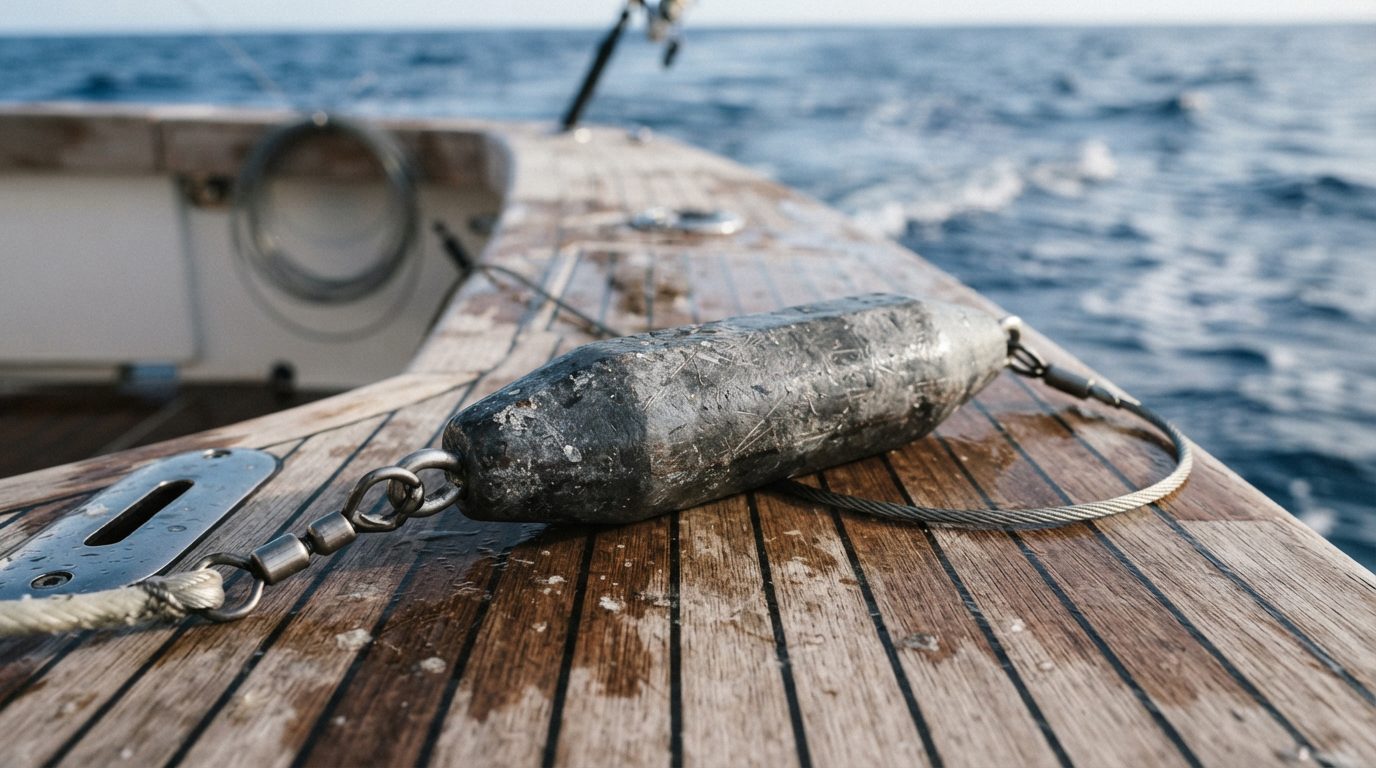
A keel lead is an elongated, hydrodynamic lead weight rigged ahead of a multi-arm teaser umbrella to counterbalance tow-line drag and prevent the dredge from spinning or rising during trolling.
Trolling Speed vs. Keel Lead Weight
====================================
6.0 - 7.0 Knots
|
v
[ 4 lb - 6 lb Lead ] -> 6-10 ft Depth
------------------------------------
7.5 - 8.5 Knots
|
v
[ 8 lb - 12 lb Lead ] -> 6-10 ft Depth
------------------------------------
9.0 - 10.0 Knots
|
v
[ 14 lb - 16 lb Lead ] -> 6-10 ft Depth
Hydrodynamic lift scales non-linearly because water resistance increases with the square of boat velocity. When an offshore crew accelerates from 6 knots to 8.5 knots to pull a faster 5-lure marlin spread distance chart, fluid dynamic pressure against the dredge arms and vinyl squids increases by roughly 100 percent. Rigging analysis published by Marlin Magazine emphasizes that splayed umbrella wires act like multi-tiered hydrofoils under load. If your keel lead is too light, that upward vertical force instantly overpowers gravity, kicking the lead weight up and causing the dredge to skip across the ocean surface.
Holding a multi-arm array down in clean water introduces a mechanical trade-off against tow-line tension. A 36-inch double-tier dredge towed behind a 16-pound torpedo weight at 9 knots creates between 60 and 80 pounds of continuous drag. Heavy-duty electric teaser reels, like the Lindgren-Pitman S2-1200 or the Miya Epoch Command X-9, handle continuous high-amperage retrieval loads, but prolonged pulling pressure risks popping outrigger halyards or stripping gears. Backing off to a lighter lead reduces that mechanical strain, but it sacrifices the subsurface profile by pushing baits upward into the white-water prop wash, where a blue marlin cannot spot the teaser.
⚠️ Anti-Pattern: The Scope-Out Trap
What it looks like: Compensating for an ascending dredge by freespooling 30 to 50 additional feet of towline further behind the transom rather than swapping to a heavier lead.
Why it’s tempting: Letting out line takes five seconds from the helm, while hauling in a high-drag umbrella to unclip an 8-pound weight and replace it with a 14-pound lead demands physical effort and briefly disrupts the troll.
What it costs: Extra towline dramatically increases cable belly and line friction, which magnifies hydrodynamic lift and pulls the dredge right back to the surface while drifting it directly into your short rigger lanes to cause catastrophic line wraps.
Do instead: Lock your dredge towline at a static transom distance between 35 and 45 feet, and regulate trolling depth exclusively by stepping up your keel lead weight whenever you increase cruising knots.
Deploying the proper lead weight secures your bait ball in clean water, but pairing that heavy ballast with incorrect outrigger halyard hardware risks snapping outrigger clips under high trolling drag. Before setting your spread, examine how varying dredge weights alter halyard tension ratings across diverse outrigger configurations in the rigging chart below.
Key Takeaways
- Deploy 8lb to 10lb keel leads for standard marlin trolling speeds between 7.5 and 8.5 knots.
- Increase lead weight to 12lb or 16lb when pushing speeds from 9 to 10 knots.
- Rig keel leads 3 to 5 feet forward of the dredge frame to eliminate dredge rolling.
- Hydrodynamic drag scales quadratically, requiring double the lead weight for a 2-knot increase in boat speed.
Table of Contents
- Keel Lead Sizing for Marlin Dredges at 6 to 10 Knots
- Hydrodynamic Drag Forces Created by Dredge Diameter and Baits
- Keel Weight Design Versus In-Line Weights for Dredge Stability
- Rigging Leader Length and Spacing Ahead of the Dredge
- The Complete Marlin Dredge Keel Weight Selection Chart
- Sources & Further Reading
Hydrodynamic Drag Forces Created by Dredge Diameter and Baits
Hydrodynamic drag generated by an offshore trolling dredge increases proportionally with towing velocity squared and expands by more than 60 percent when stepping up from a 28-inch to a 36-inch frame. As your boat accelerates from 6 to 9 knots, the horizontal pull on your towline does not double—it nearly triples due to water density and turbulent flow dynamics. Understanding these mechanical forces determines whether your dredge tracks cleanly below the surface prop wash or kicks out into clean air.
Hydrodynamic drag coefficient is a dimensionless numerical value that quantifies the fluid resistance an object generates as water flows across its profile relative to frontal surface area.
Frame Geometry: 28-Inch Versus 36-Inch Dredge Bars
The mechanical surface area of a dredge frame dictates the volume of water displaced across the bar arms. A 28-inch diameter dredge frame sweeps an operational frontal boundary of 615.75 square inches, whereas a 36-inch frame encompasses 1,017.88 square inches. This 8-inch step in frame diameter increases the swept planar face by 65.3 percent.
According to fluid dynamic modeling principles codified by S.F. Hoerner in Fluid-Dynamic Drag, total drag force scales directly with projected area and the square of velocity (\(F_d = \frac{1}{2} \rho v^2 C_d A\)). As detailed in NASA’s technical guide on the drag equation, fluid resistance compounds rapidly as speed climbs. When you pull a 28-inch titanium bar with 24 baits at 6.5 knots, the assembly creates approximately 28 pounds of horizontal resistance. Towing that same bar at 8.5 knots spikes line tension to 48 pounds.
Replacing that frame with a 36-inch footprint holding 36 baits generates over 78 pounds of horizontal pull at 8 knots. This dramatic increase changes the balance of your entire trolling layout, requiring precise load compensation on your towline systems. When rigging teasers alongside lures detailed in our 5-Lure Marlin Spread Distance Chart (7-9.5 Knots), unaccounted bar drag will alter boat tracking and pull down outrigger halyards.
Dredge Drag Profile (Single-Tier Frame)
----------------------------------------
Towing Speed: 8.5 Knots
28-Inch Frame (24 Drops):  ~48 lb pull
36-Inch Frame (36 Drops):  ~78 lb pull
Frontal Area Increase:     +65.3%
----------------------------------------
Drag Coefficients: Mullet vs. Mud Flaps vs. Silicone Squids
The geometry of individual drop baits establishes the total drag coefficient (\(C_d\)) of the entire teaser array. Natural rigged mullet, flat rubber profile silhouettes (mud flaps), and hollow silicone squids behave differently inside turbulent surface wash.
BAIT DRAG PROFILE COMPARISON
----------------------------------------
Bait Type: Mud Flaps
C_d Range: 0.18 - 0.22
Tension at 8 Knots (36 Drops): ~42 lb
Key Profile: Thin planar profile

Bait Type: Rigged Mullet
C_d Range: 0.28 - 0.35
Tension at 8 Knots (36 Drops): ~64 lb
Key Profile: Streamlined cylinder

Bait Type: Hollow Silicone Squid
C_d Range: 0.65 - 0.82
Tension at 8 Knots (36 Drops): ~112 lb
Key Profile: Flaring cup mantle
----------------------------------------
Field strain measurements published by Marlin Magazine confirm that natural mullet rigged with chin weights register a moderate drag coefficient (\(C_d \approx 0.30\)). The fish present a tapered hydrodynamic profile that sheds boundary-layer eddies efficiently. By comparison, two-dimensional rubber mud flaps yield an exceptionally low drag coefficient (\(C_d \approx 0.20\)) because their flat cut profiles slice through current with negligible displacement.
Conversely, bulbous 9-inch silicone squids possess a drag coefficient exceeding 0.70. Their hollow, open mantles act as miniature parachutes that scoop water, while flexible tentacles induce high vortex shedding. Replacing a 36-bait spread of silicone squids with hydrodynamic mud flaps reduces total towline tension by roughly 48 percent at 8 knots. For high-speed blue marlin applications, reducing bait-level turbulence is as fundamental to maintaining spread geometry as matching line specs in our Outrigger Tension Chart: 6oz to 32oz Lures (Scale Guide).
Pro-Tip: To avoid catastrophic tow-point failure, measure your dredge’s actual water-resistance tension using a marine hanging scale hooked directly between your downrigger towline and the bridle while running at target trolling speed.
Recommended gear
660lb Digital Hanging Scale with Cast Aluminum Case
A 660lb capacity hanging scale in a cast aluminium case, built to survive being carried and dropped in the field.
Affiliate link
Multi-Tier Collapsible Dredges at 8-Plus Knots
Stacking collapsible arms into multi-tier configurations compounds hydrodynamic drag through wake interference and trailing wake turbulence. Marine towing research from the Society of Naval Architects and Marine Engineers (SNAME) shows that secondary objects trailing within one to two diameters of a lead structure encounter disturbed, non-laminar flow that destabilizes overall tracking.
When you deploy a triple-tier collapsible dredge (e.g., a 36-inch lead bar, 28-inch mid-bar, and 20-inch trailing bar) populated with 60 or more drops, horizontal drag forces easily exceed 140 pounds at 8 knots and can eclipse 165 pounds at 9 knots. The trailing tiers cannot track inside undisturbed water; instead, they oscillate through the pressure wake generated by the primary bar.
Pro-Tip: When running multi-tier frames above 8 knots, maintain at least 36 inches of separation between tiers on your center cable; shorter spacing compresses the turbulent wake and forces the trailing bars to blow out toward the surface.
This compound resistance generates immense uplift along the tow cable, causing unweighted frames to ride up into the propeller turbulence where marlin cannot track them. Controlling these elevated loads requires an exact counterbalance of hydrodynamic keel weight to establish a sub-surface planing angle, which brings us to the precise poundage targets required in our keel lead sizing matrix.
Keel Weight Design Versus In-Line Weights for Dredge Stability
Bottom-weighted keel leads prevent offshore dredge rotation by establishing a low center of gravity below the towing axis, whereas symmetrical in-line weights allow hydrodynamic torque to spin the entire umbrella frame.
A dredge is an offshore teaser system consisting of an umbrella-shaped wire frame rigged with dozens of natural or artificial baitfish designed to mimic a dense bait ball schooling behind the boat.
When you pull a multi-tier dredge between 6 and 10 knots, minor structural asymmetries—such as a single bent wire arm or an offset mudflap—generate rotational torque. Symmetrical torpedo and cigar sinkers distribute their mass evenly around a central wire core. Because they lack directional resistance against rolling, they freely rotate along their longitudinal axis when torque develops, twisting your tow cord into tight hanks.
Keel weights resolve this by concentrating roughly 75% of their total lead mass below the towline eyelets. This offset mass generates a continuous righting moment: whenever rotational hydrodynamic forces push the dredge to roll, gravity exerts a corrective downward counter-torque on the weighted belly. Data published in Marlin Magazine technical rigging reviews confirms that offset keel geometry stabilizes multi-arm dredges at speeds exceeding 8 knots, whereas inline cigar weights destabilize and corkscrew under identical flow velocities. Keel designs keep your teaser array tracking upright, ensuring artificial baits swim naturally in your 5-Lure Marlin Spread Distance Chart (7-9.5 Knots).
Towing these setups generates severe mechanical loads that will destroy standard terminal tackle. Drag forces scale exponentially with the square of towing velocity (\(F_d \propto v^2\)). Bench testing by rigging manufacturer Sampo shows that pulling a heavy double-tier dredge with a 16-pound lead at 9 knots creates continuous line tension between 110 and 140 pounds, with dynamic wave-strike shocks frequently spiking above 280 pounds.
Standard brass barrel swivels bind under sustained tensions as low as 60 pounds, converting unresolved torque directly into line twist. You must connect 12-to-16-pound keel leads using rated 400lb to 600lb stainless-steel ball-bearing swivels equipped with welded rings. These heavy-duty bearings rotate freely under extreme axial pressure, insulating your tow line from failure in high-load scenarios similar to those documented in our Daytime Swordfish Lead Sizing: 8lb to 18lb (Chart).
TOW CABLE PULL
      |
      v
[400lb-600lb Swivel]
      |
      v
[Keel Lead (Belly Low)]
      |
      v
[Dredge Hub & Arms]
Hydrodynamic tracking profiles also vary dramatically between round lead molds and streamlined keel pours. According to aerodynamic and hydrodynamic drag data published by the NASA Glenn Research Center, a standard sphere displays a drag coefficient (\(C_d\)) of approximately 0.47, whereas an elongated, streamlined body drops the coefficient below 0.10.
A traditional round cannonball sinker creates massive parasitic drag and a wide turbulent wake that creates hydrodynamic lift, causing severe dredge "blowback" toward the surface at speeds over 7 knots. To counter this upward migration, crews using spherical molds must add 30% to 50% more raw ballast weight compared to hydrodynamic profiles. Poured keel designs incorporate a narrow teardrop profile with tapered lateral flanks that slice clean water, minimizing turbulent separation and tracking at consistent sub-surface depths.
🧩 Puzzle: The Ballast Paradox
A skipper trolling at 8.5 knots switches an 8-pound spherical cannonball lead for an 8-pound streamlined keel lead on the primary dredge. The streamlined keel lead has a drag coefficient less than one-fourth that of the spherical lead. Yet, upon deploying the streamlined keel lead at the exact same speed and cable length, the digital readout on the electric dredge reel registers a 20% increase in total line tension. Assuming current, sea state, and boat speed remained identical, why did line tension increase?
Reveal the answer
The streamlined keel lead eliminated hydrodynamic blowback, driving the entire 36-arm dredge 8 feet deeper into dense, green water. At this deeper angle, the entire surface area of the dredge baits remained fully submerged and perpendicular to the water flow rather than planing near the surface wake, generating far more total net system drag despite the slipperier lead. The thinking move: isolate system-level interactions from component-level metrics. A component that reduces drag can simultaneously force the broader system into a higher-resistance operating envelope.
Managing these hydrodynamic forces requires dialing in your release systems, which share load tolerances similar to the mechanisms outlined in our Outrigger Tension Chart: 6oz to 32oz Lures (Scale Guide).
Calculating precisely how much keel weight your specific frame diameter requires at your chosen troll speed comes down to a direct mathematical ratio detailed in the lead-selection matrix below.
Rigging Leader Length and Spacing Ahead of the Dredge
Connecting a trolling dredge requires a 36-inch to 60-inch shock leader of 400-pound to 500-pound monofilament or 49-strand stainless steel cable placed directly between the keel weight and the dredge hub. A dredge hub is the central reinforced stainless steel or composite ring that anchors the radiating metal framework of a tiered artificial or natural bait schooling teaser. A keel lead is a hydrodynamic trolling weight cast with an offset, low center of gravity designed to track straight through the water column without spinning under heavy drag.
Placing the lead too close to the dredge hub exposes the bait spread to displaced water turbulence, while excessive distance makes cockpit retrieval unmanageable during a chaotic hookup.
TOWLINE FROM ELECTRIC REEL
          |
          v
  500LB BALL-BEARING SWIVEL
          |
          v
   KEEL LEAD (4LB TO 16LB)
          |
          v
   36" TO 60" SHOCK LEADER
   (400LB MONO OR 7X7 CABLE)
          |
          v
  HEAVY-DUTY SNAP SWIVEL
          |
          v
    DREDGE FRAME HUB
The Step-by-Step Connection Setup
To rig the inline assembly, terminate your mainline—typically 250-pound to 400-pound hollow-core braid or Dacron—to a 500-pound ball-bearing swivel attached to the forward eye of the keel lead. Secure the trailing eye of the weight to your 36-inch to 60-inch connection leader using heavy copper crimps sized precisely to your leader diameter. For toothy environments or high-vibration hulls, Single-Strand vs 49-Strand Mako Leaders (Matrix) illustrates why 49-strand 7×7 cable resists cyclic fatigue better than single-strand wire behind trolling weights.
Terminate the aft end of the leader with an Aussie-style loop or chafe gear connected to a 450-pound test tournament snap swivel. This snap connects directly to the forward towing eyelet of the dredge hub.
Capt. Dave Ferrell documented in Marlin Magazine that spacing under 36 inches forces the heavy wake turbulence of a 10-pound keel lead directly into the front tier of baits, causing artificial squids and natural ballyhoo to wash out and spin erratically at speeds exceeding 7 knots. Conversely, extending this spacing past 60 inches moves the dredge frame beyond the reach of the cockpit wireman when the weight reaches the rod tip or towing block.
💡 Pro-Tip: Clear-Leader Buffer for Cockpit Handling
Rig your 48-inch connection leader with 400-pound monofilament enclosed in 18 inches of rigid clear PVC chafe tubing directly behind the keel lead. This semi-rigid section prevents the trailing dredge frame from looping over the lead during sudden boat deceleration while giving the cockpit crew a solid, non-abrasive handhold to pull the frame to the gunnel.
Tow-Point Elevation and Angle Dynamics
The height of your tow point dictates the vertical vector acting on the dredge, directly altering how much lead is required to achieve your target depth. A low tow point, such as a gunnel-mounted downrigger or transom tow eye mounted 3 feet above the waterline, produces an approach angle of roughly 8 to 12 degrees at trolling speed. A high tow point run through a roller block on the outrigger halyard sits 18 to 22 feet above the water, increasing the upward pull angle to 25 to 35 degrees.
HIGH TOW POINT (OUTRIGGER: 18-22 FT)
  \  Upward pull angle: 25°-35°
   \  Result: High upward lift vector
    \ Requires: 12lb to 16lb lead
     \-------------------------\

LOW TOW POINT (GUNNEL: 3-4 FT)
  ---\  Upward pull angle: 8°-12°
      \  Result: Flatter horizontal vector
       \ Requires: 6lb to 8lb lead
Naval architect reports published by the Society of Naval Architects and Marine Engineers (SNAME) on submerged towed bodies confirm that upward tow angles drastically degrade the depth performance of unfaired ballast.
At 8 knots, an 8-pound torpedo keel lead towed from a gunnel cleat 3.5 feet above the waterline tracks at an average depth of 4.5 feet below the surface. Move that identical 8-pound weight to an outrigger tow line at an 18-foot elevation, and the steeper tow angle planes the weight upward, reducing running depth to just 1.8 feet. To regain the 4.5-foot depth pocket from the outrigger position, you must scale the ballast to a 12-pound or 14-pound lead to overcome that upward vector.
For spreads balancing multiple teasers, referencing the Outrigger Tension Chart: 6oz to 32oz Lures (Scale Guide) ensures your halyards do not slip under these higher towing burdens. Adjusting these weights also preserves alignment with your surface baits, as mapped in the 5-Lure Marlin Spread Distance Chart (7-9.5 Knots).
Preventing Lead-to-Frame Collisions
The most dangerous operational moment for dredge systems occurs when the boat drops from an 8-knot troll to 0 knots during a sudden marlin hookup. Water resistance instantly drops across the multi-arm umbrella frame, while the dense lead weight sinks straight down at speeds exceeding 3.5 feet per second. Without adequate forward vessel momentum, a flexible connection leader allows the heavy lead to swing back into the collapsing dredge arms, snapping expensive titanium dredge bars or entangling wire drop lines.
To eliminate frame strikes during abrupt throttle cuts, maintain an exact 48-inch minimum leader length and sleeve the forward half in heavy-wall vinyl tubing. This sleeve eliminates the leader’s ability to bend back past a 45-degree angle under sudden slack, forcing the keel lead to sink independently on a forward plane away from the umbrella arms. When targeting large pelagics under rough conditions, pairing this connection design with heavy-duty trace principles from the GBR Grander Leader Chart: Mono Sizing by Sea State (Table) ensures zero terminal failures when retrieving fouled tackle under load.
Calculating the hydrodynamic drag of your specific umbrella frame diameter is the final parameter needed to dial in exact weight sizing without overloading your electric reel drive.
The Complete Marlin Dredge Keel Weight Selection Chart
Maintaining a blue marlin dredge at an optimal subsurface depth of 4 to 8 feet across trolling speeds of 6.0 to 10.0 knots requires matching dredge drag against keel weights scaled between 4 and 16 pounds. A keel weight is an internally weighted, hydrodynamic lead sinker with an offset center of gravity that prevents dredge spinning while forcing the rig down through the clean water below the propeller wash.
When towing large multi-arm frames, hydrodynamic drag escalates exponentially relative to water velocity. Data published by Marlin Magazine indicates that a 36-inch double-tier dredge rigged with natural mullet generates over 65 pounds of hydrodynamic drag at 8.0 knots. Without sufficient keel lead, drag overcomes ballast, resulting in dredge blowout. Blowout is the dynamic failure where hydrodynamic drag overcomes downward ballast, causing the frame to plane upward and violently skip across the sea surface.
Marlin Dredge Keel Weight Selection Matrix
The following reference matrix aligns boat trolling speed, dredge configuration, and ambient surface conditions with the exact lead required to maintain clean subsurface tracking.
| Boat Speed (Knots) | Dredge Configuration | Drag Profile (Area/Baits) | Base Weight (Calm: 1–2 ft) | Chop Adjustment (Chop: 3–5 ft) | Target Subsurface Depth |
|---|---|---|---|---|---|
| 6.0 kts | 24-Inch Single Tier (12–18 Baits) | Low (Silicone / Strip Baits) | 4 lb | 6 lb | 6.0–8.0 ft |
| 6.0 kts | 36-Inch Double Tier (24–36 Baits) | Moderate (Natural Ballyhoo/Mullet) | 6 lb | 8 lb | 5.5–7.5 ft |
| 7.0 kts | 24-Inch Single Tier (12–18 Baits) | Low (Holographic Flaps) | 4 lb | 6 lb | 5.0–6.5 ft |
| 7.0 kts | 36-Inch Double Tier (28–40 Baits) | Moderate-High (Heavy Mudpuppies) | 8 lb | 10 lb | 4.5–6.0 ft |
| 8.0 kts | 36-Inch Double Tier (28–40 Baits) | High (Natural Ballyhoo) | 10 lb | 12 lb | 4.0–5.5 ft |
| 8.0 kts | 36-Inch Triple Tier (48–60 Baits) | Maximum (Mixed Natural/Rubber) | 12 lb | 14 lb | 4.0–5.0 ft |
| 9.0 kts | 24-Inch Double Tier (24 Baits) | Moderate (Full Artificial Squids) | 10 lb | 12 lb | 3.5–5.0 ft |
| 9.0 kts | 36-Inch Double Tier (28–40 Baits) | High (Silicone Skirts) | 12 lb | 14 lb | 3.5–4.5 ft |
| 10.0 kts | 24-Inch Single/Double (18–24 Baits) | Moderate (High-Speed Strip Teasers) | 12 lb | 14 lb | 3.0–4.0 ft |
| 10.0 kts | 36-Inch Triple Tier (48+ Baits) | Extreme (Heavy Tournament Spread) | 14 lb | 16 lb | 3.0–4.0 ft |
If you balance your teasers alongside heavy lure spreads, refer to the 5-Lure Marlin Spread Distance Chart (7-9.5 Knots) to align your surface lures with the dredge’s visual footprint. Matching pull forces also demands checking your outrigger halyard limits; use the Outrigger Tension Chart: 6oz to 32oz Lures (Scale Guide) to avoid overloading clips while deploying heavy hydrodynamic targets.
Environmental Depth Retention and Field Adjustments
Maintaining your target subsurface depth requires adjusting weight and towline scope in response to sea state, current shear, and wave angle. Standard deployments use a scope ratio—the mathematical ratio comparing deployed towline length to the vertical running depth achieved—of roughly 4:1 to 5:1 when pulling between 7.0 and 8.0 knots.
       [Boat Transom]
             \
  Towline     \  Scope Ratio: ~4:1
  Length       \
                \
=================\======== [Sea Surface]
                  \
              [Keel Lead]
                   |
            [Umbrella Dredge]
                   |
            (4–8 ft Depth)
In head seas of 3 to 5 feet, boat pitch accelerates the dredge forward on every crest, generating lift. Counter this dynamic lift by adding 2 pounds of keel weight over baseline table recommendations, or extend towline scope by 8 to 12 feet. In following seas, water velocity across the dredge frame drops as the hull surfs down waves, causing excessive sinking; trim your towline by 5 to 10 feet to keep the dredge from dropping below the strike visual window.
Cross-current shear presents a different mechanical issue: crosscurrent flow catches the towline and the broad profile of the umbrella arms, pushing the teaser laterally toward the propeller wash. Increase keel weight by 2 pounds and drop towline distance by 15% to maintain rigidity. These ballast physics mirror the heavy hydrodynamic demands documented in deep-water drops; for related pull-resistance dynamics, review the Daytime Swordfish Lead Sizing: 8lb to 18lb (Chart) and the heavy-water parameters in the GBR Grander Leader Chart: Mono Sizing by Sea State (Table).
🔑 Jargon Buster
- Keel Weight
- A hydrodynamic lead weight molded with an offset, low center of gravity to keep umbrella dredges running deep without rolling or twisting the towline under sustained load.
- Blowout
- A mechanical failure occurring when water resistance overcomes the ballast weight, pulling the dredge up through the surface where it skips and entangles the trailing spread.
- Scope Ratio
- The structural mathematical relationship between the length of deployed tow cord and the actual vertical depth the dredge reaches in the water column.
- Umbrella Dredge
- A multi-armed stainless steel or titanium wire framework rigged with multiple artificial or natural baits to emulate a concentrated bait school underwater.
Weigh your rigged dredge frame and keel leads today using a hanging scale, stamp the verified poundage directly on each lead’s flat face, and stage matching 6-pound to 14-pound modules in your cockpit rigging drawer before setting your spread.
Sources & Further Reading
Trolling dredge teasers effectively for blue marlin relies on empirical hydrodynamic principles developed across decades of tournament big-game operations and documented across marine engineering and sportfishing literature.
A keel lead is an elongated, hydrodynamic lead sinker rigged ahead of an underwater teaser dredge to prevent hydrodynamic lift and counteract line drag at trolling speeds.
Water drag scales quadratically with boat velocity, meaning an umbrella frame pulled at 9 knots generates roughly 56% more upward drag resistance than the same rig traveling at 7 knots. Rigging analyses published in Marlin Magazine demonstrate that maintaining a 36-inch multi-arm teaser between 8 and 12 feet beneath the prop wash at an 8-knot trolling speed requires a minimum of 8 lb of streamlined lead. When sea conditions chop up or speeds approach 10 knots, pulling a double-tiered mullet or mudcap array demands up to 16 lb of keel weight to prevent the dredge from blowing out across the surface.
In tournament accounts documented by Captain Skip Smith, precise subsurface tracking of artificial teasers raised raise-to-bite conversion rates on Atlantic blue marlin by pulling fish closer to the transom flat lines. Balancing the towline angle requires verifying exact weight increments against your vessel’s actual cruise rpm rather than relying on manufacturer stampings.
- Marlin Magazine — Provides field-tested technical breakdowns and captain surveys detailing offshore hydrodynamic dredge setups and towline dynamics.
- Capt. Skip Smith, Tales of a Tag-and-Release Junkie (2013) — Details competitive billfish spread mechanics, boat-handling velocity, and teaser placement strategies honed over worldwide blue marlin expeditions.
- Peter B. Wright, technical trolling columns in Sport Fishing Magazine — Establishes hydrofoil drag dynamics, terminal tackle tension requirements, and offshore lead sizing principles.
- The Billfish Foundation — Tracks pelagic behavior, predatory strike geometry, and visual response data for marlin interacting with underwater hookless teaser clusters.
- Dave Ferrell, offshore rigging archives in Marlin Magazine — Documents the tactical evolution of heavy multi-tier dredge configurations and the precise lead ballasting required to fish them at high speeds.