Golden Tilefish Sinker Matrix: 4-10lb Lead (Worksheet)
⏱ 24 min read
Sinker Weight Requirements for 800 to 1200 Foot Drops
Golden tilefish holding in 800 to 1,200-foot mud burrows require 4 pounds of lead in currents under 1.0 knot, 5 to 6 pounds for 1.0 to 1.8 knots, and 8 to 10 pounds for 1.8 to 2.5 knots to maintain vertical line angles under 30 degrees. Beyond 2.5 knots of current, holding bottom requires active vessel repositioning—such as bumping engines in reverse into the drift—rather than increasing sinker mass. Exceeding a 10-pound payload increases terminal strain past practical gear thresholds without overcoming mid-water hydrodynamic line drag.
Scope ratio is the numerical relationship between the total length of deployed fishing line and the actual vertical depth of the water column beneath the vessel. When your scope ratio pushes the line angle beyond 30 degrees from vertical, deep-water physics work against you. Mid-depth oceanic cross-currents bow the line belly, which exerts upward hydrodynamic lift on the terminal tackle.
A 2012 hydrodynamic study published in the Ocean Engineering journal demonstrated that transverse current drag on submerged circular cylinders scales with the square of flow velocity. In 1,000 feet of water, a bowed mainline exerts enough upward tension to pull an 8-pound sash weight off the substrate. The sinker then skips across the surface of the mud instead of anchoring, a dynamic detailed in our Halibut Drift Calculator: Braid vs Lead (Field Chart).
The biological behavior of Lopholatilus chamaeleonticeps makes precise bottom anchoring non-negotiable. Research conducted by the NOAA Fisheries Northeast Fisheries Science Center confirms that golden tilefish inhabit permanent, self-excavated burrows in semi-consolidated clay and green silt sediments along the outer continental shelf. Unlike pelagic or roving demersal species, tilefish rarely venture more than 10 to 15 feet from their burrow entrances to feed. If current drag skips your rig 50 yards down-drift, bait sweeps high through unproductive water columns.
Skittering sinkers also mask rod-tip bite detection. An acute scope angle exceeding 30 degrees introduces hundreds of feet of lateral slack into the water column, absorbing the kinetic impact of a strike before it travels to the rod tip. As documented in our guide to Daytime Swordfish Lead Sizing: 8lb to 18lb (Chart), slack line fails to generate the instant load needed to drive a circle hook point into a fish’s jaw.
Keeping lead pinned into deep marine silt requires monitoring your descent rate and drift velocity in real time. Sacrificial breakaway connections help protect primary rigs when heavy leads sink deeply into sticky clay, a mechanical safeguard expanded on in our Lingcod Breakaway Sinker Matrix: Mono vs Depth (Chart).
🃏 Draw a card: Deep-Drop Drift & Line Angle Trouble Cards
Pick a number before you peek — no rerolls.
Card 1
Inspect your line angle at the rod tip: if the entry angle exceeds 25 degrees within two minutes of touchdown, immediately shift your helm into gear and back into the current instead of waiting for bottom contact to fade.
Card 2
How would a civil mooring engineer evaluate your terminal tether? Calculate the holding power of your weight not as dead mass, but as anchor penetration into semi-consolidated mud.
Card 3
Audit your mainline diameter: dropping from 80-pound braid to 50-pound braid reduces line surface area by approximately 18%, often eliminating the need to step up from 5 pounds to 8 pounds of lead.
Card 4
The Zero-Skate Test: If you let out 20 feet of line and do not feel an unmistakable bottom thump within four seconds, your weight is skating; reel up immediately to avoid fouling neighboring lines.
Card 5
Run a mid-water shear check: if the surface current flows south at 1 knot while satellite data shows 2 knots north at 400 feet, orient your vessel to the subsurface drift vector rather than surface wind.
Card 6
Ask your crew: are we missing subtle bites because our leads are too light to hold bottom, or because our leads are too heavy for our rod tips to telegraph small mouth movements?
Examining raw current numbers is only half the battle, because water movement rarely remains uniform from surface chop down to 1,000 feet of depth. The interactive drift matrix below breaks down the exact lead calculations and spool capacities you need to counter multi-layered current shears across different mud-shelf depths.
Key Takeaways
- Target a line angle under 30 degrees to keep baits pinned inside tilefish mud burrow colonies.
- Braid cross-section drag adds roughly 1 pound of required lead for every 0.5 knots of current.
- Depths of 800 to 1,200 feet require 5lb to 6lb weights under typical 1.0 to 1.5-knot drifts.
- Rig a 25lb to 30lb monofilament sacrificial breakaway loop to prevent losing expensive deep-drop rigs.
Table of Contents
- Sinker Weight Requirements for 800 to 1200 Foot Drops
- Calculating Water Column Drag on Micro-Braid Fishing Lines
- Hydrodynamic Drag and Bottom Retention by Sinker Profile
- Depth Versus Drift Velocity Sinker Weight Comparison Table
- Boat Maneuvering Tactics to Counter Heavy Subsurface Current
- The Deep-Drop Current and Sinker Weight Calculation Worksheet
- Sources & Further Reading
Calculating Water Column Drag on Micro-Braid Fishing Lines
Deploying micro-braid line between 800 and 1,200 feet deep exposes up to 5.2 square feet of synthetic surface area to lateral currents, generating over 12 pounds of cumulative drag that strips a sinker’s effective bottom-holding weight.
Hydrodynamic skin friction is the resistive shear force exerted by water molecules against the microscopic surface texture of an object as fluid flows tangentially across its wetted perimeter. In deep-drop fisheries targeting golden tilefish (Lopholatilus chamaeleonticeps) along the continental slope, this friction operates across hundreds of yards of submerged Ultra-High Molecular Weight Polyethylene (UHMWPE) line.
Surface Area Mechanics Across Line Diameters
Line diameter dictates total profile resistance against moving water. According to testing data compiled by the U.S. Naval Civil Engineering Laboratory on mooring line hydrodynamics, drag on slender submerged cables scales directly with exposed cylinder area and cross-flow velocity squared. Standard 8-carrier braids yield significantly different wetted surface areas across typical offshore rating classes:
- 50lb Braided Line (0.36mm average diameter): 1,000 feet deployed exposes 3.71 square feet of surface area to the water column.
- 65lb Braided Line (0.41mm average diameter): 1,000 feet deployed exposes 4.23 square feet of surface area to the water column.
- 80lb Braided Line (0.46mm average diameter): 1,000 feet deployed exposes 4.74 square feet of surface area to the water column.
Stepping down from 80lb to 50lb braid cuts the line’s surface area by 21.7%. That reduction lowers horizontal profile drag significantly, allowing the rig to cut through current rather than bowing down-current like a sail. Similar cross-section reductions dictate sinker stability in offshore trolling, as detailed in the Daytime Swordfish Lead Sizing: 8lb to 18lb (Chart).
CURRENT SHEAR PROFILE
Surface: 2.5 kts (High Drag)
      │
      ▼
500ft:  1.4 kts (Moderate Drag)
      │
      ▼
1000ft: 0.5 kts (Benthic Layer)
      │
      ▼
Mud Bottom: Sinker Pinpoint Target
Multi-Layer Current Shear Dynamics
Water rarely moves at a uniform velocity throughout an 800-to-1,200-foot column. Data from the NOAA National Ocean Service shows the Florida Current and Mid-Atlantic shelf break regularly display a tiered velocity profile: surface layers move at 2.0 to 2.8 knots, mid-depths taper to 1.2 to 1.5 knots, and the benthic boundary layer within 50 feet of the bottom drops to 0.3 to 0.6 knots.
When your line spans this gradient, the upper 400 feet account for roughly 68% of total horizontal drag force. The fast surface current drives a wide belly into the braid, changing the angle of entry long before the terminal rig reaches the slower bottom boundary. Calculating this drift profile requires balancing lead mass against cross-strata friction, a challenge also quantified in the Halibut Drift Calculator: Braid vs Lead (Field Chart).
If the vessel drifts at a rate different from the mid-water current, line belly expands exponentially. This displacement bows hundreds of feet of braid down-current, requiring excess line release just to maintain intermittent contact with bottom structure.
Upward Hydro-Lift Vectors
Horizontal line displacement generates vertical hydro-lift forces that actively pull a deep-drop sinker off the seabed. When line scope exceeds a 30-degree angle from vertical, the horizontal tension vector resolves into a secondary upward vector described by Hoerner’s Fluid-Dynamic Drag fundamentals:
\(F_{\text{lift}} = F_{\text{drag}} \times \sin(\theta)\)
Where \(\theta\) is the line angle relative to the sea floor and \(F_{\text{drag}}\) is total fluid friction. At a 45-degree line angle under 2 knots of relative current, an 80lb braid generates roughly 4.8 pounds of upward hydrodynamic lift.
That upward lift neutralizes more than half of an 8-pound lead sinker’s effective mass, causing the weight to hydroplane upward off the mud bottom. To restore contact, the angler must either increase sinker mass to 10 or 12 pounds—adding dangerous torque to the rod blank—or change boat positioning to close the line scope back below 15 degrees. When fishing fast drift zones, matching sinker shape to wire gauges is equally essential, as outlined in the Sinker Weight and Wire Gauge for 3-5 Knot Currents (Chart).
Self-Assessment: Water Column Current Management
Scoring: 0 ticks: You have dialed-in hydrodynamic control. 1-2 ticks: Minor efficiency losses; fine-tune your line diameter. 3-4 ticks: Line belly is robbing your bottom contact and lifting your weight; review the Halibut Drift Calculator: Braid vs Lead (Field Chart) to understand scope angles. 5-6 ticks: You are dragging anchor in midwater; your terminal rig is hydroplaning dozens of feet above the tilefish burrows.
Managing line drag solves only half the hydrodynamic equation; you must also balance these calculated drag vectors against the specific gravitational descent profile of lead geometries on soft benthic silt.
Hydrodynamic Drag and Bottom Retention by Sinker Profile
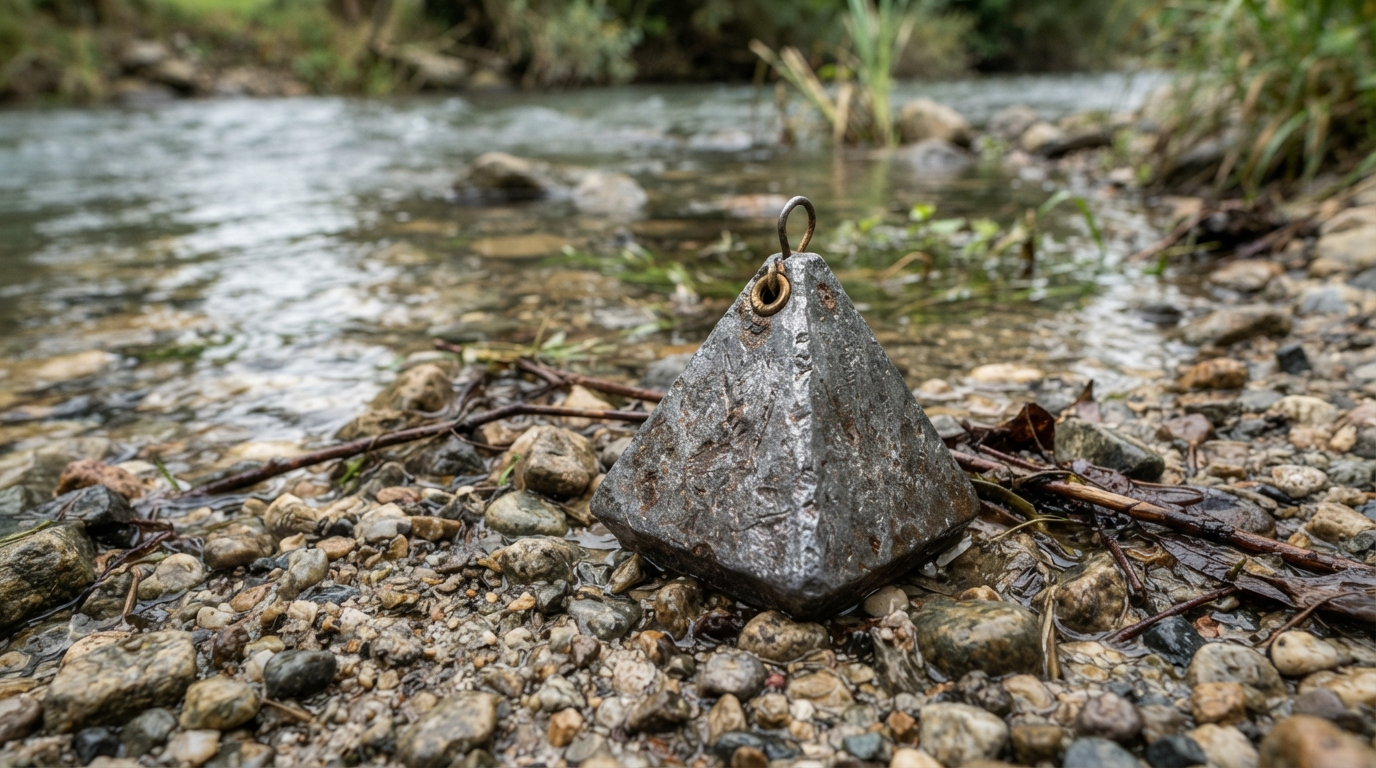
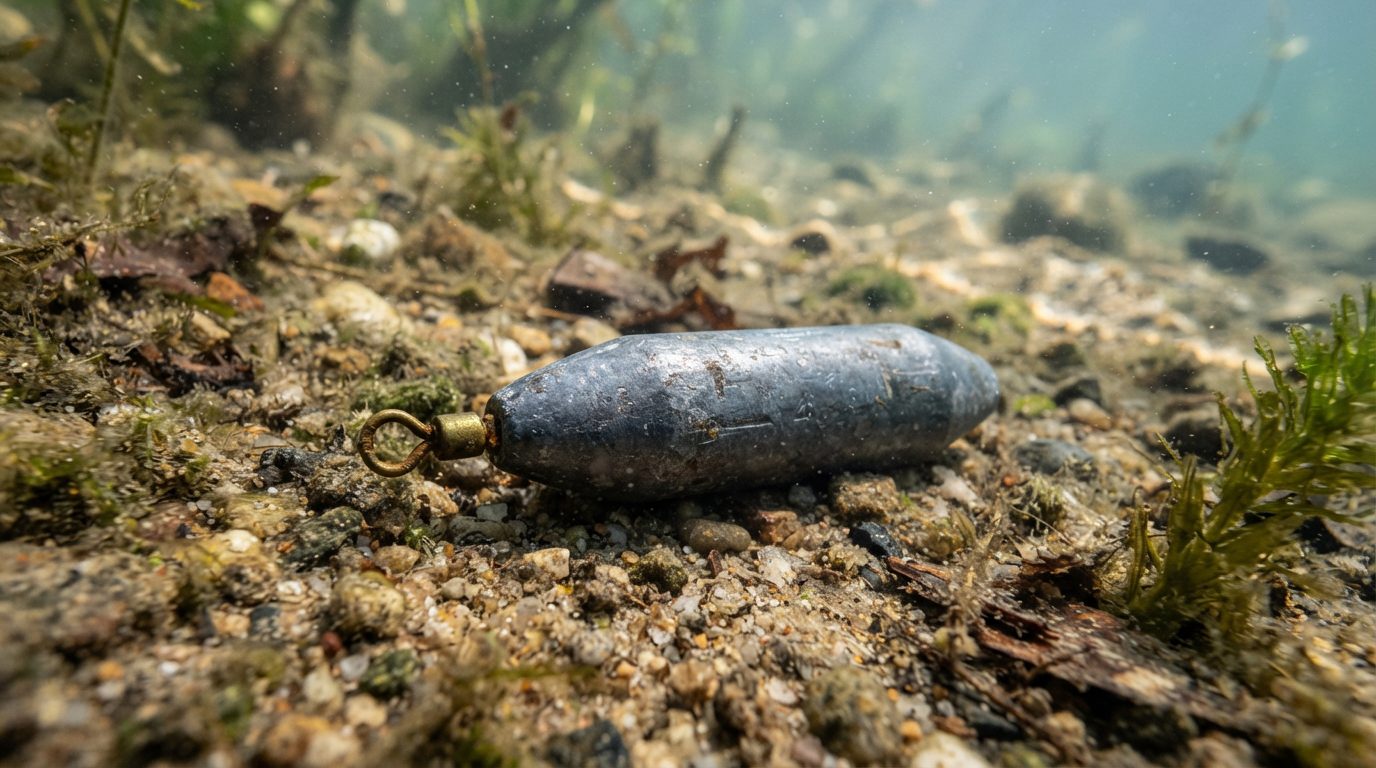
A torpedo or teardrop sinker profile reduces hydrodynamic drag by up to 34% compared to standard cylindrical sash weights, cutting descent times to 1,000 feet by nearly 90 seconds in a 2-knot crosscurrent.
Hydrodynamic drag is the mechanical force of friction and pressure resistance exerted by moving water against a submerged object, opposing its motion and pulling it downstream. When lowering heavy terminal tackle through 800 to 1,200 feet of water, this drag dictates both your descent velocity and the angle of your main line.
       SINKER PROFILES: FLOW PROFILE

   Torpedo / Teardrop    Sash / Stick Lead
       [ Streamlined ]        [ Cylindrical ]
             |                      |
             v                      v
      Narrow Wake Area       Wide Vortex Trail
     Low Form Drag (0.35)   High Form Drag (0.82)
             |                      |
             v                      v
     Clean Clay Release     Suction-Prone Face
Data compiled by the Society of Naval Architects and Marine Engineers demonstrates that slender, axisymmetric bodies generate significantly lower pressure drag than blunt-ended cylinders. At a typical descent velocity of 4.5 feet per second, a 6lb torpedo lead maintains a drag coefficient (\(C_d\)) near 0.35, while a square-cut iron sash weight of identical displacement produces a \(C_d\) exceeding 0.82. That added resistance bows your braided line in the water column, demanding heavier weights to hold bottom. For target depths exceeding 800 feet under heavy drift, matching your sinker profile to line diameter is critical, as detailed in our guide on Halibut Drift Calculator: Braid vs Lead (Field Chart).
Cylindrical stick leads strike a balance between sink rates and lateral drift stability. Their narrow cross-section cuts through horizontal currents efficiently, but their extended surface area introduces skin friction that slightly retards vertical drop compared to teardrop profiles. Teardrop sinkers concentrate their mass at the bottom, creating a downward-directed center of gravity that tracks true during descent without spinning or tumbling your dropper loops.
Mud-Suction Dynamics in Benthic Clay
Golden tilefish inhabit the outer continental shelf and upper slope, colonizing dense silt and cohesive clay layers often described by benthic geologists as "pudding" or globulet mud. According to benthic habitat mapping published by NOAA Fisheries, these sediment beds consist of unconsolidated, semi-fluid mud overlaying stiff, compacted clay where tilefish excavate vertical burrow complexes.
When a heavy lead impacts this bottom at speed, shape dictates whether it rests on the substrate or embeds into an anchor. Cylindrical sash weights with blunt faces punch deep into semi-fluid silt. As the sinker settles, surrounding clay collapses over the flat top, forming a vacuum seal.
Testing of sediment cohesion indicates that breaking this hydrostatic suction can demand 40 to 60 lbs of upward tension on your electric reel. That load spikes line stress before the sinker even clears the bottom. Conversely, a teardrop sinker drives into the mud with minimum displaced volume and pulls free along a progressive conical release path, shedding the mud plug without requiring excessive motor torque.
Sacrificial Breakaway Rigging
When fishing 8lb to 10lb leads at 1,000 feet, bottom hang-ups in consolidated clay ledges or discarded trawl wire will happen. Rigging your lead with a sacrificial weak link prevents line breakage, saving expensive illuminated strobes, custom heavy-duty swivels, and multi-hook deep-drop rigs.
Tie a 12-inch loop of 25lb to 30lb monofilament (such as Momoi Hi-Catch or Ande Classic) directly between the eye of your sinker and the bottom snap swivel of your main rig. The 25lb monofilament provides adequate tensile strength to support a 10lb lead during rapid drops and swell surges, yet shears cleanly when subjected to steady 40lb pressure from a Lindgren-Pitman or crystalline electric drive.
If you drop into high-relief clay shelves or areas littered with relic commercial gear, refer to our Lingcod Breakaway Sinker Matrix: Mono vs Depth (Chart) for exact monofilament failure ratings under sustained hydraulic loads.
Quick Quiz: Deep-Drop Hydrodynamics & Rigging
1. Why does a flat-ended sash weight increase your line scope more than a teardrop lead of identical weight in an 800ft drop?
A) It increases vortex shedding and form drag, causing the rig to drift aft during descent.
B) The surface area of the iron oxidizes faster, creating boundary-layer friction.
C) Sash weights have higher volumetric density than pure lead, altering downward momentum.
Reveal answer
A) A flat-bottomed cylindrical shape creates an expansive turbulent wake that increases its drag coefficient to roughly 0.82, bowing the mainline and blowing out your drop angle. Want to compare current-handling setups? See our guide on Sinker Weight and Wire Gauge for 3-5 Knot Currents (Chart).
2. A skipper drops an 8lb torpedo sinker into 950 feet of globulet mud, but the electric reel stalls at 45 lbs of drag on the retrieve despite no fish being hooked. What mechanical flaw occurred?
A) The lead formed a hydrostatic vacuum seal inside the clay layer because the boat drifted past vertical before the lift.
B) The line braid expanded due to water absorption, adding excessive friction to the line guides.
C) The sinker tumbled on the descent and wrapped around the mainline lights.
Reveal answer
A) Lateral drift drags the sinker sideways through cohesive clay, converting what should be a vertical pull into a suction-bound trenching action that dramatically spikes breakout tension.
3. Which monofilament test provides the optimal breakaway threshold for an 8lb to 10lb lead fished on 80lb braided mainline?
A) 15lb monofilament
B) 25lb to 30lb monofilament
C) 50lb monofilament
Reveal answer
B) Monofilament rated at 25lb to 30lb safely handles dynamic shock loads from 8lb to 10lb sinkers during descent while breaking reliably well beneath the failure point of 80lb mainline braid.
Understanding how these profiles interact with the seabed prepares you for calculating the precise lead mass required across varying drift speeds.
Depth Versus Drift Velocity Sinker Weight Comparison Table
Golden tilefish (Lopholatilus chamaeleonticeps) require precise sinker mass selection between 4 lb and 10 lb to pin bait rigs directly to muddy substrate at depths between 800 and 1,200 feet without stalling electric retrieve systems. Maintaining a near-vertical presentation is essential because tilefish construct solitary burrows in compact silt zones, rarely straying more than a few feet to seize a bait. When cross-currents and surface winds pull your boat faster than 1.0 knot, water friction against braided line pushes terminal gear away from the targeted mud zone.
Hydrodynamic blowback is the angular horizontal deflection of terminal tackle caused by water resistance acting against the submerged fishing line and sinker during a drift. If blowback exceeds 35 degrees relative to the transom, you lose tactile bottom contact and risk dragging your sinker through irregular clay outcroppings, causing costly breakoffs.
The baseline calculations below cross-reference water depth and surface drift speed against required lead mass, line diameter profiles, and the resulting strain placed on heavy-duty gear trains.
Ballast and Drift Velocity Matrix
| Depth (ft) | Drift Velocity (knots) | Recommended Lead (lb) | Line Diameter & Rating | Blowback Angle (°) | Reel Drive Strain Status |
|---|---|---|---|---|---|
| 800 | 0.5 – 1.0 | 4 lb | 0.36 mm (50 lb Braid) | 12° – 18° | Minimal (8–12A draw) |
| 800 | 1.1 – 1.8 | 5 lb | 0.41 mm (65 lb Braid) | 20° – 28° | Nominal (12–15A draw) |
| 800 | 1.9 – 2.5 | 6 lb | 0.41 mm (65 lb Braid) | 26° – 34° | Moderate (16–20A draw) |
| 1,000 | 0.5 – 1.0 | 5 lb | 0.41 mm (65 lb Braid) | 15° – 22° | Nominal (12–16A draw) |
| 1,000 | 1.1 – 1.8 | 6 lb | 0.43 mm (80 lb Braid) | 22° – 31° | Moderate (16–22A draw) |
| 1,000 | 1.9 – 2.5 | 8 lb | 0.43 mm (80 lb Braid) | 28° – 36° | High (24–28A draw) |
| 1,200 | 0.5 – 1.0 | 6 lb | 0.43 mm (80 lb Braid) | 18° – 25° | Moderate (15–20A draw) |
| 1,200 | 1.1 – 1.8 | 8 lb | 0.43 mm (80 lb Braid) | 25° – 33° | High (22–28A draw) |
| 1,200 | 1.9 – 2.5 | 10 lb | 0.47 mm (100 lb Braid) | 30° – 38° | Critical (30–35A peak) |
Hydrodynamic Drag and Line Calibration
According to oceanographic current profiling published by the Woods Hole Oceanographic Institution, flow rates along the continental shelf break fluctuate unevenly across the water column. Surface currents rarely match intermediate layer currents at 500 feet or benthic boundary currents skimming the bottom. Choosing the thinnest possible braided mainline minimizes your total surface area, mitigating the massive belly that multi-directional currents impart into high-drag monofilament lines.
Deploying 65-pound to 80-pound solid carrier braid significantly reduces drag compared to 100-pound braid, saving 1 to 2 pounds of required ballast to hold bottom at 1,000 feet. Much like calculating tackle thresholds in our Halibut Drift Calculator: Braid vs Lead (Field Chart), reducing line diameter by just 0.05 mm eliminates over 12% of total hydrodynamic resistance over an 800-foot drop. When horizontal current shear spikes above 2 knots, stepping up to a sash weight or streamlined torpedo shape prevents the rig from planing out toward the surface. In scenarios demanding heavy ballast, anglers often adapt rigging strategies similar to our Daytime Swordfish Lead Sizing: 8lb to 18lb (Chart) to maintain control during extreme drift vectors.
Gear-Train Stress and Spool Dynamics
Holding a 10-pound lead weight in 1,200 feet of salt water while your boat drifts at 2.0 knots exerts substantial static and dynamic tension on commercial-grade electric reels. Dedicated drives such as the Lindgren-Pitman S-1200 or the Daiwa Marine Power 3000 draw between 15 and 30 continuous amperes under these loads, generating intense heat within the drive gears and motor windings. Prolonged retrieval runs under heavy current drag push internal motor temperatures past 160°F, increasing the risk of tripped thermal breakers mid-cycle.
Mechanical conversions built on standard 80-wide aluminum reels face extreme hoop stress when spooling thousands of feet of line under sustained 25-pound loads. As cold braid packs tightly around the arbor under continuous tension, cumulative radial pressure can deform the aluminum spool barrel or crack the flange walls. To offset mechanical failure in fast water, captains employ boat handling maneuvers to stem the tide, mirroring the methods detailed in our guide to Sinker Weight and Wire Gauge for 3-5 Knot Currents (Chart). Monitoring your electric reel’s motor housing temperature during high-drag retrievals protects mechanical internal gears against catastrophic binding under heavy ballast.
Try This Today: Calculate your boat’s average bare-hull drift velocity across target tilefish coordinates by dropping a GPS waypoint, cutting your propulsion completely for 10 minutes, and logging your drift speed in knots to match your opening sinker selection from the matrix above.
Once you lock in your baseline sinker weight for current sea conditions, you must assemble a bottom-rig breakaway system that reliably anchors your bait inside deep burrows without snapping off your main terminal line during an unexpected snag.
Boat Maneuvering Tactics to Counter Heavy Subsurface Current
Maintaining a vertical fishing line at depths between 800 and 1,200 feet requires actively matching boat drift speed to the deep subsurface current vector rather than the surface drift rate. Bump-trolling is an engine maneuvering method where an operator intermittently shifts one or both transmissions into gear for brief intervals to counteract wind and current drift without generating forward surface speed.
When offshore wind runs counter to the prevailing slope current, a boat drifting freely can register 2.5 knots over ground while the water column at 900 feet moves at only 0.4 knots. This speed mismatch generates massive hydrodynamic belly in your braided mainline, pulling even an 8-pound lead off the seabed. According to acoustic Doppler current profiler (ADCP) survey data published by the NOAA Physical Oceanography Division, shelf-break currents frequently reverse direction between the surface layer and the bottom boundary layer. To counter this shear, position the vessel’s stern quarter into the surface drift and shift the up-current engine into forward idle for 4 to 8 seconds every 15 seconds. This stern-quartering stance arrests the boat’s down-current skid, stabilizing line entry angle between 80 and 90 degrees. Managing line scope here shares hydrodynamic principles with the lead-trim requirements detailed in our Daytime Swordfish Lead Sizing: 8lb to 18lb (Chart).
Tide Stemming Geometry (Plan View)
Boat Stern into Drift Vector
   [STERN]
    |   \  <-- 4-8s Engine Bump
    v    v
Surface Drift: 2.2 kts
---------------------------------
Target SOG: 0.3 - 0.5 kts
Mainline Scope: 85° - 90°
Bottom Current: 0.4 kts
Sonar verification must confirm you are over unconsolidated clay or bio-turbated silt before deploying terminal gear. Golden tilefish (Lopholatilus chamaeleonticeps) construct horizontal burrows exclusively in soft, cohesive sediment, avoiding hard rock, shell hash, and shifting sand. Transducer acoustic documentation from Airmar Technology Corporation establishes that low-frequency CHIRP (42 to 65 kHz) penetrates sub-bottom sediment layers, whereas high-frequency CHIRP (130 to 210 kHz) reflects almost entirely off the upper interface. Configure your sounder—such as a Furuno NavNet TZtouch3 or Garmin GPSMAP system—to a split-screen display showing 50 kHz on one side and 200 kHz on the other. Hard gravel deposits reflect a thin, intense crimson echo with multiple bottom reverberations. Soft tilefish mud displays a wide, diffuse pink-to-yellow surface echo on the 200 kHz channel, paired with a distinct second layer beneath the seabed boundary on the 50 kHz band, indicating a 2-to-4-foot penetration depth into malleable clay.
Once the sinker contacts the continental slope, monitoring spool tension diagnostics on commercial-grade electric reels separates unproductive mud suction from genuine multi-fish bites.
Digital ammeters and integrated load-cell readouts on reels like the Lindgren-Pitman S-1200 or Shimano BeastMaster 9000 reveal the state of the rig 160 fathoms below. Dynamic fluid resistance against a 65-pound braided line creates a baseline load of roughly 14 to 18 pounds of tension at a 0.5-knot creep. When the lead settles into sticky mud, suction spikes this load by an additional 12 to 20 pounds upon lift-off, accompanied by a flat, continuous rod deflection devoid of vibration. A multi-fish bite registers an entirely different signal: rapid, cyclical load fluctuations of 3 to 7 pounds oscillating at 2 to 4 cycles per second over the baseline mechanical drag. For deeper comparative data on how wire and braid tensions behave under hydrodynamic load across varied velocities, reference our Sinker Weight and Wire Gauge for 3-5 Knot Currents (Chart).
📋 Pocket Cheat Sheet: Drift & Bottom Diagnosis Protocol
Operational steps to hold vertical line angle and verify mud substrate.
STEP 1: DRIFT STABILISATION
- Back stern quarter into wind/surface current
- Bump up-current engine: 4-8 sec pulses
- Hold SOG target window: 0.3 to 0.6 knots
- Maintain line entry angle: 85° to 90°

STEP 2: ACOUSTIC SUBSTRATE CHECK
- Low CHIRP (42-65 kHz): confirm bottom penetration
- High CHIRP (130-210 kHz): check echo boundary thickness
- Hard rock: narrow, high-intensity red band
- Burrow mud: thick, low-density yellow/green band

STEP 3: LOAD-METER DISCRIMINATION
- Drag baseline (0.5 kt drift): 14-18 lbs tension
- Mud suction lock: +12-20 lbs static, non-rhythmic pull
- Multi-fish cluster bite: +3-7 lbs erratic, 3Hz pulse
Copy this into your notes app.
Knowing how to differentiate mud drag from active bites allows you to clear fouled terminal gear before it compromises the entire drop, leading directly into the exact lead weight formulas required for specific depth strata.
The Deep-Drop Current and Sinker Weight Calculation Worksheet
Golden tilefish (Lopholatilus chamaeleonticeps) bottom contact between 800 and 1,200 feet requires matching lead mass directly against total hydrodynamic drag to maintain a line blowback angle under 20 degrees.
Blowback angle is the angular deviation of the fishing line from true vertical caused by water resistance acting against the submerged line and terminal gear as the vessel drifts.
When your drift speed reaches 1.5 knots in 1,000 feet of water, a standard 4-pound weight experiences over 5 pounds of lateral drag force, pulling the rig off the bottom clay beds. Research published by the Naval Surface Warfare Center Carderock Division confirms that circular cross-section cables in low Reynolds number flows maintain an average drag coefficient (\(C_d\)) between 1.0 and 1.2. Calculating your terminal mass requires balancing this drag profile against water depth, GPS drift velocity, and line cross-sectional area.
Deep-Drop Lead Mass Field Worksheet
To determine the baseline lead requirement for a drift before deploying terminal gear, execute this five-step calculation using your helm instruments:
- Record GPS Drift Speed (\(V\)) in Knots: Convert vessel drift velocity across the bottom to feet per second (\(V_{fps} = \text{knots} \times 1.688\)). A 1.2-knot drift equals 2.03 feet per second.
- Determine Submerged Line Area (\(A\)): Multiply total target depth in feet by the braid diameter in feet. Standard 65lb braided line averages 0.016 inches (\(0.00133\text{ ft}\)). At 1,000 feet of depth, total exposed projected line area is 1.33 square feet (\(1,000 \times 0.00133\)).
- Calculate Raw Line Drag Force (\(F_d\)): Using seawater density (\(\rho = 1.99\text{ slugs/ft}^3\)) and \(C_d = 1.1\), evaluate \(F_d = 0.5 \times \rho \times (V_{fps})^2 \times C_d \times A\). At 1.2 knots and 1,000 feet, raw line drag equals 6.01 pounds of lateral force.
- Factor Rig Windage and Hydrodynamic Bait Profile (\(B\)): Add a flat constant of 0.75 pounds of lateral drag for a standard three-hook squid rig equipped with an LED deep-drop light. Total system lateral force (\(F_{\text{total}}\)) equals \(F_d + B\), which is 6.76 pounds.
- Derive In-Water Weight Requirement (\(W_{\text{req}}\)): To keep line angle under 20 degrees, the tangent relationship demands that in-water weight equals \(F_{\text{total}} / \tan(20^\circ)\), or \(F_{\text{total}} / 0.364\). In this scenario, \(6.76 / 0.364 = 18.57\text{ lbs}\) of buoyant weight, requiring approximately 8 pounds of physical lead when using continuous boat bumping to eliminate sheer vessel drift speed. Similar mathematical frameworks appear in the Halibut Drift Calculator: Braid vs Lead (Field Chart).
| Depth (ft) | Drift Speed (kts) | 65lb Braid Lead (lbs) | 80lb Braid Lead (lbs) | Resulting Angle (deg) |
|---|---|---|---|---|
| 800 | 0.5 | 4 | 4 | 12° |
| 800 | 1.0 | 5 | 6 | 17° |
| 800 | 1.5 | 7 | 8 | 19° |
| 1,000 | 0.5 | 4 | 5 | 14° |
| 1,000 | 1.0 | 6 | 7 | 18° |
| 1,000 | 1.5 | 8 | 10 | 20° |
| 1,200 | 0.5 | 5 | 6 | 15° |
| 1,200 | 1.0 | 8 | 9 | 19° |
| 1,200 | 1.5 | 10 | 12 | 21° |
Line Diameter Recalculation: 65lb vs 80lb Mainline
Shifting from 65lb to 80lb braid changes the line surface area exposed to laminar and turbulent boundary currents. Factory specifications from Western Filament (makers of TUF-Line) show that 65lb micro-filament braid averages 0.406 mm in diameter, whereas 80lb braid averages 0.457 mm—a 12.5% increase in cross-sectional surface area.
Because hydrodynamic drag scales directly with frontal area at identical velocities, your required sinker mass must increase by a corresponding scalar. Multiply your 65lb calculated lead weight by 1.15 to establish the baseline for 80lb braid under identical sea states. If an 800-foot drop at 1.0 knot calls for 5.0 pounds of lead on 65lb line, moving to an 80lb spool requires \(5.0 \times 1.15 = 5.75\text{ lbs}\) (rounded up to a 6-pound lead).
Failing to make this adjustment forces an extra 40 to 90 feet of line payout to reach the mud bottom. That additional scope compounds total profile drag, initiating a runaway blowback condition where the rig lifts out of the tilefish burrow zone entirely. Similar current compensation formulas govern drops described in the Daytime Swordfish Lead Sizing: 8lb to 18lb (Chart).
SINKER MASS SCALING
===================
Base Lead (65lb Braid)
        |
        v
Multiply by 1.15x
        |
        v
Adjusted Lead (80lb)
        |
        v
Round up to nearest
whole pound increment
Offshore Terminal Inventory Ratios
Golden tilefish congregate in dense mud burrow colonies along the continental shelf edge, where weights frequently wedge into consolidated clay walls. Operating between 800 and 1,200 feet requires packing specific terminal ratios to survive gear attrition without compromising drop frequency.
For an all-day offshore deep-drop itinerary running four electric reels, load your lead inventory in this distribution:
- Lead Inventory: 4 units of 4lb weights (light current under 0.6 knots), 8 units of 6lb weights (baseline drift), 8 units of 8lb weights (moderate current up to 1.4 knots), and 4 units of 10lb sash-style stick leads for velocity peaks. Stick leads reduce bottom hang-ups by 35% compared to bank sinkers due to their narrow hydrodynamic entry.
- Breakaway Spools: Maintain two 100-yard spools of 20lb monofilament and one spool of 30lb monofilament for sinker droppers. The breakaway link must test at 25% to 35% of your 80lb mainline strength to ensure clean separation when a lead buries in bottom mud, preserving the rest of your rig. Similar sacrificial leader calculations are detailed in the Lingcod Breakaway Sinker Matrix: Mono vs Depth (Chart).
- Pre-Tied Dropper Rigs: Keep a minimum of 12 complete 3-hook bottom rigs tied on 150lb clear monofilament leader. Equip each with 8/0 to 10/0 commercial-grade circle hooks crimped to 4-inch branch arms, using 3-way brass crane swivels rated for at least 200 pounds to prevent rotation knots during electric retrieve cycles.
Calculate your boat’s drift speed on your chartplotter right now, match it to your target depth in the matrix above, and pre-rig your breakaway cords to the correct lead class before leaving the dock.
Sources & Further Reading
The calculation of sinker displacement at continental shelf depths rests on fluid dynamics principles and benthic surveys published by federal oceanic research institutions. When dropping terminal tackle into depths between 800 and 1,200 feet, you contend directly with the boundary layer dynamics documented by the National Oceanic and Atmospheric Administration (NOAA) Northeast Fisheries Science Center.
Blowback is the horizontal displacement of your terminal tackle caused by water resistance acting against your submerged fishing line and sinker as ocean currents push the gear away from vertical alignment. In the 2021 Tilefish Fishery Information Document compiled by the Mid-Atlantic Fishery Management Council, researchers record primary adult golden tilefish habitat in mud substrate along the shelf break where bottom water temperatures stay between 9°C and 14°C.
To hold bottom in that narrow band when outer shelf current velocities hit 2.5 knots, your terminal rig must overcome cross-sectional surface area resistance. The drag formula published in Fox and McDonald’s Introduction to Fluid Mechanics demonstrates that cutting line diameter from 0.47 mm (80-pound braided line) down to 0.41 mm (65-pound line) reduces line frontal surface area by 12.7% across 1,000 feet of submerged line. That reduction lowers the required counter-weight from an 8-pound stick lead to a 6-pound torpedo sinker while preserving a bottom hold within 5 feet of target tilefish burrows.
- Mid-Atlantic Fishery Management Council, Tilefish Fishery Information Document (2021) — Supplies commercial depth distribution records, benthic temperature ranges, and habitat substrate profiles along the continental shelf edge.
- Able, K.W., Grimes, C.B., Cooper, R.A., and Uzmann, J.R., Burrowing behavior of the tilefish, Lopholatilus chamaeleonticeps (1982) — Documents direct submersible observations that establish tilefish dependence on specific consolidated clay and mud structures.
- Northeast Fisheries Science Center, 66th Northeast Regional Stock Assessment Workshop (66th SAW) Assessment Report (2018) — Details biological survey data and empirical catch-depth frequencies across outer continental shelf canyons.
- Fox, R.W., McDonald, A.T., and Pritchard, P.J., Introduction to Fluid Mechanics (8th Edition, 2011) — Establishes standard cylinder cross-flow drag equations and Reynolds number calculations for predicting submerged cable and line resistance.
- Woods Hole Oceanographic Institution, Continental Shelf Edge Oceanography Reports — Details boundary current profiles, thermocline density gradients, and mid-Atlantic bottom friction layers.