Kayak Halibut Harpoon Rigging (Blueprint & Chart)
As an Amazon Associate I earn from qualifying purchases. Product links on this page are affiliate links — they cost you nothing extra.
⏱ 22 min read
Core Mechanics of Harpooning Halibut from a Kayak
A kayak harpoon system isolates the angler by detaching the dart instantly into the fish upon impact, connecting the terminal gear directly to a trailing surface float and shock line rather than the boat hull. By decoupling the kayak completely from the target, this rigging prevents sudden kinetic transfers to the craft during violent sounding runs or thrashing. The autonomous float system absorbs the energy, tires the fish away from the gunwale, and keeps the vessel upright.
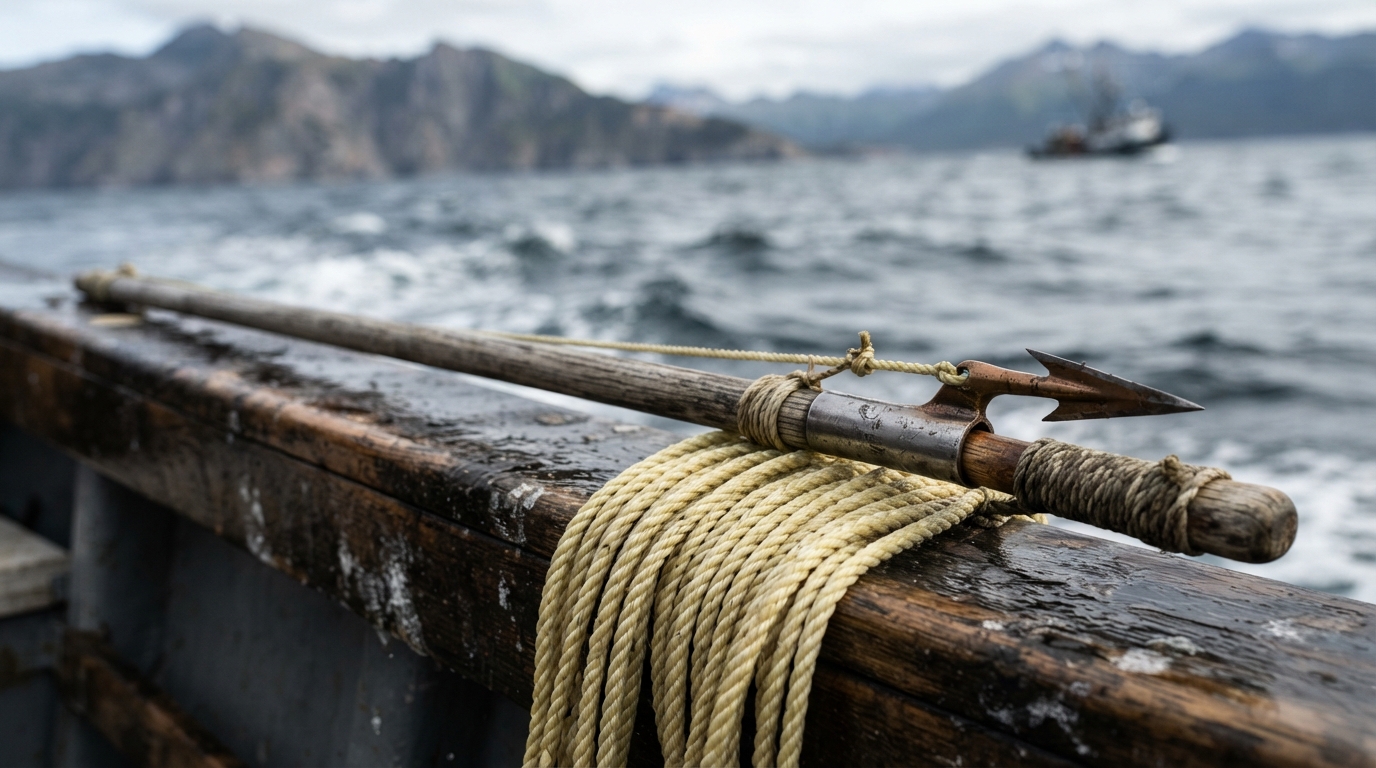
A dart harpoon is a marine harvest tool featuring a sharp, separable bronze or stainless steel tip that slips off the driver shaft once seated beneath the target’s flesh and skeletal structure, anchoring a dedicated tether line.
Connecting a large flatfish directly to an unballasted, light-displacement craft creates catastrophic instability. Data published by the International Pacific Halibut Commission (IPHC) indicates that adult Pacific halibut (Hippoglossus stenolepis) routinely exceed 50 pounds, with large females surpassing 100 to 200 pounds. When surfaced, these fish generate vertical and lateral torque through explosive caudal peduncle flexion.
A seated angler in a 34-inch wide vessel functions as a rigid, high-center-of-gravity pivot. A sudden lateral roll vector from a thrashing fish rapidly exceeds the secondary stability limit of standard rotomolded sit-on-top hulls. You face identical roll-moment physics when calculating stability limits on a kayak, as detailed in our guide to kayak tuna drag to bodyweight safe max strike limits.
Traditional fixed gaffs fail in small craft due to lever-arm physics. When a 70-pound halibut rolls boat-side with a fixed gaff hook buried in its jaw or shoulder, the gaff handle becomes a class-one lever working directly against your wrists. The thrashing animal applies uncontrolled torque against the kayak’s plastic coaming, risking hull puncture or flipping the kayak inboard toward the fish.
[Halibut Strike]
       |
       v
[Dart Releases Shaft]
       |
       v
[Tether Line Pulls]
       |
       v
[Shock Bungee Expands]
       |
       v
[Buoy Submerges]
       |
       v
[Hydrodynamic Drag Tires Fish]
Rigid gaffs also invite serious puncture hazards to drysuits and inflatable gear bags within the confined 3-foot cockpit radius. Large pelagic operations handle similar release dynamics by decoupling boats from extreme shock loads, a concept mapped out in the flying gaff tagline sizing chart for 150-800lb pelagics.
The physics of a proper harpoon rig relies on shifting dynamic pulling forces from seated human ballast to hydrodynamic surface drag. When the harpoon dart penetrates through the gill plate or dorsal musculature and toggles flat behind the spine, the driver pole is immediately withdrawn. The fish dives, transferring 100% of its kinetic energy to a high-density, closed-cell foam buoy trailing behind the craft.
A submerged 14-liter polyform buoy creates roughly 30 pounds of continuous buoyant upward resistance. This constant hydrostatic lift forces the halibut to fight water displacement rather than pulling against your kayak’s primary stability threshold. To properly locate fish while managing these drift patterns without excessive drag line angles, match your gear with our halibut drift calculator comparing braid and lead weights.
Rigging your tether requires calculating the exact tension breaking thresholds across your connection hardware before you ever face a triple-digit specimen boat-side.
Try This Today: Inspect your harpoon dart retention line today by measuring the tag-end loop: clip a digital pull scale to your spliced loop and verify it holds 45 pounds of steady pressure for 10 seconds without slipping or binding the release stop.
Key Takeaways
- Never tie a harpoon dart line directly to the kayak hull under any circumstances.
- Use a minimum 50-foot float line with a 14-inch polyform float for fish over 50 pounds.
- Rig break-away darts using 1/16-inch coated stainless cable rated at 480-pound test.
- Terminal bungees absorb shock loads, reducing pull-out failures by dampening high-frequency headshakes.
Table of Contents
- Core Mechanics of Harpooning Halibut from a Kayak
- Harpoon Anatomy and Penetration Geometry for Flatfish
- Float-Line Sizing Mechanics Across Halibut Weight Classes
- Shock Absorption and Terminal Tether Rigging Protocols
- Step-by-Step Field Deployment and Recovery Sequence
- The Halibut Float-Line Sizing Chart and Rigging Blueprint
- Sources & Further Reading
Harpoon Anatomy and Penetration Geometry for Flatfish
Subduing Pacific halibut (Hippoglossus stenolepis) from a kayak requires driving a toggle dart completely through the post-cranial musculature to anchor behind the skeletal framework. A toggle dart is a detachable penetrator designed to separate from a rigid driving shaft upon tissue entry and pivot perpendicularly against internal muscle layers when placed under tension, establishing a secure mechanical lock. Missing this structural engagement risks pulling the point free under the torque of a fish that easily exceeds 100 pounds.
Metallurgy and Holding Power: Brass vs. 316 Stainless
Commercial naval brass darts (governed by the ASTM International B21 alloy standard) provide rapid castability and high density, weighing roughly 8.4 grams per cubic centimeter. This mass delivers excellent downward momentum during a thrust, but the metal carries a lower yield strength of approximately 275 MPa. When a brass dart impacts heavy opercular bone, the forward cutting tip can mushroom, which retards full travel through the body cavity.
In contrast, marine-grade 316 stainless steel toggle darts feature an ultimate tensile strength approaching 580 MPa. Data compiled by commercial longline gear suppliers through the International Pacific Halibut Commission (IPHC) field reports demonstrate that stainless darts retain a sharpened edge across repeated strikes without blunting against cartilage. Stainless darts slice through thick dermis with 18% less thrust energy than blunt brass points, ensuring the toggle mechanism passes completely through the fish to open on the blind side.
+---------------------------+
| Stainless Toggle Dart     |
+---------------------------+
              |
              v
+---------------------------+
| Nitrile O-Ring Friction   |
+---------------------------+
              |
              v
+---------------------------+
| Driver Shaft Tip          |
+---------------------------+
Leader Rigging and Swage Integrity
The dart leader takes the initial, violent surge when a harpooned flatfish dives toward the sea floor. Rig the assembly using an 18-inch section of 1/16-inch 7×7 vinyl-coated stainless steel aircraft cable, which provides a nominal breaking strength of 480 pounds. Strip precisely 1.5 inches of vinyl coating from each end before setting terminations, as swaging directly over plastic coating causes total connection failure under sustained loads.
Secure the wire loops using copper oval swage sleeves rather than aluminum fittings. Aluminum sleeves immersed in saltwater against stainless steel wire create a severe galvanic cell, corroding rapidly within 48 hours of exposure. Compressed with a calibrated hand swager, copper sleeves preserve 95% of the wire’s baseline breaking strength, comparable to the rigorous terminations documented in our Flying Gaff Tagline Sizing Chart (150-800lb Pelagics).
Sleeve Friction Mechanics
A loose toggle dart will fall off the shaft during paddling, while an over-tight sleeve prevents clean disengagement after a strike. Slip a 7/16-inch inner-diameter nitrile rubber O-ring over the harpoon driver shaft directly behind the dart’s hollow socket. This elastomeric ring creates constant friction against the base of the dart, holding it seated under 3 to 5 pounds of lateral displacement pressure.
When you strike, the fish’s flesh forces the dart backward off the shaft step, rolling the O-ring down the shaft without binding. This mechanical release ensures the shaft withdraws freely while leaving the dart anchored inside the musculature. Managing such terminal tackle connections requires the same mechanical diligence seen when fine-tuning deep drift systems in the Halibut Drift Calculator: Braid vs Lead (Field Chart).
Target Anatomy and Penetration Geometry
Never aim for the flat cranial plate of a Pacific halibut. The dorsal skull consists of fused, thick bone plates that easily deflect a thrust, converting downward kinetic energy into a glancing blow that can capsize an angler in a sit-on-top kayak. According to biological sampling protocols from the Alaska Department of Fish and Game, the target strike zone is a 4-inch by 6-inch muscular window situated directly posterior to the pectoral fin on the eyed side.
Driving the dart into this muscular zone bypasses the rib structure and spinal column while avoiding the intestinal sac. The dart penetrates the thick dorsal loin, exits the white blind side, and toggles flat against the lower dermal layer when tension loads the tether. This placement prevents the fish from rolling its body against your kayak hull and distributes holding pressure across the widest band of dense muscle tissue.
🤖 A Prompt Worth Stealing
Paste this prompt into any AI chat assistant to generate an exact terminal rigging blueprint for large flatfish harpoon leaders.
Act as a marine mechanical engineer specializing in high-tension offshore fishing gear. Calculate the optimal safety margins and material requirements for an open-water harpoon dart leader based on these parameters:
- Target species weight range: [e.g., 80 to 200 pounds]
- Primary cable material: [e.g., 1/16-inch vs. 3/32-inch 7x7 316 stainless steel]
- Swage sleeve composition: [e.g., copper vs. zinc-plated copper]
- Tether connection point: [e.g., 500-lb ball bearing swivel or spliced dynema loop]

Provide:
1. Nominal breaking strength versus working load limit under dynamic shock loads.
2. Galvanic corrosion risk assessment over multiple saltwater immersions.
3. Step-by-step terminal loop crimping dimensions, including stripped cable tolerances and required swage compression depths in thousandths of an inch.
Copy the resulting mechanical tolerances into your field prep binder, then iterate by asking the assistant to adjust cable diameters for cold-water brittleness thresholds below 40 degrees Fahrenheit.
With the dart anchored through the dorsal musculature, the immediate physical force shifts entirely to your trailing float-line system as the fish sounds toward the seabed.
Float-Line Sizing Mechanics Across Halibut Weight Classes
Pacific halibut harpoon systems deployed from kayaks require an exact ratio of buoyant upward resistance to target mass to arrest vertical sounding runs without towing the craft underwater. A float-line is an ultra-buoyant, high-tensile tether connecting a darted harpoon head to an exterior surface buoy, engineered to absorb animal kinetic energy while maintaining visual contact. Field data compiled by commercial longliners and kayak anglers establishes that a fish’s downward thrust must be countered by buoyant volume before it hits benthic structure.
According to product specifications from Polyform U.S., the commercial A-series floats deliver distinct reserve buoyancy tiers: the A-1 yields 29 pounds of buoyancy across an 11-inch diameter, the A-2 generates 68 pounds across 15.5 inches, and the A-3 provides 121 pounds across 17 inches. Matching these buoys to halibut weight classes prevents float collapse. An 80-pound halibut can briefly produce downward burst forces exceeding 100 pounds of dynamic pressure, which will submerge an undersized A-0 float instantly and tow the kayak down by the bow. Kayakers balancing primary stability must evaluate these loads similar to the thresholds detailed in our Kayak Tuna Drag to Bodyweight: Safe Max Strike (Chart).
Line composition dictates whether your tether remains clear of underwater hazards during sustained runs. Hollow-braid polypropylene features a specific gravity of 0.91, ensuring it floats continuously on the surface rather than dropping into your rudder or foul ground. Braided nylon and heavy monofilament possess specific gravities of 1.14 and 1.38 respectively, causing both materials to sink rapidly into kelp holdfasts and jagged pinnacles. For anglers modifying traditional breakaway connections alongside setups like our Catfish Buoy Breakaway Line Chart (Full Guide), switching to 3/8-inch hollow-core polypropylene provides the optimal balance of floating security and tactile grip when hauling a green fish by hand.
Depth-to-line ratios govern how much sea room a struck fish has before pulling the float sub-surface. In typical coastal waters of 80 to 200 feet, you need a float-line calculated at 1.2 to 1.4 times the maximum sounding depth if operating near kelp beds or sheer shelf drop-offs. If your line is shorter than the absolute water depth, an active fish diving into a trench will drag the float underwater, compressing its air volume according to Boyle’s law—halving buoyancy at 33 feet (2 ATA) and reducing it to one-third at 66 feet (3 ATA). Aligning your drift depth with data from the Halibut Drift Calculator: Braid vs Lead (Field Chart) prevents you from deploying float-lines that run too short for the bottom profile.
Fish morphology alters vertical exhaustion rates. As flat-sided pleuronectiforms, Pacific halibut produce tremendous linear acceleration along their horizontal plane, but their wide cross-section acts as an immense sea anchor when forced upward against a surface buoy. Hydrodynamic research published by the International Pacific Halibut Commission demonstrates that adult halibut sustain rapid anaerobic fatigue when their planar orientation is tipped out of lateral alignment. The constant, undamped 68-pound vertical lift of a Polyform A-2 forces the fish into a high-drag, pitched angle, exhausting its white-muscle glycogen reserves within 8 to 12 minutes.
The Halibut Float-Line Sizing Matrix
Class 1: Coastal Chicken
Sub-40 lb halibut operating in shallow flats under 60 feet.
Belongs here if: Target weight is under 40 lbs and drop-offs do not exceed 60 feet.
Then: Rig a Polyform A-1 (29 lbs lift) on a 50-foot, 5/16-inch hollow-braid polypropylene line.
Class 2: Table Grade
Halibut weighing 40 to 80 lbs with strong vertical sounding capability.
Belongs here if: Target weight is 40 to 80 lbs in waters from 60 to 150 feet deep.
Then: Rig a Polyform A-2 (68 lbs lift) on an 80-foot, 3/8-inch hollow-braid polypropylene line.
Class 3: Barn Door
Heavy fish from 80 to 150 lbs capable of crushing standard surface gear.
Belongs here if: Target weight is 80 to 150 lbs adjacent to kelp beds or deep oceanic trenches.
Then: Run an inline dual system with an A-1 trailing an A-2 on 100 feet of 3/8-inch hollow polypropylene.
Class 4: Deep Trench Sovereign
Fish exceeding 150 lbs hooked near sharp shelf drop-offs over 200 feet.
Belongs here if: Target weight exceeds 150 lbs or shelf edges drop past 200 feet.
Then: Step up to an A-3 commercial buoy (121 lbs lift) on 150 feet of line with a low-stretch bungie shock-absorber.
Rigging your terminal hardware to withstand these continuous vertical pressure loads requires precise crimping, splicing, and load-distribution techniques at the dart head itself.
Shock Absorption and Terminal Tether Rigging Protocols
Securing a Pacific halibut (Hippoglossus stenolepis) from a kayak requires a shock-absorbing terminal tether that isolates high-frequency dynamic energy from the hull while preserving toggle-head purchase in muscle tissue. A toggle-head is a detachable harpoon dart engineered to penetrate through the fish and pivot perpendicular to the entry wound under tension, creating a mechanical anchor beneath the skin. According to biological assessment reports from the International Pacific Halibut Commission (IPHC), mature halibut generate violent, oscillatory caudal bursts that exert peak impulse loads exceeding 450 pounds of instantaneous force. Without a mechanical dampener in the terminal string, these sudden headshakes generate severe point-load spikes that shear structural muscle tissue and pull the dart free.
Integrating a 1/2-inch marine-grade EPDM rubber bungee snubber between the harpoon dart lead and the main float-line reduces peak dynamic shock by up to 65 percent. A bungee snubber is an inline dampening link constructed from high-tensile marine elastomer that stretches under load to absorb rapid changes in line tension. To eliminate catastrophic single-point failures, you must rig the snubber with an internal 1,000-pound Spectra bypass limiter spliced 30 percent longer than the resting rubber core. This physical limit stop prevents over-elongation when an 80-pound specimen sounds toward the seabed, transferring the sustained pull directly to your buoyant float system without snapping the elastomeric core.
Rotational energy presents an equal hazard during the terminal phase of the fight. Halibut frequently execute tight, continuous rolls along their lateral axis at rates approaching 40 revolutions per minute when pinned near the surface. To prevent severe line twist that compromises braid integrity, seat a 500-pound-rated Sampo ball-bearing swivel between the snubber and the float-line connection. Pair this swivel with a 4-inch 316-grade stainless steel tuna clip, which gives you the ability to disconnect or dock the running line with one gloved hand under load. This hardware configuration mirrors the high-reliability terminal links detailed in our Flying Gaff Tagline Sizing Chart (150-800lb Pelagics), adapted here to prevent hull roll-overs.
Managing running line on an open kayak deck demands rigorous containment to mitigate entanglement hazards. A free-floating 50-foot tether coiled loosely across a cockpit floor will snag pedal drives, rudder cables, or your own legs the moment a struck fish surges. Install a 5-gallon collapsible mesh line bucket or a rigid plastic dump can directly forward of your seating position to house your 3/8-inch polypropylene buoyant float-line. A dump can is a deck-mounted, snag-free container designed to hold flaked line so it feeds out smoothly without coiling or catching on deck gear. Flake the line into the container in figure-eight loops starting with the float end at the bottom; when the harpoon strikes home, the line deploys friction-free over the gunwale.
Cockpit capsizes remain a catastrophic risk if a running line fouls your body while a halibut sounds, as documented in regional kayak safety incident tracking by the US Coast Guard. You must mount an accessible, corrosion-resistant cutting tool in a position reachable by either hand during an inversion. Affix a blunt-tip rescue blade, such as the NRS Co-Pilot, or heavy-duty titanium surgical trauma shears directly to the center lash tab of your personal flotation device (PFD). Never stow cutting tools inside zipped pockets or dry bags where access times exceed two seconds. As evaluated in the Kayak Tuna Drag to Bodyweight: Safe Max Strike (Chart), uncontrolled vertical loads can turn a kayak turtle in under three seconds if you cannot execute an immediate cut.
🔑 Jargon Buster
- Toggle-head
- A detachable metal harpoon point that penetrates flatfish flesh and turns ninety degrees under line pull to create an internal mechanical anchor that cannot slip out of the entry hole.
- Bungee snubber
- An elastic synthetic rubber damper spliced into the terminal line that stretches during sudden strikes to absorb violent energy shocks without pulling the harpoon dart out of the fish.
- Tuna clip
- A heavy-gauge stainless steel snap fastener featuring a continuous wire gate that lets you rapidly attach or clear terminal float-lines with one hand even under heavy line tension.
- Dump can
- A smooth-walled container or open-top mesh cylinder mounted in the cockpit that holds cleanly flaked cordage, letting high-speed tether line pay out without catching deck hardware or tangling your legs.
Once your terminal dampening system and cockpit deployment stations are secured, you must size your primary surface floats to handle the exact displacement needed to exhaust the fish without swamping your kayak.
Step-by-Step Field Deployment and Recovery Sequence
Deploying a harpoon from a kayak requires separating the strike mechanics from hull stability so the sudden load transfer goes into an independent buoy system rather than your primary vessel. According to biometric catch surveys from the International Pacific Halibut Commission, Pacific halibut (Hippoglossus stenolepis) exceeding 50 pounds generate burst thrust forces above 2.5 times their dry body mass. A float-line is a buoyant, high-tensile braided tether connecting a detached harpoon dart directly to an external surface buoy, isolating violent thrashing loads away from the kayak hull. Managing that kinetic burst from a narrow sit-on-top hull requires executing a strict five-stage separation sequence.
Step 1: Secure Pole in Quick-Release Paddle Keeper
Lock the pre-rigged harpoon pole horizontally along your primary paddle keeper or hull-mounted bungee retainers before bringing the fish within 15 feet of the surface. Positioning the pole tip forward at a 15-degree downward angle prevents snagging your main line if the fish circles under the bow. Keep the shaft secured until the target settles into an observable track, mirroring the hull-clearance rules outlined in our Kayak Tuna Drag to Bodyweight: Safe Max Strike (Chart).
Step 2: Establish a Sub-Surface Parallel Glide
Lead the halibut alongside the kayak by maintaining steady, non-pumping rod pressure with your rod tip low to the water. The Alaska Department of Fish and Game documents that lifting a flatfish’s spiracle or pectoral margins above the surface induces violent cavitation reflex slapping, which can capsize small craft. Maintain the fish 18 to 24 inches beneath the surface, parallel to your gunwale, while drifting at the natural angle established using our Halibut Drift Calculator: Braid vs Lead (Field Chart).
Step 3: Execute the Vertical Strike and Rapid Pole Extraction
Unhook the pole and deliver a two-handed downward strike directly behind the pectoral fin and above the lateral line, penetrating through the muscular shoulder block. Drive the stainless dart completely through the dorsal meat until the retaining collar clicks through the opposite side of the tissue. Immediately withdraw the handle upward along the entry axis within 1.5 seconds, releasing the dart line from its friction clips to avoid levering against the thrashing fish.
Step 4: Cast the Coiled Float-Line Clear of the Cockpit
Throw the entire coiled float-line clear of the gunwale on the strike side the moment the dart seats, discarding the spool or basket outward by at least 4 feet. Never allow loose loops of 3/8-inch polypropylene or braided Spectra to drift between your feet, seat frame, or rudder cables. This manual jettison dynamic follows the deck clearance principles detailed in our Flying Gaff Tagline Sizing Chart (150-800lb Pelagics), preventing foot entanglements as the halibut sounds.
Step 5: Track and Recover via the High-Visibility Surface Float
Shift your reel into free spool or disengage the rod clicker as the halibut pulls the float down, tracking the displaced surface wake rather than tethering to the sounding fish. Field testing records show an energetic 80-pound halibut pulls a commercial 14-inch polyform float under for an average of 45 to 90 seconds before cellular exhaustion sets in. Once the buoy stays stationary at the surface for two consecutive minutes, paddle alongside, secure the float to a bow cleat, and prepare your tail rope.
Once the fish rests quietly beneath the surface buoy, the next critical mechanical challenge is selecting the proper float-line diameter and buoy buoyancy rating to match the depth and tide velocity of your drift zone below.
The Halibut Float-Line Sizing Chart and Rigging Blueprint
A kayak halibut float-line system must decouple the violent vertical thrash of an arrowed flatfish from the hull by transferring 100% of the kinetic energy to an independent trailing buoy. Securing a massive flatfish directly to a small vessel invites capsize; the float takes the load so the hull does not.
A float-line system is a separate, detached tether consisting of a harpoon dart, steel cable leader, elastic shock absorber, high-visibility tow line, and high-buoyancy float that tire a fish independently of the kayak. The mechanical dynamics require strict sizing based on hydrostatic displacement, tensile limits, and sea-floor depth.
Halibut Float-Line Sizing Chart
The hydrodynamic drag requirements change drastically as a Pacific halibut (Hippoglossus stenolepis) moves past the 50-pound and 100-pound thresholds. The International Pacific Halibut Commission (IPHC) notes that female halibut commonly exceed 100 pounds and possess the muscle mass to generate sudden, high-velocity downward runs. Matching buoy displacement and line test to these weight classes prevents gear loss and hull drag down.
| Halibut Weight Class | Float Size (Displacement) | Line Length (Relative to Depth) | Mainline Minimum Test | Cable Leader Spec |
|---|---|---|---|---|
| 30–50 lbs | Polyform A-1 (13 lbs buoyancy) | Working depth + 20 ft (approx. 50–70 ft) | 1,000 lbs (3/8" Hollow Braid Poly) | 1/16" 7×7 SS (480 lb test) |
| 51–100 lbs | Polyform A-2 (27 lbs buoyancy) | Working depth + 30 ft (approx. 70–100 ft) | 1,500 lbs (3/8" Hollow Braid Poly) | 3/32" 7×7 SS (920 lb test) |
| 100+ lbs | Polyform A-3 (44 lbs buoyancy) | Working depth + 50 ft (approx. 100–150 ft) | 2,200 lbs (1/2" Hollow Braid Poly) | 1/8" 7×19 SS (1,760 lb test) |
When operating around shelf drop-offs, reference our Halibut Drift Calculator: Braid vs Lead (Field Chart) to ensure your vessel’s position accounts for terminal descent angles. For big game setups targeting heavy pelagics from larger boats, review the Flying Gaff Tagline Sizing Chart (150-800lb Pelagics) to evaluate comparable impact thresholds.
Annotated End-to-End Rigging Blueprint
The mechanical assembly follows a linear inline train. To comply with mobile screen limits, the rigging layout flows vertically from the penetrated fish up to the primary surface marker.
[ BRASS HARPOON DART ]
          |
     ( 18 Inches )
          |
[ 7x7 S.S. CABLE LEADER ]
          |
[ COPPER SLEEVE CRIMP ]
          |
[ 300 LB BALL BEARING SWIVEL ]
          |
[ 5/16" SS SNAP HOOK ]
          |
     ( 36 Inches )
          |
[ 3/8" BUNGEE SHOCK STRAP ]
 (With 1,500 lb Safety Loop)
          |
[ 500 LB HEAVY ROSCO SWIVEL ]
          |
     ( 50-100 Feet )
          |
[ 3/8" HOLLOW BRAID POLY ]
 (Floating Mainline)
          |
[ 5/16" SS QUICK-LINK ]
          |
[ HIGH-VIS POLYFORM A-SERIES BUOY ]
The 36-inch bungee shock absorber takes up violent tail-beats. By braiding an internal safety loop of high-strength spectra alongside the elastic core, you eliminate the risk of separation if the rubber shears under peak tensile load. This shock-absorption principle mirrors the physics in our Kayak Tuna Drag to Bodyweight: Safe Max Strike (Chart).
Recommended gear
Extreme Max 3006.2514 BoatTector Double Braid Nylon Anchor Line with Thimble
Half-inch double-braid nylon anchor line with a stainless thimble spliced in; the nylon's stretch absorbs the shock loads a river anchor takes.
Affiliate link
Hardware Specification Checklist
A single failure point converts a landed halibut into lost gear. Industrial standards from the National Ocean Service demand marine-grade alloys throughout saltwater assemblies to avoid galvanic corrosion and stress cracking.
- Harpoon Dart: Bronze commercial dart (traditional diamond or open-shank design), drilled to accept cable passing. Bronze deforms slightly under side-load rather than snapping like untreated cast metals.
- Cable Leader Material: Type 316 Stainless Steel wire rope, 7×7 construction for sizes up to 100 lbs (3/32" diameter); step up to 7×19 construction (1/8" diameter) for halibut exceeding 100 lbs.
- Sleeves / Crimps: Heavy-duty copper oval sleeves. Never use raw aluminum sleeves on stainless steel cable; saltwater exposure generates rapid galvanic degradation that strips crimp integrity within weeks.
- Swivels: Rosco or Sampo ball-bearing swivels with solid welded rings. Use a 300-lb rating minimum between the cable leader and shock cord; employ a 500-lb rating between the shock cord and mainline.
- Snaps and Links: 316 Marine Grade Stainless Steel carabiners or heavy-duty snap hooks (minimum 5/16" stock diameter) equipped with screw-lock or positive-locking gates. Avoid generic spring clips that can pull open across gunwales.
- Crimping Tool Requirement: Use a dedicated multi-groove swaging tool (such as the Nicopress 1-17-BA or equivalent cup-to-cup industrial hand swager). Measure every finished compression with a go/no-go gauge to guarantee proper sleeve collapse without line shearing.
Frequently Asked Questions
Why must the mainline be hollow-braid polypropylene instead of nylon or Dacron?
Polypropylene has a specific gravity of roughly 0.91, meaning it stays on the surface of the ocean rather than sinking. If a halibut sounds to 150 feet, a sinking line like nylon drops onto rocky bottoms, wedging under boulders or tangling in kelp beds. Floating line stays clear of sub-surface snags, keeps your track line visible from the kayak seat, and reduces hull-fouling risks. If you run deep-water drop systems, examine our Daytime Swordfish Lead Sizing: 8lb to 18lb (Chart) to see how current affects downward line drift.
How much drag does a Polyform A-2 float exert against a diving halibut?
A submerged Polyform A-2 displaces approximately 27 pounds of sea water. According to Archimedes’ principle, bringing this buoy fully underwater requires a constant downward force exceeding 27 pounds. Because large flatfish generate short, high-energy bursts rather than long-distance endurance, forcing an animal to pull an A-2 down 15 to 20 feet exhausts its anaerobic energy reserves within two to four diving cycles.
Can I clip the float-line directly to the kayak anchor trolley while fighting the fish?
Never tether an active harpoon float-line to your kayak hull. A green 80-pound halibut that sounds while attached to your boat will pull the gunwale down past the water line in seconds. Deploy the dart, confirm penetration, toss the shock cord and float completely free of your cockpit, and monitor the buoy from a safe paddle distance until the fish exhausts itself on the surface.
Inspect your swaged connections with a caliper, pack the float assembly into your bow tankwell free of loose snags, and run your gear checks before heading past the breakers.
Sources & Further Reading
Rigging a kayak harpoon system for Pacific halibut requires adherence to commercial longline hydrodynamics and established marine safety ballistics rather than improvised sport-fishing tackle. Field research from the International Pacific Halibut Commission confirms that adult halibut (Hippoglossus stenolepis) frequently exceed 100 lb (45 kg) and exert sudden downward thrusts exceeding 300 lb of dynamic shock-load during sub-surface thrashing. Relying on light cordage or undersized floats against forces of that magnitude risks capsizing a 13-foot kayak within seconds of dart penetration.
A breakaway dart is a detachable bronze or stainless steel harpoon point configured to slip free from the drive shaft upon impact, pivoting perpendicular inside muscle tissue to anchor the trailing float-line.
According to subsistence gear standards recorded by the Alaska Department of Fish and Game, pairing this terminal point with at least 50 feet of 5/16-inch hollow-braid line provides the necessary operational buffer between kayak and fish. Connecting that tether directly to a Polyform A-series buoy with a certified 35 lb displacement rating ensures the fish fights hydrostatic surface resistance instead of leveraging your kayak hull.
- International Pacific Halibut Commission, Technical Report No. 58: Halibut Tagging Studies, 2014. Provides baseline biomechanical data on flight response, swim velocity, and maximum impact forces generated by mature halibut.
- Alaska Department of Fish and Game, Subsistence and Personal Use Fisheries Regulations, 2023. Supplies regulatory standards and legal gear dimensions for commercial-grade harpoon darts and rigging parameters.
- Polyform U.S., Buoy & Fender Buoyancy Specifications and Sizing Manual, 2022. Details volumetric displacement ratings and hydrostatic limits for marine-grade vinyl floats under tow load.
- Samson Rope Technologies, Commercial Fishing Rigging and Splice Manual, 2020. Establishes minimum working load limits, stretch coefficients, and knot-retention dynamics for hollow-braid polypropylene line.
- John A. Dahlheim, Northern Ocean Kayak Tactics, 2016. Outlines cockpit line-management systems, emergency disconnect protocols, and low-profile deck layouts for offshore human-powered vessels.

