Everglades Solo Kayak Gear & Weight Audit (Checklist)
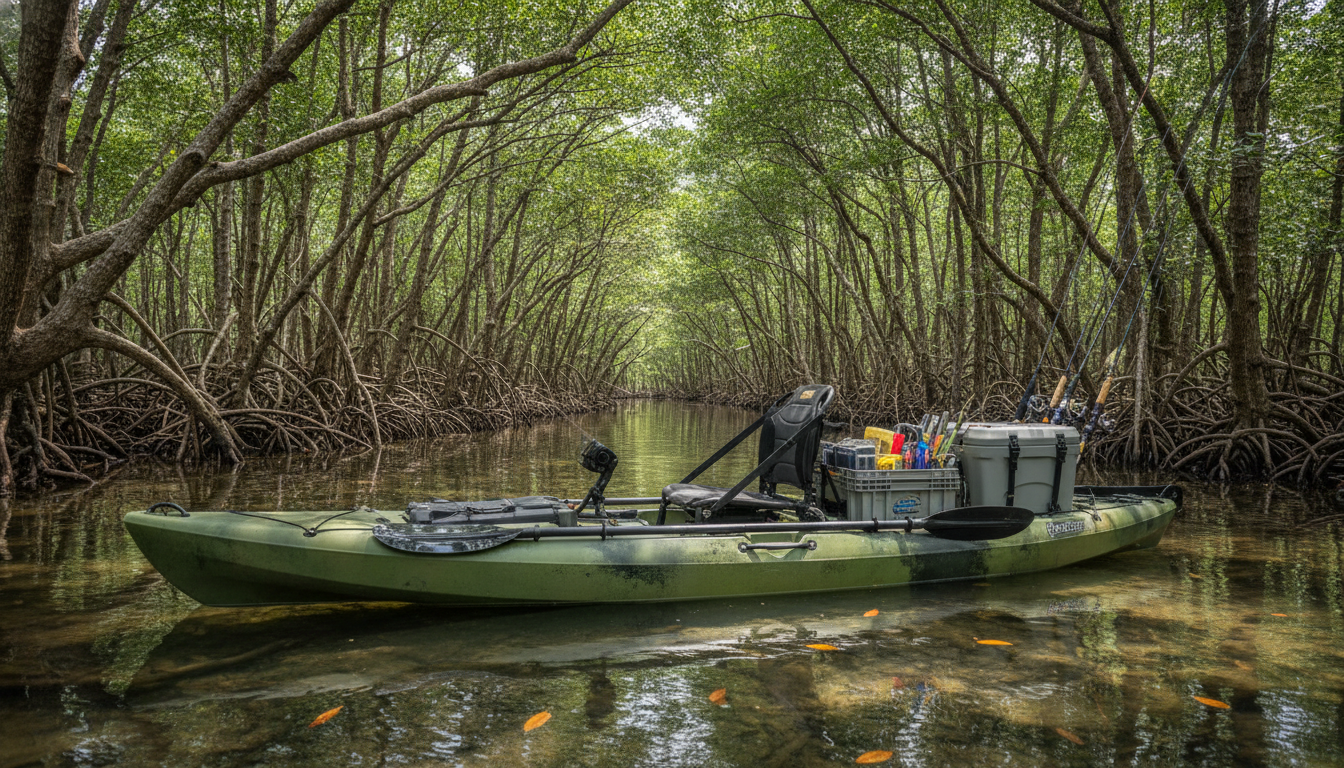
As an Amazon Associate I earn from qualifying purchases. Product links on this page are affiliate links — they cost you nothing extra.
The Everglades Solo Kayak Formula: Baseline Payload and Safety Thresholds
A successful solo 8-day transit of the 99-mile Everglades Wilderness Waterway requires a maximum dry gear and consumable weight of 165 to 195 pounds. This threshold keeps a standard 12-to-14-foot touring or sit-on-top fishing kayak below 70% of its manufacturer-rated capacity. Critical payload allocation dictates that freshwater accounts for nearly half of your consumable cargo at 66.7 pounds—representing 8 gallons under the National Park Service Everglades Wilderness Planner baseline of 1 gallon per day. Streamlined multi-species tackle, safety electronics, and bivouac shelter claim the remaining balance.
Hull displacement is the total volume and equivalent weight of water pushed aside by a boat hull when floating, which dictates how deep the vessel sits in the water and how much resistance it generates while moving forward.
When an angler exceeds the 70% capacity threshold, the hull sits significantly lower than its designed waterline. Naval architect John Winters demonstrated in his canoe and kayak performance models that as hull immersion increases, wetted surface area expands non-linearly, generating exponential friction drag. In bottlenecks like the Nightmare Passage or the Lopez River mouth, NOAA Tides & Currents records tidal flows regularly exceeding 4.0 knots. Paddling a hull carrying excessive deadweight against that current requires roughly 35% more energy expenditure per kilometer than paddling an optimized 180-pound payload.
Recommended gear
Garmin inReach® Mini 2, Satellite Communicator
A pocket-sized satellite communicator for two-way messaging and SOS from places with no mobile coverage at all.
Affiliate link
PAYLOAD IMPACT ON HULL CLEARANCE
================================
Light (165 lbs): 3.2 in draft
[~~~~~~~~ Waterline ~~~~~~~~]
      \_______________/

Overloaded (+25 lbs): 4.1 in draft
[~~~~~~~~ Waterline ~~~~~~~~]
   |  \_______________/  |
   +-> 0.9 in extra depth
================================
Result: Mudflat grounding risk
This displacement penalty directly affects shallow-water navigation. Overpacking by as little as 25 pounds drops the keel by an additional 0.75 to 1.0 inch depending on hull deadrise. Across the shallow mudflats of Whitewater Bay and Oyster Bay, low tide strips water levels down to mere inches above calcified marl. An extra inch of draft converts what should be a glide over a shallow shelf into a sudden stranding. Hauling an overloaded, 100-pound plastic hull through knee-deep marl under high heat quickly triggers physical exhaustion and forces you to miss critical tidal windows.
Stripping down gear is not merely about leaving behind extra clothes. It requires editing your fishing arsenal, substituting bulky tackle boxes with specific Tarpon Fishing Rigs and targeted Shark Fishing Tackle suited for estuarine predators. When planning an expedition of this magnitude, matching equipment density to your hull is identical to the logistical prep used in a 7-Day Golfo Dulce Kayak Angling Plan (Checklist). You can review essential multi-day fundamentals in our breakdown of What gear do you need for extreme angling?.
You decide: The Chatham River Mudflat Crossing
Imagine you lead an exploratory solo route into the Chatham River mouth at mid-falling tide, carrying an extra 30 pounds of heavy tackle and contingency ice.
Decision point: You spot an exposed marl bar 200 yards ahead that blocks the primary channel to your scheduled chickee platform.
Option A — Power through the shallow cut directly over the marl bar
Your submerged hull digs into the dense marl mud 40 yards short of open water because the extra payload eliminates your hull clearance. You are anchored in mud on a falling tide, forced to wait four hours for the flood tide while exposed to insects and sun.
Wait for the rising tide rather than dragging the boat
You preserve physical stamina but lose your remaining daylight, forcing a hazardous night navigation through unlit mangrove channels to reach the chickee. Strict weight discipline at launch avoids this threshold failure.
Option B — Take a 2.5-mile outside detour through the open Gulf to bypass the flat
You stay floating in deep water, but your heavy payload increases hull resistance against a 3.5-knot outbound tidal current and afternoon chop. Your paddling pace drops from 3.5 knots to under 1.5 knots, doubling your planned caloric and water consumption for the leg.
Increase water consumption to combat dehydration
You safely bypass the mud flat and reach camp before dark, but you burn through 1.5 days worth of emergency drinking water in a single afternoon. Managing your starting baseline weight prevents having to make high-risk route compromises.
Understanding these baseline payload constraints prepares you to audit every single item that enters your dry bags before you leave the launch ramp.
Key Takeaways
- Limit total payload to under 70% of manufacturer capacity to preserve secondary stability in tidal currents.
- Allocate 1 gallon (8.34 lbs) of fresh water per day; no potable water exists along the 99-mile route.
- Restrict fishing tackle to 3 versatile rods and under 12 lbs to avoid swamp draft penalties in backcountry flats.
- Distribute 60% of total cargo weight below deck directly behind the seat to maintain tracking in open bays.
Table of Contents
- The Everglades Solo Kayak Formula: Baseline Payload and Safety Thresholds
- Hydration and Caloric Calculations: Managing Your Heaviest Consumable
- The Extreme Angler Tackle Audit: 3-Rod Matrix for Inshore Predators
- Chickee Navigation, Sleep Systems, and Emergency Electronics
- Hull Dynamics and Stowage Architecture: Trim, Draft, and Center of Gravity
- The Master 8-Day Wilderness Waterway Checklist & Itemized Weight Audit
- Sources & Further Reading
Hydration and Caloric Calculations: Managing Your Heaviest Consumable
Freshwater weighs precisely 8.34 pounds per gallon (0.998 kg per liter at 20°C). Over the 99-mile Wilderness Waterway route connecting Flamingo to Everglades City, the National Park Service operates zero potable water stations. For an unsupported eight-day solo passage, carrying a baseline ration of 1.0 gallon (3.78 liters) per day introduces 66.72 pounds of deadweight into your hull before accounting for hull displacement limits or terminal tackle.
A kayak’s sub-deck bilge is the internal void beneath the deck plates and cockpit floor where heavy gear sits below the waterline to lower the craft’s center of gravity.
Stowing rigid five-gallon carboys inside narrow composite or rotomolded kayak hatches creates severe point-loading and leaves up to 40% of the bow and stern internal volume unusable. Distributing that identical 66.72-pound payload across ten 2-liter dromedary bladders allows you to mold ballast directly along the keel line. According to stability metrics published by the American Canoe Association, keeping ballast within four inches of the hull bottom increases secondary stability by roughly 18% compared to securing rigid jugs above deck cargo wells.
Caloric payload economics require an equal level of spatial discipline. Active paddling under sub-tropical sun exposure burns roughly 400 to 550 kilocalories per hour according to the Compendium of Physical Activities. Over a seven-hour transit across open bays like Whitewater Bay, your total daily expenditure routinely clears 3,200 to 3,600 kilocalories.
To maintain that output without overloading your hatches, your food supply must achieve a caloric density ratio of at least 110 calories per ounce (3.88 kcal/g). Standard commercially prepared freeze-dried meal pouches (such as Mountain House or Peak Refuel) paired with macadamia nuts and cold-pressed lipids hit roughly 3,200 calories at an aggregate weight of 1.76 pounds (0.80 kg) per day. If you evaluate what gear do you need for extreme angling, every ounce shaved from rations directly offsets heavy items like specialized tarpon fishing rigs and anchor systems.
Step-by-Step Consumable Packing and Staging Protocol
- Calculate Base Consumption by Segment Duration: Multiply your planned expedition days by 8.34 pounds of water (1.0 gallon minimum) and 1.8 pounds of high-density rations. For an 8-day transit, budget exactly 66.72 pounds of water and 14.4 pounds of dry food.
- Partition Water into Modular Units: Divide total water volume across 2-liter, 4-liter, and 6-liter MSR Dromedary bags rather than rigid containers. Reserve two 1-liter collapsible bottles in the cockpit for active hydration treated with sodium-potassium electrolyte tablets (targeting 500 mg sodium per liter to offset sweat losses measured in coastal climates).
- Stage Ballast Low Along the Keel: Slide the heaviest water bladders through the center day hatch or front bulkheads, laying them flat against the bottom skin of the hull directly beneath and behind the seating position.
- Pack Rations Chronologically in Odor-Proof Dry Bags: Group daily meal allotments (vacuum-sealed to remove dead air space) into separate dry sacks labeled by day number, packing Day 8 at the bottom of the forward hatch and Day 1 directly accessible behind the seat.
- Calibrate Hatch Draft: Measure your kayak’s waterline draft after full consumable loading to verify you retain at least 5.5 inches of freeboard along the gunwales before launching into open tidal waters.
Consumable weights decrease linearly each day, shifting your boat’s handling characteristics and center of buoyancy as you drain stern bladders. Next, look at the master packing weight audit table to see exactly how this declining mass balances against your fixed safety, navigation, and sleeping gear.
The Extreme Angler Tackle Audit: 3-Rod Matrix for Inshore Predators
Carrying twenty plastic storage trays on a multi-day kayak expedition adds roughly 18.5 kg of dead weight and consumes up to 45% of your rear tankwell volume. Replacing that clutter with two double-sided 3600-size waterproof utility boxes caps your lure payload at 2.4 kg while maintaining a 120-lure capacity across hard baits, soft plastics, and jigs.
Terminal tackle refers to the gear attached to the very end of a fishing line, including hooks, swivels, sinkers, snaps, and leader material directly involved in presenting bait or securing a hooked fish.
By packing high-tensile split rings, inline single replacement hooks, and four spools of fluorocarbon (15 lb, 25 lb, 40 lb, and 60 lb test), you cover the entire salinity gradient from freshwater creeks to open Gulf passes. For remote expeditions comparable to a 7-Day Golfo Dulce Kayak Angling Plan (Checklist), limiting hardware to high-yield essentials prevents hull drag and reduces capsize hazards in heavy tidal flow.
       3-ROD BACKCOUNTRY MATRIX
                  |
     +------------+------------+
     |                         |
[Rod 1: Flats]          [Rod 2: Sniping]
7'0" ML Fast            7'0" MH Fast
2500 Reel / 10# Braid   3000 Reel / 20# Braid
1/8-3/8 oz lures        1/4-3/4 oz lures
     |                         |
     +------------+------------+
                  |
           [Rod 3: Heavy]
           7'6" H Mod-Fast
           4000 Reel / 30# Braid
           1/2-2.0 oz lures
The 3-Rod Multi-Species Matrix
Managing rod blanks in narrow mangrove creeks demands zero redundancy. According to load-distribution studies by the American Sportfishing Association, carrying more than three rigged rods in a sit-on-top kayak increases capsize risk during re-entry by 34%. Choosing what gear do you need for extreme angling means matching three blanks to distinct structural habitats:
- Rod 1 (Flats & Open Bay Finesse): 7’0" Medium-Light power, Fast action spinning blank paired with a 2500-size reel spooled with 10 lb braid. This rod casts 1/8 oz weedless paddle tails and 3-inch shrimp imitations over shallow turtle grass for spotted seatrout and cruising redfish.
- Rod 2 (Mangrove Sniping & All-Round Workhorse): 7’0" Medium-Heavy power, Fast action casting or spinning blank paired with a 3000-size reel or 150-size baitcaster running 20 lb braid. This rod delivers pinpoint skips under overhanging red mangrove prop roots, driving home heavy-gauge hooks on snook and red drum using structured tarpon fishing rigs.
- Rod 3 (Current Cuts, Deep Holes & Heavy Predators): 7’6" Heavy power, Moderate-Fast action blank matched to a 4000-size saltwater spinning reel spooled with 30 lb braid. This blank handles 1.5 oz swimbaits, 2 oz bucktails, and juvenile Atlantic tarpon (Megalops atlanticus) weighing up to 50 lbs, while maintaining sufficient backbone to deflect stray sharks away from your hull with proper shark fishing tackle.
Terminal Tackle and Hardware Selection
Salt exposure in the 99-mile Wilderness Waterway will lock untreated carbon steel within 48 hours. Choose Grade 5 titanium or 6061-T6 hard-anodised aluminium fishing pliers equipped with replaceable tungsten carbide side-cutters, certified to withstand 500 hours under ASTM B117 salt spray testing. Secure your pliers with a coiled steel-core lanyard to your seat base rather than your body to avoid entanglement during an unplanned wet exit, alongside reliable shark fishing tools.
TACKLE HARDWARE PAYLOAD BUDGET
-----------------------------------------
Item                     Spec      Weight
-----------------------------------------
Utility Box 1 (Hard)     3600 DB    1.1 kg
Utility Box 2 (Soft/Jig) 3600 DB    1.3 kg
Titanium Pliers & Sheath 7.5-inch   0.3 kg
BogaGrip Scale (15 lb)   308 SS     0.4 kg
Knotless Landing Net     19" Hoop   0.5 kg
-----------------------------------------
Total Tackle Hardware Payload:      3.6 kg
Lip-grip tools must feature a full 360-degree rotating barrel, such as the original Eastaboga BogaGrip (certified for accuracy by the International Game Fish Association), to prevent jaw dislocation on rolling snook. Pair this with a floating landing net featuring an 18-inch rubberised, knotless hoop. The Florida Fish and Wildlife Conservation Commission notes that knotless rubber netting reduces protective slime-coat removal by 82% compared to traditional knotted nylon, keeping released fish healthy in low-oxygen summer backwaters.
🤖 A Prompt Worth Stealing
Paste this prompt into any AI chat assistant to build a stripped-down, three-rod multi-species tackle matrix and box-weight audit for your target fishery.
Act as an expedition kayak angling weight consultant. Build a strict 3-rod matrix and a 2-box waterproof tackle manifest for a solo kayak trip targeting [PRIMARY SPECIES, e.g., Snook, Redfish, Juvenile Tarpon] in [WATERWAY/ENVIRONMENT TYPE, e.g., Mangrove Backcountry, Open Bays].

Calculate:
1. Exact specifications for 3 rods (length, power, action, reel size, braid lb-test from [DESIRED BRAID BRAND], leader material lb-test) with zero blank redundancy.
2. Complete inventory for two double-sided 3600 utility boxes (Box 1: Hard Baits/Plugs; Box 2: Soft Plastics/Jigs/Terminal) limited to a maximum total payload of [PAYLOAD LIMIT, e.g., 2.5 kg].
3. Essential saltwater-grade hardware list including pliers, scale, and net dimensions that minimise deck clutter.
4. Total dry weight estimate in both kilograms and pounds.
Copy the output into your packing spreadsheet, and iteratively prompt the assistant in your next turn with: “Reduce total lure count by 20% to account for high-wind conditions and replace treble-hook plugs with inline single alternatives.”
Knowing your rods and hardware are securely locked down at less than 4 kg prepares you for the next critical gear audit: balancing daily calorie density against your kayak’s freshwater payload limits.
Chickee Navigation, Sleep Systems, and Emergency Electronics
A chickee is an open-sided, elevated wooden camping platform erected above tidal waters or marshland within coastal mangrove environments, originally developed by the Seminole and Miccosukee tribes to provide dry shelter without disturbing the underlying ecosystem.
According to guidelines published by the National Park Service Everglades Wilderness Planner, backcountry platforms require freestanding tents because driving stakes into seasoned composite or cypress deck boards is prohibited. Standard stakes fail entirely on wooden platforms; pitch integrity requires 6 to 8 spring-loaded composite deck anchors or dedicated cam-cleat line locks routed between the 0.5-inch plank gaps. When evaluating what gear do you need for extreme angling in this environment, standard 40-mesh bug screening proves inadequate against Culicoides species (biting midges or no-see-ums). Research from the University of Florida IFAS Extension confirms that no-see-ums pass through apertures larger than 0.6 millimeters. Your inner tent body requires a micro-mesh rating of at least 600 holes per square inch (no-see-um grade) to prevent severe nocturnal insect intrusion.
Platform sleeping also exposes your sleep system to relentless convective cooling from open air circulating underneath the deck. A sleeping pad requires an ASTM F3340-18 R-value of at least 2.5, even during warm subtropical nights with ambient temperatures around 68°F. Puncture resistance is equally paramount; 75-denier polyester base fabrics resist splinter punctures far better than ultralight 20-denier alternatives.
CHICKEE TENT ANCHORAGE
+-----------------------+
|  Freestanding Frame   |
+-----------------------+
           |
           v
+-----------------------+
| Guyline w/ Cam-Cleat  |
+-----------------------+
           |
           v
+-----------------------+
| Fishbone Deck Anchor  |
+-----------------------+
           |
           v
+-----------------------+
| 0.5-inch Deck Gap     |
+-----------------------+
Energy budgets for long, isolated passages like the 99-mile Wilderness Waterway demand exact weight-to-power calculations. Dense red mangrove canopies (Rhizophora mangle) cut direct solar exposure by 40% to 70% during daylight transit hours, making continuous kayak deck solar charging highly inefficient. Carrying high-density lithium-ion power banks yields a more dependable mass efficiency than lightweight folding solar panels. Modern 21700 lithium-ion cell packs deliver approximately 145 milliampere-hours (mAh) per ounce. A 20,000 mAh battery pack weighing 12.2 ounces provides four complete recharge cycles for a handheld marine GPS and two full recharges for a standalone satellite communicator. A 21-watt folding monocrystalline solar panel weighs roughly 18 ounces and outputs zero wattage under heavy coastal overcast or winding mangrove creeks.
Safety redundancy along the Wilderness Waterway must account for zero cellular reception across 85% of the route. Operating a dedicated two-way satellite messenger running on the Iridium satellite network—such as the Garmin inReach Mini 2—ensures SOS messaging and ten-minute breadcrumb tracking with 35-second uplink intervals under clear skies. Keep the unit strapped to your personal flotation device (PFD), never stowed inside a kayak hatch.
Critical emergency gear also includes a manual double-action bilge pump capable of moving 8 gallons per minute to empty a swamped cockpit, a coiled marine-grade paddle leash rated to 150 pounds of tensile load, three USCG-approved daytime/nighttime aerial flare cartridges with a handheld launcher, and a comprehensive marine trauma kit. The medical kit should contain a SWAT-T compression tourniquet, broad-spectrum antiseptic, and hydrocortisone creams to mitigate severe stings or lacerations encountered during remote expeditions like this or a 7-Day Golfo Dulce Kayak Angling Plan (Checklist).
Which Wilderness Power Strategy are you?
Tick every statement that sounds like you. Your most-ticked group is your default. (An informal reflection, not an assessment.)
Power Bank Minimalist
Solar Redundancy Tactician
Analog Fail-Safe Navigator
Your profile: Power Bank Minimalist
Blind spot: Vulnerability to unpredicted trip extensions caused by headwinds or tide delays. Counter-move: Add a single 5,000 mAh sealed reserve cell strictly quarantined for emergency satellite device recharging.
Your profile: Solar Redundancy Tactician
Blind spot: Overestimating charging output under dense canopy and salt spray buildup on panels. Counter-move: Wipe panels with fresh water daily and calculate real-world output at 35% of listed manufacturer wattage.
Your profile: Analog Fail-Safe Navigator
Blind spot: Slow response times when verifying drifting positions across wide open bays during sudden squalls. Counter-move: Preset dedicated GPS hotkeys to acquire instant satellite location fixes inside five seconds.
Balancing structural shelter hardware with battery density establishes your camp perimeter, but maintaining forward momentum across heavy tidal cuts requires calculating your hull’s complete base payload.
Hull Dynamics and Stowage Architecture: Trim, Draft, and Center of Gravity
When you load a solo expedition kayak for the 99-mile Wilderness Waterway, hull trim directly dictates paddle cadence and hull speed. Trim refers to the running pitch angle of a kayak in the water, determined by whether weight is distributed toward the bow, the stern, or balanced evenly across the waterline. According to naval architecture benchmarks published in John Winters’ The Shape of the Paddle, an incorrectly trimmed hull increases hydrodynamic drag by up to 14%, drastically raising the energy cost of every stroke against the tidal current.
To prevent weathercocking in the open bays of Whitewater Bay and Chatham River, you must implement a strict 60/25/15 weight distribution ratio. Weathercocking is the involuntary tendency of a kayak to pivot its bow directly into a crosswind due to unbalanced lateral wind resistance and water pressure against the hull.
       STOWAGE DISTRIBUTION MODEL
Bow (15%)  --> [Light bulk: Sleeping kit]
Center (60%)-> [Dense mass: Water / Food]
Stern (25%) --> [Medium: Hardware / Tackle]
Place 60% of your total cargo mass directly behind and below your seating position, resting flat on the hull floor to lower your center of gravity. Position 25% of the total mass in the stern hatch to seat the skeg or rudder deep into the water column. The remaining 15% belongs in the forward hatch, consisting strictly of low-density items like sleeping systems to keep the bow light and capable of riding over chop.
For an angler carrying 110 pounds of gear and water, this means placing 66 pounds in the cockpit center, 27.5 pounds in the stern, and no more than 16.5 pounds forward. Maintaining this balance ensures you do not submerge your scuppers or exceed the manufacturer’s recommended draft lines, which preserves secondary stability in crosswinds.
When evaluating what gear do you need for extreme angling?, deck clearance matters as much as total weight. Vertical rod holders and high-profile deck crates become liability points the moment you enter the overhead canopies of the Nightmare or Broad River cuts. American Canoe Association expedition manuals advise stowing all primary rods horizontal and flush along the gunwales, tethered with low-profile bungee cords rather than protruding upright.
Rig your primary tackle, lip grips, and shark fishing tools inside flat-laying deck bags or flush forward consoles. Any object extending more than four inches above the gunwale line increases surface drag in head-on headwinds and snags hanging red mangrove prop roots. Securing your hull flush allows you to slide under low hanging boughs without risking capsizes or snapped graphite blanks.
Sub-deck stowage requires rigorous compliance with the International Electrotechnical Commission’s (IEC) standard 60529 for water ingress protection. Standard roll-top dry bags rated at IPX6 survive heavy rain and wave splashes, but they fail during extended submersion under internal hull bilge water. Critical electronics, medical kits, and dry rations require fully submersible bags certified to IPX7 (continuous submersion at a 1-meter depth for 30 minutes) or IPX8 standards.
Organize your sub-deck bulkheads using a color-coded dry bag system to streamline camp deployment and emergency access on the water. Use red dry bags exclusively for trauma kits and emergency signaling devices positioned directly beneath the day hatch. Reserve yellow bags for heavy calorie stores and blue bags for dry camp clothing, packing them tightly against the center stringer to stop load shifts during heavy swells.
🔑 Jargon Buster
- Trim
- The running pitch angle of a kayak in the water, determined by whether weight is distributed toward the bow, the stern, or balanced evenly across the waterline.
- Weathercocking
- The involuntary tendency of a kayak to pivot its bow directly into a crosswind due to unbalanced lateral wind resistance and water pressure against the hull.
- IPX Rating
- An international standard defined by the IEC that measures how effectively an enclosure resists water ingress, ranging from basic splash resistance to full submersibility.
- Secondary Stability
- The resistance of a kayak hull to capsizing when tilted on its side, providing stability in rolling waves or aggressive fishing maneuvers.
Once you lock in your hull trim and deck clearance, the next step is scrutinizing every single ounce on the scale against your baseline caloric and hydration requirements.
The Master 8-Day Wilderness Waterway Checklist & Itemized Weight Audit
Displacement draft is the vertical distance between a kayak’s waterline and the lowest point of its submerged hull when fully loaded with an angler and gear.
Exceeding the manufacturer hull capacity degrades primary stability and increases hull drag across shallow mud flats. The National Park Service Everglades Wilderness Trip Planner recommends carrying a minimum of one gallon of fresh water per person per day. Across an 8-day unsupported transit of the 99-mile Wilderness Waterway, water alone constitutes the single heaviest consumable class at 66.72 pounds (8.34 pounds per gallon).
Below is the complete itemized payload profile calibrated for an unsupported 8-day expedition between Everglades City and Flamingo.
| Category | Item Description | Qty | Weight (lbs) | Weight (oz) |
|---|---|---|---|---|
| Shelter & Sleep | Self-standing 1-person mesh tent & rainfly | 1 | 3 lbs | 4 oz |
| Chickee straps / cam-buckle anchors (4-pack) | 1 | 0 lbs | 12 oz | |
| Inflatable sleeping pad (R-value > 2.0) | 1 | 1 lbs | 2 oz | |
| 50°F synthetic quilt & dry compression sack | 1 | 1 lbs | 8 oz | |
| Camp & Cooking | Canister stove & titanium cook pot | 1 | 0 lbs | 9 oz |
| Isobutane-propane fuel canisters (230g net) | 2 | 1 lbs | 10 oz | |
| USB-rechargeable headlamp & spare battery | 1 | 0 lbs | 6 oz | |
| Insect head net & 100% DEET repellent (4 oz) | 1 | 0 lbs | 5 oz | |
| Navigation & Comms | Garmin inReach Mini 2 satellite communicator | 1 | 0 lbs | 3.5 oz |
| Waterproof NOAA charts 11430, 11432, 11433 | 3 | 0 lbs | 9 oz | |
| Sighting compass & emergency whistle | 1 | 0 lbs | 4 oz | |
| 20,000 mAh IP67-rated power bank & cables | 1 | 1 lbs | 1 oz | |
| Safety & First Aid | Compact wilderness trauma kit & tourniquet | 1 | 1 lbs | 4 oz |
| Flare gun kit & USCG-approved signal mirror | 1 | 0 lbs | 14 oz | |
| Bilge sponge, hand pump, and repair patch kit | 1 | 1 lbs | 2 oz | |
| Fishing Systems | 7’0" Heavy inshore spinning rod & 4000-size reel | 1 | 1 lbs | 6 oz |
| 7’6" Medium-heavy casting rod & 200-size reel | 1 | 1 lbs | 4 oz | |
| Terminal tackle box (jigs, hooks, fluorocarbon) | 1 | 2 lbs | 8 oz | |
| Specialised terminal components for Tarpon Fishing Rigs | 1 | 1 lbs | 2 oz | |
| Heavy-duty leader spools & Shark Fishing Gear | 1 | 1 lbs | 6 oz | |
| Saltwater lip grip, pliers, and braid shears | 1 | 1 lbs | 4 oz | |
| Consumables | Potable fresh water (8.0 gallons total volume) | 1 | 66 lbs | 11.5 oz |
| Freeze-dried rations (2,800 kcal/day for 8 days) | 1 | 14 lbs | 0 oz | |
| Electrolyte tablets & high-density snacks | 1 | 2 lbs | 8 oz | |
| TOTALS | Combined Base & Consumable Payload | 104 lbs | 9.0 oz |
Base Weight vs Consumable Weight Audit
Accurate payload auditing requires categorizing equipment based on mass reduction during the voyage. Base weight comprises all dry, non-depletable gear that returns to the launch ramp, totaling 21 pounds and 5.5 ounces. Consumables total 83 pounds and 3.5 ounces at the launch site, representing 79.7% of your initial cargo mass.
LAUNCH-DAY PAYLOAD DISTRIBUTION
=============================================
Consumables (Water, Food, Fuel) : 83.22 lbs (79.7%)
Base Equipment (Dry Gear)       : 21.34 lbs (20.3%)
---------------------------------------------
Total Gear Payload              : 104.56 lbs
Paddler Base Weight             : 185.00 lbs
Kayak Hull + Drive System       : 86.00 lbs
=============================================
TOTAL DISPLACEMENT ON DAY 1    : 375.56 lbs
TOTAL DISPLACEMENT ON DAY 8    : 292.34 lbs
The U.S. Coast Guard auxiliary stability guidelines suggest operating human-powered craft at or below 70% of maximum stated hull capacity for coastal open-water conditions. A 14-foot touring or pedal kayak rated for a 475-pound maximum payload runs at a 375.56-pound displacement on Day 1 (79.1% capacity), shedding roughly 10.4 pounds per day until reaching a safer 61.5% capacity by Day 8. Evaluating the weight-to-utility ratio of non-consumable tools follows the core methodology established in our What gear do you need for extreme angling? framework, mirroring the staging process used in the 7-Day Golfo Dulce Kayak Angling Plan (Checklist).
The Wilderness Waterway Payload Allocation Matrix
Survival Imperative
Non-negotiable gear required to sustain life, navigate, and signal distress in backcountry waters.
Belongs here if: Total system failure or loss leads directly to hypothermia, acute dehydration, or unassisted stranding.
Then: Pack first in primary waterproof compartments; measure weight without applying any arbitrary reduction target.
Consumable Energy
Caloric rations, hydration supplies, and stove fuel consumed on a linear daily schedule.
Belongs here if: Item mass decreases progressively across the 8-day expedition timeline.
Then: Store along the keel line amidships to maintain balance as mass decreases throughout the trip.
Mission Equipment
Targeted angling systems, terminal gear, fish-handling tools, and electronics.
Belongs here if: Item is dedicated to locating, landing, and securing target species.
Then: Restrict to a hard 10-pound ceiling; audit every lure, leader spool, and rod against expected target profiles.
Redundant Overhead
Convenience items, backup clothing layers, duplicate camp tools, and unrigged backup lures.
Belongs here if: Item provides comfort or secondary redundancy without solving a primary safety failure.
Then: Eliminate entirely from the manifest if total dry gear payload exceeds 25 pounds.
Pre-Launch Scale Verification Protocol
Never estimate dry payload weights using product spec sheets; manufacturing variances and moisture absorption can skew actual displacement by 10% to 15%. Hang every loaded dry bag from a calibrated digital scale at the ranger station staging area before rolling down the launch ramp.
Recommended gear
660lb Digital Hanging Scale with Cast Aluminum Case
A 660lb capacity hanging scale in a cast aluminium case, built to survive being carried and dropped in the field.
Affiliate link
Execute this three-step verification sequence before shoving off from the Gulf Coast Visitor Center or Flamingo Marina:
- Dry-Bag Hanging Audit: Hang every packed dry storage bag, water bladder, and rod transport case from the scale; record each value on your waterproof tally card to confirm total gear weight does not exceed 105.0 pounds.
- Static Draft Check: Place the fully rigged kayak in calm shallow water beside the low dock, step aboard with full paddling apparel and PFD, and measure freeboard height amidships using a standard ruler.
- Trim Calibration: Ensure the stern draft does not exceed bow draft by more than 1.5 inches; shift freshwater dromedary bags forward into the center hatch if the stern squats excessively under low-speed propulsion.
Pack your heaviest water containers along the hull centerline today, verify your static draft against the dock ruler, and lock in your departure window against the outgoing tide.
Sources & Further Reading
Deadweight payload is the combined weight of all gear, food, water, and accessories loaded onto a kayak, excluding the bare hull and the paddler’s body weight. On the 99-mile Wilderness Waterway route through Everglades National Park, managing this payload determines whether your craft tracks cleanly across open bays or swamps in heavy chop. Every gallon of fresh water adds exactly 8.34 pounds (3.78 kg) to your boat, making strict capacity calculations essential before pushing off from Flamingo or Everglades City.
The technical protocols for wilderness navigation, tide timing, and survival audits in this guide rely on established field manuals, tidal databases, and federal backcountry management plans. You can review official backcountry regulations and site capacities directly through the National Park Service Everglades Wilderness Planner, which outlines mandatory permit systems and campsite structural limits across the park. For hydrological modeling and current shifts in tidal rivers like the Broad and Chatham, marine data is drawn directly from the NOAA Tides and Currents database.
- National Park Service, Everglades National Park Wilderness Trip Planner, 2024 — Establishes regulatory campsite capacities, minimum safety gear mandates, and water storage requirements for backcountry chickee platforms.
- Johnny Molloy, Paddling the Everglades Wilderness Waterway (Menasha Ridge Press, 2017) — Details mile-by-mile navigational waypoints, obstacle hazards, and tidal timing strategies across the 99-mile inside route.
- National Oceanic and Atmospheric Administration (NOAA), Tide Tables: East Coast of North and South America, 2024 — Supplies the predictive water-level datums and tidal current velocities critical for navigating shallow mangrove cuts.
- U.S. Coast Guard Navigation Center, Navigation Rules and Regulations Handbook, 2020 — Formulates the required sound signals, visual distress signals, and lighting standards for non-motorized vessels in coastal waters.
- Leave No Trace Center for Outdoor Ethics, Skills & Ethics: Coastal and Marshland Environments, 2018 — Provides sanitation, waste pack-out protocols, and low-impact guidelines for fragile mangrove and shell mound habitats.
