Hammerhead Shark Revival: 5-Step Boat Protocol
⏱ 12 min read
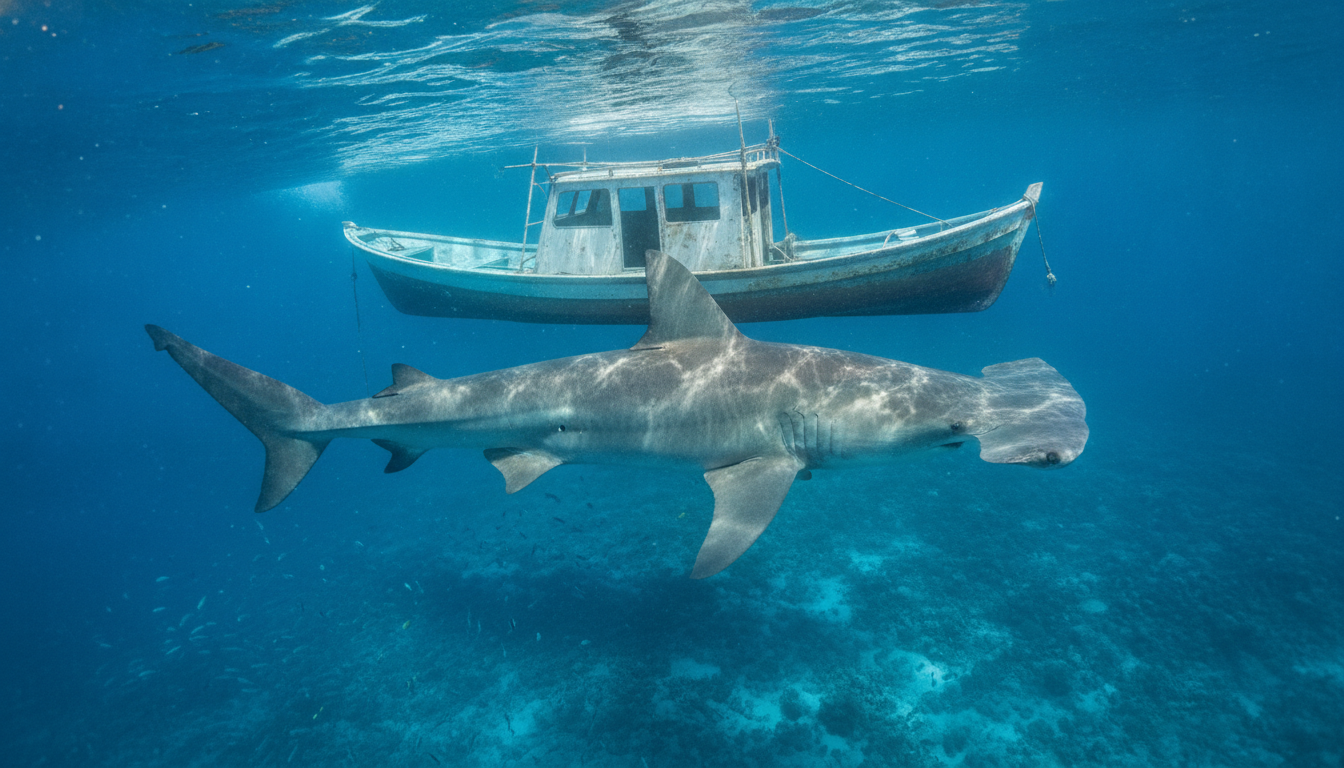
Reviving a fight-exhausted great hammerhead requires keeping the animal submerged, idling the boat forward at 1.0 to 2.0 knots to force oxygenated seawater across its branchial arches, and cutting all terminal tackle within 120 seconds. This active ram-ventilation protocol directly flushes lethal blood lactate accumulations, reversing acute metabolic acidosis before irreversible cardiac arrest sets in. Letting an exhausted hammerhead drift stationary alongside the hull guarantees post-release mortality because this species cannot pump water over its gills while stopped.
That physical mandate creates an immediate operational challenge at the gunwale: how does an offshore crew safely tow an unhooked, 300-pound apex predator in gear while avoiding hull strikes, green water, and tail whips?
Key Takeaways
- Zero Stationary Soaks: Great hammerheads are obligate ram ventilators; an unmoving shark at the gunwale is suffocating.
- Mandatory 1 to 2 Knot Headway: Maintain forward engine idle during the entire dehooking and revival sequence.
- 30-Minute Battle Ceiling: Fight durations exceeding 30 minutes push blood lactate past 30.0 mmol/L and drop blood pH below 7.1.
- In-Water Regulation: Removing an adult hammerhead from the water causes internal organ crushing and cephalofoil damage.
Table of Contents
- The Physiology of Capture Stress: Why Hammerheads Crash
- Mandatory Pre-Revival Protocols: Boat-Side Control and Safety
- Physiological Triage: Assessing Neurological and Muscle Recovery
- The 5-Step Boat-Side Hammerhead Lactic Acid Recovery Checklist
- Gear Staging Manifest for Boat-Side Shark Handling
- Sources & Further Reading
The Physiology of Capture Stress: Why Hammerheads Crash
Great hammerheads (Sphyrna mokarran) fight to absolute biochemical exhaustion faster than any other large pelagic shark. When hooked on recreational or commercial gear, their initial burst runs depend almost entirely on fast-twitch white muscle tissue powered by anaerobic glycolysis. This anaerobic burn produces extreme quantities of hydrogen ions and lactic acid in the blood.
In a study published in the journal Functional Ecology, lead researcher Dr. Austin Gallagher demonstrated that great hammerheads exhibit the most severe physiological disturbance among studied pelagic elasmobranchs. Blood lactate levels surge from a resting baseline of roughly 1.0 mmol/L to more than 30.0 mmol/L during prolonged rod-and-reel captures. Concurrently, blood pH crashes from a balanced 7.8 down to acidic levels below 7.1 within 20 to 30 minutes of sustained line pressure.
Obligate ram ventilation requires the animal to swim forward constantly with an open mouth to direct water across the branchial membranes. Unlike benthic nurse sharks or sand tiger sharks, hammerheads lack the muscular branchial pumps needed for buccal pumping. A tired shark held alongside a stationary hull experiences zero water flow over its gills. Cellular hypoxia rapidly shuts down peripheral motor nerves, leading to branchial collapse, cardiac arrhythmia, and death.
Controlling fight times represents the first line of defense against metabolic collapse. Battles extending past 30 minutes push mortality risk past 50%. Anglers targeting heavy pelagics must run terminal rigs matching high drag curves, such as those detailed in our guide on 50-Wide vs 130 Marlin Drag Curves (Chart & Worksheet), to plane fish to the hull quickly. Anglers who run spinning gear must monitor spool friction under prolonged pressure using benchmarks from our Spinning Reel Drag Heat Chart: Run Times at 35lb+ Drag.
⚠️ Anti-Pattern: The Stationary Soak Trap
What it looks like: Leaving the boat drifting in neutral while crew members secure the leader, take prolonged photos, or pry stubbornly on an embedded circle hook at the waterline.
Why it’s tempting: It feels safer and easier to manage tackle on an unmoving vessel than keeping outboards turning in forward gear near floating lines.
What it costs: Without dynamic forward water flow, the shark cannot flush carbon dioxide or absorb oxygen, triggering terminal branchial collapse while the crew works on the hook.
Do instead: Put the boat in forward idle at 1.0 to 2.0 knots the second the leader is touched, pointing the shark’s snout directly into the forward slipstream.
Field studies by the National Oceanic and Atmospheric Administration (NOAA) Fisheries confirm that continuous forward towing during handling dramatically reduces post-release mortality across high-metabolism carcharhinid and sphyrnid sharks. When heavy pressure shortens the battle, the shark arrives boat-side with sufficient cellular reserves to survive resuscitation.
| Capture Variable | Safe Physiological Zone | Lethal Breakdown Threshold |
|---|---|---|
| Fight Duration | Under 25 minutes | Exceeding 40 minutes |
| Blood Lactate | 1.0 to 12.0 mmol/L | Above 30.0 mmol/L |
| Arterial Blood pH | 7.6 to 7.8 | Below 7.1 |
| Ram Flow Velocity | 1.5 to 2.5 knots | Stationary (0.0 knots) |
Mandatory Pre-Revival Protocols: Boat-Side Control and Safety
The wide head profile known as the cephalofoil serves as an expansive sensory hydrofoil, but its delicate cartilage structure is exceptionally vulnerable to blunt trauma and crushing force. Under no circumstances should an adult hammerhead be boated or dragged onto a swim platform. A 2014 study led by Dr. Austin Gallagher in Comparative Biochemistry and Physiology showed that out-of-water handling removes hydraulic buoyancy, causing internal hemorrhaging and liver trauma from the animal’s own body weight.
State and federal regulations reinforce these biological requirements. The Florida Fish and Wildlife Conservation Commission strictly prohibits removing protected shark species from the water during gear removal. Keeping the shark fully submerged alongside the gunwale remains the only compliant and survivable method.
Safe boat-side management on modern hulls requires defined crew positioning, an operational standard highlighted across our guide to Fishing Boats – A Guide. Crew assignments must be established before the leader breaks the water:
- The Leader Specialist: Takes short, controlled wraps with heavy release gloves, tracking the shark along the forward third of the vessel away from the propellers.
- The Tool Operator: Employs 24-inch bypass cable cutters or long-handled dehookers to eliminate terminal gear without crossing the center line of the jaws.
- The Tail Controller: Employs a soft, floating 5/8-inch polypropylene tail rope with an oversized eye to stabilize the caudal peduncle if lateral rolling threatens the hull.
When running heavy leader systems like those covered in our breakdown of 500lb Mono vs 400lb Cable: Goliath Rig (With Test Chart), cutting the terminal tackle takes absolute priority over recovering expensive hooks. If a circle hook cannot be removed with a standard twist within 30 seconds, snip the wire leader flush against the hook eye using hardened cutters.
Practical Scenario: Boat-Side Control Under Heavy Swell
Consider a 32-foot center console drifting in a 4-foot chop when a 300-pound great hammerhead reaches the leader after a 22-minute fight on 80-pound stand-up tackle.
The helmsman immediately kicks the port outboard into forward gear, idling at 1.5 knots into the seas. This creates a sheltered lee along the starboard gunwale where the leader handler works, preventing chop from slamming the animal against the hull plating.
The leader handler takes two wraps on the 400-pound monofilament wind-on leader, maintaining the shark’s snout 12 inches below the surface and pointing straight forward. As the boat maintains steerage, oxygenated green water forces open the shark’s mouth, generating steady branchial flushing.
The tool operator identifies an offset circle hook embedded deep in the tough cartilaginous jaw hinge. Instead of wrestling the fish with a release gaff or prying tool, the operator uses 24-inch compound wire cutters to crop the mono leader within one inch of the hook eye in under 4 seconds.
The leader drops, the tail controller verifies no loose line trails near the hull, and the helmsman holds a straight course to complete the active ram-ventilation protocol.
Physiological Triage: Assessing Neurological and Muscle Recovery
Determining whether a hammerhead can safely sustain independent swimming requires precise sensory and muscular checks before final release. Anglers frequently mistake tonic immobility or deep metabolic coma for cooperative calm. Releasing an uncoordinated shark results in negative buoyancy sinking, where the animal spirals to the seabed and suffocates.
A study led by Dr. Austin Gallagher in Conservation Physiology underscored that blood lactate accumulation directly degrades motor function and vertical equilibrium in pelagic sharks. While towing the animal at 1.5 to 2.0 knots, evaluate three core neurological indicators:
- Gill Contraction Cadence: Measure the gill flare rate across a 60-second window. A recovering hammerhead establishes a steady rate of 12 to 18 complete contractions per minute. Weak, spasmodic flutters below 6 contractions per minute indicate severe brainstem hypoxia requiring extended towing.
- Cephalofoil and Dorsal Alignment: The dorsal fin must maintain a 90-degree vertical orientation relative to the water surface. If the shark lists past a 30-degree roll angle, dynamic equilibrium is absent. Maintain forward towing until muscular tonus straightens the dorsal fin.
- Ocular Tracking Reflex: Test the pupillary rotation reflex. Wave a gloved hand or release tool across the shark’s eye. A neurologically responsive hammerhead rolls its eye downward or tracks the object; a fixed, unresponsive pupil indicates profound metabolic shock.
Handling large pelagic predators at the waterline demands the same physical discipline outlined in our Great White Shark Release Protocol (Checklist). Stand-up anglers applying high drag pressures should also ensure their harness systems are correctly tuned via our checklist for Rigging Stand-Up Harnesses for 50+ lbs Drag (Checklist) to prevent angler fatigue that prolongs landing times.
Quick Quiz: Test Your Boat-Side Shark Revival Knowledge
1. An exhausted great hammerhead is brought to the boat, completely upright but exhibiting only 4 weak gill contractions per minute. What is your immediate action?
A) Cut the leader immediately and let the shark swim away so it does not stress against the boat.
B) Idle the boat forward at 1.5 to 2.0 knots to force water over the gills until contractions reach 12-18 per minute.
C) Put the engines in neutral and hold the shark stationary by the dorsal fin until it kicks.
Reveal answer
Correct Answer: B. Hammerheads are obligate ram ventilators. Slower gill flare rates indicate profound hypoxia that requires continuous forward boat speed to push oxygenated water through the mouth and over the gills.
2. Why is cutting the terminal wire leader within 120 seconds preferable to spending 5 minutes working a dehooker on a deep-set circle hook?
A) Circle hooks dissolve in seawater within 24 hours.
B) Extended dehooking times allow blood lactate to keep climbing while the shark suffocates alongside a stationary or struggling boat.
C) Cutting the wire leader sharpens the hook point inside the fish.
Reveal answer
Correct Answer: B. Time is the primary biological constraint. Research from the University of Miami Shark Research & Conservation Program highlights that handling delay directly drives post-release mortality. If a hook cannot be popped instantly, cut the leader flush.
3. You notice the shark’s cephalofoil rolling 45 degrees to the left while being towed. What does this mean?
A) The shark has regained full equilibrium and is attempting to dive.
B) The shark lacks sufficient muscle tone and neurological control to maintain dynamic balance.
C) The shark has entered beneficial tonic immobility.
Reveal answer
Correct Answer: B. Rolling past 30 degrees indicates lost motor control from severe acidosis. Towing must continue until the shark rights its dorsal fin to a rigid, 90-degree vertical orientation. For more details on apex handling mechanics, see our Great White Shark Release Protocol (Checklist).
The 5-Step Boat-Side Hammerhead Lactic Acid Recovery Checklist
Executing this step-by-step checklist the moment the leader reaches the gunwale systematically reverses metabolic acidosis and restores arterial blood oxygenation.
Step 1: Submerged Boat-Side Alignment
Keep the shark completely submerged along the forward gunwale. Do not allow the cephalofoil or gill slits to lift clear of the water surface. The lead wireman grips the heavy leader with Kevlar-reinforced gloves, guiding the shark’s head forward into the vessel’s slipstream and away from engine intakes or outdrives.
Step 2: Controlled Forward Ram-Tow
Engage a single outboard in forward gear at engine idle, adjusting throttle to hold a steady speed of 1.0 to 2.0 knots through the water. This forward motion forces clean, turbulent water into the open mouth and across the five pairs of branchial slits. Tow straight into the current for a minimum of 3 to 5 minutes to clear dissolved carbon dioxide and re-oxygenate systemic muscle beds.
Step 3: Rapid Hardware Removal or Clearance
Clear all terminal hardware while the boat maintains forward idle. If a barbless or non-offset circle hook is positioned in the jaw hinge, use an ARC dehooker with a sharp push-pull stroke. If extraction encounters heavy resistance past 30 seconds, immediately bring in heavy-duty bypass cable cutters and snip the monofilament or wire leader within one inch of the hook eye.
Step 4: Neurological and Tonus Verification
Confirm the return of self-directed muscular power and central nervous response before releasing the animal. The tall first dorsal fin must stand stiff and true at 90 degrees to the waterline. Gill flare rates must demonstrate a stable rhythm between 12 and 18 contractions per minute, and the caudal peduncle should actively resist lateral rolling against the water column.
Step 5: Stride-Matched Hydrodynamic Release
Never shove the shark laterally away from the hull. Release the animal in sync with its own swimming propulsion. When the shark delivers a powerful, rhythmic lateral tail beat away from the boat, release the leader cleanly. Track the animal visually from the gunwale to verify a downward departure angle of 20 to 30 degrees toward open structure.
Which Boat-Side Scenario Matches Your Current Conditions?
The shark lists heavily on its side and fails to kick after 3 minutes of towing
Extend the forward idle tow at 1.5 knots for an additional 5 to 7 minutes without handling the shark. Ensure the mouth remains slightly open to allow clean water passage. Check for pupil tracking before making the release decision.
Large predators or barracuda begin circling the boat during revival
Do not release a weakened shark in the presence of aggressive scavengers. Steer the vessel away from the structure at 2.5 knots to pull the hammerhead into clean open water before executing the final tail release.
A long battle on spinning gear has overheated the drag and left the fish lifeless
Cut terminal lines immediately to eliminate resistance, engage forward headway, and tow the shark for up to 10 minutes. Review our Spinning Reel Drag Heat Chart and Stand-Up Harness Rigging Guide to ensure future terminal setups apply maximum leverage.
Gear Staging Manifest for Boat-Side Shark Handling
Success at the gunwale depends entirely on preparing your safety tools before the bait hits the water. Keep these items staged in a dedicated washdown caddy within arm’s reach of the release station:
Boat-Side Apex Shark Release Manifest
- 24-Inch Heavy-Duty Bypass Cable Cutters: For instant cropping of 400lb+ mono, multi-strand wire, or hook shanks.
- ARC Pole Dehooker (36 to 48 inches): For rapid hook removal from the jaw corner without placing hands near teeth.
- Kevlar-Reinforced Release Gloves: Puncture-resistant gloves providing non-slip grip on heavy monofilament or cable.
- Floating Polypropylene Tail Rope (5/8-inch, 15 feet): Soft-lay rope with an eye splice used only for emergency stabilization in heavy chop.
- Marine Timer / Waterproof Stopwatch: Pre-programmed to 60-second intervals to monitor gill flare rates accurately.
- Long-Handled Release Knife: Secured in an open sheath at the gunwale to cut entangling leaders instantly if safety is compromised.
How does your crew split responsibilities between the helm and the gunwale during heavy game releases, and what gear cuts your handling time fastest? Share your deck layout strategies in the comments below.
Sources & Further Reading
- Gallagher, A. J., Serafy, J. E., Cooke, S. J., & Hammerschlag, N. (2014). Physiological stress and post-release mortality in great hammerhead sharks (Sphyrna mokarran) during commercial and recreational capture. ICES Journal of Marine Science, 71(9), 2345–2355.
- Skomal, G. B., & Mandelman, J. W. (2012). The physiological response to capture stress in elasmobranch fishes. Journal of Experimental Biology, 215(8), 1255–1268.
- Gallagher, A. J., Romeiro, J., Canabal, D., Canabal, V., & Hammerschlag, N. (2014). Blood acid-base status and physiological exhaustion in captured pelagic sharks. Comparative Biochemistry and Physiology Part A: Molecular & Integrative Physiology, 173, 58–65.
- Cooke, S. J., & Suski, C. D. (2005). Do we need to consider physiological condition in catch-and-release angling? Conservation Biology, 19(5), 1548–1552.
- Florida Fish and Wildlife Conservation Commission (2019). Shore-Based and Boat-Based Shark Fishing Best Practices. FWC Saltwater Regulations.
- National Oceanic and Atmospheric Administration (NOAA) Fisheries. Highly Migratory Species Management and Release Guidelines. NOAA Fisheries.
