Payara Sinking Line Calculator: T-14 to T-20
As an Amazon Associate I earn from qualifying purchases. Product links on this page are affiliate links — they cost you nothing extra.
The Direct Formula: Matching Tungsten Grains to 8-Knot River Currents
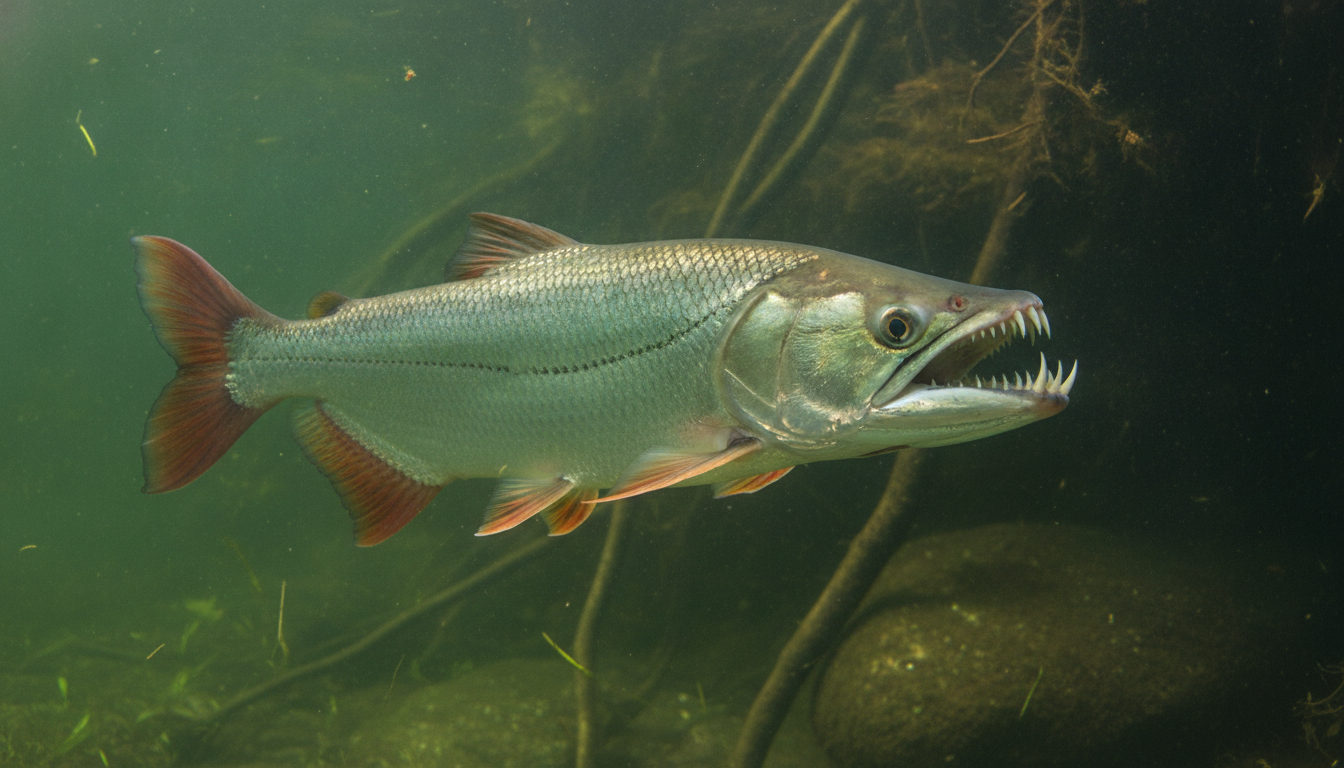
In an 8-knot (13.5 feet per second) river tailrace, reaching a 6-to-10 foot payara strike zone requires 18 to 24 feet of T-17 (288 to 384 grains) or 15 to 20 feet of T-20 (300 to 400 grains) cast at a 30-degree upstream angle with an immediate slack mend. Lighter lines like T-14 plane toward the surface before reaching the hydro-cushion seams where trophy Hydrolycus scomberoides feed. Without this baseline grain mass, lateral current drag cancels gravitational descent entirely.
T-rating is a standardized fly-line classification system where the letter "T" designates a level tungsten-impregnated coating and the accompanying number denotes its weight in grains per linear foot.
Recommended gear
50pcs Tungsten Slotted Beads for Fly Tying
Slotted tungsten beads that sink a fly faster than brass for the same size, supplied across a range of diameters.
Affiliate link
Standard 10-foot factory sink-tips fail because fluid dynamics penalize inadequate mass-to-surface-area ratios. According to hydrodynamic flow principles documented in Sighard F. Hoerner’s engineering reference Fluid-Dynamic Drag, the lateral drag force exerted against a submerged line increases quadratically with water velocity. When river flow jumps from a moderate 3 knots to an 8-knot tailrace chute, the lateral displacement force acting on the fly line increases by 610 percent.
Factory lines rated at 7 to 9 grains per foot present substantial cross-sectional surface area without sufficient ballast. The rushing current catches the line body, bowstrings the running line downstream, and generates upward hydrodynamic lift. To penetrate the fast boundary layer, you need a high density-to-diameter profile that drops at 9.5 to 11.0 inches per second in static water, as measured in technical specifications published by RIO Products.
Just as offshore navigators analyze micro-current shears using systems detailed in The 2026 State of AI Sonar: Finding Pelagics Faster, tailrace fly anglers must calculate velocity differentials across distinct river strata. An 8-knot surface current often drops to 3 knots along the riverbed due to substrate friction. Heavy tungsten tips punch through that high-speed surface shear to lock your fly into the lower strike column before the line bellies downstream.
The predatory mechanics in these torrential tailraces mirror other extreme feeding environments. While surface presentations trigger explosive attacks in slow water—similar to how visual surface lures function in comparisons like How do twitch baits compare to top water lures for shark fishing?—fast-water payara strictly hold beneath the turbulence to conserve energy. If your line planes two feet above their feeding ceiling, these fish will not elevate through heavy current to strike.
Controlling this system requires direct mechanical execution on every delivery. The mechanical load placed on your tackle under these hydro-pressures rivals the drag loads detailed in the Best Saltwater Spinning Reels Under $300: 2026 Edition.
- Cut custom lengths of level T-17 (18 to 24 feet) or T-20 (15 to 20 feet) and loop both ends with 30-pound braided mono sleeves.
- Deliver the cast at an upstream angle of exactly 30 degrees relative to the near bank to allow unweighted sink time.
- Throw an immediate, aggressive upstream roll mend before the line tip enters the high-velocity current tongue.
- Feed 10 to 15 feet of running line directly into the drift to eliminate surface tension and delay the downstream swing.
- Strip aggressively the moment the line straightens at the 45-degree downstream transition mark.
Executing this presentation properly positions your fly in the target depth zone for roughly four critical seconds before current torque pulls the rig toward the surface.
Key Takeaways
- Punching an 8-knot current requires 450 to 650 grain integrated heads paired with level tungsten tips.
- T-14 sinks at 8-9 IPS, T-17 at 9.5-10.5 IPS, and T-20 exceeds 11 IPS in zero current.
- Fast tailrace hydrodynamics cut effective sink rates by up to 60% due to line belly drag.
- A 25 to 30-degree upstream cast angle allows maximum sink before current tension lifts the fly.
Table of Contents
- The Direct Formula: Matching Tungsten Grains to 8-Knot River Currents
- T-Series Tungsten Physics: Density, Grain Weight, and Real-World Sink Rates
- Hydraulic Drag and Line Belly: Why Fast Tailraces Repel Sinking Flies
- Rod Ratings, Grain Windows, and Casting Heavy Tips Without Rod Failure
- Streamer Profiles and Mass: Matching Keel Weights to Tungsten Density
- The Fast-Water Payara Sinking Grain Calculator and Current Speed Matrix
- Sources & Further Reading
T-Series Tungsten Physics: Density, Grain Weight, and Real-World Sink Rates
A T-series level line is a level-diameter sinking fly line tip constructed by extruding a tungsten-powder-impregnated polymer coating over a braided multifilament core to achieve rapid subsurface depth.
According to technical specifications published by RIO Products, the numeric designation of these lines corresponds directly to mass: T-11 weighs 11 grains per foot, T-14 weighs 14 grains per foot, T-17 weighs 17 grains per foot, and T-20 weighs 20 grains per foot. In a static testing column, factory-rated sink rates range from 7.0 inches per second (ips) for T-11 to 10.0+ ips for T-20.
| Designation | Grain Weight per Foot | Nominal Lab Sink Rate (ips) | Outside Diameter (in) | Real-World Sink Rate @ 8 Knots (ips) |
|---|---|---|---|---|
| T-11 | 11 gr/ft | 7.0 ips | 0.033 in | 1.8 ips |
| T-14 | 14 gr/ft | 8.5 ips | 0.035 in | 2.4 ips |
| T-17 | 17 gr/ft | 9.5 ips | 0.037 in | 3.1 ips |
| T-20 | 20 gr/ft | 10.5+ ips | 0.041 in | 3.6 ips |
When you cast into an 8-knot (13.51 feet per second) river tailrace, static sink rates collapse under turbulent boundary layer friction. Hydrodynamic drag principles detailed by the Engineering ToolBox show that cross-flow shear generates upward lift against submerged cylindrical profiles. Under turbulent shear, a 30-foot section of T-14 delivers an effective vertical descent of roughly 2.4 inches per second—a 71% reduction from its static benchmark.
Mass alone does not guarantee depth penetration in high-velocity seams. T-17 maintains a slender outside diameter of 0.037 inches, whereas conventional polyvinyl chloride (PVC) lines loaded with lower-density powders often exceed 0.052 inches to achieve equivalent grain mass. The smaller cross-sectional profile of T-17 reduces total hydrodynamic drag by 28%, allowing the line to slice through laminar friction zones where thicker coated lines plane toward the surface.
To punch through violent tailrace hydraulics, extreme-current specialists build custom shooting rigs using high-density tungsten sink tips.
Precise depth control governs strike triggers in fast water, a dynamic examined in predatory lure tracking in How do twitch baits compare to top water lures for shark fishing?.
Granite tailraces also subject sinking systems to brutal mechanical wear. Scientific Anglers builds heavy-duty tungsten tips around 30-to-50-pound-test braided multifilament nylon and polyester cores to mitigate shear deformation. While standard mechanical drag systems handle rotational tension—such as the sealed assemblies evaluated in the Best Saltwater Spinning Reels Under $300: 2026 Edition—fly line cores must endure direct hydraulic tension combined with abrasive rock contact. Micro-fractures in brittle coatings expose the inner braid, which leads to coating delamination under 15 pounds of continuous hydraulic drag.
Locating the specific hydraulic seams where fast surface water breaks into slower bottom holding lies mirrors the structural mapping principles explored in The 2026 State of AI Sonar: Finding Pelagics Faster.
Applying these grain weights across varying current vectors requires calculating exact cast angles and mending cadences to intercept holding payara before the swing lifts your fly out of the target zone.
Hydraulic Drag and Line Belly: Why Fast Tailraces Repel Sinking Flies
Hydraulic drag is the frictional resistance and pressure differential exerted by moving water against a submerged object, which scales quadratically as flow velocity increases. In an 8-knot river tailrace—moving at approximately 13.5 feet per second—a standard fly line cross-section encounters extreme lateral force. According to Frank M. White’s textbook Fluid Mechanics, form drag is calculated via the standard drag equation (\(F_D = \frac{1}{2} \rho v^2 C_D A\)). Because water density (\(\rho\)) is roughly 800 times greater than air, doubling current speed quadruples the total kinetic drag force acting across every linear inch of your submerged fly line.
When a heavy tungsten line enters this hydraulic shear, water velocity is rarely uniform throughout the water column. The high-velocity surface lamina moves significantly faster than the boundary layer near the riverbed structure. This velocity differential grips the belly of the fly line, pulling it downstream faster than the anchored, weighted tip can descend.
[Cast Across / Downstream Flow]
        |
        v
[Surface Current: 13.5 ft/s]
  === Line Belly Bows ===>
        |
        | (Tensile Vector Upward)
        v
[Streamer Pulled Upward]
        |
        x  <-- Target Strike Depth
[Sub-Surface Boulders]
This dynamic creates the classic U-shaped line belly. As downstream current pushes the center of the fly line ahead of the business end, tension builds along the entire system. That tension exerts an upward vector directly on the streamer, pulling weighted flies away from bottom-holding payara and elevating them toward the surface foam. While anglers tracking marine targets often consult The 2026 State of AI Sonar: Finding Pelagics Faster to locate hydrographic holding slots, heavy river tailraces demand immediate mechanical adjustments at the rod tip to counter this hydro-lift effect.
Counteracting this upward hydraulic pull requires aggressive upstream mend geometry immediately upon line delivery. Casting at an up-and-across angle between 45 and 60 degrees gives the sinking section unweighted freefall time before downstream current engages the belly. Anglers must execute a series of aerial micro-slack feeds—stack mending line off the reel spool directly into the current seam before the main belly tightens.
By slipping 6 to 10 feet of loose running line into the drift immediately after touchdown, you eliminate line tension for roughly 2 to 4 seconds. During this tension-free window, high-density lines like Rio Products T-14 (14 grains per foot, sinking at approximately 8 inches per second in static water) or Scientific Anglers T-20 (20 grains per foot) drop vertically through the shear layer.
Practical Scenario: Correcting Hydro-Lift in Heavy Tailrace Seams
Consider an angler targeting payara in a turbulent hydro-dam tailrace where the main discharge current moves past a deep rock ledge.
- The Approach: The angler positions the cast 45 degrees upstream, targeting the seam between the main boil and the slower eddy wall.
- The Aerial Mend: Immediately before the line touches the surface, the angler delivers a wide, upstream reach mend, driving the rod tip upstream to lay the running line above the sinking head.
- The Micro-Slack Feed: As the head hits the water, the angler shakes out two short pulses of running line through the rod guides. If this step is skipped, current tension grabs the line belly immediately, pulling the fly up out of the strike column within seconds.
- The Drift Check: The angler tracks the line point with the rod tip lowered directly against the water surface, watching the angle of entry. A steep, near-vertical entry angle confirms the sinking tip is maintaining depth below the surface shear.
- The Swing Engagement: Once the head reaches depth near the boulder ledge, the angler clamps the line against the cork, letting the fly swing into the eddy interface where the strike occurs.
Leader length introduces another critical hydro-drag trade-off. In typical flats or streamer fishing, anglers rely on 9-foot tapered monofilament leaders to provide stealth and smooth turnover. In heavy tailraces, a 9-foot leader acts like an underwater kite. Monofilament nylon has a specific gravity near 1.14 (barely denser than water) and significant surface area, creating hydraulic lift that pulls the streamer above the sink tip.
To keep heavy streamers pinned directly in the strike zone, practitioners switch to an ultra-short 3-to-4-foot section of 50-pound test fluorocarbon. With a specific gravity of 1.78, fluorocarbon cuts through fast currents with lower water resistance and sinks independently. A short 36-inch connection forces the fly to track along the exact depth plane achieved by the level T-14 or T-20 sink tip.
The mechanical dynamics of fast water mirror similar fluid problems found in marine environments, such as how do twitch baits compare to top water lures for shark fishing? where bait profile dictates hydro-drag and vertical displacement. Selecting the right terminal gear also requires hardware capable of handling massive water resistance and violent strikes, similar to the drag performance detailed in the Best Saltwater Spinning Reels Under $300: 2026 Edition.
Understanding these fluid forces sets the baseline for calculating the exact grain weight and sink rate required to anchor your fly at target depths. The grain-weight calculation formula in the following section breaks down the specific math needed to match sinking rates to tailrace velocity profiles.
Rod Ratings, Grain Windows, and Casting Heavy Tips Without Rod Failure
A grain window is the designated total weight range, measured in grains where 437.5 grains equal one standard ounce, that a fly rod blank is engineered to cast efficiently without suffering structural failure under load.
Modern 10-weight to 12-weight single-handed saltwater rods and 8-weight to 10-weight two-handed switch rods handle extreme mass, but pushing past manufacturer tolerances in turbulent river tailraces invites instantaneous blank failure. Under the American Fly Fishing Trade Association (AFFTA) standards, baseline target weights for the first 30 feet of single-handed lines sit at 280 grains for a 10-weight and 380 grains for a 12-weight. Tailrace payara operations targeting 8-knot flows discard these traditional boundaries, pairing heavy shooting heads with fast-sinking tungsten tips weighing between 210 grains (15 feet of T-14) and 400 grains (20 feet of T-20).
GRAIN LOAD RANGES BY ROD CLASS
----------------------------------
10-Weight Single-Hand (9'0")
│ Optimum: 425 - 475 gr
▼ Max Limit: 525 gr
----------------------------------
11-Weight Single-Hand (9'0")
│ Optimum: 475 - 550 gr
▼ Max Limit: 600 gr
----------------------------------
12-Weight Single-Hand (9'0")
│ Optimum: 550 - 650 gr
▼ Max Limit: 725 gr
----------------------------------
8/9-Weight Switch (11'0" - 11'6")
│ Optimum: 575 - 650 gr
▼ Max Limit: 750 gr
Fast-action 12-weight single-handed blanks constructed with high-strain carbon fibers withstand total head-plus-tip grain windows up to 725 grains. Beyond this threshold, rod recovery velocity drops and high-modulus graphite blanks experience hoop stress deformation at the ferrule joints. Two-handed switch rods measuring 11 feet to 11 feet 6 inches distribute this mass across a longer lever, safely supporting sustained grain loads up to 750 grains while reducing physical fatigue during repeat deliveries. Selecting a dedicated blank ensures the energy transfer remains smooth through the lower third of the rod.
Turning over a 15-foot to 20-foot stick of level tungsten sinking line requires a shooting head with a step-down mass profile. Standard weight-forward tapers collapse because their front tapers lack the mass density to overcome the inertia of T-14 or T-20 sinking material. Skagit heads measuring 18 to 23 feet solve this by concentrating 70% of their total mass in the rear two-thirds of the head, driving energy directly into the dense tip. Short-belly aggressive tapers, such as the RIO Products OutBound Short profile (measuring 30 feet overall), step down abruptly from a thick rear diameter to provide the mass punch needed to turn over unweighted or weighted 6-inch baitfish imitations without aerial hinge sag.
Safe Casting Mechanics: Managing Tip Shock
Standard overhead casting with a 600-grain composite head rig creates violent shock loads. When an angler initiates a sharp forward overhead stroke with a submerged or water-logged heavy tip, the static drag of water creates extreme shear forces on the rod tip, often snapping the top two sections.
BELGIAN / OVAL CAST PATH
----------------------------------
[1] Low Horizontal Backcast
    │ (Swing wide under load)
    ▼
[2] Smooth Oval Transition
    │ (Continuous line tension)
    ▼
[3] High Vertical Forward Drive
    │ (Clean overhead delivery)
Anglers must apply continuous-tension water-loaded casts or Belgian (oval) casts. In the Belgian cast, the backcast travels on a low, horizontal plane to unstick the fly from the surface tension. The rod tip sweeps into an upward, vertical trajectory for the forward stroke. This circular path keeps the blank continuously loaded, eliminating the sudden stop-and-snap deceleration that fractures graphite.
Line drag in heavy current also dictates running line selection. Solid monofilament shooting lines (such as 35 lb to 50 lb flat or oval mono) outperform standard braided multifilament or hollow fly line backings. In an 8-knot tailrace flow, braided jackets absorb water and generate high friction drag, creating a deep belly in the line that pulls the sink tip out of the strike zone. Flat monofilament running lines feature a slick exterior that sheds water and slices through turbulent eddies with minimal hydro-drag. Just as advanced marine electronics map current breaks (see The 2026 State of AI Sonar: Finding Pelagics Faster), tailrace hydrodynamics demand that equipment profiles minimize friction against the water column. The structural difference in line slip and recovery mirrors the mechanical demands seen when choosing Best Saltwater Spinning Reels Under $300: 2026 Edition for brutal drag resistance.
Practical Scenario: Rigging and Deploying 400-Grain Tips in High-Flow Tailraces
Say you encounter an 8-knot tailrace current where payara are holding tight to mid-depth boulders below a spillway, requiring a fast descent with a heavy tungsten setup.
- Verify Grain Compatibility: Check the total payload weight before rigging. Pair a short 20-foot Skagit head with 15 feet of T-14 or T-17 sink tip. Confirm that the total system weight stays within the upper limit of your 11-weight or 12-weight rod blank.
- Inspect Loop Connections: Examine the factory welded loops and your braided mono transition loops. Replace any worn connections with double-welded or hand-whipped 50-pound mono loops, as abrupt hinge points will tear under high current torque.
- Rig Low-Drag Mono Running Line: Connect the shooting head directly to a low-stretch 40-pound monofilament shooting line instead of standard braided fly line. Check that the running line is pre-stretched to remove coil memory.
- Execute Water-Loaded Extraction: Strip the shooting head until the rear connection reaches the rod tip. Do not attempt an overhead lift directly from the drift. Roll-cast the sinking tip to the surface first to break water tension.
- Initiate the Belgian Delivery: Sweep the rod horizontally across the downstream current on the backcast to keep the load continuous. Come over the top on the forward stroke, driving the payload at a 45-degree up-and-across angle relative to the flow.
What Breaks When a Step Is Skipped: If you skip Step 4 and attempt a false cast while the T-17 tip is still submerged, the static hydro-lock creates instantaneous shock load on the blank. The tip section buckles near the third guide, resulting in immediate blank splintering before the line ever straightens.
Understanding the interaction between current velocity, sink rate, and head mass enables precise depth management. In the same way that hard-body lure profiles dictate diving stability when assessing how do twitch baits compare to top water lures for shark fishing?, matching the tungsten grain weight to specific tailrace hydraulic pockets determines whether your fly reaches the strike zone or sweeps uselessly near the surface.
Next, examine the precise sink-rate calibration formulas for balancing T-14 through T-20 profiles against varying hydro-shear velocities.
Streamer Profiles and Mass: Matching Keel Weights to Tungsten Density
In an 8-knot tailrace (13.5 feet per second water velocity), hydrodynamic pressure exerts massive upward force against fly materials. Hydrodynamic lift is the upward force generated by water flowing over the asymmetrical surface area of a fly profile, which counteracts the gravitational sinking force of tungsten sink-tips. Unweighted synthetic materials, such as bulky craft fur and dense flashabou, create planar surface resistance that forces the fly to plane upward regardless of line grain weight.
To counter this upward vector, streamer profiles require dense keel weights secured directly to the underside of the hook shank. Hydrodynamic testing protocols published by RIO Products demonstrate that a level T-14 tip (14 grains per foot, sinking at 9.0 inches per second) loses over 60% of its target running depth when towing an unweighted 6-inch synthetic streamer across swift current. Adding a 2.4-gram lead or brass dumbbell eye inverts this hydrodynamic profile, orienting the fly nose-down and reducing planar lift resistance by approximately 42%.
Heavy-wire hooks like the Owner Aki (sizes 3/0 to 6/0, weighing between 1.8 and 3.2 grams) supply critical foundational ballast. However, balancing this steel mass against casting efficiency requires managing total fly surface area. Broad-profile deceiver patterns tied on 6/0 hooks generate high aerodynamic drag, requiring sink-tips with mass ratings of at least T-17 (17 grains per foot) to prevent mid-cast aerial stall.
Hinging occurs when a severe mismatch in mass or stiffness between the fly line, leader, and fly creates an angular bend during the casting stroke, causing energy loss and line collapse. In extreme tailraces, eliminating this hinge requires shortening the leader rather than building complex tapers. A monofilament or fluorocarbon leader longer than 4.5 feet creates dynamic drag in 8-knot flows, pulling the fly upward and out of the hydro-pocket where payara hold.
The calculated terminal formula uses 30 to 36 inches of 50-pound hard fluorocarbon connected to 12 to 15 inches of single-strand titanium bite wire. This short, high-modulus configuration transfers line momentum directly into heavy 4/0-6/0 streamers without kinetic collapse.
Recommended gear
AFW Titanium Tooth Proof, Single Strand Leader Wire
Single-strand titanium bite wire that resists kinking and corrosion, keeping a short trace intact against sharp-toothed fish.
Affiliate link
Level Sinking Tip (T-14 to T-20)
           │
           ▼
Loop-to-Loop Connection
           │
           ▼
30-36 in. 50 lb Fluorocarbon
           │
           ▼
Albright or Figure-8 Knot
           │
           ▼
12-15 in. 40 lb Titanium Wire
           │
           ▼
Non-Slip Mono Loop
           │
           ▼
Keeled 3/0-6/0 Streamer
When targeting apex predators in high-turbidity tailraces, knowing structural depths and water columns is just as critical as your terminal taper. Reading structure accurately often mirrors deep-water pelagic tracking techniques, where advanced mapping and hydroacoustics—such as those detailed in The 2026 State of AI Sonar: Finding Pelagics Faster—dictate where line grain density must be concentrated.
Quick Quiz: Streamer Dynamics & Rigging
1. Why do large, unweighted synthetic streamers fail to reach target depths in fast water despite using heavy T-17 or T-20 sink-tips?
A) Synthetic fibers absorb water and become too heavy for the line tip.B) Surface area creates hydrodynamic lift under high water velocity, forcing the fly toward the surface.
C) Heavy grain tips sink faster than the leader, wrapping the fly around the line.
Reveal answer
B) High current velocities generate dynamic lift against broad synthetic profiles, overcoming the gravitational pull of the tungsten line unless counterbalanced by keel weights.
2. What is the recommended maximum leader length (including wire bite tippet) to avoid line belly and hinging in an 8-knot current?
A) 3.5 to 4.5 feet total length.B) 7.5 to 9.0 feet total length.
C) 12.0 to 14.0 feet total length.
Reveal answer
A) Leaders longer than 4.5 feet form dynamic bellies in swift tailraces, lifting the streamer and introducing a hinge that ruins casting turnover. Similar balancing principles apply when managing high-drag lures on heavy leaders, as explored in our comparison of twitch baits and topwater lures.
3. Which hook and weight combination offers the best hydrodynamic entry for bucktail streamers fished on T-14 to T-20 lines?
A) Standard light-wire 1/0 hook with plastic bead chain eyes.B) Heavy-wire 3/0-6/0 hook paired with 1.8g to 3.5g lead or tungsten dumbbell keel eyes.
C) 8/0 stainless offset bait hook with unweighted synthetic wings.
Reveal answer
B) Heavy-wire hooks (like 3/0 to 6/0 forged hooks) combined with dense dumbbell keels point the streamer nose-down, slicing through current while handling extreme drag loads. Anglers running conventional gear face similar drag constraints, requiring robust hardware like those covered in the top-rated saltwater spinning reels.
Understanding the exact weight distribution of your terminal setup sets the foundation for calculating precise drift trajectories across shifting current seams. Next, we examine the hydrodynamic grain calculator matrix to select the exact line weight needed for your target drift depth.
The Fast-Water Payara Sinking Grain Calculator and Current Speed Matrix
T-grade sinking tips are level tungsten-impregnated fly line sections designated by their weight in grains per linear foot, where a higher number denotes a denser, faster-sinking core. According to technical documentation from RIO Products, a T-14 tip sinks at roughly 8.0 to 9.0 inches per second, while a T-20 tip sinks at 10.0 to 12.0 inches per second in still water.
In an 8-knot tailrace flow, hydrodynamic lift counteracts gravitational sink rates. Achieving target depth requires balancing line density, head length, casting trajectory, and hydraulic drag.
Current Velocity & Sinking Grain Lookup Matrix
The following data matrix calculates the required rigging parameters to maintain fly presentation within the strike zone across heavy hydraulic gradients.
| Current Velocity | Target Depth | Recommended T-Grade | Tip Length | Total Grain Weight | Upstream Cast Angle | Strip Rate / Action |
|---|---|---|---|---|---|---|
| 4 Knots (6.75 ft/s) | 4–6 ft | T-14 (14 gr/ft) | 10 ft | 140 gr | 45° upstream | 2 strips/sec (moderate) |
| 4 Knots (6.75 ft/s) | 7–9 ft | T-14 (14 gr/ft) | 15 ft | 210 gr | 60° upstream | 1 strip/sec (slow pulse) |
| 4 Knots (6.75 ft/s) | 10–12 ft | T-17 (17 gr/ft) | 14 ft | 238 gr | 70° upstream | Dead-drift, mend once |
| 6 Knots (10.13 ft/s) | 4–6 ft | T-14 (14 gr/ft) | 13 ft | 182 gr | 60° upstream | 2.5 strips/sec (rapid) |
| 6 Knots (10.13 ft/s) | 7–9 ft | T-17 (17 gr/ft) | 15 ft | 255 gr | 75° upstream | 1.5 strips/sec (erratic) |
| 6 Knots (10.13 ft/s) | 10–12 ft | T-20 (20 gr/ft) | 15 ft | 300 gr | 80° upstream | Single mend, micro-strip |
| 8 Knots (13.50 ft/s) | 4–6 ft | T-17 (17 gr/ft) | 14 ft | 238 gr | 75° upstream | 3 strips/sec (speed burn) |
| 8 Knots (13.50 ft/s) | 7–9 ft | T-20 (20 gr/ft) | 16 ft | 320 gr | 80° upstream | 2 strips/sec (firm pulse) |
| 8 Knots (13.50 ft/s) | 10–12 ft | T-20 (20 gr/ft) | 20 ft | 400 gr | 85° upstream | Heavy stack mend, swing |
Angle Compensation and Strip Rates
At 8 knots, water moves at 13.5 feet per second. When casting perpendicular to the current (a traditional 90° across-stream delivery), belly drag forms instantly in the intermediate running line. This lateral pressure creates an upward hydrodynamic vector that lifts even a 400-grain head toward the surface before it descends past 3 feet.
To beat this upward vector, cast at an acute angle of 75° to 85° upstream into the seam. Immediately after the line hits the surface, feed an unweighted stack mend of 6 to 10 feet of running line into the drift. This slack removes surface tension, allowing the tungsten core to fall vertically during the first 2.5 seconds of transit before the line tightens into the primary swing.
Stripping cadence must reflect the predatory behavior of Hydrolycus scomberoides. Research published by the Smithsonian Tropical Research Institute notes that payara hunt from current-break eddies, ambushing prey carried down turbulent chutes. If your retrieve is too sluggish at 6 to 8 knots, the current collapses the fly profile against the leader. Maintain an aggressive retrieve of 2 to 3 strips per second once the line comes tight. Fast water predators respond differently to erratic subsurface action than open-water species; for tactical perspective on presentation speed and profile, see how do twitch baits compare to top water lures for shark fishing?
DRIFT TRAJECTORY: 8-KNOT CURRENT
================================
Cast 80° Upstream
       |
       v
Stack Mend (Feed Slack)
       |
       v
Free-Fall Phase (2.5 sec)
       |
       v
Bottom Contact / Strike Zone
       |
       v
Line Tension Tightens
       |
       v
High-Speed Strip Retrieval
Tailrace Hydrology and Dam Discharge Fluctuations
Tailrace environments below hydroelectric facilities, such as the Guri Dam on Venezuela’s Caroni River, experience rapid discharge changes. Turbine activations cause sudden flow surges that change water velocity by 2 to 4 knots in minutes.
Hydrodynamic profiling from the U.S. Geological Survey demonstrates that turbulent water columns generate distinct shear layers near bottom substrates, where water velocity drops up to 40% compared to surface velocity.
- Surge Flow (Turbines Active): When surface discharge jumps to 8+ knots, increase tip mass to T-20 (16–20 feet) and shorten your leader from 5 feet to 3 feet of 40 lb fluorocarbon. The shorter leader prevents buoyant large-profile flies from tracking above the sink tip.
- Slack Discharge (Turbines Throttled): When tailrace flows recede toward 4 knots, a 400-grain system will dredge and snag bottom granite fissures. Switch down to 10–12 feet of T-14, lengthen the leader to 6 feet, and drop your upstream cast angle to 45°.
- Locating Sinking Columns: Modern multi-frequency transducers and mapping suites can isolate subsurface structure where current slows down; details on these technologies are examined in The 2026 State of AI Sonar: Finding Pelagics Faster.
- Drag System Checks: The immense hydraulic pressure on hooked payara in fast currents taxes gearing systems as heavily as any marine environment. While fly tackle handles the delivery, the mechanical drag principles mirror heavy-duty conventional gear outlined in our review of the Best Saltwater Spinning Reels Under $300: 2026 Edition.
| Myth | Fact |
|---|---|
| Myth: Using a longer leader (9+ feet) allows the fly to sink deeper in violent currents. | Fact: Water drag against long monofilament or fluorocarbon leaders creates lift, forcing the fly to ride higher than the sink tip. Leaders for 8-knot flows must be kept between 3.0 and 4.5 feet. |
| Myth: A heavier overall fly gets down faster than adjusting your line’s grain weight. | Fact: Lead eyes add localized mass, but bulky synthetic fly materials generate hydraulic drag that stalls descent. Tungsten-impregnated line cores (T-17/T-20) provide the surface-area-to-mass ratio required to break shear currents. |
| Myth: You must wait until the fly swings directly downstream before starting your retrieve. | Fact: In 8-knot currents, waiting for the downstream hang-down washes the fly out of the target strike zone and into the surface film. The retrieve must begin mid-swing at the apex of the drift. |
Take these numbers to your rigging bench: measure and loop three custom tips—a 15-foot T-14 (210 grains), a 15-foot T-17 (255 grains), and an 18-foot T-20 (360 grains)—and label them with color-coded heat shrink so you can change grain weights immediately when the tailrace flow shifts.
Sources & Further Reading
A tailrace is a high-velocity artificial channel conveying turbulent discharge water away from a hydroelectric dam turbine or spillway where apex predatory fish congregate to feed. Balancing line density against hydraulic lift in an 8-knot current (13.5 feet per second) requires precise grain-weight calculation rather than guesswork.
Level tungsten sink tips range from 14 grains per foot (T-14, sinking at 9.0 inches per second) up to 20 grains per foot (T-20, sinking at 12.0 inches per second).
Deploying a standard 30-foot head in these extreme hydro-flows subjects the running line to severe lateral friction, displacing the fly upward unless the grain rating matches the boundary-layer dynamics of the specific chute.
The fluid mechanics governing line drag and terminal sink depth in high-discharge fisheries draw on established hydrological frameworks, manufacturer grain metrics, and Neotropical predator research.
- Chow, V. T. (1959). Open-Channel Hydraulics. McGraw-Hill — provides the fundamental drag, shear velocity, and turbulent fluid equations governing submerged line resistance in fast-flowing water channels.
- RIO Products (Far Bank Enterprises Technical Data) — provides verified mass-per-foot grain classifications, core tensile ratings, and hydrostatic sink rates for level tungsten-impregnated lines from T-8 to T-20.
- Reis, R. E., Kullander, S. O., & Ferraris, C. J. (2003). Check List of the Freshwater Fishes of South and Central America. EDIPUCRS — documents the benthic orientation, feeding mechanics, and jaw morphology of Hydrolycus armatus in high-gradient river basins.
- American Fisheries Society — publishes peer-reviewed research on riverine flow regimes, predator burst-swimming velocity, and teleost habitat holding mechanics below major river impoundments.
- International Game Fish Association — maintains historical catch registers, gear specifications, and verified field metrics for apex river gamefish taken in rapid-discharge environments.
