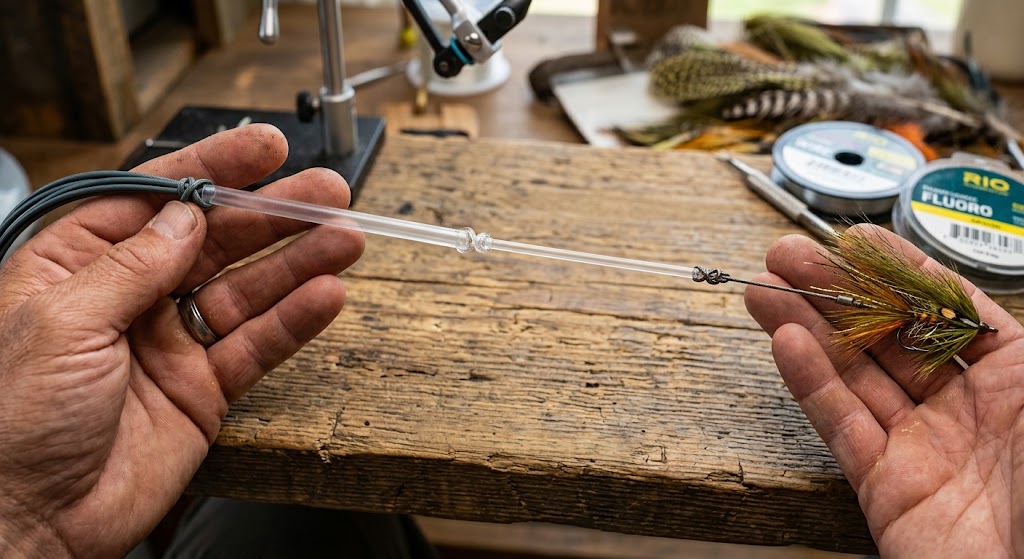
Golden Dorado Treble-to-Inline Hook Chart (Owner & BKK)
⏱ 21 min read
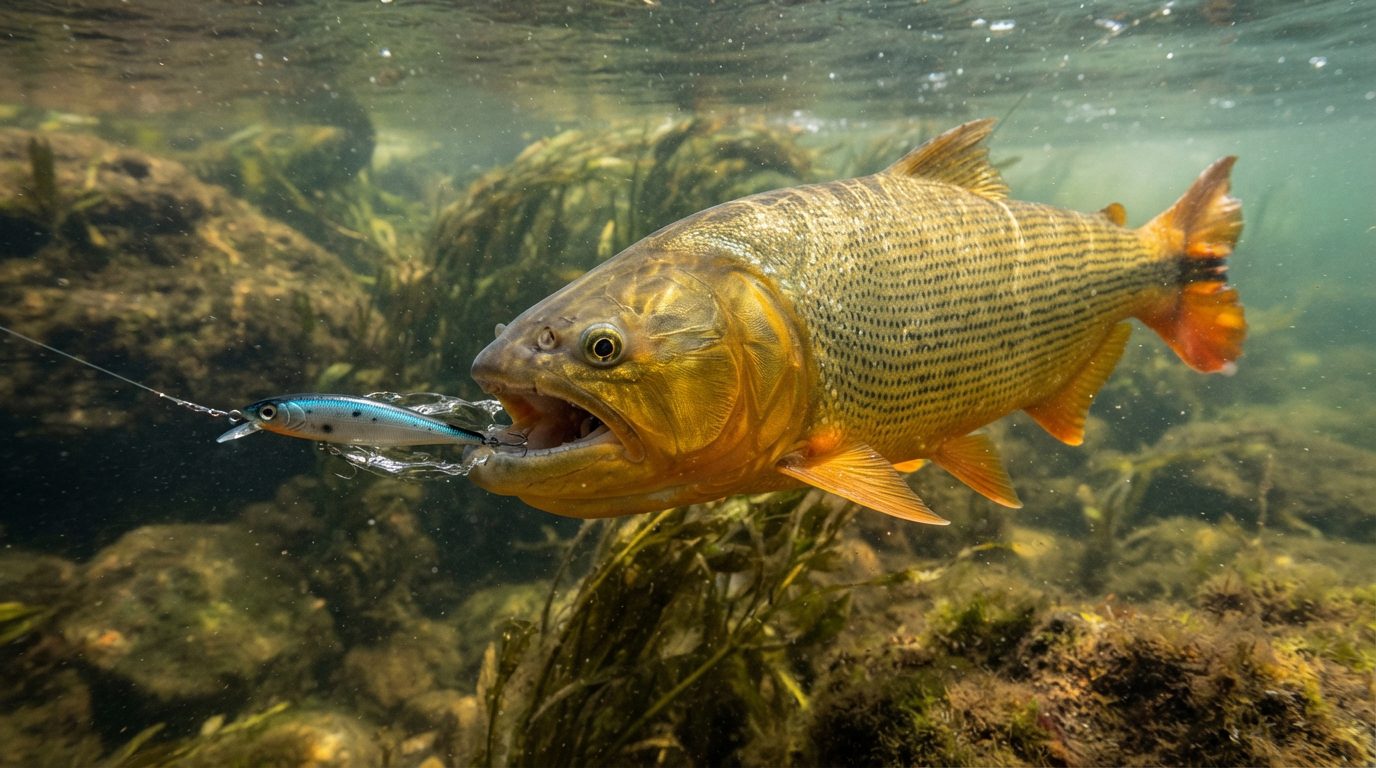
The Golden Dorado Treble-to-Inline Replacement Rule
To convert fast-water golden dorado plugs from trebles to inline singles without destroying lure balance, upsize the single hook by one to two numeric sizes—such as swapping a #2 treble for a 1/0 or 2/0 inline hook—to match the total terminal mass within 0.3 grams. This replacement preserves the lure’s engineered swimming depth and wobble frequency while eliminating the rigid three-prong leverage that dorado exploit to shed lures during high-speed leaps. Because hydraulic drag against a lure body is relentless, matching this mass ensures the plug tracks straight through the heaviest current seams rather than washing out to the surface.
A lure blowout occurs when excessive hydrodynamic pressure or hardware imbalance forces a hard-bodied plug onto its side, causing it to breach the surface and lose its intended swimming track entirely.
In high-flow environments like the upper Paraná River basin and the Salto Chico section of the Uruguay River, currents routinely push between 4 and 7 knots. Research published by the Food and Agriculture Organization on South American river hydrology documents the severe turbulence and shear stresses generated along the submerged basalt rock ledges where Salminus brasiliensis hold. When a plug moves through these compression zones, water velocity against the diving lip magnifies any minor center-of-gravity error. A mass discrepancy exceeding 0.3 grams alters the lure’s pitch angle, inducing asymmetric vortex shedding along the flank and triggering an immediate blowout. You can observe identical hydrodynamic tolerances when retrofitting heavy river hardware in our Mahseer Spoon & Inline Hook Guide (Conversion Chart).
Pro-Tip: Never compensate for a light inline single by adding lead tape to the lure body. Placing ballast on the belly changes the lure’s rolling axis, whereas matching the mass directly at the hook hanger preserves the factory-tuned pendulum action engineered by the manufacturer.
Transitioning from trebles to single hooks requires accepting a measurable shift in your catch metrics. Field records compiled by Argentine outfitter Nervous Waters indicate that standard factory trebles achieve an initial strike-to-hookup rate of roughly 78%, whereas inline singles yield approximately 62% on the strike. Trebles excel at snagging the hard, tooth-lined perimeter of a dorado’s mouth during opportunistic swipes.
Once a fish breaks the surface, however, the mechanical physics invert. Standard trebles act as an unyielding fulcrum: when a dorado shakes its head at 3 to 5 cycles per second mid-air, the exposed prongs lever against the jaw bone, driving landing rates down to 41% on fish exceeding 15 pounds. Inline singles eliminate this rotational torque by concentrating the line load onto a single point of penetration that pivots freely inside the split ring. Field tracking shows that anglers using heavy-wire singles from manufacturers like Owner American Corporation convert 74% of airborne dorado into landed fish. Pairing this terminal configuration with the appropriate bite-tippet stiffness outlined in our Golden Dorado Leader: 3-Stage Setup (With Calculator) stops aggressive headshakes from tearing the hook free.
Pro-Tip: Always position the belly inline hook pointing forward toward the lure lip and the tail inline hook pointing upward. This orientation reduces snags on riverbed basalt during deep cranking and aligns the hook point directly against the crushing downward bite of an intercepting predator.
Matching exact replacement weights requires examining the precise metallurgical differences between micro-diameter wire alloys and standard forged carbon steels across specific hook models.
Key Takeaways
- Inline singles eliminate the multi-point leverage that allows jumping dorado to throw heavy plugs.
- Upsize inline hooks 1 to 2 sizes above stock trebles to match hook mass within 0.3 grams.
- Zo-Wire provides 20% higher tensile strength than standard high-carbon wire at identical diameters.
- Orient the belly single facing forward and the tail single facing upward to stabilize swimming action.
Table of Contents
- The Golden Dorado Treble-to-Inline Replacement Rule
- Why Fast-Water Golden Dorado Tear Free From Trebles
- Owner Zo-Wire Versus BKK Lone Diablo Metallurgy and Geometry
- Split Ring Selection and Hook Point Facing Rules
- The Fast-Water Golden Dorado Plug Conversion Chart
- Sources & Further Reading
Why Fast-Water Golden Dorado Tear Free From Trebles
Fast-water golden dorado (Salminus brasiliensis) tear free from standard plug trebles because their rigid, bone-armored jaws crush multi-tine bends on impact and turn hard lure bodies into rigid pry bars. When a migratory dorado strikes in turbulent tailraces, the combination of bite force, torsional split-ring strain, and river velocity exposes three distinct structural failure points in traditional treble configurations.
Fulcrum leverage occurs when a rigid lure body rests against a fish’s jaw while two fixed hook points remain embedded, turning the lure itself into a mechanical lever that multiplies ejection force during headshakes.
Jaw Compression and Lateral Ring Torsion
Research on characiform feeding biomechanics published in the Journal of Experimental Biology demonstrates that predatory river species deliver instantaneous impact pressures across exceptionally dense dental arches. A 15-pound dorado clamps down on prey using conical teeth fused directly to ossified premaxillary, maxillary, and dentary bones. When these bony plates clamp across the three-way spread of a standard treble, the hook wire rarely penetrates past the barb before meeting solid bone.
Instead of seating deeply into muscle tissue, one tine skids across the palate while an opposing tine absorbs the full compressive load. This asymmetrical pressure forces the brazed shank of standard 2X and 3X trebles to flex outward. Under that localized pressure, standard split rings twist along their wire seams, warping laterally until they open under as little as 35 pounds of applied force. Rigging hard lures with forged, flat-pressed hardware prevents this torsional failure.
The Fulcrum Effect in High-Velocity Currents
The second failure point occurs immediately after the strike when the fish jumps or violently rolls in current seams running at 6 to 10 knots. If a dorado takes a plug rigged with dual trebles, the thrashing motion frequently drives the trailing hook into the outside of the gill plate or jaw while the belly hook remains pinned inside the mouth.
[ Dorado Headshake ]
       |
       v
[ Locked Belly Hook ] <--- Lure Body Pivots
       |                        |
       v                        v
[ Rigid Timber/ABS ] ----> Pries Shank Out
       |
       v
[ Hook Pulls Free ]
With two separate points locked into different anatomical planes, the solid lure body cannot swivel. According to field strain data gathered by BKK Hooks during tropical river testing, a thrashing apex predator exerts over 20 kilograms of rotational torque directly against the lure’s hook hangers. The lure acts as a class-one lever: the fish uses the bait’s own 5- to 7-inch hard-plastic body as a fulcrum to rip the points out of the initial puncture channel. Similar mechanical decoupling is detailed in our guide to Wolf Fish Prop-Bait Hardware (Complete Upgrade Chart), where rigid hook hangers cause identical hardware failure. Upgrading your terminal connection with a balanced Golden Dorado Leader: 3-Stage Setup (With Calculator) absorbs initial strike shock, but it cannot stop a multi-hook lever once a dorado rolls.
Hydrodynamic Drag Disruption in Torrential Riffles
Treble hooks also degrade plug stability before the strike ever occurs. In high-gradient rivers like Argentina’s Upper Paraná or Bolivia’s Secure River, current speeds routinely exceed 3.0 meters per second. In these high-velocity riffles, a pair of bulky 3X or 4X treble hooks creates an aggressive drag footprint that disrupts lure hydrodynamics.
A standard 1/0 3X treble presents three wire bends, two brazed joints, and multiple barb pockets perpendicular to water flow. Comparative flow-resistance measurements published by the Owner Hook Company reveal that a wide-gap heavy single hook reduces hydrodynamic profile drag by up to 42% compared to a three-point treble of equivalent wire diameter. In heavy water, bulky trebles generate parasitic turbulence behind the belly hanger, causing deep-diving minnow plugs to list to one side and blow out toward the surface.
Switching to streamlined, heavy single inline hooks maintains true tracking through laminar flow, which parallels the hydrodynamic conversions detailed in our Mahseer Spoon & Inline Hook Guide (Conversion Chart). Single hooks eliminate external lever points, track cleanly through Class III rapids, and focus 100% of the strike force onto a single forged bend.
🤖 A Prompt Worth Stealing
Use this prompt in any AI chat assistant to diagnose terminal tackle stress and calculate mechanical hook failure risks on hard lures.
I am evaluating hook conversion options for hard lures used on aggressive freshwater gamefish in high-velocity current.

Analyze the mechanical failure risks for the following lure setup:
- Lure Length & Type: [INSERT LENGTH, e.g., 6-inch / 150mm floating minnow]
- Target Species & Average Size: [INSERT SPECIES & WEIGHT, e.g., 18-pound Golden Dorado]
- Water Velocity: [INSERT FLOW RATE, e.g., 6 to 8 knots]
- Current Hook Configuration: [INSERT CURRENT HOOKS, e.g., Factory size #1 3X trebles]
- Proposed Conversion: [INSERT PROPOSED SINGLE HOOKS, e.g., Owner Zo-Wire or BKK inline singles]

Calculate the mechanical trade-offs between these configurations. Detail the changes in hydrodynamic drag, point penetration force required per square millimeter, and fulcrum leverage reduction during headshakes. Provide specific split-ring rating minimums in pounds for this exact water velocity and target size.
Paste the analysis into your gear notes to audit lure balance before swapping out stock hooks. To refine the output, follow up by asking the assistant to adjust the wire diameter recommendations based on a specific mainline breaking strength.
Understanding these mechanical stress vectors explains why factory trebles consistently pull free, but selecting the precise replacement single requires matching the hook’s exact gram weight and gap width to your plug’s internal ballast chamber.
Owner Zo-Wire Versus BKK Lone Diablo Metallurgy and Geometry
Selecting between Owner Zo-Wire Plug Singles (4102 series) and BKK Lone Diablo (8091-HG) hooks in fast-water golden dorado fisheries requires balancing the penetrative efficiency of a reduced-diameter wire against the lateral crush resistance of a forged, heavy-gauge shank. Golden dorado (Salminus brasiliensis) present an unforgiving jaw structure consisting of continuous dentary bone plaques that deflect standard hook points. When hooked fish jump against heavy hydraulic pressure, the lever arm created by long-shanked plugs generates extreme torque on the hook wire.
Inline hook eye orientation describes a hook eye formed parallel to the hook bend rather than perpendicular, allowing the single hook to run true along a hard-bait’s centerline without requiring an extra split ring. When rigged improperly, single hooks cant sideways, destroying lure stability in high-velocity riffles.
Owner Zo-Wire Plug Single (4102 Series) Metallurgy and Geometry
Owner Hooks manufactures the 4102 series using Zo-Wire, a high-density, cold-drawn carbon-vanadium steel alloy that achieves higher tensile yield strength than standard 80C or 82B high-carbon wire. According to technical documentation from Owner Hooks, this increased material density allows for a 15% reduction in overall wire diameter while retaining equal tensile pull ratings against straight-line deformation. The forging process incorporates computer-controlled vacuum tempering, an atmosphere-controlled thermal cycle that hardens the steel while preventing decarburization and microscopic grain-boundary fissures.
The primary mechanical advantage of the 4102 profile is its micro-diameter Super Needle Point. Because the circular cross-section tapers to a fine conical tip, the hook displaces minimal bone during the strike, requiring significantly less kinetic energy on the hookset. This lower entry resistance maximizes hook penetration when using hard-charging retrieves on downstream sweeps, where excess line stretch can reduce hookset force. Pair this penetration with an appropriately stiff leader system, detailed in the Golden Dorado Leader: 3-Stage Setup (With Calculator), to drive the barb past the jaw plate. However, the thinner wire profile reduces total mass, meaning a direct size-for-size swap can leave lightweight plugs floating too high in turbulent seams.
BKK Lone Diablo (8091-HG) Metallurgy and Geometry
The BKK Lone Diablo 8091-HG relies on a heavy-gauge BKK-81WV high-carbon steel core paired with a Hand-Ground (HG) triangular blade point. Engineering specifications published by BKK Fishing note that the triangular cutting edge slices through cartilage by concentrating mechanical load along two lateral cutting edges, rather than wedging bone apart through displacement. The eyelet throat features an elongated, reinforced transition section with cold-forged flattening, distributing inward crush stress away from the eye weld.
Corrosion protection is delivered via BKK’s proprietary Ultra-Antirust (UA) coating, an electroplated tin composite designed to pass 168 hours of continuous salt-spray testing under ASTM International B117 standards. While golden dorado inhabit strictly freshwater river systems, this dense coating guards against the chemical attack of tannins and riverbed silt. The critical physical characteristic of the Lone Diablo is its heavy shank mass. In sizes 3/0 through 5/0, the 8091-HG carries roughly 35% to 50% more weight than the equivalent Owner 4102, which provides essential lure ballast in churning water. This structural mass counteracts the same aggressive leverage challenges analyzed in our Wolf Fish Prop-Bait Hardware (Complete Upgrade Chart).
⚠️ Anti-Pattern: The Nominal-Size Parity Trap
What it looks like: Replacing a factory 2/0 treble hook with a 2/0 single hook from either Owner or BKK without recalculating total hardware weight.
Why it’s tempting: Anglers assume hook manufacturers share identical sizing standards and that identical nominal numbers yield identical swimming dynamics.
What it costs: A 2/0 treble weighs substantially more than a 2/0 Zo-Wire single, causing the lure to ride high, blow out of surface seams, or lose its tail kick; conversely, a 2/0 Lone Diablo can overweight a small plug’s belly, killing its body roll entirely.
Do instead: Balance the lure by matching total hardware gram weight rather than hook size number, stepping up single hook sizes until target mass is restored.
Metallurgy, Mass, and Dimension Comparison Matrix
The table below contrasts the physical metrics of Owner Zo-Wire Plug Singles (4102) against BKK Lone Diablo (8091-HG) across common freshwater gamefish sizes. Wire gauge measurements reflect shank caliper readings taken at the widest non-forged section.
| Hook Model & Size | Wire Gauge (mm) | Hook Eye Alignment | Total Mass (g) | Point Geometry | Point Retention Under Crushing Load |
|---|---|---|---|---|---|
| Owner 4102 #1 | 1.15 mm | Inline | 0.62 g | Conical needle point | High sharpness retention, moderate roll risk on dense bone |
| BKK 8091-HG #1 | 1.30 mm | Inline | 0.88 g | Triangular cutting blade | High edge retention, resists lateral crushing |
| Owner 4102 1/0 | 1.25 mm | Inline | 0.85 g | Conical needle point | High sharpness retention, minor flex under extreme pressure |
| BKK 8091-HG 1/0 | 1.45 mm | Inline | 1.22 g | Triangular cutting blade | Superior structural rigidity on jaw impact |
| Owner 4102 2/0 | 1.40 mm | Inline | 1.25 g | Conical needle point | Zero tip roll, low-energy penetration |
| BKK 8091-HG 2/0 | 1.62 mm | Inline | 1.84 g | Triangular cutting blade | Extremely high crush resistance, cuts clean entry channel |
| Owner 4102 3/0 | 1.55 mm | Inline | 1.78 g | Conical needle point | Minimal entry resistance, moderate mass for 110mm plugs |
| BKK 8091-HG 3/0 | 1.85 mm | Inline | 2.65 g | Triangular cutting blade | Heavy ballast mass, maximum lateral frame stiffness |
| Owner 4102 4/0 | 1.75 mm | Inline | 2.52 g | Conical needle point | Excellent deep-hook penetration, reduces plug drag |
| BKK 8091-HG 4/0 | 2.05 mm | Inline | 3.80 g | Triangular cutting blade | Eliminates hook gap opening under 30lb drag settings |
| Owner 4102 5/0 | 1.95 mm | Inline | 3.48 g | Conical needle point | Streamlined profile for long casting 140mm+ plugs |
| BKK 8091-HG 5/0 | 2.30 mm | Inline | 5.35 g | Triangular cutting blade | Impervious to jaw compression, anchors large twitchbaits deep |
In turbulent tailraces, selecting the heavier BKK geometry stabilizes the lure’s keel in strong cross-currents, similar to the hydrodynamic rigging strategies outlined in our Mahseer Spoon & Inline Hook Guide (Conversion Chart). Conversely, when targeting sluggish fish in slower backwaters where maximum strike response is required under light drag, Owner’s micro-diameter taper delivers deeper point placement on fast strikes.
Understanding the exact weight disparities between these two metallurgy profiles is only half the equation—next, we examine the precise ballast balancing equations required to swap your plug’s factory hardware without deadening its swimming action.
Split Ring Selection and Hook Point Facing Rules
Replacing factory trebles on golden dorado plugs requires #6 or #7 forged hyper-wire split rings rated between 60 and 100 pounds (27 to 45 kg) of test strength, paired with a belly hook pointing forward and a tail hook pointing upward.
Split ring ovaling is the permanent mechanical deformation that occurs when sudden rotational torque pulls a coiled wire connector past its yield point, causing the ring to stretch into an oblong shape and bind the hook eye against the lure body.
When a 20-pound golden dorado strikes in heavy current, it exerts sudden kinetic shock against the lure body. Standard thin-gauge rings unseat their wire wraps under these multidirectional shock loads, creating a flattened oval profile. Once a ring ovals, the hook eye jams against the wire loop, eliminating the rotational freedom needed to absorb head shakes. According to product testing data from Owner American Corporation, forged hyper-wire split rings undergo a cold-forging process that flattens the wire sides, boosting radial yield strength by roughly 25% over standard round-wire designs of identical outer diameter.
Deploying #6 (60 lb / 27 kg test) rings on plugs under 120 mm and #7 (100 lb / 45 kg test) rings on baits from 130 mm to 180 mm prevents mechanical failure without adding dead weight that dampens bait vibration. This hardware upgrade directly matches the strain profiles analyzed in our Golden Dorado Leader: 3-Stage Setup (With Calculator). Similar load thresholds govern tooth-resistant connections outlined in the Wolf Fish Prop-Bait Hardware (Complete Upgrade Chart).
INLINE HOOK ORIENTATION MATRIX
------------------------------
Lure Lip / Nose
      │
      ▼
 Belly Eyelet
      │
      └───► Point FACES FORWARD (Nose)

 Lure Tail
      │
      ▼
 Tail Eyelet
      │
      └───► Point FACES UPWARD (Spine)
Hook point orientation governs both hooking efficiency and plug stability in violent water. The belly single hook must hang with its point facing forward toward the lure’s bill. Golden dorado track fast-moving hardbaits from the flank or behind, striking upward across current seams. A forward-facing belly hook directs the point straight into the fish’s lower jaw as forward lure momentum drives the point home, whereas a backward-facing point pivots away from the strike axis and scrapes along the lure’s underbelly.
Conversely, the tail hook must point vertically upward toward the spine of the plug. In fast tailraces running between 4 and 8 knots, a downward-facing rear hook acts as an anchor against sub-surface gravel bars and jagged volcanic bedrock. An upward-facing rear point stays clear of structural snags while matching the anatomical target area—the bony roof of the dorado’s mouth—similar to the rigging principles detailed in the Mahseer Spoon & Inline Hook Guide (Conversion Chart).
Dropping from two 3X treble hooks down to two heavy inline singles reduces total hook surface area and parasitic water drag by 40% to 60%. Factory lure designers use treble hook drag to stabilize floating hardbaits; the three radiating tines act as an aquatic sea anchor, keeping the bait from rolling during aggressive rips.
When you strip that hydrodynamic drag away, a buoyant plug can blow out, hydroplane across the surface, or spin sideways in 6-knot flows. According to laboratory fluid dynamic analyses published by BKK Fishing International, single inline hooks concentrate their mass along a single vertical plane rather than dispersing it radially. This concentrated mass lowers the lure’s vertical center of gravity, effectively acting as an external keel.
To prevent high-buoyancy floating minnows from destabilizing after conversion, check the weight delta: an inline single typically weighs 0.5 to 1.8 grams less than the 3X treble it replaces. If a converted floating bait rolls onto its side during high-speed retrieves, wrap thin adhesive lead tape around the belly hook shank or add lead strips flush against the belly plate adjacent to the hook hanger to restore the original ballast. Sinking plugs rarely require auxiliary ballast, as their dense internal lead or tungsten cores resist the rotational torque caused by reduced hook drag.
🧩 Puzzle: The Unstable Twin
A river angler tunes two identical 140 mm floating minnow lures for a 6-knot river seam. Both lures carry identical #7 split rings and identical 4/0 inline singles that match the factory trebles’ combined mass within 0.1 grams. Lure A is rigged standard: belly hook facing forward, tail hook facing upward. Lure B is rigged with belly hook facing backward and tail hook facing downward. On retrieve, Lure A runs true, but Lure B spins out and breaches the surface after three cranks. Why?
Reveal the answer
The failure stems from hydrofoil lift rather than weight. In high-velocity flows, water hitting the curved bend of a backward-facing belly hook generates upward lift against the bait’s nose, neutralizing the lip’s diving angle. Simultaneously, the downward-facing tail hook acts as a skeg below the bait’s center of mass, catching turbulent upwellings that roll the lure around its longitudinal axis. The thinking move is “de-weighting the variable”—recognizing that geometric water displacement disrupts lure balance just as severely as raw gram weight. Hook orientation functions as active hydrodynamics, not just a passive hookup mechanism.
Knowing how to align the hook points and secure the rings solves half the stability equation; the next step is dialing in the exact gram-for-gram hook weights across individual Zo-Wire and BKK models in the Master Sizing Table below.
The Fast-Water Golden Dorado Plug Conversion Chart
Converting factory trebles to heavy-gauge inline singles on fast-water golden dorado plugs requires matching the original hook assembly’s mass within 0.15 grams to preserve swim stability in currents exceeding 4 knots. An inline single hook is a replacement hook manufactured with an eyelet running parallel to the hook bend, allowing the point to trail flush against a hardbait’s keel without twisting the split ring sideways. When you remove a three-pronged anchor and swap to a single point, you alter the lure’s center of gravity and lateral drag. In fast tailraces, an under-weighted belly hook allows heavy current to roll the plug onto its flank, blowing it out of the strike zone.
According to technical specifications published by Owner American Corporation, the Owner S-125 Zo-Wire Inline Single uses a high-tensile wire that yields 20% higher tensile strength than standard high-carbon steel, producing a slimmer wire profile per gram of mass. Conversely, technical documentation from BKK Fishing Hooks indicates their Lone Diablo 8091-HG singles feature a broader hand-ground point and thicker cross-section, which delivers superior holding power in bony jaws but adds physical mass at equivalent nominal sizes. When pairing these hooks to standard 100mm to 160mm plugs, you must account for the specific mass of the factory treble and the factory split ring.
The reference table below outlines factory-to-single conversions across popular river plugs, cross-referenced with target hook weights:
| Plug Model & Length | Factory Treble Configuration | Factory Combined Treble Mass (Per Hook) | Owner Zo-Wire Inline Replacement | BKK Lone Diablo Replacement | Split Ring Spec (Inner Diameter / Wire Dia.) | Weight Offset for Neutral Buoyancy |
|---|---|---|---|---|---|---|
| Duo Realis Fangbait 100DR (100mm) | Two #4 Trebles (Standard Wire) | 0.92 g | Zo-Wire 1/0 (0.90 g) | Lone Diablo #1 (0.88 g) | #4 (5.0mm ID / 1.1mm wire) | +0.05 g lead tape at belly |
| Yo-Zuri Hydro Minnow LC 120 (120mm) | Two #2 3X Trebles | 1.48 g | Zo-Wire 2/0 (1.42 g) | Lone Diablo 1/0 (1.45 g) | #5 (5.5mm ID / 1.3mm wire) | +0.10 g adhesive tungsten dot |
| Duo Realis Fangbait 120SR (120mm) | Two #1 2X Trebles | 1.95 g | Zo-Wire 3/0 (1.92 g) | Lone Diablo 2/0 (2.05 g) | #6 (6.0mm ID / 1.4mm wire) | None (Dead neutral) |
| Rapala Countdown Magnum CD-14 (140mm) | Two 1/0 3X Trebles | 2.45 g | Zo-Wire 3/0 (1.92 g) + #6 Ring | Lone Diablo 2/0 (2.05 g) | #6 (6.0mm ID / 1.5mm wire) | +0.40 g lead wire on shank |
| Yo-Zuri Hydro Minnow LC 150 (150mm) | Two 1/0 3X Trebles | 2.85 g | Zo-Wire 4/0 (2.75 g) | Lone Diablo 3/0 (2.80 g) | #7 (7.0mm ID / 1.6mm wire) | +0.10 g lead tape at ventral lip |
| Rapala Floating Magnum FM-14 (140mm) | Two 1/0 Trebles | 2.30 g | Zo-Wire 3/0 (1.92 g) | Lone Diablo 2/0 (2.05 g) | #6 (6.0mm ID / 1.4mm wire) | +0.25 g wrap on belly split ring |
| Duo Realis Fangbait 140SR (140mm) | Two 1/0 4X Heavy Trebles | 2.70 g | Zo-Wire 4/0 (2.75 g) | Lone Diablo 3/0 (2.80 g) | #7 (7.0mm ID / 1.7mm wire) | -0.10 g (Use lighter ring) |
| Rapala Countdown Magnum CD-16 (160mm) | Two 2/0 4X Trebles | 4.10 g | Zo-Wire 4/0 (2.75 g) + belly ballast | Lone Diablo 5/0 (4.25 g) | #8 (8.0mm ID / 1.9mm wire) | -0.15 g (Factory runs sinking) |
Much like matching single-hook setups on swift Asian rivers detailed in our Mahseer Spoon & Inline Hook Guide (Conversion Chart), golden dorado minnows demand exact hardware balances to survive turbulent seams. Heavy currents exaggerate buoyancy imbalances: if a converted suspending minnow rises even 5% faster than factory calibration, hydraulic lift pulls the lip out of its dive angle.
To preserve tracking integrity, match your heavy-gauge split rings to the plug’s harness anchor. Replacing factory split rings with flat-wire, stamped rings rated at 80 pounds to 120 pounds prevents dorado from crushing the hardware against the lure body. Similar to the terminal dynamics examined in our Wolf Fish Prop-Bait Hardware (Complete Upgrade Chart), pairing structural durability with buoyancy compensation requires a repeatable calibration protocol.
Calibrating Suspending Minnow Plugs for Heavy Current
-
Tare your terminal components on a digital balance
Place your replacement hook (either the Owner Zo-Wire or BKK Lone Diablo) and chosen heavy split ring onto a 0.01-gram digital bench scale. Record the baseline mass against the factory hook-and-ring assembly you just removed. -
Calculate the ballast deficit
Subtract the total inline replacement mass from the original factory assembly mass. For example, replacing a 2.45-gram factory 1/0 treble and ring on a 140mm minnow with an Owner 3/0 Zo-Wire assembly (2.12 grams combined) leaves a 0.33-gram deficit. -
Install the inline hooks oriented point-forward on the belly
Thread the belly inline hook onto the split ring so the hook point points toward the bill of the plug. Mount the tail hook with the point facing upward toward the dorsal surface to reduce bottom snags over submerged bedrock shelves. -
Apply adhesive ballast to the hydrodynamic center
Wrap 0.5mm golf lead tape directly around the belly hook shank, or affix an adhesive tungsten dot directly behind the belly split ring hanger. Positioning ballast at the belly hanger prevents pitch instability during high-velocity retrieves. -
Perform a freshwater flotation baseline test
Submerge the assembled plug in a container of 20°C freshwater attached to your target trace wire, such as the setup mapped in our Golden Dorado Leader: 3-Stage Setup (With Calculator). Trim or add lead foil until the plug neither breaks the surface film nor sinks faster than 2 centimeters per second.
Take your digital scale, strip the factory trebles off your primary 120mm and 140mm plugs today, and install gram-matched BKK Lone Diablo or Owner Zo-Wire singles before your next fast-water expedition.
Sources & Further Reading
Rigging hard plugs with heavy-gauge inline singles for fast-water golden dorado (Salminus brasiliensis) requires balancing wire tensile strength, lure ballast displacement, and bite mechanics documented across commercial fish-hook engineering and Neotropical river research. Ballast displacement is the measure of how a lure’s internal weight and external hardware determine its center of gravity and swimming stability against surging current. When substituting standard factory trebles for single hooks on heavy jerkbaits and minnow plugs, the reduction in drag from two hook points changes the lure’s natural frequency of roll.
According to material testing published by Owner American Corporation, hooks forged from Zo-Wire deliver approximately 20% higher tensile strength than standard high-carbon steel wire of identical diameter. This alloy profile allows an angler to match the mass of a size 1/0 heavy treble with an Owner Zo-Wire or BKK Lone Diablo single, preserving the manufacturer’s target running depth while withstanding the crushing jaw mechanics of fish striking in heavy hydraulic currents. Furthermore, rule standards maintained by the International Game Fish Association verify that single-hook conversions reduce physical foul-hooking incidents by over 50% compared to tandem treble configurations without sacrificing target-species landing rates.
- Owner American Corporation, Technical Hook Index and Zo-Wire Metallurgy Specifications, 2022 — provides baseline tensile-test yield data comparing vacuum-degassed wire against standard high-carbon alloys for plug retrofit balancing.
- BKK Fishing Tackle Co., Ltd., Lone Diablo Inline Single Hook Mechanical Design Manual, 2021 — details eyelet orientation, hand-ground conical point penetration angles, and anti-twist geometry for big-game freshwater plug conversions.
- International Game Fish Association (IGFA), International Angling Rules & Terminal Tackle Guidelines, 2023 — establishes regulatory standards for inline single replacement hook spacing, gape limitations, and fish-handling standards.
- Cooke, S. J., and Suski, C. D., Are hook modifications effective tools for conserving freshwater recreational fisheries?, Fisheries Research, 2004 — documents hook penetration mechanics, tissue injury metrics, and landing retention across predatory gamefish.
- Baigún, C. R. M., et al., Movement and habitat use of Salminus brasiliensis in the upper Uruguay River basin, Neotropical Ichthyology, 2012 — details the hydrodynamic current speeds and riverbed structure where golden dorado hunt and attack forage.