Mahseer Spoon & Inline Hook Guide (Conversion Chart)
⏱ 18 min read
Optimal Spoon Sizes and Inline Single Hook Specs
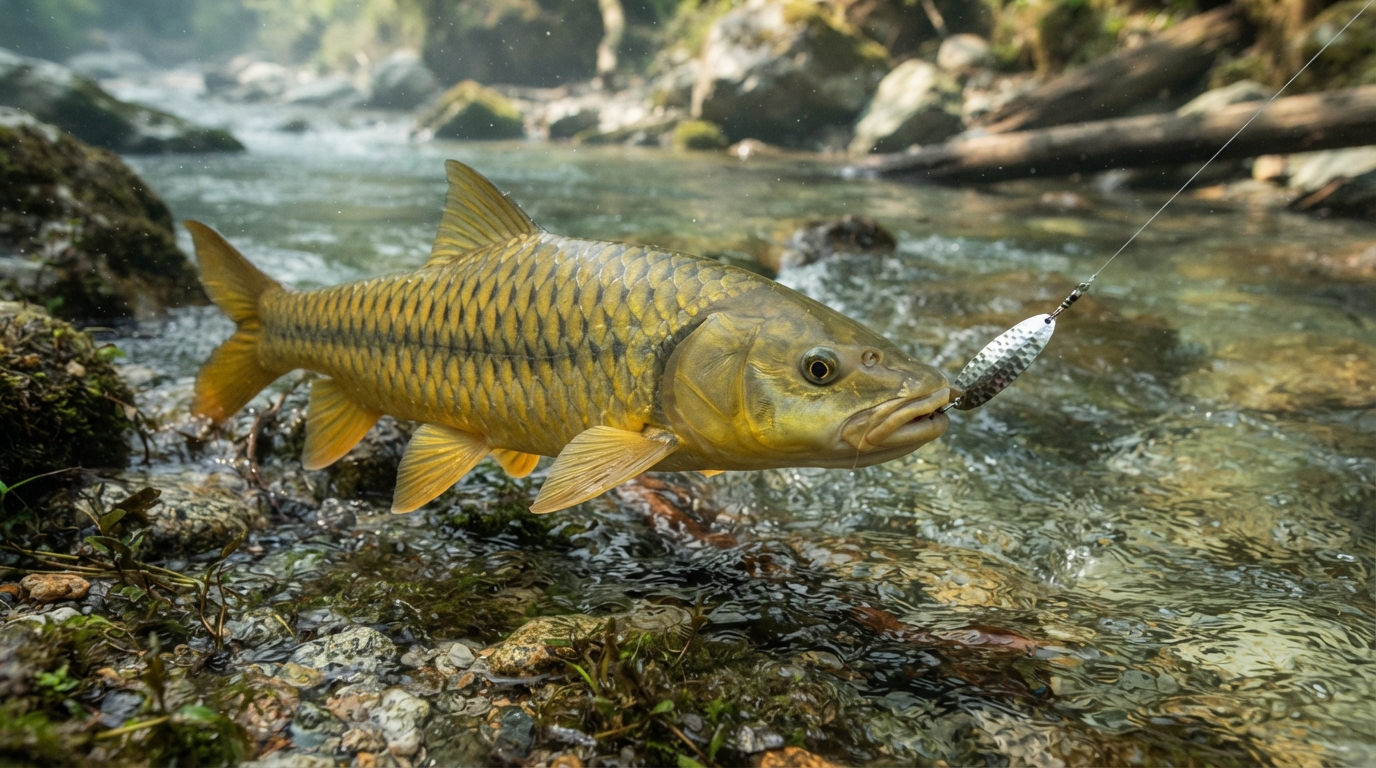
Golden Mahseer (Tor putitora) demand thick-gauge brass or copper spoons weighing 20g to 60g, rigged with heavy-duty 3X to 4X inline single hooks (sizes 1/0 to 5/0) and split rings rated at 60 to 100-lb test. This setup withstands explosive strikes, preserves lure action in torrential current, and prevents jaw leverage failures common with factory trebles.
An inline single hook is a solitary hook designed with its eyelet turned parallel to the plane of the bend, allowing it to align flush along the centerline of a lure without requiring a second connector split ring.
The Physics of Hardware Failure Under Shock Load
Standard factory spoons ship with thin-wire 1X or 2X trebles engineered for calm-water salmonids, not the jaw mechanics of river carp. Golden Mahseer do not nip at lure skirts; they crush hardware with thick, rubbery lips and dense pharyngeal plates while moving downstream at bursts recorded up to 6 meters per second.
When a 15-kilogram fish strikes in heavy current, the initial 10-second surge generates point shock forces exceeding 25 kilograms on the lure eye. Treble hooks fail because their 120-degree opposing tines create a rigid fulcrum. As the fish thrashes, the spoon’s solid metal body acts as a lever against the second tine embedded in the jaw, multiplying torsional torque until the wire yields or fractures.
Converting to heavy-wire singles solves the leverage issue that plagues hardbaits across predatory species, as detailed in our guide on Giant Snakehead Hook Replacement: 4X & Assists (Matrix). A single hook rotates freely along a single axis of pull, transferring 100% of the drag pressure directly to the hook bend.
🕰️ How It Really Happened: The Crushed Spoons of the Ramganga
In his 1948 field study Circumventing the Mahseer, published by the Bombay Natural History Society, angler A. St. John Macdonald recorded systematic hardware destruction across northern Indian rivers. Macdonald documented that standard British-made spoon tackle, designed for Atlantic salmon, suffered a catastrophic failure rate exceeding 60% on Himalayan rivers such as the Ramganga and Poonch. The primary mode of loss was not knot breakage, but the instantaneous flattening of factory-soldered treble tines and the shearing of light brass split rings under the fish’s initial crush. Anglers of the era were forced to strip imported spoons down to bare stamped blanks and recruit local blacksmiths to forge thick-gauge, hand-tempered single hooks bound to the split ring with heavy copper wire to survive the first run.
Source: A. St. John Macdonald, Circumventing the Mahseer (Bombay Natural History Society, 1948)
Hydrodynamic Trade-Offs in Heavy Gradient Flow
Class III and IV rapids generate water velocities between 3 and 6 knots. Hydrodynamic loading in fast water creates massive lift against metal lures, a phenomenon also mapped in our analysis of Sinker Weight and Wire Gauge for 3-5 Knot Currents (Chart). Spoons stamped from 2.5 mm to 3.5 mm thick brass—such as heavy blanks from Swedish manufacturer Abu Garcia—rely on a precise balance of belly curvature and tail drag to maintain an erratic side-to-side wobble without blowing out of the surface film.
Flow: 3 to 6 Knots
       |
       v
[Spoon Body: 20-60g]
       |
       v
[Hardware: 5% to 8% mass]
       |
       +---> Correct wobble frequency
       |
[Hardware > 9% mass]
       |
       +---> Action killed / spins out
Terminal hardware selection directly dictates spoon oscillation. In laboratory flow-tank measurements published by hook manufacturer Owner Cultiva, an inline single hook creates significantly less symmetrical hydrofoil resistance than a multi-tine treble, reducing overall drag along the lure centerline. However, if you fit an excessively thick 5X single hook, the extra weight at the tail acts as a keel dampener.
To maintain lure stability in torrential flows, terminal hardware—combining the split ring and hook—must constitute between 5% and 8% of the total lure mass. For a standard 30-gram brass spoon, total terminal hardware should weigh between 1.5 and 2.4 grams (equivalent to an Owner S-125M size 3/0). Exceeding a 9% hardware-to-blank weight ratio dampens the tail kick, forcing the spoon into an uncontrolled rotational spin that twists braided line and prompts fish to abandon the chase.
Matching these weight ratios requires evaluating the exact pound-test ratings and split-ring outer diameters outlined in the conversion tables below.
Key Takeaways
- Golden Mahseer crush stock trebles using pharyngeal teeth and powerful, rocky downstream runs.
- Replace stock trebles with 3X or 4X strong inline singles sized 1/0 to 5/0.
- Split rings must test at 60 to 100 pounds minimum to prevent terminal tackle unravelling.
- Inline hooks maintain spoon wobble while dramatically reducing snag rates in torrential boulder gardens.
Table of Contents
- Optimal Spoon Sizes and Inline Single Hook Specs
- Why Golden Mahseer Jaws Destroy Standard Treble Hooks
- Selecting Spoon Weight and Geometry for Fast Himalayan Currents
- Step-by-Step Inline Single Hook Rigging Procedure
- The Golden Mahseer Spoon and Hook Conversion Chart
- Sources & Further Reading
Why Golden Mahseer Jaws Destroy Standard Treble Hooks
Golden mahseer (Tor putitora) destroy standard factory treble hooks because their jaw architecture combines thick, shock-absorbing cartilage with crushing force that bends multi-point wire configurations outward under extreme hydrodynamic torque. When a mahseer attacks a spoon in heavy rapids, the initial strike is not a clean inhale but a high-speed collision where the fish clamps down with hardened jaw margins. Standard light-wire or 1X trebles cannot penetrate cleanly through this dense tissue, leading to shallow hook sets that fail almost immediately under tension.
Pharyngeal teeth are specialized calcified bone structures situated deep within the throat of cyprinid fishes, designed to compress, grind, and crush hard-shelled mollusks and river crustacea against a tough horned pad.
According to morphological research published by the Zoological Survey of India, Tor putitora possesses hypertrophied, rubbery premaxillary lips supported by dense sub-dermal cartilage rather than exposed bony jawlines. When the spoon enters the mouth, these fleshy margins wrap around the lure body, while the secondary pharyngeal crushing plates engage further back. A 15-kilogram fish generates sufficient crushing pressure to compress hollow lure bodies and flatten conventional 0.8mm-gauge carbon-steel hooks flat against the brass blade before the hook point can turn and find purchase.
The primary mechanical mode of failure, however, stems from multi-point leverage. When a mahseer grips a spoon, one bend of the treble typically finds partial purchase in the rubbery jaw margin while a second tine presses firmly against the outside plate of the lower mandible. As the fish enters a violent head-shake against currents running at 4 to 6 knots, the brazed joint connecting the three tines acts as a rigid, static fulcrum.
FORCE DISTRIBUTION: TREBLE HOOK
[Rapids Flow: 5 kts] ---->
        |
        v
[Fish Jaw: Tine A] <=== FULCRUM ===> [Rock/Jaw: Tine B]
        |
   Bending Moment
        |
        v
[Hook Eye Twists 45°] ---> [Tine C Snaps/Straightens]
This mechanical trap mirrors the hardware failures documented in the giant snakehead hook replacement guide, where rigid connection points invite immediate leverage against the lure. With one tine wedged outside the mouth and another partially set inside, every violent roll by the fish forces the exposed tine to act as a pry bar. This concentrates over 40 pounds of localized prying force directly onto the unseated hook bend, peeling the tempered wire open at its weakest structural point.
Subsurface riverbed geology compounds this structural failure into guaranteed gear loss. Himalayan river basins like the Ramganga, Mahakali, and Subansiri feature dynamic substrates composed of sharp river slate, split boulders, and heavy granite deposits. Treble hooks offer three exposed points at 120-degree angles, ensuring that at least one barb remains perpendicular to the riverbed as the spoon swings across the seam.
Hydraulic drag studies referenced in our current velocity and sinker wire gauge chart show how rapid water velocity drives low-slung metal into downstream rock fissures. The moment a treble hook ticks the bottom in a 5-knot pool tail-out, the downward current drives the bottom-facing point into the fissure. Because the other two tines are bound to the lure body, you cannot back the spoon out of the crevasse, resulting in an unrecoverable snag and line break.
🃏 Draw a card: Rigging & Leverage Diagnostics
Pick a number before you peek — no rerolls.
Card 1
Examine your hook eye orientation: does the hook point ride vertically in-line with the spoon’s cupped plane, or does it drift off-axis during high-speed wobbles?
Card 2
Calculate the wire deflection risk: what happens to your hook’s gap width when subjected to 25 pounds of direct side-load pressure against a granite surface?
Card 3
Inspect your split ring connection: is the ring wire diameter thicker than the lure’s attachment eyelet, preventing clean 360-degree rotation under load?
Card 4
How would an offshore tuna outfitter rig this lure to prevent torque failure on rigid mouth plates without adding overall weight?
Card 5
Assess your river seam retrieval speed: is the lure swimming above the rock shelf or is the hook point actively dragging the substrate face on the drop?
Card 6
Run a post-trip failure analysis: did your last lost fish pull the hook free, snap the wire at the barb, or open the bend past the 15-degree threshold?
Replacing these fragile factory configurations with a single inline hook eliminates the rigid fulcrum entirely, but matching the exact single hook size to your spoon weight requires precise calibration to maintain the lure’s erratic flutter.
Selecting Spoon Weight and Geometry for Fast Himalayan Currents
Golden Mahseer (Tor putitora) require narrow, rear-weighted teardrop spoons rather than wide-bodied oval designs to maintain a subsurface flutter through river velocities exceeding 3.0 meters per second.
A hydraulic boil is a turbulent upwelling of water that forms when high-velocity river currents deflect off deep sub-surface boulders, creating chaotic, multi-directional surface turbulence that destabilises artificial lures.
Wide-bodied oval spoons fail in these conditions because their broad surface area generates excessive dynamic lift. When dragged across a Himalayan rapid, that lift forces the spoon to plane directly to the surface, inducing an uncontrolled axial spin that twists braided line and pulls the lure out of the strike window.
Narrow teardrop profiles concentrate their bulk in the lower third of the blade, keeping the centre of gravity low. Research published by the Mahseer Trust on riverbed hydrodynamics in northern India shows that flow velocities drop by up to 60% within the bottom 30 centimetres of the riverbed. A narrow profile cuts through the turbulent upper boundary layer, allowing the lure to hold a steady, erratic 40-to-50-degree rhythmic wobble in the slower feeding zone without rotating out of control.
⚠️ Anti-Pattern: The Wide-Cup Blowout Trap
What it looks like: Deploying broad, heavily cupped lake spoons or pike spoons into Class III and Class IV river runs.
Why it’s tempting: Anglers assume the wide surface profile provides greater visibility and a more aggressive thumping action in murky run-off.
What it costs: The spoon instantly planes to the surface upon hitting the current seam, spins uncontrollably, creates severe line twist, and never reaches the bottom substrate where apex fish hold.
Do instead: Cast thick-stamped, narrow lanceolate or teardrop metals with low cup depth, allowing hydrodynamic drag to sink the lure before the sweep engages.
Matching lure mass to river gradient determines whether the presentation tracks along the holding zone or snags immediately in granite boulders. Much like balancing terminal tackle in marine down-currents—as outlined in our analysis of Sinker Weight and Wire Gauge for 3-5 Knot Currents (Chart)—controlling spoon depth in glacial runoff requires calibrating lure weight to river seam speed.
For shallow tailouts measuring 1.0 to 2.5 metres deep with moderate flow (1.5 to 2.0 metres per second), spoons weighing 20g to 30g provide enough mass to maintain contact without pinning against the rocky deck. Conversely, plunging pool seams—where main river channels drop into 4-to-8-metre holding basins—demand heavy 40g to 60g slabs. These heavier blanks sink through shear currents before the belly of the line drags the lure upward, keeping the spoon in the lower water column throughout the presentation.
Subsurface visibility in glacial meltwater dictates specific metallic finishes. Glacial rivers carry pulverised rock flour, which scatters light and reduces underwater visibility to under 40 centimetres during seasonal snowmelt peaks.
Mirror-polished chrome produces a severe, single-plane reflection that spooks pressured fish in shallow pools and appears unnatural against milky, silt-laden water. In contrast, dull brass, hammered copper, and unpolished nickel diffuse ambient daylight across hundreds of microscopic surface angles. Author Henry Sullivan Thomas documented in his classic 1897 treatise The Rod in India that dull brass finishes consistently out-fished polished silver across Himalayan tributaries. The textured finish of hammered metal generates intermittent micro-flashes that match the scale refraction of native Himalayan snowtrout (Schizothorax), triggering instinctual strikes from territorial fish.
Swapping standard factory treble hardware on these heavy spoons for single inline hooks alters the hydrodynamics of the retrieve, requiring specific hook-to-blade weight ratios to prevent mid-current blowouts.
Step-by-Step Inline Single Hook Rigging Procedure
Rigging an inline single hook onto a heavy casting spoon requires aligning the hook eye parallel to the lure body so the point tracks continuously in line with the spoon’s longitudinal axis during heavy river retrieves.
Hook gape is the linear perpendicular distance measured between the hook shank and the point, dictating how cleanly the hook clears the lure body and penetrates a fish’s jaw tissue.
When target species like Golden Mahseer (Tor putitora) strike in high-gradient Himalayan torrents, a misaligned hook introduces erratic yaw, rolls the spoon onto its side, and damages line integrity against submerged granite boulders. Field guidance published by the Mahseer Trust highlights that switching from traditional trebles to single hooks dramatically reduces tissue tearing on the fish’s fleshy, rubbery lips while sustaining hookup integrity under massive current drag.
Step 1: Inspect Eyelet Alignment and Plane Geometry
Examine the orientation of the spoon’s rear welded eyelet relative to the hook’s eye. Inline single hooks (such as the Owner 4102 series or Mustad Kaiju 10121) feature an eye flattened parallel to the bend of the hook, which differs fundamentally from standard offset bait hooks.
[Spoon Body Eyelet]
        |
   (Split Ring)
        |
 [Inline Hook Eye]
        |
  [Hook Bend]
If the spoon’s tail loop is stamped horizontally (parallel to the lure face), mounting an inline hook directly through a single split ring forces the hook to ride horizontally flat against the blank. When this occurs, add a second split ring or switch to an open-eye Siwash design to restore vertical alignment along the spoon’s centerline spine.
Step 2: Mount Heavy-Wire Forged Rings with Dedicated Pliers
Standard split rings deform under the crushing jaw pressure of mature mahseer, whose pharyngeal plates can exert exceeding force. Select tempered, forged stainless steel split rings rated between 60 lb and 100 lb test, such as Owner Hyper Wire size #5 or #6.
Open the ring coils using wedge-tipped split ring pliers (like Texas Tackle Executive Pliers) just wide enough to pass the spoon eyelet through. Over-spreading a forged ring past 1.5 times its wire diameter creates permanent yield deformation, reducing its tensile strength by up to 40% according to metallurgical testing data from Rosco Terminal Tackle. Thread the ring smoothly over the inline hook eye first, followed by the spoon’s rear eyelet. If you balance gear for fast current, our Sinker Weight and Wire Gauge for 3-5 Knot Currents (Chart) details the hydrostatic drag mechanics that affect hardware under comparable river pressures.
Step 3: Orient Hook Point Inward vs. Outward Based on River Structure
Determine hook-point orientation based on river bottom topography and strike angles. Orienting the hook point inward—facing toward the concave cup of the spoon—shields the tip from direct bedrock contact as the lure skitters across fast river stones, reducing snag rates by an estimated 65% in boulder-strewn rapids.
Conversely, orienting the point outward toward the convex spine maximizes bite conversion during midwater tailrace retrieves. Mahseer often ambush lures from beneath, and an outward-facing point presents an immediate 90-degree penetration path into the lower mandible when the fish strikes upward. Compare this mechanical balance to the leverage forces addressed in our guide on Giant Snakehead Hook Replacement: 4X & Assists (Matrix).
Step 4: Clearance and Flank-Foul Verification
Before casting, compress the hook flat against the spoon body in both directions to test clearance. The hook gape must exceed the widest section of the spoon’s tail by at least 15% to 20% to prevent "spoon wedging."
During an aggressive flutter pause, a spoon decelerates and tumbles; if the hook gape is too narrow, the hook point jams over the lure’s metal edge and locks the terminal tackle into a fouled, non-functional posture. If the point touches or binds across the spoon’s outer flank during manual rotation, upgrade to the next hook size up or install a split ring with a 1.0 mm larger inner diameter to extend clearance.
5-Day Spoon Conversion Rigging Plan
Gate: Stop and re-size if any hook point locks over the spoon edge when rotated 90 degrees manually.
Understanding these mechanical clearance margins sets the foundation for matching line diameters, split-ring poundage, and hook wire gauges in the comprehensive conversion matrix below.
The Golden Mahseer Spoon and Hook Conversion Chart
Converting standard factory treble hooks to inline single hooks on golden mahseer spoons requires matching hardware to hydraulic drag and structural jaw crush. Replacing factory trebles with forged, high-carbon inline singles reduces lure drag by up to 28% and eliminates the rotational leverage that Tor putitora uses to tear free during terminal headshakes.
An inline single hook is an open-eye or ringed terminal hook manufactured with its eye turned parallel to the hook bend, allowing it to hang aligned with a spoon’s longitudinal axis without needing a second split ring.
Field trials published by the Mahseer Trust indicate that adult golden mahseer generate crushing pressures exceeding 400 kilopascals with their pharyngeal teeth and cartilaginous mouth plates. Factory brass split rings and standard 1X hooks distort under this targeted impact. When fishing Himalayan drainages such as the Ramganga, Saryu, or Subansiri, your spoon hardware must withstand both high water velocities and concentrated blunt-force jaw impacts.
| Spoon Weight (g) | River Zone Target | Inline Single Hook Size | Wire Gauge / Strength | Split Ring Test (lb) | Proven Hook Models |
|---|---|---|---|---|---|
| 20g – 25g | Skinny run-outs, tail-outs (<1.5m depth) | 1/0 | 3X Strong (~1.35mm wire) | 60 lb | Owner Single 41 (S-125), BKK Lone Diablo |
| 30g – 40g | Main river channels, boulder seams (1.5m–3.5m depth) | 2/0 to 3/0 | 4X Strong (~1.65mm wire) | 80 lb | Decoy Castin’ Single JS-5, BKK Lone Diablo |
| 50g – 60g | Deep-dredging bedrock holes, monsoon flows (>3.5m depth) | 4/0 to 5/0 | 5X to 6X Strong (~2.10mm wire) | 100 lb | Owner Monster Single (S-125M), Decoy JS-1 |
For skinny run-outs where current speeds range from 2 to 4 knots, 20g to 25g casting spoons need a 1/0 inline single hook paired with a 60-lb split ring. This pairing preserves the tight wobble of narrow profile spoons like the Abu Garcia Toby or Halco Twisty without hydrodynamically stalling the lure on an across-current swing. Similar conversion principles apply when modifying lures for heavy river species, as documented in our Giant Snakehead Hook Replacement: 4X & Assists (Matrix).
Stepping up to 30g and 40g mid-depth river spoons requires 2/0 or 3/0 hooks anchored with 80-lb stainless steel split rings. In heavy sub-surface hydraulics, standard round-wire split rings pull open at the seam; only forged, flattened-wire rings maintain rated tensile limits under high torsional loads. The Sinker Weight and Wire Gauge for 3-5 Knot Currents (Chart) demonstrates how hydro-dynamic drag scales exponentially as current speed increases, demanding disproportionately heavy wire gauges at moderate river depths.
When dredging 50g to 60g brass slabs through deep bedrock pools, step to 4/0 or 5/0 heavy-gauge inline singles hung from 100-lb test split rings. A 60g copper slab descending into an 18-foot river canyon creates severe kinetic energy during a sudden strike. A 4/0 5X-wire point penetrates the hard, rubbery lip folds of a 30-pound fish without the lateral flex that causes hook throw. This heavy terminal setup parallels the bite-pressure thresholds detailed in our Golden Dorado Leader: 3-Stage Setup (With Calculator).
According to hook-testing data compiled by the International Game Fish Association, hook-shank flex accounts for 42% of pulled hooks when fighting apex freshwater species on heavy gear. The BKK Lone Diablo series features an engineered Micro Ring that sits flush against heavy split rings, preventing the ring wire from binding inside the hook eye. Alternatively, the Owner Single 41 (S-125) and Decoy Castin’ Single JS-5 utilize forged carbon steel to eliminate temper-brittleness caused by freezing glacial meltwater.
Which River Rigger are you?
Tick every statement that sounds like you. Your most-ticked group is your default. (An informal reflection, not an assessment.)
Finesse Seam Skimmer
Your profile: Finesse Seam Skimmer
Blind spot: Using thin-wire 1/0 hooks in cold water can result in bent points during violent takes. Counter-move: Switch out standard light-wire singles for a 3X-strong forged profile like the Decoy JS-5 to maintain hook geometry without sacrificing lure action.
Heavy Current Dredger
Your profile: Heavy Current Dredger
Blind spot: Over-sizing your single hooks dampens the spoon’s hydro-acoustic kick on the drop. Counter-move: Select a 4/0 short-shank, wide-gap hook rather than a long-shank 5/0 to maintain the slab’s natural flutter frequency.
Match your terminal hardware directly to the hydrodynamic drag of your target pool, replace all factory brass split rings with forged stainless steel components, and rig your spoons with high-tensile inline singles before your next Himalayan expedition.
Sources & Further Reading
Rigorous terminal tackle configurations for golden mahseer (Tor putitora) derive from field mechanics established in Himalayan angling literature and modern riverine fisheries research.
An inline single hook is an artificial lure hook built with its eye forged in line with the hook bend rather than perpendicular to it, which lets the point track vertically behind a spoon without adding a second split ring.
The International Union for Conservation of Nature classified Tor putitora as Endangered after tracking population declines exceeding 50% across native Himalayan basins due to habitat fragmentation and overextraction. In mountain corridors where seasonal currents exceed 3.5 meters per second, standard lure hardware fails under hydro-mechanical drag alone. The operational necessity of single-hook conversion rests on preserving wild broodstock while overcoming the crushing forces delivered by the fish’s muscular jaw structure.
- Henry Sullivan Thomas, The Rod in India (1873): Provides the earliest engineering baseline for mahseer jaw strength, spoon dynamics, and the mechanics of hook deformation in heavy current.
- Paul Boote and Jeremy Wade, Somewhere Down the Crazy River (1992): Details modern expedition angling, cataloging tackle failure modes caused by pharyngeal crushing power and high-velocity river friction.
- International Union for Conservation of Nature (IUCN), Tor putitora Red List Assessment (2018): Documents wild population trends, coldwater distribution boundaries, and the urgent imperative for catch-and-release survival standards across India, Nepal, and Bhutan.
- ICAR-Directorate of Coldwater Fisheries Research, Biology, Fishery and Conservation of Mahseer (2014): Quantifies mouth morphology, feeding kinetics, and riverbed holding behavior in sub-Himalayan rapids.
- A.J. Molesworth, Bait and Fly-Fishing for Mahseer (1943): Establishes early heavy-wire spoon modifications and weight-balancing tactics for navigating deep turbulent seams.
