Best Saltwater Spinning Reels Under $300: 2026 Edition
The pursuit of the perfect saltwater spinning reel has historically forced anglers into a difficult paradigm: either sacrifice long-term durability for immediate affordability, or deplete fishing budgets entirely on flagship models exceeding the thousand-dollar mark. However, the mechanical engineering landscape within the tackle industry has fundamentally shifted entering 2026. Advanced manufacturing techniques, precise computational fluid dynamics utilized for internal sealing, and the trickledown economics of oversized gearing have completely transformed the mid-tier market. Today, securing the best saltwater spinning reels 2026 has to offer, specifically under the highly competitive $300 threshold, no longer requires a compromise on torque, smoothness, or reliability.
In this comprehensive technical analysis, the focus is placed squarely on the heavyweights currently dominating the commercial market: the newly released Quantum Benchmark and the structurally proven Daiwa BG MQ. Both of these specific reels have been evaluated meticulously against the harsh realities of the marine environment. The central thesis of this report relies on two highly critical metrics that separate disposable gear from generational tackle: sustained durability in highly corrosive saltwater environments, and absolute drag linearity under extreme, sudden tension. High performance on the flats, in the surf, or pulling pelagics from the deep blue does not have to break the bank.
The Foundational Metrics of Evaluation: Drag Linearity and Marine Durability
Before dissecting the specific internal architecture of the contending reels, it is mathematically imperative to understand the technical parameters that define a premium saltwater spinning reel. Marketing terminology and flashy exterior paint frequently obscure real-world mechanical performance, making empirical evaluation necessary.
The Physics of Drag Linearity
Drag linearity refers to the mechanical consistency of resistance applied to the fishing line as it is pulled from the spool by a fleeing fish. When a powerful pelagic species, such as a mature tarpon or yellowfin tuna, makes a sudden, high-speed surge, the reel’s drag stack must engage instantaneously and smoothly. A non-linear drag system suffers from high “start-up inertia.” This means it requires significantly more physical force to overcome static friction and start the spool spinning than to maintain dynamic friction and keep it spinning. This sudden, momentary spike in tension is the primary cause of snapped fluorocarbon leaders and pulled hooks.
A strictly linear drag system provides a flat, highly predictable curve of resistance regardless of the spool’s rotational velocity. Furthermore, mechanical physics dictates that as line is stripped from the spool, the spool’s effective diameter decreases, which inherently increases the force required to turn it. Therefore, standard angling practice requires utilizing a digital scale to set the initial drag tension to exactly 20% to 30% of the main line’s stated breaking strength, accounting for this diameter reduction and the drag of the line moving through the water column.
Decoding Marine Durability and IPX Ingress Ratings
Saltwater is one of the most highly corrosive naturally occurring substances on earth. When saltwater intrudes into a reel’s gearbox and subsequently evaporates, it leaves behind abrasive salt crystals that act like grinding paste on delicate brass and aluminum gears. To quantitatively measure a reel’s water resistance, the industry utilizes the International Protection (IP) or Ingress Protection standard.
An IPX5 rating indicates resistance to low-pressure water jets, making it suitable for moderate spray. An IPX6 rating signifies protection against high-pressure water jets from any direction, allowing a reel to survive heavy surf conditions. An IPX8 rating denotes that the reel can withstand continuous, sustained submersion. However, anglers must maintain strict awareness that IPX testing is conducted utilizing fresh water; therefore, regardless of the IP rating, routine post-trip maintenance involving light freshwater rinsing and strategic lubrication remains mandatory to prevent galvanic corrosion.
Contender 1: The Quantum Benchmark Spinning Reel
The Quantum Benchmark represents a massive, calculated resurgence for the Quantum brand within the heavy-duty saltwater sector. Designed from the ground up as a rugged, uncompromising workhorse, this reel competes directly with established stalwarts like the Penn Battle III and Slammer IV, while maintaining a highly accessible price point ranging strictly between $189.99 and $239.99 depending on the size class. Available in an array of six sizes ranging from a compact 2500 up to a massive 8000, it effectively covers marine applications from light-tackle speckled trout in the backcountry to heavy offshore jigging.
Internal Architecture and Key Engineering Features
The foundational core of the Quantum Benchmark is its exceedingly rigid aluminum frame and sideplate. While carbon-composite and graphite bodies reduce overall weight, they are prone to microscopic flexing under immense load. Rigid aluminum prevents this frame flex, ensuring that the internal drive and pinion gears remain in perfect, strict alignment during heavy, prolonged fights with bottom-dwelling species like grouper.
The drivetrain itself features Quantum’s proprietary GEARTEQ Machined Gearing. These gears are precisely CNC-cut from premium aluminum and brass to incredibly tight tolerances, resulting in extreme cranking torque with virtually zero backplay in the handle assembly. This is supported by a 5+1 stainless steel ball bearing system that utilizes a specialized DURA-LOQ clutch bearing, ensuring instantaneous hooksets without the rotor slipping backward.
However, where the Benchmark truly separates itself from competitors in the sub-$200 price bracket is the integration of the SEALOQ 6 protection system. Rated to strict IPX6 standards, both the primary body and the spool are fully sealed against heavy saltwater spray, intruding sand, and fine debris. For surf casters and kayak anglers who routinely expose their gear to high-pressure waves, this level of verified sealing offers unprecedented longevity without requiring a $600 investment.
Drag Linearity and Stopping Power
Quantum engineered the Benchmark specifically with their class-leading CFX200 Carbon Fiber Xtreme drag system. Laboratory and field testing reveals a highly consistent, perfectly linear drag curve. The thermal dissipation properties of the carbon fiber washers prevent the drag from overheating, which causes the jerky, erratic behavior seen in cheaper felt-washer systems. The 8000-size model produces an absolutely staggering 40 pounds of maximum drag, while the smaller 3000-size yields a highly respectable 20 pounds. This provides exceptional stopping power for arresting the initial runs of large snook heading for mangrove roots.
| Model Size | Gear Ratio | Weight (oz) | Braid Capacity (Yds/Lbs) | Max Drag (lbs) | Retail Price (Est) |
|---|---|---|---|---|---|
| BK2500 | 6.2:1 | 10.4 | 275 / 10 | 20 | $189.99 |
| BK3000 | 6.2:1 | 11.2 | 275 / 15 | 20 | $199.99 |
| BK4000 | 6.2:1 | 12.8 | 300 / 20 | 25 | $199.99 |
| BK5000 | 5.6:1 | 16.9 | 400 / 30 | 30 | $219.99 |
| BK6000 | 5.6:1 | 21.2 | 375 / 50 | 35 | $229.99 |
| BK8000 | 4.7:1 | 26.5 | 410 / 65 | 40 | $239.99 |
Contender 2: The Daiwa BG MQ
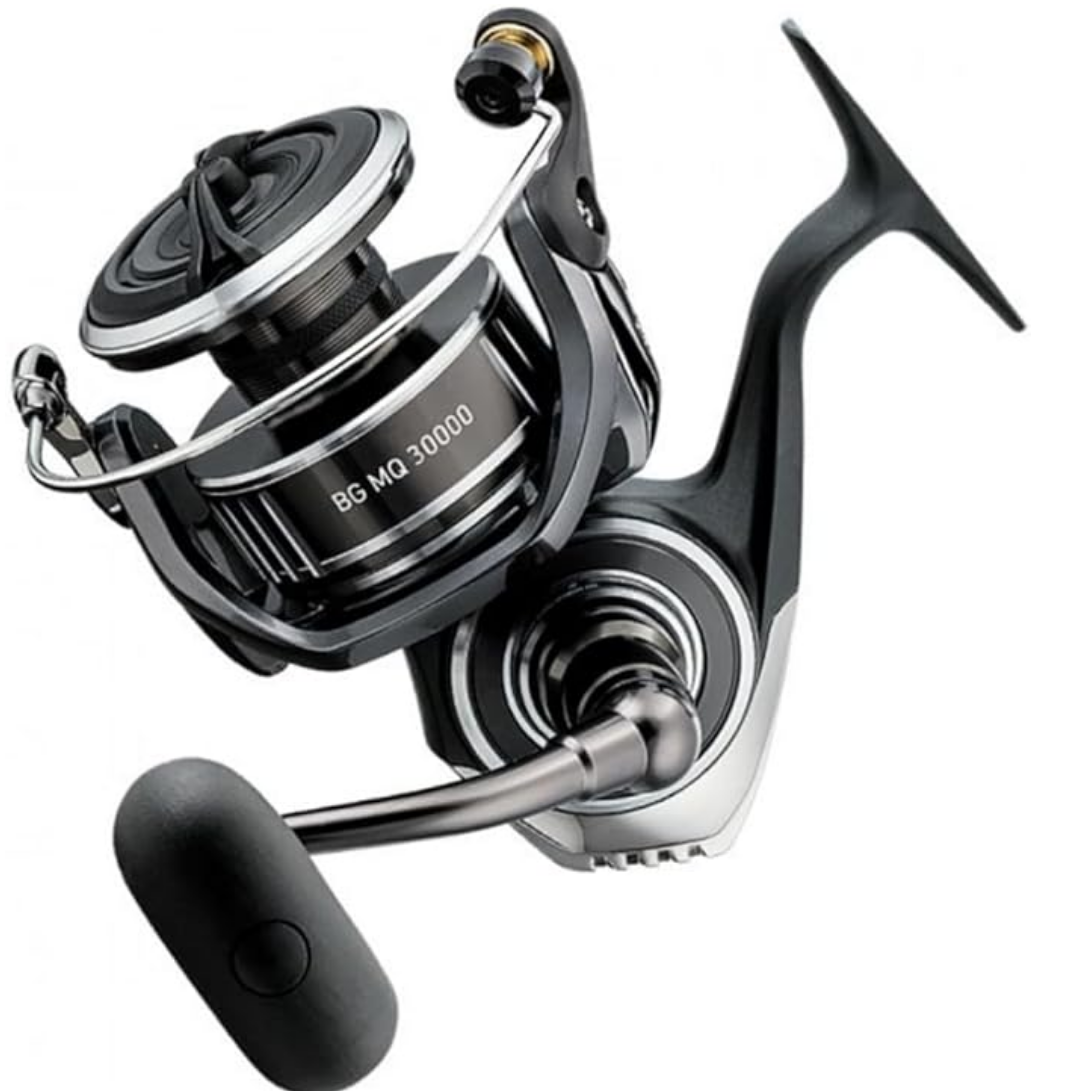
The Daiwa BG MQ builds upon the legendary, decade-spanning reliability of the original black-and-gold Daiwa BG, elevating the internal design with advanced Monocoque (MQ) technology. Ranging in price from $249.99 to $349.99 (for the largest offshore sizes), the BG MQ sits at the absolute upper echelon of the sub-$300 category for its inshore and nearshore models. It is widely considered an engineering marvel that brings flagship $800+ Daiwa Exist technology down to an accessible consumer level.
The Monocoque Revolution and Digigear
The architectural cornerstone of the Daiwa BG MQ is its Monocoque (MQ) aluminum chassis. Historically, spinning reels utilized a two-piece body design, relying on lateral screws to secure the side plate to the main frame. Under extreme torsional loads, these screwed frames exhibit micro-flexing, which forces the internal gears out of precise alignment. The MQ design entirely circumvents this physical limitation by employing a symmetrical, single-piece aluminum housing capped by a massive threaded engine plate.
This elimination of screw ports serves a dual purpose. First, it drastically reduces the potential points for water ingress, providing superb overall water resistance. Second, and most importantly, it dramatically increases the spatial efficiency within the gearbox. This extra internal volume permits the integration of a digitally milled Digigear that boasts a 20% to 40% larger diameter than the gears found in the original BG and equivalently sized competitor reels. A larger gear with an aggressive, broadened tooth pattern translates directly to increased winching torque and a mechanical lifespan that testing indicates is one to three times longer than standard gears.
In terms of sealing, the BG MQ utilizes 9 strategic internal rubber seals at key intrusion points, including the main shaft and handle assembly. Interestingly, Daiwa actively opted not to use their proprietary magnetic oil (MagSeal) technology on this specific model. For many hardcore surf and kayak anglers, the reliance on high-quality rubber gaskets over magnetic oil is a distinct advantage, as it vastly simplifies home maintenance, allowing users to break down and re-grease the reel themselves without requiring specialized factory fluids.
ATD Drag and Start-Up Inertia
The BG MQ features Daiwa’s Automatic Tournament Drag (ATD) system. The ATD system is a marvel of chemical engineering, utilizing a highly specialized, proprietary drag grease that exhibits distinct non-Newtonian fluid properties. When the spool is at rest, the grease maintains a low viscosity. The exact millisecond a fish strikes and the spool begins to rapidly accelerate, the friction instantly causes the grease to become highly viscous.
This mechanical wizardry drastically reduces the initial start-up inertia, allowing the line to peel off the spool instantly without the sharp, sudden spike in tension that typically snaps light leaders. The result is one of the smoothest, most incredibly linear drag engagements available on the global market, making the smaller 2500 and 3000 sizes the absolute ultimate choice for finesse targeting of easily spooked inshore species.
| Model Size | Gear Ratio | Weight (oz) | Braid Capacity (Yds/Lbs) | Max Drag (lbs) | Retail Price (Est) |
|---|---|---|---|---|---|
| BGMQ2500D-H | 5.7:1 | 8.3 | 250 / 10 | 22.0 | $249.99 |
| BGMQ3000D-XH | 6.2:1 | 9.3 | 250 / 15 | 22.0 | $249.99 |
| BGMQ4000D-XH | 6.2:1 | 10.1 | 280 / 20 | 26.4 | $249.99 |
| BGMQ6000D-H | 5.7:1 | 15.2 | 320 / 30 | 26.4 | $289.99 |
| BGMQ8000-H | 5.7:1 | 22.4 | 330 / 40 | 33.1 | $299.99 |
| BGMQ10000-H | 5.7:1 | 22.8 | 330 / 50 | 33.1 | $299.99 |
Alternative Honorable Mentions in the Sub-$300 Category
While the Quantum Benchmark and the Daiwa BG MQ dominate the current conversation regarding the absolute best saltwater spinning reels in 2026, the marine environment is incredibly diverse. Therefore, two additional models warrant strict consideration depending on highly specific angling applications.
Penn Spinfisher VII: The Surf Caster’s Standard
The newly updated Penn Spinfisher VII (retailing between $179.95 and $289.95 depending on size) remains the undisputed standard for hardcore surf casters. Featuring an IPX5 sealing rating, it is specifically built to take a heavy splashing from crashing waves and ride exposed in a bumper-mounted rod rack through heavy salt spray without internal water intrusion into the gearbox. Its full metal body and CNC gear technology ensure the gears stay perfectly aligned, while the legendary HT-100 carbon fiber drag washers provide the heavy, unyielding stopping power required to turn massive sharks and bull redfish in heavy current.
Shimano Stradic FM: The Inshore Finesse Scalpel
For anglers dedicated strictly to inshore, light-tackle finesse applications, such as pitching 1/8th ounce soft plastics to tailing redfish or sight-casting to spooky bonefish, the Shimano Stradic FM (starting around $220) is unparalleled. While it lacks the heavy-duty IPX6 submersion sealing of the Benchmark or the massive winching power of the Spinfisher, its cold-forged HAGANE gear and MicroModule II tooth design deliver a remarkably silky-smooth, frictionless rotation. Weighing a mere 7.9 ounces in the 3000 size, it drastically reduces wrist and forearm fatigue during exhaustive, all-day casting sessions on the flats.
Head-to-Head Synthesis: Quantum Benchmark vs. Daiwa BG MQ
When directly comparing the Quantum Benchmark to the Daiwa BG MQ, identifying a solitary “winner” is a functional impossibility. The correct purchasing decision ultimately rests entirely on the angler’s primary marine environment, target species, and personal maintenance preferences.
Opt for the Quantum Benchmark if: The primary fishing environment involves heavy offshore spray, chaotic kayak fishing, or wading situations where the reel might be briefly but completely dunked in the wash. The certified IPX6 sealing provides immense, verified peace of mind against catastrophic water intrusion. Furthermore, the 40-pound max drag on the 8000 size offers a distinct, measurable superiority for winching heavy bottom fish out of sharp, line-cutting reef structures. Finally, the highly aggressive price point leaves extra room in the budget for spooling the reel with premium, 8-strand braided line.
Opt for the Daiwa BG MQ if: Absolute rotational smoothness, extended gear longevity, and extreme drag linearity are your ultimate priorities. The oversized Digigear housed within the rigid Monocoque body creates a feeling of effortless, fluid power that is simply unmatched at this specific price tier. The ATD drag system is scientifically proven to reduce start-up inertia, making the BG MQ the objectively superior choice when fishing lighter fluorocarbon leaders for easily spooked pelagics, albacore, or oversized speckled trout where a sudden jerk would result in immediate tackle failure.
Final Verdict
The best saltwater spinning reels of 2026 clearly demonstrate that high-end, precision marine engineering is no longer restricted strictly to flagship models with exorbitant price tags. Both the Quantum Benchmark and the Daiwa BG MQ deliver uncompromising durability, immense torque, and exceptional drag linearity. By carefully matching the reel’s specific technological advantages, whether that is the IPX6 ingress sealing of the Benchmark or the frictionless Monocoque chassis of the BG MQ, to your specific saltwater environment, you are guaranteed a reliable, high-performance experience that will endure years of harsh marine abuse.
External References & Technical Resources
To further expand your understanding of marine tackle mechanics, we recommend the following external resources.
Disclaimer: Extreme Angler participates in the Amazon Services LLC Associates Program. If you utilize the commercial links provided within this analysis, a specialized commission is generated at no supplemental cost to your purchase. This structural model strictly funds the ongoing independent testing of marine hardware.