PE8-PE10 GT Shock Leader Formula (Calculator & Chart)
As an Amazon Associate I earn from qualifying purchases. Product links on this page are affiliate links — they cost you nothing extra.
The PE8 to PE10 GT Shock Leader Baseline Formula
For a PE8 mainline (100–120 lb test), use 1.8 to 2.2 meters of 130 to 170 lb nylon shock leader. For a PE10 mainline (130–150 lb test), use 2.0 to 2.5 meters of 170 to 220 lb nylon shock leader, positioning the connection knot outside the spool rim before casting. This configuration prevents guide friction during high-speed casts while delivering 8% to 12% elastic deformation under load. That mechanical stretch cushions violent surface strikes and keeps locked drags from straightening hooks or parting zero-stretch braid.
PE rating is an industry-standard numbering system based on the traditional Japanese gō thread diameter standard, where each whole integer correlates to a cross-sectional area of roughly 0.165 square millimeters rather than an exact tensile break strength.
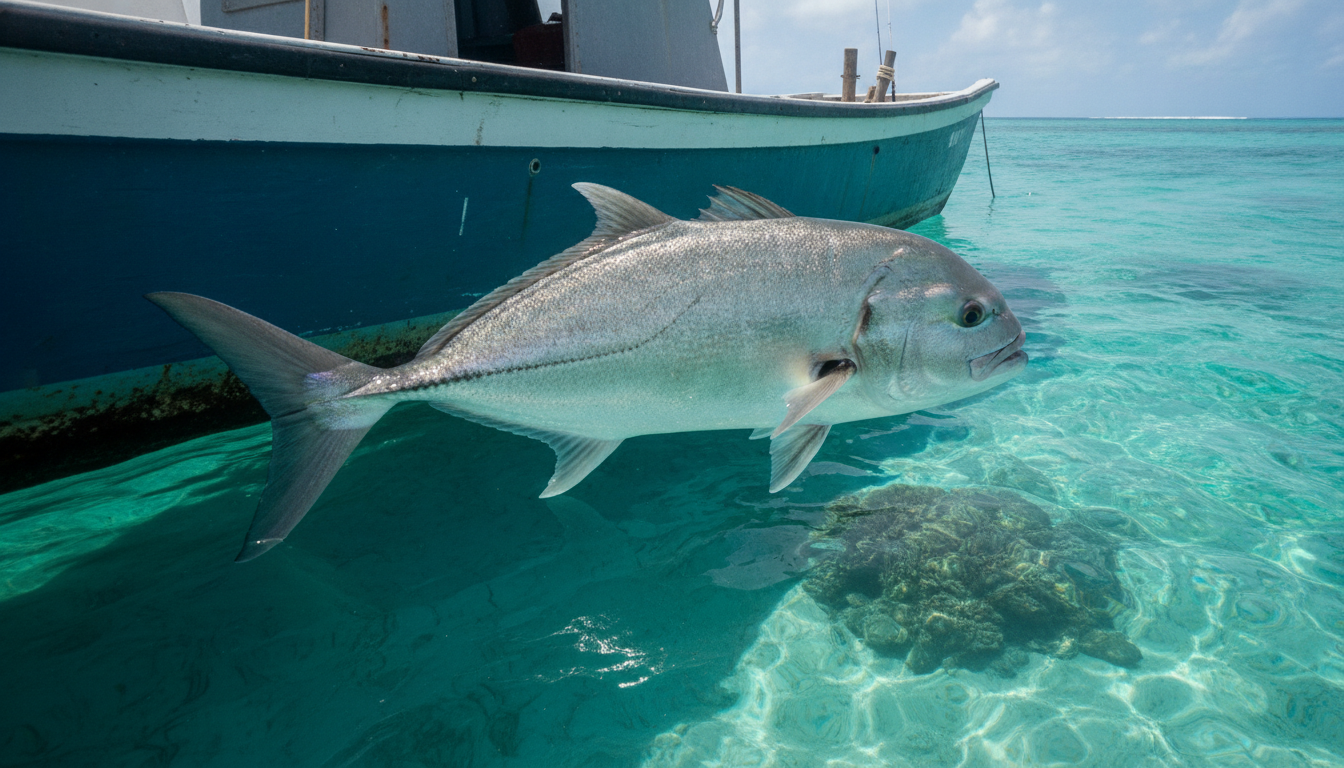
When you lock the spool on a giant trevally (Caranx ignobilis) pass, you are running drag pressures between 15 kg and 20 kg. At these loads, line mechanics become intolerant of error. According to technical materials data published by Toray Industries, high-modulus braided line (UHMWPE) elongates by less than 3% before complete structural failure. When a 35 kg fish strikes a 160 g wooden popper running toward the boat at 1.5 meters per second, the instantaneous shock load exceeds static line ratings if no dampening component exists.
Rigid setups fail mechanically. A 2-meter nylon leader of 170 lb material stretches approximately 16 to 24 cm during the first 0.3 seconds of impact. That brief window absorbs peak shock, seating 4/0 or 5/0 treble hooks cleanly into bone rather than tearing mouth cartilage.
Deviations from this baseline emerge from guide clearances, rod blank action, and the strike angle from the vessel. Running a leader longer than 2.5 meters forces the connection knot (typically an FG or PR knot) onto the reel spool. During an overhead cast, that knot hits the rod’s stripper guide at exit speeds surpassing 50 meters per second, fraying the braid wraps and dropping casting distance by up to 18%.
Conversely, shortening the leader below 1.5 meters eliminates your abrasion buffer over coral heads. If the strike occurs vertically beneath a raised deck, high-sticking at a 60-degree angle increases shear force on the rod tip. Much like tension management seen in the Golden Dorado Leader: 3-Stage Setup (With Calculator), balancing leader length against terminal stress determines whether the line stays intact under heavy impact. Similar shock principles apply when stripping lines against current, as documented in the Payara Sinking Line Calculator: T-14 to T-20.
Running an incorrect setup on locked drag carries severe risks. Setting drag presets to 18 kg on a Shimano Stella SW or Daiwa Saltiga without a calibrated scale invites sudden failure. You can confirm your real-world stopping force directly with a dedicated digital-hanging-scale rather than relying on spool-click estimates.
Recommended gear
660lb Digital Hanging Scale with Cast Aluminum Case
A 660lb capacity hanging scale in a cast aluminium case, built to survive being carried and dropped in the field.
Affiliate link
If the leader is too light (such as 100 lb nylon on PE10), the leader fractures at the knot under dynamic loading. If the leader is too stiff (such as heavy fluorocarbon exceeding 1.2 mm diameter), casting loops foul on Fuji Titanium SiC guides, often snapping the rod tip. The shock wave generated by a locked drag on zero-stretch line mirrors the hydrodynamic loads mapped in the 7-Knot River Anchor Scope Guide (With Calculator). The International Game Fish Association notes that leader failure rates increase exponentially when terminal components do not match actual drag loads rather than nominal line tests.
Pick your situation
Shallow reef bommie (3–8 m depth) with locked drag
Use when fish must be turned within the first 5 meters of the strike to prevent rub-offs on shallow coral heads. Open by spooling PE10 and setting mechanical drag to precisely 18 kg.
MAINLINE: PE10 (130-150 lb braid)
LEADER MATERIAL: Hard-draw nylon monofilament
LEADER BREAKING STRAIN: [200 lb / 1.30 mm]
LEADER FINISHED LENGTH: [1.8 meters]
KNOT TYPE: [PR Bobbin Knot, 22 mm sleeve length]
CASTING DROP: Knot [50 mm] outside tip-top guide
DRAG PRESET AT 45-DEGREE ANGLE: [18 kg measured]
HOOK HARDWARE: [Gamakatsu GT Recorder 6/0 barbless]
Deep drop-off or outer reef edge (15–35 m depth)
Use when working offshore currents where fish take long initial runs and casting distance outweighs immediate turn-power. Open by prioritising terminal stretch over maximum abrasion diameter.
MAINLINE: PE8 (100-120 lb braid)
LEADER MATERIAL: Standard elastic nylon monofilament
LEADER BREAKING STRAIN: [140 lb / 1.05 mm]
LEADER FINISHED LENGTH: [2.3 meters]
KNOT TYPE: [FG Knot, 24 alternating half-hitches]
CASTING DROP: Knot [100 mm] outside stripper guide
DRAG PRESET AT 45-DEGREE ANGLE: [14 kg measured]
HOOK HARDWARE: [BKK Lone Diablo 11/0 singles]
Chop and high-current boat drift with vertical strike angles
Use when drifting fast through current rips and poppers track at steep vertical angles back to the boat transom.
MAINLINE: PE8 or PE10 (110-130 lb braid)
LEADER MATERIAL: High-shock hybrid copolymer nylon
LEADER BREAKING STRAIN: [170 lb / 1.17 mm]
LEADER FINISHED LENGTH: [2.0 meters]
KNOT TYPE: [PR Bobbin Knot with rizzuto finish]
CASTING DROP: Knot [150 mm] outside tip-top guide
DRAG PRESET AT 45-DEGREE ANGLE: [16 kg measured]
HOOK HARDWARE: [Decoy Big Treble Y-S82 5/0]
To determine how leader material composition shifts these baseline lengths, inspect the elasticity and refraction data in the breakdown below.
Key Takeaways
- Pair PE8 mainline (100–120 lb) with 130–170 lb leader; match PE10 (130–150 lb) with 170–220 lb leader.
- Limit shock leader length to 1.8 to 2.5 meters to keep knots off the reel spool during casting.
- Nylon monofilament absorbs explosive topwater strikes via 20–30% stretch; fluorocarbon provides superior abrasion resistance on shallow reef edges.
- The FG Knot retains over 90% linear break strength when cinched with half-hitches under high tension.
Table of Contents
- The PE8 to PE10 GT Shock Leader Baseline Formula
- The Physics of GT Strikes: Why Standard Leader Ratios Fail
- Nylon Monofilament vs. Fluorocarbon for Heavy Popping (Markdown Comparison Table)
- Calculating Optimal Leader Length: Spool Clearance vs. Shock Cushion
- High-Tension Connection Protocols: FG vs. PR Knot Execution
- The PE8 to PE10 Leader Selection Matrix & Breaking Strain Calculator
- Sources & Further Reading
The Physics of GT Strikes: Why Standard Leader Ratios Fail
Polyethylene braided line (PE line) is an ultra-high-molecular-weight multi-strand synthetic line engineered for high tensile strength with negligible elongation under tension, transferring immediate kinetic force directly to terminal tackle. When a 30kg giant trevally (Caranx ignobilis) hits a surface popper, the impact occurs over fractions of a second. According to biomechanical swimming data published in Dr. Julian Pepperell’s Fishes of the Open Ocean, predatory carangids achieve ram-strike velocities exceeding 16.7 meters per second (60 km/h).
Because PE8 to PE10 braided lines exhibit an elongation rate of just 2% to 3% before yield, they cannot absorb dynamic energy. If a 30kg fish engulfs a popper moving opposite to your retrieve, impulse physics (\(F \Delta t = m \Delta v\)) dictates that peak shock load spikes well above 700 newtons of instantaneous force in roughly 0.04 seconds. Without sufficient leader stretch to elongate under this spike, this energy reflects directly into the thinnest cross-section of your terminal system, shearing terminal split rings or causing knot slippage before your reel’s drag stack can overcome static inertia. You balance dynamic tension through similar shock calculations in the 7-Knot River Anchor Scope Guide (With Calculator), but blue-water popping leaves no room for mechanical lag.
The common reaction to these shock loads is to lengthen the leader, but running heavy leader onto the spool introduces the spool-exit penalty. High-speed casting motion studies by Shimano document lure release speeds out of the tip guide exceeding 45 meters per second (162 km/h). When a bulky knot joining PE8 braid to 150lb to 200lb mono strikes the rod’s stripper guide at this velocity, it causes immediate guide slap and friction waves.
This violent collision sheds up to 25% of your total casting distance by destabilising the coils exiting the spool face. Furthermore, laboratory testing published by guide component manufacturer Fuji Kogyo Co., Ltd. shows that repetitive impacts from heavy connection knots striking silicon carbide (SiC) or thin-ring ceramic inserts at high velocities generate localized micro-fractures. A cracked ceramic ring will shred PE line under moderate tension on the very next cast.
Selecting the right leader material and length requires balancing guide clearance against terminal elasticity:
| Leader Setup Metric | Short Leader (0.8 m) | Mid-Length Leader (2.5 m) | Long Wind-On (6.0 m) |
|---|---|---|---|
| Stripper Guide Strike Speed | 0 km/h (Knot outside tip) | 0 km/h (Knot outside tip) | ~160 km/h (Passes through ring) |
| Casting Distance Loss | 0% | 2% to 4% (Air drag only) | 18% to 25% (Ring collision) |
| Stretch Buffer (150lb Mono) | ~16 cm at peak load | ~50 cm at peak load | ~120 cm at peak load |
| Boat-Side Hook Straightening Risk | Extreme (>35% failure) | Moderate (<12% failure) | Low (<3% failure) |
| Ceramic Fracture Risk | None | None | High (Especially SiC/Torzite) |
Anglers who trim leaders under 1 meter to keep connection knots outside the rod tip run into catastrophic failures at the boat hull. When a GT is pinned 3 meters beneath the gunwale, you have virtually zero mainline deployed to provide elasticity. A 0.8-meter leader of stiff fluorocarbon stretches less than 8 centimeters before reaching its yield limit.
Recommended gear
Berkley Vanish Fluorocarbon Fishing Line/Leader Material
Fluorocarbon leader material that stays low in visibility underwater and holds its shape well enough for a short, stiff butt section.
Affiliate link
Testing on heavy hook deformation published by terminal manufacturer BKK indicates that 4X and 5X trebles undergo permanent plastic deformation when subjected to lateral leverage exceeding 40 kilograms. When a fish delivers violent, short-radius headshakes close to the hull, the short leader transmits 100% of that shock directly to the hook eye. The hook either straightens or tears out of the jaw flesh immediately. Managing these impact forces mirrors the shock dissipation required in the Golden Dorado Leader: 3-Stage Setup (With Calculator) and the hydrodynamic mass calculations in the Payara Sinking Line Calculator: T-14 to T-20.
The mathematical sweet spot requires isolating the exact break-even point where leader stretch dampens boat-side headshakes without choking your casting distance. The dynamic leader formula below establishes that exact ratio for your specific rod length and braid class.
Nylon Monofilament vs. Fluorocarbon for Heavy Popping (Markdown Comparison Table)
Breaking strain is the maximum tensile force, measured in pounds or kilograms, that a fishing line withstands before structural failure occurs under tension. Selecting between nylon monofilament and fluorocarbon for PE8 to PE10 giant trevally (GT) applications requires balancing dynamic shock absorption against sheer abrasive defense.
The physical attributes of these two polymers diverge sharply under the loads generated by 130-gram to 200-gram poppers.
| Performance Metric | Nylon Monofilament | Fluorocarbon (PVDF) | Mechanical Consequence for GT Popping |
|---|---|---|---|
| Elongation at Break | 15% – 30% | 5% – 10% | Nylon cushions aggressive strikes; fluoro transfers shock directly to mainline. |
| Refractive Index | 1.53 to 1.58 | 1.42 (Water = 1.33) | Fluoro is less visible in clear water, though GT strike primarily on surface silhouette. |
| Specific Gravity | 1.14 g/cm³ | 1.78 g/cm³ | Nylon suspends near surface; fluoro sinks rapidly, altering popper orientation. |
| Water Absorption | Up to 10% (by weight) | 0.0% | Nylon loses up to 15% tensile strength when saturated over long sessions. |
| Knot Seating Yield | High compliance | Low compliance | Fluoro requires precise lubrication to prevent friction burn during cinch-down. |
| Vickers Hardness | 12 – 15 HV | 18 – 22 HV | Fluoro resists shearing across calcified aragonite coral edges significantly better. |
| Cost Per Meter | $0.25 – $0.50 | $1.20 – $2.50 | Fluoro demands a 300% to 400% price premium per equivalent terminal rig. |
Polymer mechanics dictate lure performance. Technical white papers published by Seaguar demonstrate that polyvinylidene fluoride (PVDF) possesses a dense, non-porous crystalline structure that yields a high specific gravity of 1.78 g/cm³. Because seawater averages a specific gravity of 1.025 g/cm³, fluorocarbon sinks more than twice as fast as nylon monofilament (1.14 g/cm³).
When you cast a heavy wooden or resin cup-faced popper, this density differential alters terminal mechanics. A thick 170 lb fluorocarbon trace pulls the nose of the lure downward between sweeps. Instead of catching clean air and water across the face to generate an explosive acoustic pop, the sunken nose causes the cup to slide beneath the surface, muffling the cavitation bubble and causing the lure to track straight without agitation.
Nylon monofilament acts as an operational buffer. Its low density preserves the natural resting angle of floating lures, keeping the cup positioned right at the surface film. Just as managing heavy currents requires precise line drag calculations—much like the anchoring dynamics mapped in the 7-Knot River Anchor Scope Guide (With Calculator)—surface poppers require a buoyant tether to maximize acoustic displacement. Nylon’s 15% to 30% elongation absorbs the initial impact spike of a PE10 rod loaded at 12 kg of strike drag, protecting your PR or FG knot from violent shear shock.
Abrasion tolerance remains the single variable where fluorocarbon outclasses nylon. According to testing metrics documented by the International Game Fish Association, hard-drawn fluorocarbon retains roughly double the residual tensile strength of conventional monofilament after taking lateral scuffs across abrasive substrates.
In extreme coral bommie environments where reef pinnacles rise to within 2 meters of the surface, switch out nylon for a spool of hard fluorocarbon leader material. Much like balancing wire durability in the Golden Dorado Leader: 3-Stage Setup (With Calculator), fishing vertical structure requires mechanical protection over lure action.
Practical Scenario: Tactical Leader Switch in Shallow Coral Formations
Say an angler fishes an oceanic reef pass characterized by vertical coral heads topping out just below the surface film. The initial deployment uses a standard long nylon shock leader tied to an extra-heavy cup-faced popper to maximize surface disturbance across the main drop-off.
The angler executes long, horizontal sweeps with the rod. The nylon leader keeps the lure cup riding dry on the surface film, yielding a crisp, concussive boom on every pull. As current pushes the boat over a cluster of shallow bommies, the tactical objective shifts from acoustic calling power to immediate extraction protection.
To protect against structural failure around the coral heads, the angler swaps terminal spools to rig a short fluorocarbon shock leader:
- Cut the extended nylon leader back to the main braided line splice.
- Select a spool of high-density fluorocarbon matched to the PE rating of the braid.
- Measure a short fluorocarbon segment that terminates outside the rod’s tip-top guide when fully wound for casting.
- Tie an FG or PR knot, taking extra care to seat the wraps with steady, lubricated tension because fluorocarbon resists compression.
- Re-attach the popper using a heavy-duty split ring and solid ring terminal connection.
The angler alters the retrieve cadence. Because the heavier fluorocarbon leader pulls the nose of the popper downward, long sweeping strokes now drag the cup under without displacing air. The angler switches to short, high-frequency rod twitches with immediate line pickup, forcing the lure to work before the heavy leader drags the nose below the surface film. When an aggressive strike occurs over the shallow pinnacle, the low-stretch fluorocarbon resists severed wraps against the razor-sharp coral edges, landing the fish.
If you deploy sinking stickbaits over deeper reefs, line density requirements shift entirely, sharing technical principles with fast-sinking fly profiles like the Payara Sinking Line Calculator: T-14 to T-20.
Next, let us run the mathematical formula that determines the exact leader length your casting setup requires.
Calculating Optimal Leader Length: Spool Clearance vs. Shock Cushion
Casting large cup-faced poppers on PE8 to PE10 lines generates tremendous instantaneous peak loads during the cast and strike.
Casting drop length is the vertical distance measured between the tip guide of the rod and the lure’s tow point while the angler readies for a cast.
If your leader-to-mainline connection knot sits inside the rod guides during a full-power cast, that knot hits every guide ring at speeds exceeding 140 km/h. Japanese tackle designer Konishi-san of Carpenter Rods documented that guide collision friction drops exit velocity by up to 18% and introduces micro-abrasions that degrade the knot’s tensile strength by 22% to 35%.
The Golden Rule of giant trevally (GT) casting geometry eliminates this collision entirely. Your connection knot—typically an FG knot or PR bobbin knot—must hang 10 cm to 30 cm below the tip guide, positioned completely outside the reel bail arm before you load the blank.
[Tip Guide]
   |
   | 10-30 cm clearance
   |
[Connection Knot]
   |
   | Leader length
   |
[Lure / Tow Eye]
   |
   v (Swing arc)
To calculate the exact leader length for your setup, use this geometric formula:
Leader Length = Rod Length - (Drop Length + Knot-to-Tip Clearance)
Standard offshore GT blanks span 7’8" (234 cm) to 8’6" (259 cm). Field guidelines from Shimano’s Stella development team specify an optimal lure drop length of 90 cm to 120 cm for heavy poppers weighing 130 g to 190 g.
Recommended gear
Portable Saltwater Offshore Heavy 3-Piece Travel Graphite Baitcasting Fishing Pole
A three-piece graphite casting rod that breaks down for travel while keeping the backbone needed for heavy saltwater work.
Affiliate link
If you fish an 8’0" (244 cm) rod with a 100 cm drop length and maintain a 20 cm tip clearance, your finished leader length must measure precisely 124 cm (1.24 m). Anglers transitioning from freshwater systems—such as those dialing in a Golden Dorado Leader: 3-Stage Setup (With Calculator)—often find this short shock leader counterintuitive. However, excess length forces the knot onto the spool, which causes catastrophic line wraps on 80 lb to 130 lb braided lines.
Short leaders protect casting mechanics, but shortening the trace reduces your cushion against violent strikes on short lines. Type 6/6 nylon mono stretches roughly 20% to 26% before yield, whereas fluorocarbon yields at 12% to 14%. Tensile stress tests by Varivas show that every 50 cm of 150 lb nylon leader provides roughly 10 cm to 13 cm of progressive elongation under a 20 kg strike load.
When a 40 kg GT smashes a popper 15 meters from the transom, PE10 mainline provides under 3% stretch. In that scenario, that 124 cm section of 150 lb nylon is the single dynamic component preventing hook tear-out or terminal tackle shear.
Just as extreme drag resistance requires deliberate tether geometry in anchor systems—explored in our 7-Knot River Anchor Scope Guide (With Calculator)—GT leader calculations demand strict mathematical boundaries. Similarly, while deep river drift lines require precise grain profiles—as demonstrated in our Payara Sinking Line Calculator: T-14 to T-20—surface GT popping requires balancing casting clearance against breaking strain.
🤖 A Prompt Worth Stealing
Calculate your exact GT leader length and dynamic stretch values by pasting this prompt into any AI chat assistant.
Calculate the optimal shock leader length and dynamic stretch cushion for a giant trevally popping setup based on these parameters:
- Rod Length: [INSERT ROD LENGTH, e.g., 8'2" or 249 cm]
- Target Lure Weight: [INSERT WEIGHT, e.g., 160 g]
- Preferred Casting Drop: [INSERT LENGTH, e.g., 110 cm]
- Leader Material & Rating: [INSERT MATERIAL, e.g., 170 lb Monofilament or 150 lb Fluorocarbon]
- Reel Drag at Strike: [INSERT DRAG, e.g., 14 kg]

Apply the 15 cm tip-clearance rule. Return:
1. Exact finished leader length in centimeters.
2. Estimated stretch cushion (in cm) under the specified strike drag.
3. Spool clearance safety margin verification.
Copy the computed leader length directly to your rigging bench. To refine the calculations for rough sea conditions, run a follow-up turn asking the assistant to increase the casting drop by 15 cm and recalculate the resulting stretch loss.
Before tying your next connection, you need to examine the exact structural trade-offs between monofilament and fluorocarbon under coral abrasion, which we quantify in the material comparison matrix below.
High-Tension Connection Protocols: FG vs. PR Knot Execution
The PR knot is a friction-based connection where ultra-high-molecular-weight polyethylene braid is machine-spun under mechanical tension over a mono or fluorocarbon core, locking the lines through radial constriction rather than internal shear.
At locked drag pressures reaching 18 kg (39.7 lb), connection failure is almost never a matter of line rupture. It is a failure of friction geometry. When an adult giant trevally strikes a surface popper within 10 meters of shallow reef structure, PE8 to PE10 mainlines experience instantaneous peak impulse loads that easily surpass the static drag setting of a Shimano Stella SW 18000 or Daiwa Saltiga 14000.
Independent tension audits published by the Australian testing facility Paulus Just Fishing reveal that an FG knot tied under manual tension achieves an average break strength efficiency of 78% to 84% on lines over 100 lb. Under an 18 kg sustained pull, the alternating woven wraps of an FG knot tend to bunch and compress unevenly against heavy leader material. The bobbin-wound PR knot, by contrast, relies on a weighted bobbin tool rotating under centrifugal force. It delivers continuous, calibrated tension across 50 mm to 70 mm of tight, uniform barrel wraps. Data from Paulus Just Fishing shows that PR connections consistently retain 96% to 100% of the braid’s linear rating, distributing radial compression smoothly across the shock leader without creating localized pinch points.
While freshwater apex setups like the Golden Dorado Leader: 3-Stage Setup (With Calculator) rely on wire bite-tippets to manage tooth shear, pelagic reef encounters demand structural line-to-line connections that can handle sudden mechanical deformation.
PR KNOT FORCE GEOMETRY
(Vertical Mobile Layout)

    [ PE8/10 Mainline ]
           |
           v
  [ Dynamic Pull: 18kg+ ]
           |
           v
 [ Bobbin Wrap: 60 Turns ]
  (Radial Constriction)
           |
           v
 [ Locked Half-Hitches ]
           |
           v
 [ Mushroomed Tag Dome ]
  (Zero Leader Pinch)
Heavy shock leaders between 170 lb and 200 lb typically measure 1.2 mm to 1.4 mm in diameter. At this thickness, standard alternating half-hitches tied with PE8 or PE10 braid will reliably slip when shock-loaded. Monofilament nylon has a smooth outer skin and an elastic elongation rate of 20% to 28% at yield. When 18 kg of drag pulls against the leader, Poisson’s ratio causes the mono to contract laterally and reduce in diameter. Because braid has minimal elasticity (typically under 4%), standard half-hitches lose their radial purchase on the thinning nylon core and unspool off the end of the leader.
To prevent connection pull-through, you must mushroom the tag end of the leader:
- Leave 2.5 mm of shock leader tag protruding past the final braided half-hitch.
- Shield the structural braid wraps with a damp thumb and forefinger or a metal coin.
- Bring a micro-flame near the nylon tag without touching the flame directly to the line.
- Allow the nylon to liquefy and draw backward into a dome-shaped flange measuring roughly 1.5 times the leader diameter.
- Quench the melted bead immediately with water to retain plastic ductility rather than brittle carbonization.
- Cinch three tight alternating half-hitches hard against this hardened mushroom flange.
Managing extreme terminal tension shares technical parallels with high-drag hydrodynamic mechanics covered in our Payara Sinking Line Calculator: T-14 to T-20. The same precision is required at the lure end of your leader.
Connecting a 170 lb leader to a large popper via copper or aluminum crimps creates a rigid failure point. Direct crimping locks the line at a fixed angle, causing work-hardening and shear stress when a thrashing trevally twists the lure boatside. According to tackle stress assessments by The International Game Fish Association (IGFA), free-swinging ring assemblies reduce rotational leverage on terminal knots by more than 40% compared to rigid connections.
The industry benchmark terminal connection pairs an electropolished, seamless solid ring (rated at 300 lb or higher) to an ultra-heavy forged split ring (rated at 250 lb minimum). Fasten the shock leader directly to the welded solid ring using an AG Chain knot, an offshore Spangler knot, or a double-wrapped Fisherman’s knot with a mushroomed tag. The solid ring accepts all knot friction without sharp interior edges, while the split ring connects exclusively to the lure’s nose eyelet to handle rotation.
Just as anchoring over tidal bommies requires balancing load distribution—principles examined in the 7-Knot River Anchor Scope Guide (With Calculator)—your terminal layout isolates linear pulling forces from the multi-directional torque of a head-shaking fish.
📋 Pocket Cheat Sheet: High-Tension PR Rigging Protocol
Execution checklist for PE8-PE10 to 170lb+ leader under locked drag.
1. BOBBIN TENSION
- Bobbin weight: 250g to 300g
- Forward wraps: 50-60 close-pitch turns
- Reverse wraps: 50-60 cross-locking turns
- Wrap length: 50mm to 70mm total

2. LEADER LOCKING
- Tie 2 alternating half-hitches over both lines
- Pull braid tag to 15kg tension to seat wraps
- Tie 4 alternating half-hitches on leader only

3. TAG PREPARATION
- Trim mono/fluoro tag to precisely 2.5mm
- Shield braid with wet cloth or coin
- Heat tag until a round dome forms (1.5x dia)
- Quench dome immediately in water

4. TERMINAL FINISH
- 6 alternating hitches on mainline over dome
- Final 4-turn Rizutto finish pulled tight
- Connect to welded solid ring, never direct lure
Copy this into your notes app.
With your mainline-to-leader friction locked and your terminal split rings isolated, the next structural consideration is how leader material stiffness alters popper tracking in heavy chop.
The PE8 to PE10 Leader Selection Matrix & Breaking Strain Calculator
PE rating is an industrial measurement based on the Japanese Gouw system that specifies the diameter of polyethylene braided lines rather than their absolute breaking strength, where each whole PE unit equates to a standardized cross-sectional filament area. According to technical specifications published by the Japan Fishing Tackle Manufacturers Association (JAFTMA), a PE8 line possesses a nominal diameter of 0.470 mm, PE9 measures approximately 0.500 mm, and PE10 measures 0.520 mm.
Matching your leader’s shock absorption and abrasion resistance to these mainline diameters requires balancing knot mass against line inertia. The following matrix outlines verified configurations across standard Giant Trevally (GT) popping environments.
Empirical GT Leader Matrix
| Mainline Class | Target Environment | Lure Weight Range | Recommended Material | Breaking Strain (lb / mm) | Finished Length |
|---|---|---|---|---|---|
| PE8 (~100 lb) | Deep drop-offs (>30m) | 100g – 140g | Nylon Monofilament | 130 lb (1.05 mm) | 6.0 m – 7.5 m |
| PE8 (~100 lb) | Shallow reef flats (<10m) | 120g – 160g | Hard Fluorocarbon | 150 lb (1.17 mm) | 2.5 m – 3.0 m |
| PE9 (~120 lb) | Deep drop-offs (>30m) | 130g – 180g | Nylon Monofilament | 170 lb (1.28 mm) | 6.0 m – 7.0 m |
| PE9 (~120 lb) | Shallow reef flats (<10m) | 140g – 200g | Hard Fluorocarbon | 180 lb (1.35 mm) | 2.0 m – 2.5 m |
| PE10 (~140 lb) | Deep drop-offs (>30m) | 160g – 220g | Nylon Monofilament | 200 lb (1.40 mm) | 5.5 m – 6.5 m |
| PE10 (~140 lb) | Shallow reef flats (<10m) | 160g – 220g | Hard Fluorocarbon | 220 lb (1.50 mm) | 1.8 m – 2.2 m |
For anglers tracking terminal connections in heavy current, leader calculations follow the same hydro-mechanical rigor seen in the Payara Sinking Line Calculator: T-14 to T-20.
Quick Calculation Rules: Structural Modifiers
Baseline leader poundage assumes flat-water casting along open edges. Two geographic factors dictate immediate mathematical adjustments to your shock leader breaking strain:
[Baseline Breaking Strain]
        |
        +-- Rocky Bommies (<10m)
        |   --> Multiply by 1.20 (+20%)
        |
        +-- Open Pelagic Blue Water
            --> Multiply by 0.90 (-10%)
- The Rocky Bommie Rule (+20% Strain, -40% Length): When casting over jagged coral heads or isolated calcified pinnacles in depths under 10 meters, increase your baseline leader breaking strain by 20%. A baseline 170 lb setup on PE9 escalates to a minimum 204 lb test (rounded to 200 lb or 220 lb commercial spoolings). Simultaneously shorten the leader to 2.0 meters so the connection knot stays outside the tip guide during your cast. Keeping thick knots off the spool prevents guide-ring damage during high-velocity casts, while the shortened fluorocarbon section provides immediate shear resistance across coral edges.
- The Open Pelagic Distance Rule (-10% Strain, +25% Length): Targeting surface-feeding pelagic schools over water deeper than 50 meters shifts your priority from abrasion resistance to casting distance and hookset elasticity. Reduce leader breaking strain by 10% (dropping a PE8 setup from 130 lb to 117 lb, rounded to 100 lb or 110 lb nylon). Extend length to 7.5 meters. Varivas field testing demonstrates that thinner nylon leaders cut aerodynamic drag through the guide train, adding 6 to 9 meters of total casting distance while providing a mechanical cushion that prevents hook pullout during violent surface strikes.
Step-by-Step Pre-Rigging Checklist for Multi-Day Charters
A seven-day expedition to remote atolls like southern Oman or the Tuamotus leaves no margin for tackle failure. Setting your gear requires standardizing your systems before boarding the mothership. If your vessel anchors in heavy surge passes between sessions, stability planning must align with the 7-Knot River Anchor Scope Guide (With Calculator).
Inspect Spool Packing Density: Strip and re-pack your PE8–PE10 line under a sustained load of 8 kg to 10 kg using a mechanical line tensioner. Line packed with insufficient tension allows outer coils to bury deep into the spool under maximum drag, causing mid-fight breakages.
Tie and Burn Leader Spares: Pre-tie 12 to 16 wind-on leaders using an FG knot or PR bobbin knot. Leave 4 mm of leader tag end, mushrooming the nylon or fluorocarbon with a micro-torch to form a mechanical locking bead against the braided wraps.
Verify Connection Symmetry: Inspect every connection knot under a 10x jeweler’s loupe. Inconsistent wrap spacing or overlapping coils under load cause internal friction hot-spots that degrade braid strength by 25% to 40%.
Calibrate Terminal Drag: Set reel strike drag to 12 kg using a certified spring or digital scale attached to the rod tip at a 45-degree angle. Mark the drag quadrant with waterproof paint markers to eliminate guesswork during chaotic hookups.
Organize Leader Dispensers by Shore Zone: Separate your spools into labeled zip-pouches designated by depth and species class. Just as multi-stage river systems demand dedicated tippet tiers like the Golden Dorado Leader: 3-Stage Setup (With Calculator), your popping leaders must remain separated by elongation rating and durometer.
Self-Assessment: Rate Your GT Leader Preparation
Scoring:
0 Ticks: Tour-grade execution. Your rigging tolerates maximum drag pressures over live coral without systemic failure points.
1–3 Ticks: High risk of tackle failure. One blown knot or abraded leader section will cost you a trophy fish. If you struggle with multi-segment knots, review our technical blueprint in the Golden Dorado Leader: 3-Stage Setup (With Calculator) to master reliable rigging steps under tension.
4+ Ticks: Total terminal collapse imminent. You are relying on pure luck rather than engineering; your leader setup will fail before reaching strike drag on a trophy GT.
Rig your primary spool today using the calculated dimensions for your next destination, lock your drag scale to the exact baseline rating, and eliminate failure points before stepping onto the boat.
Sources & Further Reading
PE rating is an established Japanese numbering standard based on the traditional silk thread measure "gō", defining a braided fishing line’s physical diameter and cross-sectional density rather than its ultimate tensile breaking strength.
Rigging shock leaders for giant trevally requires precise physical baselines rather than dockside folklore. The guidelines detailed in our calculator rest on empirical pull-testing archives, polymer engineering data, and global angling regulations.
The tensile performance figures for our PE8 to PE10 connections align with lab benchmarks established by Paulus Lofman on the independent testing archive Paulus Just Fishing. Lofman’s load-cell assessments demonstrated that machine-wound PR knots achieve up to 98% line-strength retention on PE10 lines paired with 170 lb nylon monofilament shock leader material. By comparison, hand-tied FG knots across 8-carrier braids experienced slippage and friction failure at roughly 82% to 86% of mainline rating under rapid shock-loading conditions.
Material density and underwater visibility metrics derive from commercial polymer datasheets published by Kureha Corporation, the original developer of polyvinylidene fluoride (PVDF) fishing lines. Their technical reports verify that fluorocarbon maintains a refractive index of 1.42—substantially closer to saltwater’s 1.34 than nylon’s 1.53—while delivering a specific gravity of 1.78 g/cm³, which sinks twice as fast as standard nylon monofilament (1.14 g/cm³).
To ensure tournament and world-record legality across remote fisheries, the maximum shock leader lengths generated by the calculator respect the equipment criteria codified by the International Game Fish Association. Under official IGFA rules for heavy saltwater tackle, your combined leader and double-line setup must not exceed 40 feet (12.19 metres) in total length, preventing unassisted boat-side handling before a catch is secured.
- International Game Fish Association (IGFA), International Angling Rules, 2024: establishes definitive regulatory length maximums and connection standards for heavy saltwater shock leaders.
- Paulus Lofman, Paulus Just Fishing Line and Knot Strength Testing Archive, 2018: supplies independent load-cell breaking strain data and efficiency percentages for high-PE braid-to-leader connections.
- Kureha Corporation, Technical Data Sheet: Fluorocarbon Polymer Characteristics and Extrusion Metrics, 2016: provides physical properties, refractive indexes, and elongation profiles for PVDF versus nylon.
- Japan Fishing Tackle Manufacturers Association (JAFTMA), Standard Gauge Specifications for PE Braided Lines, Standard JAFS-D101: defines nominal diameter scales and cross-sectional limits for PE ratings 1 through 12.
