4-Step Great White Bleed Abort Protocol (Checklist)
⏱ 21 min read
Immediate Actions When a Great White Approaches
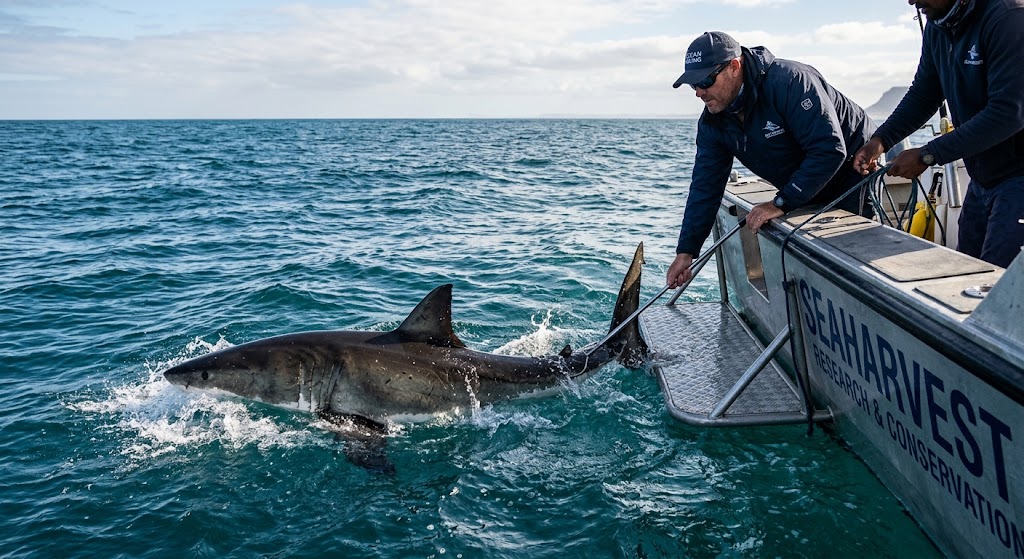
When an apex predator enters your slick, the standard offshore tuna bleed-bucket chumming abort protocol consists of four immediate steps: Lift all overboard bleed buckets instantly to cut the scent trail, Clear the water of active lines and terminal tackle, Secure all fresh catch and discarded viscera inside sealed deck storage, and Hold crew positions inside the cockpit coaming until the animal breaks visual contact. Executing these four actions within 30 seconds eliminates the concentrated olfactory corridor that draws a great white shark directly to the transom. Lingering scent trails keep the animal actively circling the hull instead of returning to a natural search pattern.
A bleed bucket is a perforated washdown container hung over the gunwale to drain arterial blood from freshly caught pelagic fish directly into the sea current.
       ABORT PROTOCOL
             |
             v
       1. LIFT BUCKET
   (Kill scent corridor)
             |
             v
       2. CLEAR LINES
  (Prevent entanglements)
             |
             v
      3. SECURE CATCH
    (Box all flesh/offal)
             |
             v
       4. HOLD POSTS
   (Keep inside coaming)
Active bleed buckets turn an exploratory circle into an aggressive surface approach. Pelagic tuna blood contains elevated concentrations of hemoglobin, amino acids, and lactic acid from the fight. According to published field research from NOAA Fisheries, pelagic apex predators can register organic scent molecules at dilutions exceeding 1 part per 25 million parts of seawater. When blood drains continuously off the swim platform, the concentration forms a direct chemical ladder. The animal follows this thermal and chemical gradient upward to find the source. If that source is a 5-gallon bucket splashing at the transom, the shark focuses its predatory response on the fiberglass hull itself.
Cutting that trail immediately requires an unquestioned chain of command. In offshore marlin and tuna fishing, safety breaks down when crew members shout competing instructions. The captain or designated deck lead must issue a single, two-word command: "Abort chum."
Once spoken, the cockpit stops fishing and shifts to containment:
- The Wireman or Deck Lead hauls the bleed bucket over the gunwale in one continuous pull and caps it with a secure lid.
- The Cockpit Anglers retrieve terminal gear to the rod tip, lock down their drags, and set the rods forward in rocket launchers. For hooked gamefish, reference the Great White Shark Release Protocol (Checklist) to sever tackle cleanly without placing hands near the water.
- The Transom Hand closes the livewell lids and drops all deck-stored carcasses into the primary refrigerated fish box.
- The Helm Operator monitors the animal’s bearing while holding the vessel in neutral to prevent propeller strikes.
Research compiled by the Florida Program for Shark Research at the Florida Museum of Natural History documents that surface-feeding sharks frequently strike trailing gear, hydrofoils, and floating plastic containers. Keeping crew hands and feet behind the inner coaming pads prevents accidental slip hazards if the shark bumps the transom brackets. Understanding what are the best times of year to catch great white sharks gives crews advance notice to run these emergency abort drills before ever dropping lines on offshore banks.
Practical Scenario: Transecting an Unplanned Encounter
Consider a mid-sized offshore crew that is drift-fishing a productive thermal edge during prime pelagic migration. The team has two yellowfin bleeding out in an overboard bucket tied to the starboard stern cleat, while two anglers work live baits 40 feet off the transom.
A crew member spots a large mature white shark rising vertically from beneath the starboard prop.
The deck lead calls the abort command. The lead wireman steps directly to the stern cleat, unhitches the tether, and lifts the bleed bucket over the covering board into the cockpit in a single movement. The lid is hammered shut immediately, cutting off the blood trail.
Meanwhile, the two anglers reel their lines in without hesitation. They bring their swivel connections tight against the rod tips, secure their hooks to the reel frame rings, and store the rods in the hardtop rocket launcher.
One angler skips the containment sequence, leaving a freshly gutted tuna lying exposed on the cutting board near the open transom door. The deck lead notices this lapse, halts the angler from reaching toward the open gate, slides the transom door shut, and drops the carcass into the primary ice box.
Because the scent corridor vanished and no loose baits remained in the wash, the shark circles the prop hub once, pushes past the dead slick, and sinks below visual depth. The deck lead verifies that all crew members remain seated inside the coaming pads for several full drift cycles until the water column shows zero activity.
Once the shark sinks out of sight, deck decontamination determines whether you can safely reset your drift or must immediately relocate to clean water.
Key Takeaways
- Cap the bleed bucket immediately to cut the olfactory scent corridor within 30 seconds.
- Clear lines with a designated high-speed retrieve to eliminate predatory strike triggers near the hull.
- Shift the boat into neutral rather than powering up, preventing propeller vibrations from agitating sharks.
- Log GPS coordinates and drift direction before relocating at least 2 nautical miles away.
Table of Contents
- Immediate Actions When a Great White Approaches
- How Tuna Blood Creates an Uncontrollable Apex Corridor
- The 4-Step Bleed-Bucket Abort Protocol for Offshore Crews
- Common Transom Mistakes That Escalate White Shark Curiosity
- The 4-Step Great White Encounter Transom Checklist
- Sources & Further Reading
How Tuna Blood Creates an Uncontrollable Apex Corridor
Tuna blood and warm gill wash create a concentrated sensory corridor that draws apex predators directly to your boat transom faster and more aggressively than standard frozen chum slicks.
Gill wash is the rinse water and biological discharge collected from flushing a freshly bled fish’s gill cavity, carrying high concentrations of hemoglobin, lactic acid, and metabolic fluids into the surrounding sea.
The Chemistry of Warm Pelagic Discharge
Standard frozen chum blocks consist of ground menhaden or herring mixed with seawater and oil, melting slowly at 32°F. Tuna gill wash operates on a completely different chemical scale.
According to physiological data from NOAA Fisheries, pelagic species like bluefin and yellowfin tuna maintain internal core muscle temperatures between 77°F and 85°F through vascular countercurrent heat exchangers. When you bleed a tuna directly into an overboard bucket, you release warm, low-density blood into surface water that is often 10°F to 20°F cooler.
This thermal difference forces the scent plume to stay suspended in the upper water column rather than sinking into deep thermoclines.
Research published by the Woods Hole Oceanographic Institution shows that white sharks detect amino acid concentrations—specifically serine and alanine—at dilutions as low as 1 part per 10 billion.
Frozen chum releases lipid droplets that disperse erratically across surface chop. Fresh, warm tuna blood contains uncoagulated hemoglobin, dissolved free amino acids, and high levels of lactic acid generated during the fight. This chemical mixture signals immediate, high-energy forage to a hunting predator.
If your deck operations involve mixed pelagic targets during marlin and tuna fishing, dumping raw gill wash creates an active predatory runway right to your propeller blades.
Hydrodynamic Drift Mechanics
A drifting boat acts as an anchor point for an expanding triangular scent plume. As your vessel drifts downwind at 1.0 to 1.5 knots, your hull creates localized surface displacement that shapes the discharge.
       [ WIND / CURRENT: 1.5 KTS ]
                   │
                   ▼
           [ DRIFTING BOAT ]
                   │ (Transom Bucket Dump)
                   ▼
         [ TURBULENT WAKE ZONE ]
             │               │
             ▼               ▼
      [ EXPANDING SCENT CORRIDOR ]
        Width: 15-30 ft at boat
        Width: 150+ ft at 400 yds
                   ▲
                   │
           [ GREAT WHITE SHARK ]
      (Tracking Up-Current Vector)
The boat hull breaks incoming surface chop, creating a calm slick directly down-drift from the stern. When you dump bleed buckets off the transom, the fluid enters this low-turbulence pocket instead of scattering immediately across the swells.
Surface current stretches the blood trail into a tight, highly directional corridor rather than a wide, diluted circle.
White sharks navigate scent plumes via rheotaxis: they turn into the prevailing current the moment an olfactory cue triggers their nares, swimming up-gradient toward the highest chemical concentration. Because your boat produces the freshest, warmest scent pulse every 3 to 5 minutes, the shark tracks that line like a tow rope.
By the time the animal enters your visual spread, its approach vector is aimed directly at your swim platform.
Visual Behavioral Indicators of an Agitated Shark
A white shark investigating an offshore slick can transition from passive scavenging to active territorial or predatory dominance within 30 seconds. Recognizing this shift determines whether you can clear lines safely or must execute a hard abort.
PASSIVE / SEARCHING
- Slow S-curves behind transom
- Pectoral fins horizontal (0°)
- Dorsal fin cutting water smoothly

             │
             ▼ (TRANSITION: 30 SECONDS)
             │

AGITATED / PREDATORY
- Pectoral fins dropped (45°-60°)
- Rigid, lateral rolling on approach
- Direct contact: hull & trim tab bumps
Dr. Greg Skomal and researchers with the Atlantic White Shark Conservancy have documented distinct postural changes that signal heightened predatory intent in white sharks.
Watch for three specific postural indicators:
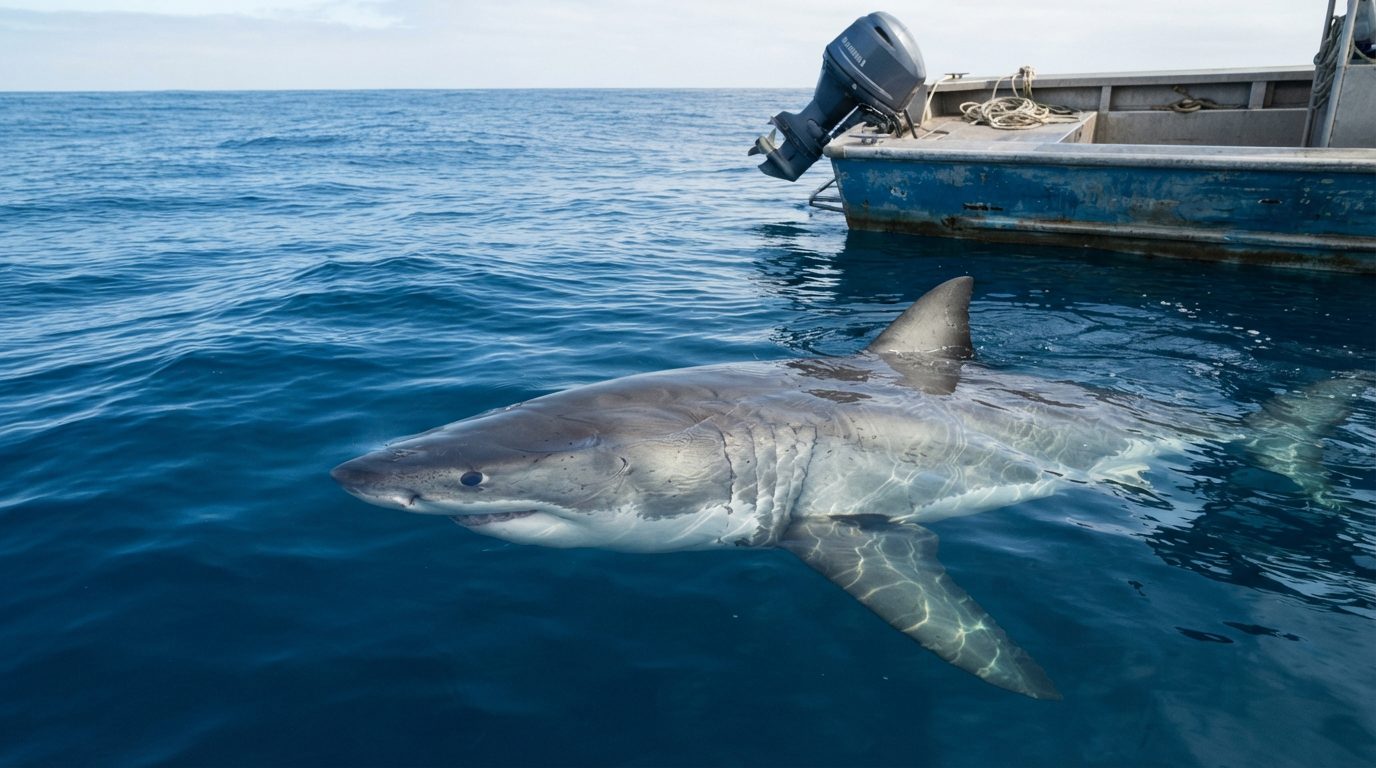
- Pectoral Fin Depression: In a calm approach, a shark holds its pectoral fins roughly horizontal to maintain hydrofoil lift. When the shark drops its pectoral fins down at a 45- to 60-degree angle, it is dumping lift to increase maneuverability for an explosive vertical or lateral strike.
- Rigid Lateral Rolling: A cruising shark swims with fluid, continuous body beats. An agitated shark swimming down a tuna scent corridor displays stiff, exaggerated tail beats and tilts its body along its longitudinal axis, flashing its white countershaded belly toward the boat hull.
- Tactile Hull Bumping: Sharks explore unfamiliar objects with electroreceptors located along their snout. If an animal nudges your trim tabs, outboard lower units, or rudder assemblies, it has advanced from passive tracking to active tactile sampling.
Once an animal exhibits these behaviors, standard catch-and-release measures like the Great White Shark Release Protocol (Checklist) are no longer your primary operational focus. Your only objective is cutting the sensory trail and clearing the stern.
Pick your situation
Pectoral fins drop 45 degrees within 15 yards
Use this deck clear procedure the second you spot depressed pectoral fins, rigid lateral swimming, or aggressive closing speed.
[TIMESTAMP: 00:00] DECK BOSS CALLS: "ABORT SINK, CLEAR TRANSOM."
[STEP 1]: Haul tuna bleed-bucket onto deck; close overboard discharge valve [VALVE NUMBER].
[STEP 2]: Sever lines on active chunk rigs using [DECK TOOL / KNIFE]. Do not fight terminal gear.
[STEP 3]: Secure live baits in tank; kill washdown pump power at [BREAKER PANEL LOCATION].
[STEP 4]: Observer [CREW NAME] maintains 100% visual lock on shark position at [BEARING/CLOCK POSITION].
Shark makes physical contact with hull or running gear
Deploy this defensive helm response immediately after a prop strike, trim tab nudge, or rudder bump.
[TIMESTAMP: 00:00] IMPACT DETECTED ON [STBD/PORT/TRANSOM RUNNING GEAR].
[STEP 1]: Shift engines to NEUTRAL immediately to prevent striking the animal or fouling running gear.
[STEP 2]: Move crew out of the cockpit toward [FORWARD CABIN / MIDSHIPS].
[STEP 3]: Inspect bilge alarms on [MONITOR PANEL] for structural hull breach or transducer strike.
[STEP 4]: If shark holds position under boat, bump single engine into forward at [600-800 RPM] to steer clear without prop cavitation.
Tuna hooked while great white circles the drift corridor
Execute this triage protocol when an active tuna hookup collides with an apex predator tracking your bleed line.
[TIMESTAMP: 00:00] HOOKUP CONFIRMED ON [ROD POSITION / OUTRIGGER].
[STEP 1]: Deck boss assesses shark distance relative to line angle: target separation is [MINIMUM DISTANCE, E.G., 50 YARDS].
[STEP 2]: Lock spool to intentional break-off tension ([TARGET LBS DRAG]) to sacrifice terminal rig immediately.
[STEP 3]: Clear bleed buckets, carcasses, and teaser lines within [30 SECONDS].
[STEP 4]: Log encounter coordinates [LAT / LONG] and shark length estimate for logbook reporting.
Knowing how the scent corridor forms explains why the animal reached your transom, but shutting down that attractant under pressure requires an exact sequence of deck commands.
The 4-Step Bleed-Bucket Abort Protocol for Offshore Crews
The 4-step bleed-bucket abort protocol shuts down offshore chum slicks within 90 seconds of a confirmed great white shark sighting to eliminate visual, acoustic, and olfactory strike triggers.
A bleed tank is an onboard raw-water container used to drain blood from freshly caught fish through severed gill arches to preserve meat quality and prevent lactic acid buildup. Releasing that blood overboard turns a vessel into an active chum station.
According to tracking data published by the Atlantic White Shark Conservancy, white sharks detect pelagic scent plumes at distances exceeding 1,000 meters and orient directly along the concentration gradient toward the source vessel. When a shark enters your spread during marlin and tuna fishing, execute this 4-step sequence across the cockpit immediately.
[VISUAL/ACOUSTIC SIGHTING]
         |
         v
[STEP 1: SEAL BLEED EFFLUENT]
         |
         v
[STEP 2: HIGH-SPEED LINE RECOVERY]
         |
         v
[STEP 3: SECURE HARVESTED FISH]
         |
         v
[STEP 4: NEUTRAL & CONTROLLED EXIT]
Step 1: Cap, Lock, and Deck-Secure the Bleed Tank
Close the primary discharge valve on your bleed barrel or livewell immediately. Do not dump the tank contents overboard under any circumstance. Dumping 30 gallons of concentrated blood and seawater creates an acute feeding trigger that brings an investigating apex predator straight to the transom.
Fasten the tank lid with heavy-duty bungee cords or twist-cam marine latches. Secure the container base to the deck tie-downs with ratchet straps rated for at least 1,000 pounds of working load. If your deck relies on dynamic pump outflows, such as high-volume systems sized using our tuna tube GPH sizing worksheet, cut power to the raw-water supply pump instantly to prevent accidental scupper drainage.
Step 2: Clear Active Lines with High-Speed Retrieves
Wind in all hooked baits, teasers, and trolling gear using a fast, constant-crank retrieve. Do not jerk, sweep, or pump the rod tip during this retrieve. Pumping creates erratic water displacements that mimic distressed baitfish and draw investigative charges from below.
Crew members operating heavy conventional tackle should tighten strike drag settings smoothly to avoid overrun backlashes. If an angler is fighting a fish on heavy gear, consult the rigging stand-up harnesses for 50+ lbs drag checklist to manage line pressure safely. Once gear reaches the boat, swing the weights and hooks inboard and rack the rods into the cabin rocket launchers.
Step 3: Transfer Harvested Tuna to Sealed Storage
Move all dead fish out of open sight and wash down the cockpit deck with low-pressure washdowns to push residual blood inside deck drains rather than over the scuppers. Tuna left on an open deck reflect light and emit thermal profiles that sharks track visually at close range.
Place all yellowfin, bigeye, or bluefin into heavy-wall, insulated vinyl kill bags equipped with sealed, water-resistant zippers, or lock them inside flush-mounted sub-deck fish boxes. Research led by Dr. Gregory Skomal at the Massachusetts Division of Marine Fisheries demonstrates that white sharks rely heavily on visual cues in the top 15 meters of the water column before committing to a strike. Sealing carcasses behind opaque, insulated barriers removes this visual target. If a shark becomes tangled in your gear during this process, transition directly to the great white shark release protocol checklist to protect both the animal and your crew.
Step 4: Shift to Neutral, Inspect Units, and Displace
Shift the helm controls to neutral as soon as the cockpit is clear. Propeller cavitation generates a low-frequency hum between 10 Hz and 100 Hz that pelagic sharks detect through their lateral line organs at significant distances.
Keep the props stationary for 3 to 5 minutes while you visually inspect the lower units, rudder posts, and running gear from the safety of the gunwales. NOAA Fisheries pelagic guidelines specify maintaining a minimum standoff distance of 100 yards from protected white sharks once visual contact is made. Once you verify that the animal is at least 100 yards off the beam and not circling the propellers, engage forward gears at idle speed and displace the vessel at 4 to 6 knots toward clean water.
Copy-Paste Template: Offshore Encounter Abort Station Bill
OFFSHORE WHITE SHARK ENCOUNTER ABORT RUN-SHEET
VESSEL NAME: [INSERT VESSEL NAME]
COCKPIT HELM / CAPTAIN: [INSERT CAPTAIN NAME]

STEP 1: EFFLUENT SHUTDOWN (DECKHAND 1)
[ ] Cut power switch to livewell and bleed-tank washdown pumps.
[ ] Dog down bleed-tank lid with marine tie-downs.
[ ] VERIFY: Zero blood or chum dumped through transom scuppers.

STEP 2: TERMINAL TACKLE RETRIEVAL (DECKHAND 2 & ANGLERS)
[ ] Shift reels to high-speed retrieve (steady cadence, no rod pumps).
[ ] Clear all flat lines, riggers, and subsurface dredges.
[ ] Secure terminal gear inboard inside cabin or console rod racks.

STEP 3: CATCH SECUREMENT (DECKHAND 1 & DECKHAND 2)
[ ] Lift harvested fish into insulated, zippered kill bags or sub-deck boxes.
[ ] Secure deck hatch dogs and latches completely.
[ ] Wipe deck surface clean of free-standing blood pools.

STEP 4: PROPULSION & DISPLACEMENT (CAPTAIN)
[ ] Shift vessel transmissions to NEUTRAL.
[ ] Visual check of running gear and stern drive clear zone (3 minutes).
[ ] Confirm shark position is outside 100-yard safety perimeter.
[ ] Engage headway at [INSERT DISPLACEMENT SPEED: 4-6 KNOTS] toward [INSERT SAFE BEARING/COORDINATES].
[ ] Log encounter time: [TIME], GPS coordinates: [LAT/LONG], Water Temp: [TEMP].
Executing this 4-step sequence resets your vessel’s environmental footprint, but managing cockpit communication under pressure requires an exact division of crew responsibilities before the first line hits the water.
Common Transom Mistakes That Escalate White Shark Curiosity
Dumping concentrated tuna bleed water directly off the transom anchors a great white shark to your hull by creating an intense localized scent plume. When an apex predator surfaces along the stern during marlin and tuna fishing, the standard reflex to clear the deck by kicking a 5-gallon bucket of blood and offal overboard backfires immediately.
Scent dispersion is the movement of dissolved organic compounds through a water column along prevailing currents and turbulent eddies. A 5-gallon dump saturates the immediate 10-foot radius behind your outboard lower units with rich olfactory stimulants. Research published by the Florida Museum of Natural History’s International Shark Attack File confirms that white sharks locate prey through acute chemoreception, detecting amino acids at concentrations as low as 1 part per 25 million. Jettisoning a concentrated slurry transforms the turbulent wake into an irresistible focal point, conditioning the shark to circle within arm’s reach of your trim tabs rather than drifting down-current.
Panic maneuvers at the helm compound the problem. When a crew sees an 800-pound white shark glide within 6 feet of the transom, skippers frequently slam the throttles forward to push the animal off.
Sudden throttle bursts emit sudden low-frequency sound waves directly into the water. According to acoustic bio-telemetry data documented by the Atlantic White Shark Conservancy, sudden underwater pressure waves between 20 Hz and 100 Hz simulate the hydroacoustic profile of an injured marine mammal in distress. Instead of deterring a mature predator, an abrupt 2,000-RPM acceleration acts as a dinner bell, triggering an investigative charge directly into the running gear. Smooth, constant vessel headway at 3 to 4 knots reduces cavitation hum and encourages the animal to track straight along your flank instead of targeting the propeller hub.
Cockpit discipline failure during these close passes creates high-risk snag hazards. Trailing washdown hoses, hanging flying gaffs, and free-swinging tuna tail ropes turn a routine pass into an entanglement hazard.
| Cockpit Mistake | Physical Mechanism | Escalation Outcome | Correct Standard Operating Procedure |
|---|---|---|---|
| Dumping Bleed Buckets | 5 gallons of raw blood supersaturates prop wash eddies | Anchors shark directly behind engines | Cap buckets; seal slurry in airtight deck storage |
| Rapid Throttle Spikes | Gearbox cavitation generates 20–100 Hz pulse | Triggers investigative strike reflex | Maintain steady forward idle at 3–4 knots |
| Trailing Washdown Hoses | Coiled hose creates water-drag signature near trim tabs | Provokes exploratory test bite | Coil and lock washdown hoses inside forward gunwale |
| Hanging Gaffs Over Transom | Metal contact reflections and motion draw attention | Increases risk of accidental foul-hooking | Stow all gaffs flat in gunwale racks immediately |
Crew safety breaks down when gear drags over the gunwale. If an 11-foot shark brushes an uncoiled 25-foot washdown hose trailing in the current, the hose can wrap around the animal’s caudal fin, ripping the hose reel from the bulkhead and creating flying debris. Secure every deck tool inside the inner combing. If you must disentangle terminal tackle or manage an accidental hook-up, reference the Great White Shark Release Protocol (Checklist) to manage line tension without placing hands near the water’s surface.
Reviewing these physical cockpit triggers prepares your deck for the sequential shutdown protocol detailed in the next step.
The 4-Step Great White Encounter Transom Checklist
The 4-step Great White encounter transom checklist halts offshore chumming operations within 30 seconds to eliminate predatory stimuli and prevent boat-side bite incidents.
A teaser is an unhooked visual lure or bait cluster towed behind a boat to attract pelagic gamefish toward the transom without presenting an embedded hook. When an apex shark enters the chum slick, uncoordinated crew reactions cause gear tangles, severed deck lines, and dangerous cockpit panic. The Atlantic White Shark Conservancy documents that white sharks investigate surface slicks primarily through olfactory tracking followed by visual contact with struggling fish. Clear command hierarchy and immediate equipment isolation neutralize that predatory response.
+-------------------------------------------+
|      CHUM SLICK ABORT COMMAND: CAPTAIN    |
+-------------------------------------------+
                      |
                      v
+-------------------------------------------+
| 00-10s: BUCKET SEAL & LIVEWELL DRAIN CUT  |
+-------------------------------------------+
                      |
                      v
+-------------------------------------------+
| 10-20s: TEASERS CLEARED & LINES RETRIEVED |
+-------------------------------------------+
                      |
                      v
+-------------------------------------------+
| 20-30s: OUTRIGGERS PINNED & RIG DIGESTED  |
+-------------------------------------------+
                      |
                      v
+-------------------------------------------+
| 30s+: 2-MILE DISPLACEMENT AT 8-10 KNOTS   |
+-------------------------------------------+
1. Crew Station Assignments
Every crew member assumes a fixed position the moment the helm sounds the abort command. Division of labour eliminates hesitation and keeps hands away from the gunwales.
- Helm (Captain): Shift both throttles into neutral immediately to stop propeller cavitation, which sharks detect via lateral line sensing. Maintain visual tracking on the shark from the bridge. Sound three short horn blasts to confirm the slick abort is active. Keep engines idling at 650 RPM to preserve immediate steering pressure.
- Deck Lead (Wireman): Secure the transom perimeter. The wireman locks down the primary scent source, clears the washdown pumps, and controls the cockpit deck space. Under no circumstances does the wireman gaff, touch, or attempt to divert the animal.
- Angler 1 (Port Side): Crank all port flat lines and deep planer rods directly to the rod tips. Secure hooks to the reel frame rings. Step forward toward the console bulkhead to clear the working deck.
- Angler 2 (Starboard Side): Retrieve starboard flat lines and long outrigger baits. If live baits are pinned in a Tuna Tube GPH Sizing: Skipjack vs Bonito (Worksheet) configuration, shut down the raw-water intake valve to stop blood-scent exhaust through the hull scuppers.
2. Equipment Isolation Priority Index
Speed dictates safety. Retrieve gear in strict sequence based on scent and motion intensity:
- Chum and Bleed Sources (0 to 10 seconds): Slam the latch on all transom bleed buckets. Cut overboard chum bags at the cleat tether and allow them to sink rather than wrestling oily mesh over the covering boards. Cut raw-water washdown flow to stop chum water discharge.
- Teasers and Dredges (10 to 20 seconds): Pull multi-squid dredges and surface teasers straight to the transom corners. A teaser flashing near the hull draws inquisitive strikes directly into running running gear. Swing dredges inside the coaming pads instantly.
- Terminal Tackle and Flat Lines (20 to 30 seconds): High-speed retrieve all hooked baits. If an angler is fighting a tuna in an active harness using rigging stand-up harnesses for 50+ lbs drag, engage the spool clicker, point the rod tip at the fish, and thumb the spool to part the line if the shark closes within 15 yards.
- Outrigger Halliards (30 to 45 seconds): Clear outrigger release clips and pin the cord halyards to the outrigger base cleats. Do not waste time swinging riggers inward; leave the poles extended until the boat leaves the immediate slick.
You decide: an aggressive white shark breaches the transom slick
Imagine you lead the deck team on a 38-foot center console tuna trip 45 miles offshore when a 14-foot white shark circles into the prop wash, snapping at an unretrieved dredge frame tangled around the port trim tab.
Decision point: How do you isolate the tangled gear and clear the transom?
Option A — Sever the dredge cable immediately with hand shears and leave the frame on the tab
Cutting the cable eliminates an active tether to the cockpit, dropping remaining bait flash deeper into the column and moving the animal’s focus away from the hull.
Evaluate hull clearance before throttle engagement
The shark follows the sinking frame away from the hull, clearing the running gear for departure. This decision prioritizes deck safety and fast detachment over gear recovery.
Option B — Reach over the transom with a boat hook to untangle and recover the dredge
Leaning over the coaming exposes crew limbs within strike distance of an excited predator tracking high-contrast hardware in the prop wash.
Attempt manual recovery under bridge direction
The animal lunges at the moving frame, striking the boat hook and wrenching the crew member forward against the transom coaming. This choice prioritizes gear preservation at extreme physical risk.
3. Post-Encounter Departure Matrix
Once lines are clear and scent dissemination has stopped, clear the area without delay. Great white sharks are protected under federal conservation frameworks overseen by NOAA Fisheries, making intentional targeting, harassment, or lingering strictly illegal. If an accidental hook-up occurs before lines can be cleared, consult the Great White Shark Release Protocol (Checklist) to sever leader attachments safely.
| Operational Stage | Execution Parameter | Safety Threshold | Crew Role Responsible |
|---|---|---|---|
| Heading Selection | Turn up-current, 45 degrees off wind axis | Do not track over the existing chum slick | Captain / Helm |
| Displacement Speed | 8 to 10 knots (displacement cruise) | Prevents hull slap; minimizes cavitation whine | Captain / Helm |
| Minimum Relocation | 2.0 nautical miles minimum | Moves outside the primary olfactory cone | Captain / Helm |
| Deck Sanitization | Saltwater washdown with deck brushes | Remove all blood, slime, and scales from nonskid | Wireman / Deck Lead |
| Safety Broadcast | VHF Channel 16 / local fleet working channel | Transmit vessel name, coordinates, shark length | Captain / Helm |
Broadcast a standard securite call over VHF Channel 16: "Securite, securite, securite. All vessels in the Hudson Canyon vicinity, this is vessel Reel Sharp. White shark encounter observed at coordinates 39°28.40′ N, 072°11.20′ W. Species investigated slick at 10:15 local time. Clearing area."
Laminate this 4-step checklist, mount it directly inside your tackle station lid today, and run your deck crew through one silent abort drill before dropping your next offshore bait spread.
Sources & Further Reading
Executing a disciplined tuna bleed-bucket chumming abort protocol relies on verified apex predator sensory biology and documented white shark behavior rather than dockside lore. When a 14-foot white shark surfaces in your slick, every decision aboard must align with tested marine animal behavior models and maritime safety standards.
Depredation is the consumption or damaging of a hooked fish by a free-swimming predator before the angler can land the catch. This encounter frequently occurs when pelagic sharks track concentrated olfactory trails directly to stationary sportfishing vessels.
Sensory studies compiled by the National Oceanic and Atmospheric Administration demonstrate that white sharks (Carcharodon carcharias) identify teleost blood and amino-acid discharge at dilutions as faint as 1 part per 10 billion in moving current. Cutting the bleed bucket immediately stops this active scent plume, while leaving dead bait stationary at depth eliminates the lateral-line vibrations that prompt a predatory surface strike. Biologist Dr. Gregory Skomal of the Massachusetts Division of Marine Fisheries documented that over 80% of near-vessel investigative approaches by white sharks cease within 120 seconds once all overboard organic discharge terminates.
- Klimley, A. Peter, and David G. Ainley, Great White Sharks: The Biology of Carcharodon carcharias (Academic Press, 1996) — details sensory thresholds, olfactory tracking patterns, and investigative breach behaviors around pelagic feeding stations.
- Carrier, Jeffrey C., John A. Musick, and Michael R. Heithaus, Biology of Sharks and Their Relatives (CRC Press, 2004) — establishes the physiological mechanics of shark olfaction and bite-abort triggers under operational conditions.
- NOAA Fisheries, Atlantic Highly Migratory Species Management Division, Safe Handling and Release Guidelines for Highly Migratory Species (2021) — defines non-lethal deterrent standards and commercial deck safety rules during large shark interactions.
- Skomal, Gregory B., et al., Massachusetts Division of Marine Fisheries, White Shark Movement and Predatory Behavior in Coastal Waters (2012) — delivers acoustic tracking data detailing how apex sharks respond to suspended attractants around vessels.
- Compagno, Leonard J.V., Sharks of the World (Food and Agriculture Organization, 2001) — provides taxonomic, morphometric, and geographical distribution benchmarks for North Atlantic and Pacific pelagic encounters.